
BPD Treatment Specialization: Four Parent Types Affecting Emotional Regulation
For individuals with borderline personality disorder (BPD), emotional regulation difficulties rarely emerge in isolation. Research increasingly suggests that

Key Takeaways
- For individuals with borderline personality disorder (BPD), emotional regulation difficulties rarely emerge in isolation
- Research increasingly suggests that early parenting experiences play a substantial role in shaping how we manage
- When it comes to BPD treatment specialization, understanding four parent types affecting emotional regulation—puzzled...
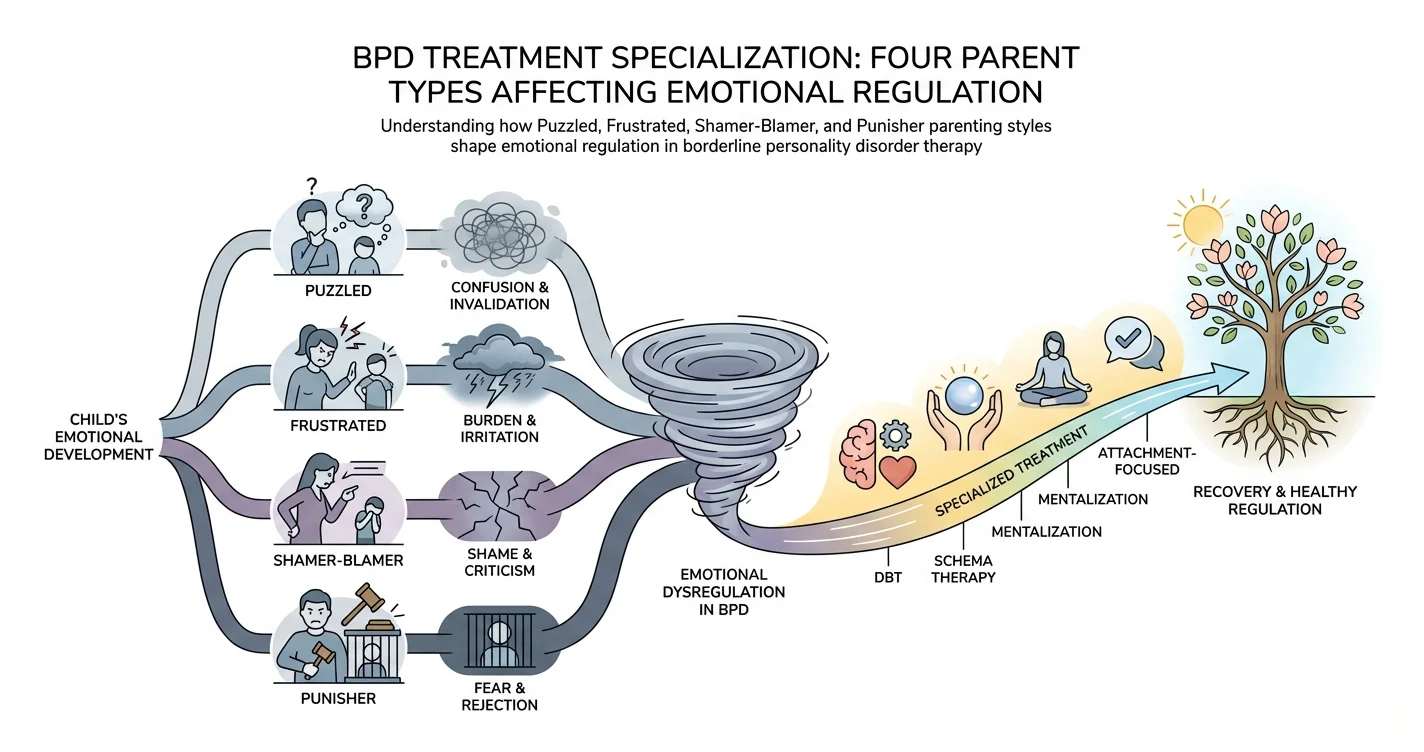
Understanding how puzzled, frustrated, shamer-blamer, and punisher parenting styles shape emotional regulation in borderline personality disorder therapy.
Introduction
For individuals with borderline personality disorder (BPD), emotional regulation difficulties rarely emerge in isolation. Research increasingly suggests that early parenting experiences play a substantial role in shaping how we manage emotions throughout adulthood. When it comes to BPD treatment specialization, understanding four parent types affecting emotional regulation—puzzled, frustrated, shamer-blamer, and punisher—has become central to effective therapeutic approaches. These parenting patterns create distinct emotional landscapes that influence how someone with BPD experiences and responds to their internal world. This article explores how specialized BPD treatment addresses the lasting impact of these four parenting styles, offering practical insights drawn from clinical experience and evidence-based approaches to help individuals understand their emotional patterns and develop healthier regulation strategies.
Understanding the Four Parent Types in BPD Development
The concept of four distinct parenting patterns emerged from clinical observations of how caregivers respond to a child's emotional needs during critical developmental periods. These patterns aren't about labeling parents as good or bad, but rather understanding specific interaction styles that may contribute to difficulties with emotional regulation later in life.
The puzzled parent appears confused or overwhelmed by their child's emotional displays. When a child expresses distress, anger, or fear, this parent seems uncertain about what the emotion means or how to respond appropriately. According to practitioners specializing in BPD treatment, children of puzzled parents often learn that their emotions are confusing or invalid, leading to difficulties identifying and trusting their own emotional experiences.
The frustrated parent responds to emotional expression with visible irritation or exasperation. This parent might sigh heavily, roll their eyes, or express annoyance when their child shows strong feelings. Over time, children internalize the message that their emotions are burdensome to others, creating shame around natural emotional responses.
The shamer-blamer parent goes further, actively criticizing or ridiculing the child's emotional experiences. This parent might say things like "you're being ridiculous" or "there's no reason to feel that way." Research from attachment theory suggests this pattern can severely disrupt a child's ability to develop emotional self-trust and may contribute to the intense shame many individuals with BPD experience.
The punisher parent responds to emotional expression with punishment—whether through withdrawal of affection, harsh discipline, or even physical consequences. This creates a particularly challenging dynamic where emotions become associated with danger and rejection. Children who experience this pattern often develop hypervigilance around their own emotional states and others' reactions.
How Parenting Patterns Shape Emotional Dysregulation in BPD
The connection between these four parenting types and BPD's characteristic emotional dysregulation becomes clearer when we examine what happens during emotional development. Children naturally look to caregivers to help them understand and manage intense feelings—a process sometimes called "co-regulation." When caregivers respond in the patterns described above, this co-regulation process breaks down in specific ways.
Impact on emotional awareness: Individuals who experienced puzzled or frustrated parenting often struggle to identify what they're feeling. In specialized BPD treatment, clients frequently describe emotions as overwhelming waves they cannot name or understand. This makes emotional regulation particularly challenging because you cannot effectively manage what you cannot identify.
Development of shame responses: The shamer-blamer and frustrated parenting patterns contribute significantly to the intense shame many people with BPD experience around their emotions. Some practitioners note that clients often describe feeling "too much" or believing their emotional responses make them fundamentally flawed. This shame layer adds complexity to treatment because it creates resistance to experiencing and working with emotions.
Fear-based emotional suppression: When punishment follows emotional expression, individuals often develop sophisticated suppression strategies. However, research suggests that chronic emotional suppression paradoxically increases emotional intensity when feelings do emerge. This creates the pattern of emotional avoidance followed by overwhelming emotional flooding that characterizes many BPD experiences.
Trust and relationship patterns: All four parenting types affect how individuals with BPD approach relationships. When early caregivers responded to emotions with confusion, frustration, shame, or punishment, the child learns that expressing needs and feelings threatens connection. This contributes to the intense fear of abandonment and relationship instability common in BPD.
Clinical experience shows that most individuals with BPD experienced combinations of these patterns, sometimes from different caregivers or from the same caregiver in different contexts. The specific combination influences which emotional regulation difficulties are most pronounced and which therapeutic approaches may be most effective.
Specialized Treatment Approaches Addressing Parental Influence
Effective BPD treatment specialization addressing these four parent types involves helping individuals understand how their early experiences shaped current patterns while developing new emotional regulation skills. Several evidence-based approaches directly target these developmental influences.
Dialectical Behavior Therapy (DBT) explicitly teaches emotional regulation skills that many people didn't learn in childhood. When working with clients who experienced puzzled parenting, therapists often focus extensively on emotion identification—helping clients build a vocabulary for their internal experiences. The mindfulness component of DBT helps individuals observe emotions without the shame or fear they learned from frustrated, shamer-blamer, or punisher parents.
Schema Therapy directly addresses the internalized "parent voices" that developed from these early experiences. This approach helps individuals identify which critical or dismissive thoughts about their emotions originated from external sources rather than objective truth. For someone who experienced shamer-blamer parenting, schema therapy might involve recognizing the "you're being ridiculous" thought as their parent's voice, not their own assessment.
Mentalization-based Treatment (MBT) focuses on understanding one's own mental states and those of others. For individuals who experienced puzzled or frustrated parenting, this approach helps develop the reflective capacity their caregivers couldn't model. Practitioners using MBT help clients explore what emotions mean and where they come from, building the understanding that was missing in childhood.
Attachment-focused approaches work with the relationship patterns that developed from these parenting styles. The therapeutic relationship itself becomes a corrective experience where emotional expression meets validation rather than confusion, frustration, shame, or punishment. Over time, this can reshape expectations about how others respond to emotional needs.
Tools like Lovon.app can provide supplementary support between therapy sessions for processing emotional experiences in real-time. When someone notices a strong emotional reaction, having immediate access to reflective conversation can help practice new regulation skills and reinforce the validation missing from early experiences.
Practical Strategies for Healing Emotional Regulation
Beyond formal therapy modalities, specialized BPD treatment incorporates specific practices that address the legacy of these four parenting types. These strategies help individuals build the emotional skills their early environment didn't support.
Developing emotional literacy: For those who experienced puzzled or frustrated parenting, building a detailed emotional vocabulary becomes foundational work. This might involve using emotion wheels or charts that distinguish between similar feelings like disappointment, sadness, and grief. Some people find it helpful to journal about physical sensations associated with different emotions, creating a personal reference guide for identification.
Self-validation practices: Counteracting shamer-blamer parenting requires deliberately practicing self-validation. This involves statements like "it makes sense I feel this way given what happened" or "my feelings are valid even if others don't understand them." Research suggests that self-validation doesn't mean agreeing with every thought or acting on every feeling, but rather acknowledging that emotions arise for reasons and deserve attention rather than criticism.
Creating emotional safety: Individuals who experienced punisher parenting often need to consciously build internal and external safety around emotional expression. This might involve identifying safe people to share feelings with, creating physical comfort during emotional experiences, or developing mantras that remind you that feeling emotions isn't dangerous.
Graduated exposure to emotions: For anyone who learned to suppress feelings, carefully increasing tolerance for emotional experiences becomes important work. Some practitioners recommend starting with less intense emotions and gradually building capacity for stronger feelings. This might look like noticing and staying with mild annoyance before working with intense anger.
Repairing the internal parent-child relationship: Many therapeutic approaches include visualization or writing exercises where you imagine responding to your child self with the validation, patience, and understanding that was missing. This helps create an internal caregiving voice that counters the puzzled, frustrated, shaming, or punishing messages internalized from childhood.
When implementing these strategies, having access to support can make a significant difference. Resources like Lovon.app offer on-demand opportunities to process emotions as they arise, helping bridge the gap between therapy sessions and providing the responsive attention that these four parenting patterns failed to offer.
Integrating Understanding with Recovery
Recovery from the emotional regulation difficulties associated with these parenting patterns isn't about erasing the past or placing blame. Instead, specialized BPD treatment helps individuals understand how their emotional landscape developed while building new capacities for regulation and relationship.
Recognizing triggers: Understanding your specific parenting history helps identify why certain situations feel particularly overwhelming. Someone who experienced shamer-blamer parenting might notice intense reactions when they perceive criticism, while someone with punisher parenting might struggle especially with fear of consequences.
Building compassion: When you understand that your emotional regulation difficulties developed as adaptations to challenging early environments rather than personal failings, self-compassion often increases. This shift from self-criticism to self-understanding creates space for genuine change.
Choosing relationships wisely: Recognizing the four parenting patterns helps identify which current relationships might be recreating those dynamics. This awareness allows for more conscious choices about who you spend time with and how you set boundaries around emotional expression.
Appreciating progress: Recovery from BPD involves building skills that many people absorbed naturally from validating caregivers. Recognizing the magnitude of learning emotional regulation as an adult—rather than in childhood—helps frame progress realistically and celebrate genuine achievements.
Conclusion
Understanding BPD treatment specialization through the lens of four parent types affecting emotional regulation—puzzled, frustrated, shamer-blamer, and punisher—provides a compassionate framework for addressing the developmental roots of emotional dysregulation. These parenting patterns created specific challenges with emotion identification, shame, suppression, and relationship trust that specialized treatment approaches can effectively address. Whether through DBT skills training, schema work, mentalization practice, or attachment-focused therapy, individuals with BPD can develop the emotional capacities their early environment didn't support. The journey involves not just learning regulation techniques but also transforming your relationship with your own emotions from one shaped by confusion, frustration, shame, or fear to one characterized by understanding, validation, and skillful response. With appropriate support—including therapy, peer connections, and accessible resources—the lasting impact of these parenting patterns can be substantially transformed, opening pathways to more stable emotional experiences and more satisfying relationships.
Disclaimer: This is general information, not medical advice or diagnosis. If symptoms are severe, affecting your daily life, or you're having thoughts of self-harm — seek professional help. In the US: call or text 988 (Suicide & Crisis Lifeline). For immediate danger: 911 or local emergency services.
How AI Support Helps You Heal
AI emotional support isn't about replacing human connection — it's about filling the gaps. The moments when you need to talk at 2 AM, when you don't want to burden your friends again, or when you simply need someone to listen without judgment.
Here's what happens in a typical Lovon session:
You share what's on your mind
There's no script, no intake form, no waiting room. You speak or type whatever you're feeling — in your own words, at your own pace.
Lovon validates and explores
Using frameworks from CBT (Cognitive Behavioral Therapy) and motivational interviewing, Lovon acknowledges your feelings first, then gently helps you explore them. No dismissive "just move on" advice.
You build coping skills together
Lovon doesn't just listen — it actively works with you on evidence-based techniques: thought reframing, urge surfing, behavioral experiments, and more.
What a Session with Lovon Looks Like

When to Seek Professional Help
AI support is a valuable tool, but it's not a replacement for professional care. Please consider reaching out to a licensed therapist if you experience any of the following:
- Persistent thoughts of self-harm or suicide
- Inability to perform daily activities (work, eating, sleeping) for more than 2 weeks
- Turning to alcohol or substances to cope
- Intense anger or desire to harm your ex-partner
- Complete emotional numbness that doesn't improve over time
Crisis Resources (US): If you're in immediate danger, call 988 (Suicide & Crisis Lifeline) or text HOME to 741741 (Crisis Text Line). Available 24/7, free, and confidential.
Outside the US? Find a crisis line in your country
Ready to Start?
Your healing journey can begin right now
A 7-day trial. No judgment. Just a safe space to process what you're going through.
Frequently Asked Questions
Is Lovon a replacement for a real therapist?
Is my conversation with Lovon AI private?
How is Lovon different from ChatGPT for emotional support?
Can I use Lovon if I'm already seeing a therapist?
Can I try Lovon before subscribing?
About the Author

The Lovon Editorial Team
Mental Health & Wellness Content Team
The Lovon Editorial Team develops mental health and wellness content designed to make psychological concepts accessible and actionable. Our goal is to bridge the gap between clinical research and everyday life - helping you understand why your mind works the way it does and what you can do about it....
Related articles
- Role Reversal With Narcissistic Parents: When Children Become Emotional Caretakers
When narcissistic parents create role reversal where the child becomes the emotional caretaker, the fundamental…
- How to Heal from Emotionally Immature Parents and Conditional Love
Growing up with emotionally immature parents who offer conditional love creates lasting patterns that many adults…
- BPD Attachment Style: The Push-Pull Cycle Explained 2026
BPD attachment style is almost always disorganized. Learn what drives the push-pull cycle, the 5-step loop, and what…
- BPD — Attachment Style as Identity and Loss Perception
For individuals living with borderline personality disorder (BPD), the connection between attachment style and identity…
See also
Quizzes
- Emotionally Unavailable Test: 12-Question Self-Check
See which part of you closes off, in three minutes.
- Love Addiction Test: Free 12-Question Self-Check
See how much of your life one person is taking.
Free tools
- What to Say Back to a Hostile Co-Parent
A chat, not a form. Paste the message your ex sent about the kids, say what actually has to be decided, and you get a…
- Attachment Trigger Plan for Anxious and Avoidant Patterns
Pick your pattern, tick the moments that set it off, and finish one card for each: your body signal, the thing you will…
From the wiki
- What is an attachment style?
An attachment style is the habit your nervous system formed for handling closeness: what you actually do when someone…
Disclaimer: This article is for informational purposes only and does not constitute medical advice, diagnosis, or treatment. Always seek the advice of your physician or other qualified health provider with any questions you may have regarding a medical condition. If you are in crisis or think you may have an emergency, call 988 (Suicide & Crisis Lifeline) or go to the nearest emergency room. Outside the US? Find a crisis line in your country.