
Progressive Muscle Relaxation for Stress Reduction
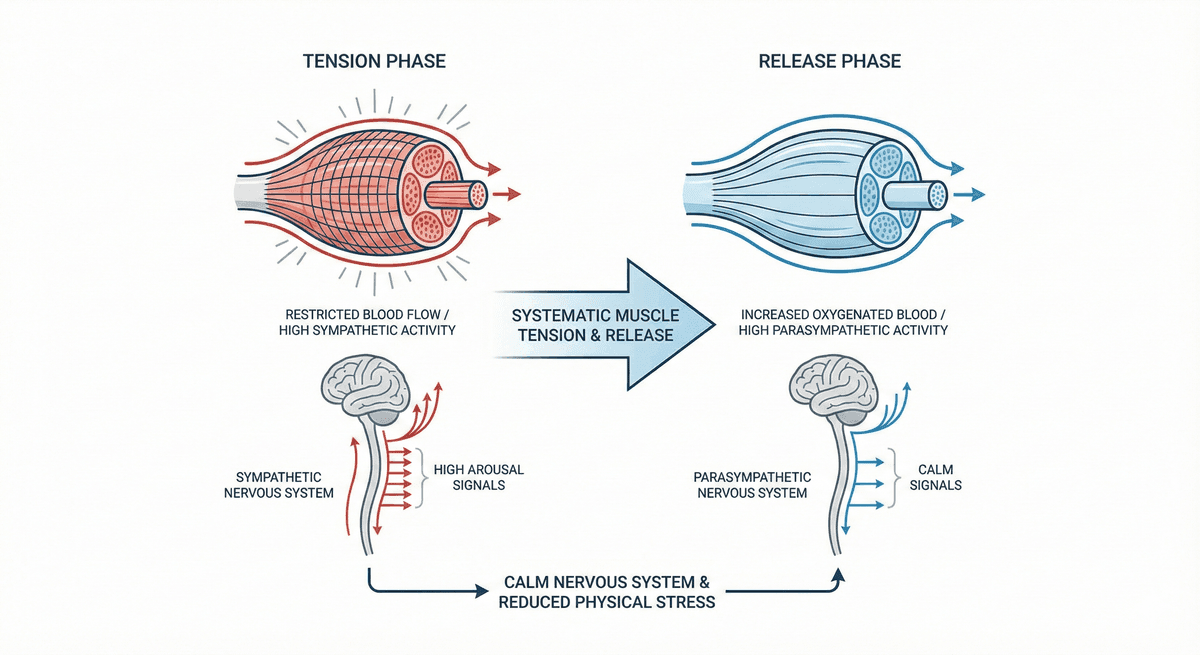
A systematic muscle group tension and release technique that calms the nervous system and reduces physical stress.

Key Takeaways
- Progressive Muscle Relaxation (PMR) reduces stress by systematically tensing and releasing muscle groups.
- The technique helps retrain the nervous system to recognize the difference between tension and relaxation.
- PMR is especially useful for people who struggle with passive relaxation or racing thoughts.
A structured, evidence-based technique to release physical tension and calm the stress response.
Introduction
When stress accumulates in the body, it often shows up as muscle tension—tight shoulders, a clenched jaw, shallow breathing, or a persistent sense of physical unease. Progressive Muscle Relaxation (PMR) for stress reduction offers a systematic muscle group tension and release technique that helps interrupt this pattern. Originally developed in the 1920s by physician Edmund Jacobson, PMR is an evidence-based approach that teaches you to recognize and actively release physical tension.
Unlike passive relaxation methods that ask you to “just relax,” PMR engages your body directly. By deliberately tensing and then releasing specific muscle groups, you create a clear contrast between tension and relaxation. This makes the experience concrete and accessible, particularly for people who find it difficult to calm their minds through meditation alone. This article explains how PMR works, how to practice it effectively, and how it fits into a broader stress management strategy.
Understanding Progressive Muscle Relaxation and How It Reduces Stress
Progressive Muscle Relaxation works through a simple but powerful mechanism: awareness through contrast. Many people live with chronic muscle tension without realizing it—their nervous system has adapted to a heightened baseline of activation. PMR gently resets this baseline by teaching the body what relaxation actually feels like.
Physiologically, the technique influences the autonomic nervous system. When you tense a muscle group, blood flow is briefly restricted. Upon release, increased circulation produces sensations of warmth and softness. This shift sends signals to the brain that the body is safe, helping reduce sympathetic nervous system activity (the "fight or flight" response) and support parasympathetic activity associated with rest and recovery.
Research suggests that regular PMR practice may reduce stress-related symptoms such as muscle pain, tension headaches, sleep difficulties, and generalized anxiety. One of PMR’s strengths is its immediacy: you don’t need to believe in it or analyze it intellectually. You can feel the effect directly in your body, which often makes the practice more convincing and sustainable over time.
The Systematic Approach: Muscle Groups and Sequence
The effectiveness of Progressive Muscle Relaxation lies in its structured, sequential nature. Instead of attempting to relax the whole body at once, PMR guides you through specific muscle groups in a consistent order. This ensures full-body awareness and helps identify habitual tension patterns.
A commonly used sequence includes:
- Hands and forearms: Clench fists, noticing tension in fingers, palms, and forearms
- Upper arms: Bend elbows and tense biceps without involving the hands
- Shoulders: Lift shoulders toward the ears
- Neck: Gently press the head back or tilt carefully (without strain)
- Face: Tighten forehead, eyes, jaw, and mouth
- Chest and upper back: Inhale deeply while drawing shoulder blades together
- Abdomen: Tighten core muscles as if bracing
- Hips and buttocks: Squeeze glute and hip muscles
- Thighs: Tense front and back of thighs
- Calves: Point toes downward
- Feet: Curl or flex toes
Each muscle group is typically tensed for 5–10 seconds and then released for 15–20 seconds. During the release phase, attention is directed toward the sensation of letting go. The predictable order helps create a reliable routine and makes the practice easier to repeat consistently.
How to Practice Progressive Muscle Relaxation
To practice PMR effectively, choose a quiet space where you can remain uninterrupted for 15–20 minutes. You may lie down, sit in a supportive chair, or recline comfortably. Many people prefer practicing in the evening as part of a wind-down routine, though PMR is equally useful during the day.
Getting started
Begin with a few natural breaths and allow your body to settle. Close your eyes if comfortable. Notice any areas of existing tension without trying to change them yet.
The tension-release cycle
For each muscle group:
- Inhale and tense the muscles to about 50–70% of maximum effort
- Hold the tension for several seconds while breathing normally
- Exhale and release the tension suddenly
- Rest and observe the sensation of relaxation
Focus on the contrast between tension and release. This awareness is the core of the technique.
Safety considerations
PMR should never cause pain. Skip or modify muscle groups if you have injuries or chronic conditions. Use extra caution with the neck and back. If you have cardiovascular concerns, consult a healthcare professional before beginning regular practice, as muscle tension temporarily increases blood pressure.
Many people initially use guided audio recordings to learn the timing and sequence. Over time, the practice becomes intuitive and can be done without guidance. For moments when stress is emotionally driven—such as relationship tension or work pressure—PMR can calm the body, making it easier to reflect or talk things through afterward using supportive tools or conversations.
Integrating PMR Into a Broader Stress Strategy
Progressive Muscle Relaxation works best as part of an overall stress-regulation approach rather than as a standalone solution.
Consistency over duration
Daily practice is more impactful than occasional long sessions. Even 10 minutes per day can lower baseline tension if practiced consistently. Over time, your body learns to relax more quickly.
Shortened versions for daily life
Once familiar with PMR, you can use abbreviated versions focusing on your personal tension hotspots—often the shoulders, jaw, and hands. These short practices can be done at a desk, before meetings, or after stressful interactions.
Combining PMR with other tools
PMR pairs well with breathing exercises, mindfulness, journaling, or reflective conversation. Physical relaxation often creates the mental space needed to process emotions or think more clearly. After calming the nervous system, it may be easier to address underlying stressors through communication, planning, or therapeutic work.
Regular practice also builds interoceptive awareness—the ability to notice internal bodily states. This helps you recognize stress earlier and intervene before tension escalates into pain, burnout, or emotional overwhelm.
Limitations and When PMR Is Not Enough
While PMR is effective for managing physical stress responses, it does not resolve the root causes of stress. Ongoing conflicts, trauma, or mental health conditions require additional support beyond relaxation techniques.
PMR is best understood as a regulation tool rather than a solution in itself. It helps calm the body so that problem-solving, emotional processing, or therapy becomes more accessible. Some individuals may also experience increased anxiety when focusing on bodily sensations; in such cases, alternative approaches like gentle movement or external grounding may be more appropriate.
If stress significantly impacts your sleep, relationships, or daily functioning, or if symptoms persist despite self-help strategies, professional guidance can help create a more comprehensive plan.
Conclusion
Progressive Muscle Relaxation for stress reduction is a practical, evidence-based technique that uses systematic muscle group tension and release to calm the nervous system. By teaching the body the difference between tension and relaxation, PMR lowers baseline stress, increases bodily awareness, and provides a reliable tool for managing physical manifestations of stress.
When practiced regularly and integrated into a broader stress management approach, PMR can improve resilience, support emotional regulation, and enhance overall well-being. Start with the full sequence, adapt it to your needs, and use it as a foundation for healthier responses to stress in daily life.
Disclaimer: This content is for general informational purposes only and does not constitute medical advice or diagnosis. If stress or anxiety significantly affects your life, consider consulting a qualified healthcare or mental health professional.
How AI Support Helps You Heal
AI emotional support isn't about replacing human connection — it's about filling the gaps. The moments when you need to talk at 2 AM, when you don't want to burden your friends again, or when you simply need someone to listen without judgment.
Here's what happens in a typical Lovon session:
You share what's on your mind
There's no script, no intake form, no waiting room. You speak or type whatever you're feeling — in your own words, at your own pace.
Lovon validates and explores
Using frameworks from CBT (Cognitive Behavioral Therapy) and motivational interviewing, Lovon acknowledges your feelings first, then gently helps you explore them. No dismissive "just move on" advice.
You build coping skills together
Lovon doesn't just listen — it actively works with you on evidence-based techniques: thought reframing, urge surfing, behavioral experiments, and more.
What a Session with Lovon Looks Like

When to Seek Professional Help
AI support is a valuable tool, but it's not a replacement for professional care. Please consider reaching out to a licensed therapist if you experience any of the following:
- Persistent thoughts of self-harm or suicide
- Inability to perform daily activities (work, eating, sleeping) for more than 2 weeks
- Turning to alcohol or substances to cope
- Intense anger or desire to harm your ex-partner
- Complete emotional numbness that doesn't improve over time
Crisis Resources (US): If you're in immediate danger, call 988 (Suicide & Crisis Lifeline) or text HOME to 741741 (Crisis Text Line). Available 24/7, free, and confidential.
Outside the US? Find a crisis line in your country
Ready to Start?
Your healing journey can begin right now
A 7-day trial. No judgment. Just a safe space to process what you're going through.
Frequently Asked Questions
Is Lovon a replacement for a real therapist?
Is my conversation with Lovon AI private?
How is Lovon different from ChatGPT for emotional support?
Can I use Lovon if I'm already seeing a therapist?
Can I try Lovon before subscribing?
About the Author

The Lovon Editorial Team
Mental Health & Wellness Content Team
The Lovon Editorial Team develops mental health and wellness content designed to make psychological concepts accessible and actionable. Our goal is to bridge the gap between clinical research and everyday life - helping you understand why your mind works the way it does and what you can do about it....
Related articles
- How to Calm Interview Anxiety Before a Big Interview 2026
Calm interview anxiety fast with box breathing, grounding, and prep steps that work in 2026, plus what to do if panic…
- Progressive Muscle Relaxation for Stress (2026 Guide)
Step-by-step progressive muscle relaxation for stress: tense each muscle group 6 seconds, release 25–30 seconds, repeat…
- Mindfulness for Anxiety: Techniques That Work in 2026
The best mindfulness techniques for anxiety in 2026 — body scan, 4-6 breathing, and 5-4-3-2-1 grounding — with…
- AI Coping Tools for Anxiety 2026: What Actually Works
AI coping tools for anxiety compared for 2026: box breathing, grounding, and PMR ranked with clear verdicts on what to…
See also
Quizzes
- What's My Attachment Style? Free 12-Question Quiz
Find your attachment pattern in 3 minutes.
- Toxic Masculinity Test: Which Rules Are You Running?
See which learned rules cost you most, in 3 minutes.
Free tools
- Am I Overreacting, or Is This a Big Deal?
A chat for the small thing you cannot stop turning over. Say what happened and what you have already told yourself about…
- 5-4-3-2-1 Grounding Exercise
A guided run through the 5-4-3-2-1 technique, with paced breathing first if you need it. No sign-up, nothing stored…
From the wiki
- What is inhibited grief?
Inhibited grief is grief that never gets out. The loss happened, you kept functioning, and the feeling stayed sealed…
Disclaimer: This article is for informational purposes only and does not constitute medical advice, diagnosis, or treatment. Always seek the advice of your physician or other qualified health provider with any questions you may have regarding a medical condition. If you are in crisis or think you may have an emergency, call 988 (Suicide & Crisis Lifeline) or go to the nearest emergency room. Outside the US? Find a crisis line in your country.