
Avoidant Attachment Deflecting Positive Feedback as Nervous System Threat
When someone with an avoidant attachment style receives a compliment or positive feedback, their immediate response often puzzles those around them. Rather

Key Takeaways
- Expectation of reciprocal vulnerability: "If I accept this, I may need to open up emotionally"
- Fear of dependency: "If I acknowledge this matters, I become dependent on their approval"
- Anticipated disappointment: "If I believe this, I'll be let down when they inevitably withdraw"
- Loss of control: "Accepting this means lowering my defenses"
- Physical discomfort or tension when receiving praise
Avoidant Attachment Deflecting Positive Feedback as Nervous System Threat
Understanding why compliments and praise can trigger deep discomfort and self-protective responses in avoidant individuals
avoidant-attachment-deflecting-positive-feedback-nervous-system-threat
Introduction
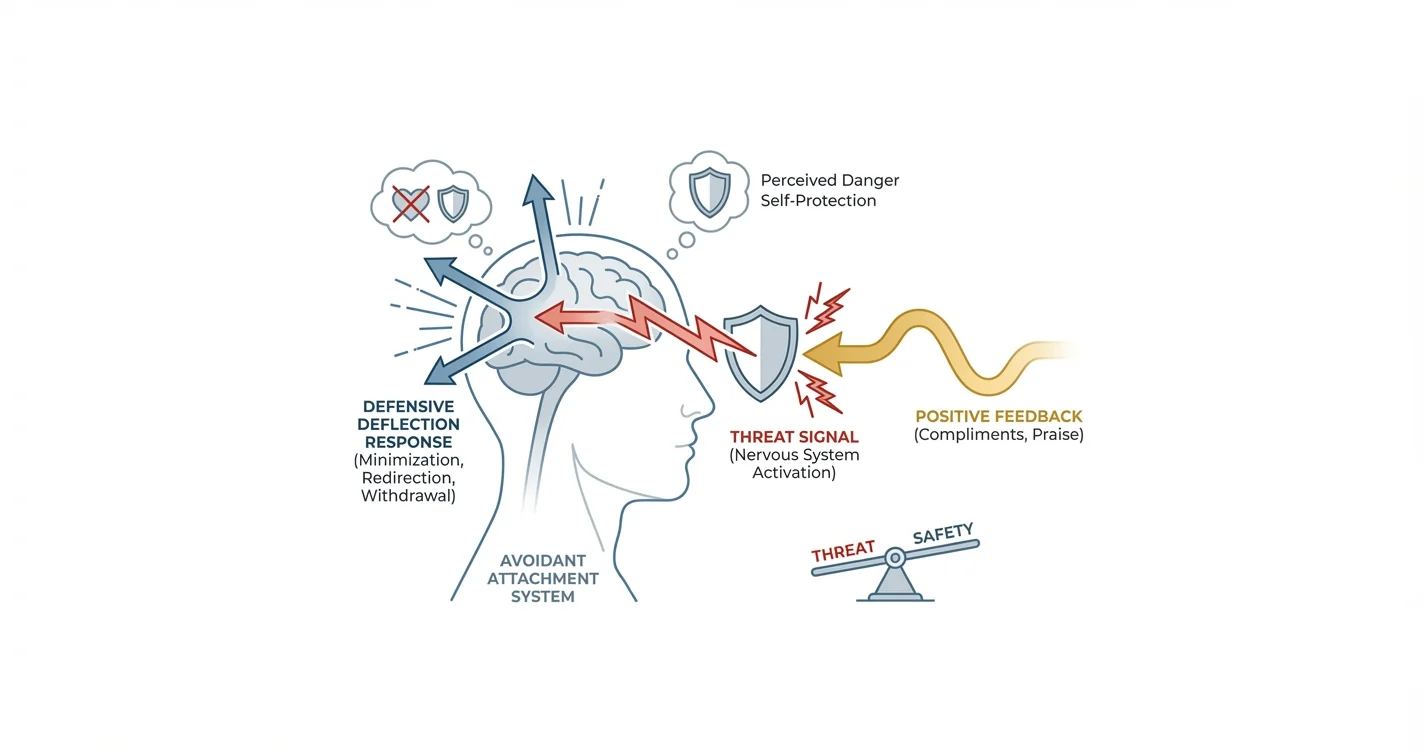
When someone with an avoidant attachment style receives a compliment or positive feedback, their immediate response often puzzles those around them. Rather than accepting the praise gracefully, they deflect, minimize, or even appear uncomfortable—sometimes to the point of changing the subject entirely. This reaction isn't simply about modesty or low self-esteem. Research suggests that avoidant attachment deflecting positive feedback and compliments as nervous system threat represents a deeply wired protective mechanism developed early in life. The nervous system, shaped by early relational experiences where emotional needs were consistently unmet or dismissed, learns to perceive emotional closeness—even in the form of genuine praise—as potentially dangerous. Understanding this neurobiological response helps explain why avoidantly attached individuals struggle with receiving recognition and how this pattern affects their relationships and self-perception.
The Neurobiological Foundation of Avoidant Attachment and Threat Response
Avoidant attachment develops when caregivers consistently fail to respond to a child's emotional needs or actively discourage emotional expression. The child's nervous system adapts by learning that expressing vulnerability or seeking connection leads to rejection or dismissal. Over time, this creates a habitual pattern where the autonomic nervous system associates emotional closeness with danger rather than safety.
When an avoidantly attached person receives positive feedback, their nervous system may interpret this as an invitation to emotional closeness—something their early experiences taught them to avoid. Neuroimaging studies suggest that individuals with avoidant attachment show distinct patterns of neural activation when processing social and emotional information. The brain regions involved in threat detection and self-protective responses may become activated when faced with situations that require emotional vulnerability or reciprocal connection.
This isn't a conscious choice or character flaw. The nervous system operates largely outside conscious awareness, responding to perceived threats within fractions of a second. For someone with avoidant attachment, a compliment may unconsciously signal:
- Expectation of reciprocal vulnerability: "If I accept this, I may need to open up emotionally"
- Fear of dependency: "If I acknowledge this matters, I become dependent on their approval"
- Anticipated disappointment: "If I believe this, I'll be let down when they inevitably withdraw"
- Loss of control: "Accepting this means lowering my defenses"
Research from attachment theory frameworks indicates that avoidant individuals prioritize self-reliance and emotional independence as core protective strategies. Positive feedback threatens this carefully maintained stance by suggesting that others' opinions matter, creating internal conflict between the desire for recognition and the need for emotional safety.
Why Avoidant Attachment Style Rejects Compliments Through Nervous System Response
The rejection of compliments in avoidant attachment operates through several interconnected mechanisms rooted in nervous system activation and learned relational patterns.
Hyperactivation of the Threat Detection System
When positive feedback triggers a threat response in avoidant attachment, the sympathetic nervous system may activate as if facing a genuine danger. This can manifest as:
- Physical discomfort or tension when receiving praise
- Mental urgency to deflect, redirect, or minimize the compliment
- Racing thoughts focused on why the compliment is inaccurate or undeserved
- Desire to physically or emotionally distance from the person offering praise
This response mirrors the body's reaction to other perceived threats, even though the rational mind recognizes that a compliment is objectively positive. The nervous system, shaped by early experiences, responds to the emotional implication rather than the logical content.
Internal Working Models and Cognitive Dissonance
Avoidantly attached individuals often develop internal working models—deeply held beliefs about themselves and relationships—that emphasize self-sufficiency and minimize the importance of others' approval. These models typically include beliefs such as:
- "I don't need validation from others"
- "Depending on others' opinions makes me weak"
- "People can't be trusted to consistently see my value"
- "It's safer to rely only on myself"
When someone offers genuine, positive feedback, it creates cognitive dissonance with these established beliefs. The nervous system perceives compliments as nervous system danger because accepting them would require restructuring these protective models—a process that feels threatening to one's sense of identity and safety.
The Vulnerability Paradox
Practitioners working with attachment patterns note that avoidant individuals face a unique paradox: they often desperately want recognition and validation but find it nearly intolerable to receive. This creates a push-pull dynamic where:
- The person seeks achievement and external markers of success
- When recognition arrives, the nervous system registers vulnerability
- Defensive mechanisms activate to restore emotional distance
- The person deflects or minimizes, maintaining their protected stance
This pattern explains why highly accomplished individuals with avoidant attachment may struggle to internalize their successes. Tools like Lovon.app can help individuals explore these contradictory feelings in a low-pressure environment, processing the discomfort that arises when they receive positive feedback without the added complexity of managing another person's reactions in real time.
How Avoidant Attachment Treats Positive Feedback as Threat to Nervous System
The specific ways that deflecting compliments avoidant attachment nervous system activation manifests vary between individuals, but several common patterns emerge consistently in relationship dynamics and self-perception.
Deflection Strategies and Their Functions
Avoidantly attached individuals employ various deflection strategies, each serving a protective function:
Minimization: "Oh, it wasn't that big a deal" or "Anyone could have done it"
- Function: Reduces the emotional significance of the interaction
- Nervous system effect: Lowers perceived vulnerability by downplaying achievement
Redirection: Immediately shifting focus to the other person or changing subjects
- Function: Moves attention away from self-disclosure
- Nervous system effect: Creates distance and reduces intimacy of the moment
Rationalization: "I just got lucky" or "The circumstances were favorable"
- Function: Attributes success to external factors rather than personal qualities
- Nervous system effect: Maintains belief in self-sufficiency by avoiding acknowledgment of personal worth
Humor or sarcasm: Making jokes or self-deprecating comments
- Function: Diffuses emotional intensity through levity
- Nervous system effect: Creates emotional buffer between self and vulnerability
Counter-complimenting: Immediately complimenting the other person in return
- Function: Shifts relational dynamic away from receiving
- Nervous system effect: Restores sense of control and emotional equilibrium
The Physiological Experience
When avoidant attachment perceiving compliments as nervous system danger, the physical sensations can be surprisingly intense. Some people report:
- Chest tightness or difficulty breathing
- Increased heart rate
- Flushing or temperature changes
- Urge to flee or end the conversation
- Mental fog or difficulty processing what was said
- Muscle tension, particularly in shoulders and jaw
These physiological responses reinforce the behavioral deflection—the body literally experiences the compliment as something to escape. This nervous system threat response when avoidants receive compliments and praise operates automatically, often before conscious awareness can intervene.
Impact on Relationships and Self-Perception
The pattern of deflecting positive feedback affects both how avoidant individuals see themselves and how others experience them:
In relationships, partners may feel:
- Their affection or admiration is unwanted
- The avoidant person doesn't value their perspective
- Emotional intimacy is one-sided or impossible
- Frustrated by the constant need to prove their sincerity
Internally, avoidant individuals may experience:
- Persistent self-doubt despite external achievements
- Difficulty building self-esteem or self-worth
- Sense of fraudulence or imposter syndrome
- Chronic feeling of being misunderstood
Studies indicate that this pattern can become self-reinforcing. The deflection of positive feedback prevents the integration of success and recognition into self-concept, maintaining the belief that external validation is unreliable and that self-sufficiency is the only safe strategy.
Recognizing and Working With This Pattern
Understanding how avoidant attachment treats positive feedback as threat to nervous system is the first step toward change. While deeply ingrained patterns don't shift overnight, awareness creates space for gradual adjustment.
Developing Awareness of the Response Pattern
The first practical step involves recognizing when the deflection response activates. This requires developing what practitioners call "meta-awareness"—the ability to observe your own reactions without immediately acting on them. Some strategies that may help:
- Notice physical sensations: When receiving praise, pay attention to bodily responses—tension, temperature changes, breathing patterns
- Identify automatic thoughts: What thoughts immediately arise? "They don't mean it," "They don't know the real me," "This is uncomfortable"
- Observe behavioral impulses: Notice the urge to deflect, change topics, or minimize before acting on it
- Track patterns: Keep a brief journal of when deflection occurs and what triggered the response
Gradual Tolerance Building
Rather than forcing acceptance of compliments—which can feel overwhelming and activate even stronger defenses—a gradual approach may be more effective:
Start with simple acknowledgment: Instead of elaborate deflection, practice a simple "thank you" without additional explanation. This doesn't require fully accepting or believing the compliment, just tolerating the moment.
Experiment with brief sitting: When receiving positive feedback, try staying present for three conscious breaths before responding. This creates a small space between stimulus and reaction.
Practice with lower-stakes situations: Begin with compliments about neutral topics (work tasks, practical skills) before tackling praise about personal qualities or emotional matters.
Use internal dialogue: Develop a phrase that acknowledges both the discomfort and the reality: "This feels uncomfortable, and that's a normal response for me. The discomfort doesn't mean the feedback is dangerous."
For those exploring these patterns, platforms like Lovon.app offer on-demand support for processing the emotions that arise when confronting deeply ingrained attachment responses, providing a space to examine these reactions without the added pressure of managing a therapist's schedule or another person's emotional responses in the moment.
Understanding the Difference Between Genuine Humility and Defensive Deflection
Not all deflection of praise indicates avoidant attachment. Genuine humility—accurately acknowledging one's contributions while recognizing others' roles and avoiding grandiosity—differs significantly from defensive deflection:
Genuine humility:
- Acknowledges contribution while recognizing context
- Feels internally calm rather than anxious
- Doesn't create distance in relationships
- Allows for accurate self-assessment
Defensive deflection:
- Creates internal distress and urgency
- Patterns of minimizing even clearly earned recognition
- Consistently creates relational distance when praised
- Prevents integration of positive information into self-concept
This distinction matters because the goal isn't to accept every compliment uncritically, but rather to respond from choice rather than automatic nervous system activation.
When Professional Support Becomes Important
While self-awareness and gradual practice can help, some individuals benefit from professional support, particularly when:
- The pattern significantly impairs relationships or professional development
- Deflection extends to rejecting all positive information, even objective achievements
- The nervous system response to praise includes panic-level anxiety
- Self-worth remains persistently low despite external evidence of capability
- The pattern coexists with other attachment-related difficulties (fear of intimacy, relationship avoidance, emotional numbness)
Therapists specializing in attachment-focused approaches can help identify the specific early experiences that shaped these patterns and develop targeted strategies for gradually increasing tolerance for emotional closeness. Modalities such as EMDR, Somatic Experiencing, or Internal Family Systems may address the nervous system component directly, helping recalibrate threat responses.
When to Seek Professional Help
If you recognize these patterns in yourself and find that they're significantly affecting your relationships, career progression, or sense of self-worth, professional support can be valuable. Consider reaching out to a mental health professional if:
- You consistently feel distressed or anxious when receiving any form of recognition
- Important relationships are suffering because partners feel their affection is rejected
- You're unable to experience satisfaction from achievements due to automatic deflection
- The pattern prevents you from pursuing opportunities that might involve recognition
- You experience shame or self-criticism about your inability to accept positive feedback
- These responses coincide with other difficulties managing emotional intimacy or vulnerability
Mental health professionals with training in attachment theory, particularly those specializing in adult attachment patterns, can provide targeted support. Approaches that address both the cognitive patterns and the nervous system responses tend to be most effective for attachment-related difficulties.
Conclusion
The phenomenon of avoidant attachment deflecting positive feedback and compliments as nervous system threat reveals the profound influence that early relational experiences have on our neurobiological responses to connection. When the nervous system learns to associate emotional closeness with danger, even genuinely positive interactions can trigger self-protective responses that seem irrational on the surface but make perfect sense within the logic of early adaptation.
Understanding that this pattern represents a threat response rather than ingratitude, false modesty, or character flaw creates compassion—both for oneself and others exhibiting these patterns. The deflection isn't about rejecting the person offering praise; it's about managing an internal experience that feels genuinely unsafe.
Change is possible, though it requires patience. By developing awareness of the response pattern, gradually building tolerance for the discomfort, and understanding the difference between automatic nervous system reactions and conscious choice, individuals with avoidant attachment can slowly expand their capacity to receive recognition without overwhelming their system. Resources ranging from attachment-focused therapy to accessible support tools that help process these complex reactions in real time can support this journey.
The goal isn't to force yourself to accept every compliment enthusiastically or to abandon healthy humility. Rather, it's about creating enough nervous system safety that positive feedback can be received without triggering protective defenses—allowing you to integrate accurate information about your capabilities and worth, and to experience emotional closeness without perceiving it as a threat.
Disclaimer: This is general information, not medical advice or diagnosis. If symptoms are severe, affecting your daily life, or you're having thoughts of self-harm—seek professional help. In the US: call or text 988 (Suicide & Crisis Lifeline). For immediate danger: 911 or local emergency services.
How AI Support Helps You Heal
AI emotional support isn't about replacing human connection — it's about filling the gaps. The moments when you need to talk at 2 AM, when you don't want to burden your friends again, or when you simply need someone to listen without judgment.
Here's what happens in a typical Lovon session:
You share what's on your mind
There's no script, no intake form, no waiting room. You speak or type whatever you're feeling — in your own words, at your own pace.
Lovon validates and explores
Using frameworks from CBT (Cognitive Behavioral Therapy) and motivational interviewing, Lovon acknowledges your feelings first, then gently helps you explore them. No dismissive "just move on" advice.
You build coping skills together
Lovon doesn't just listen — it actively works with you on evidence-based techniques: thought reframing, urge surfing, behavioral experiments, and more.
What a Session with Lovon Looks Like

When to Seek Professional Help
AI support is a valuable tool, but it's not a replacement for professional care. Please consider reaching out to a licensed therapist if you experience any of the following:
- Persistent thoughts of self-harm or suicide
- Inability to perform daily activities (work, eating, sleeping) for more than 2 weeks
- Turning to alcohol or substances to cope
- Intense anger or desire to harm your ex-partner
- Complete emotional numbness that doesn't improve over time
Crisis Resources (US): If you're in immediate danger, call 988 (Suicide & Crisis Lifeline) or text HOME to 741741 (Crisis Text Line). Available 24/7, free, and confidential.
Outside the US? Find a crisis line in your country
Ready to Start?
Your healing journey can begin right now
A 7-day trial. No judgment. Just a safe space to process what you're going through.
Frequently Asked Questions
Is Lovon a replacement for a real therapist?
Is my conversation with Lovon AI private?
How is Lovon different from ChatGPT for emotional support?
Can I use Lovon if I'm already seeing a therapist?
Can I try Lovon before subscribing?
About the Author

The Lovon Editorial Team
Mental Health & Wellness Content Team
The Lovon Editorial Team develops mental health and wellness content designed to make psychological concepts accessible and actionable. Our goal is to bridge the gap between clinical research and everyday life - helping you understand why your mind works the way it does and what you can do about it....
Related articles
- Avoidant Attachment Shutdown Triggers: What Sets It Off (2026)
Avoidant attachment shutdown triggers explained: the 4 patterns behind it, body signals to watch, and steps to interrupt…
- Break the Anxious Attachment Cycle: 2026 Step-by-Step Guide
Break the anxious attachment cycle in 2026 with 7 concrete steps, troubleshooting fixes, and tools for the moments…
- Anxious Attachment Triggers: How to Defuse Them (2026)
Anxious attachment triggers explained: a 6-step sequence to name, regulate, and defuse them in 2026, plus…
- Fearful Avoidant Attachment: Triggers & Healing (2026)
Fearful avoidant attachment explained: the 4 trigger categories, a 90-second distress protocol, and a 6-step healing…
See also
Quizzes
- Do I Have Abandonment Issues? 12-Question Self-Check
See how loudly the fear of being left runs things.
- Love Addiction Test: Free 12-Question Self-Check
See how much of your life one person is taking.
Free tools
- Attachment Trigger Plan for Anxious and Avoidant Patterns
Pick your pattern, tick the moments that set it off, and finish one card for each: your body signal, the thing you will…
- Deep Conversation Starters That Fit the Person You're Asking
The right question depends on who is across from you and how much history is behind it. Tell it who you are talking to…
From the wiki
- What does clingy mean in a relationship?
Clingy is what people call behavior that asks for more contact or reassurance than the other person wants to give…
Disclaimer: This article is for informational purposes only and does not constitute medical advice, diagnosis, or treatment. Always seek the advice of your physician or other qualified health provider with any questions you may have regarding a medical condition. If you are in crisis or think you may have an emergency, call 988 (Suicide & Crisis Lifeline) or go to the nearest emergency room. Outside the US? Find a crisis line in your country.