
OCPD — "Do It Right to Feel Safe" Perfectionism Pattern
For people living with Obsessive-Compulsive Personality Disorder (OCPD), perfectionism isn't about vanity or high standards—it's about survival. The core

Key Takeaways
- Paralysis around decisions: Choosing the "right" option feels critical, leading to extensive research, comparison,
- Time distortion: Spending disproportionate time on minor details while major deadlines approach, because the detail
- Difficulty completing projects: Nothing ever feels quite finished or good enough to submit, leading to chronic
- Rigid routines: Specific ways of doing everyday tasks (morning routines, meal preparation, cleaning) that must be
- Relationship friction: Insisting others follow the "correct" procedures, offering unsolicited corrections, or
Introduction
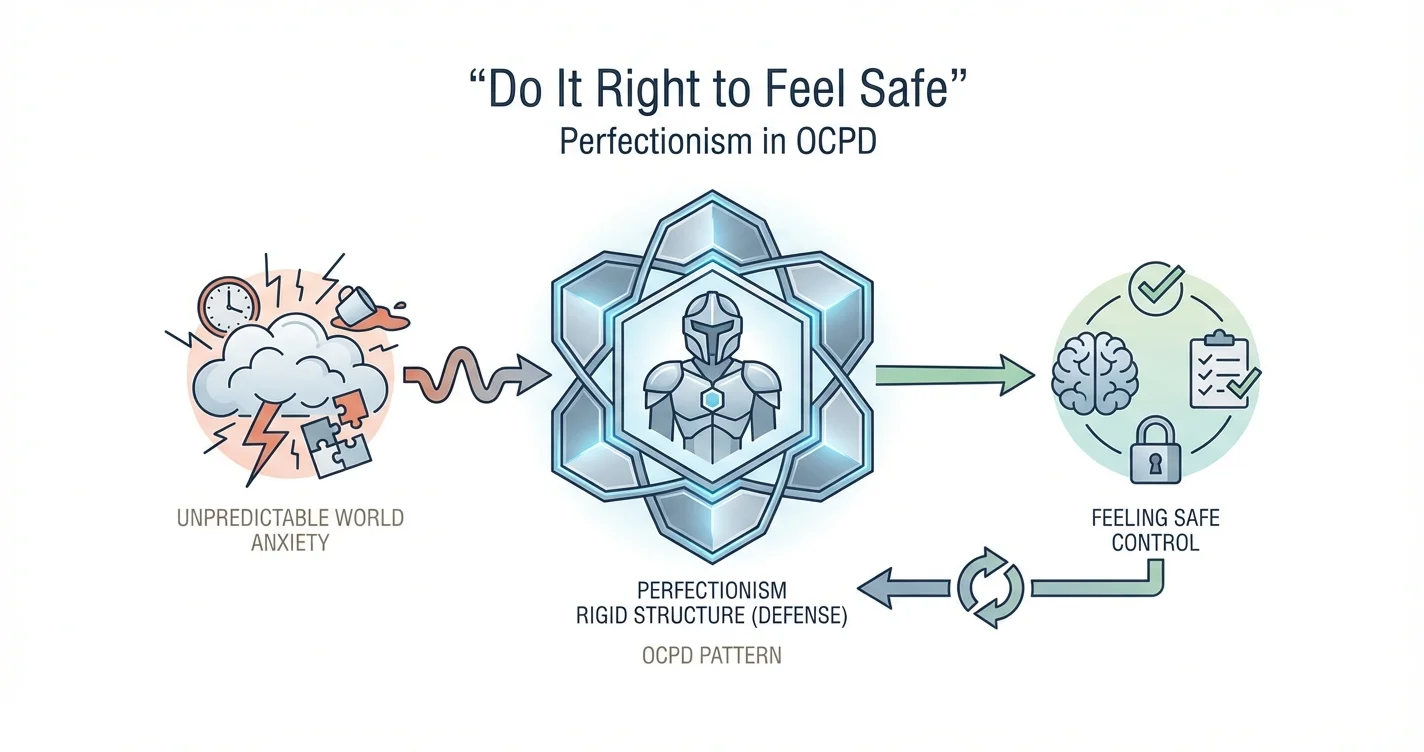
For people living with Obsessive-Compulsive Personality Disorder (OCPD), perfectionism isn't about vanity or high standards—it's about survival. The core pattern underlying OCPD — "do it right to feel safe" perfectionism — reveals how these individuals use control, order, and exactness as psychological armor against an unpredictable world. This safety-seeking perfectionism differs fundamentally from the pursuit of excellence; it's driven by an underlying belief that anything less than perfect creates vulnerability to criticism, failure, or chaos. Understanding this pattern helps explain why someone with OCPD might spend hours organizing a closet while urgent tasks wait, or why they struggle to delegate even minor responsibilities. This article examines the mechanisms behind the "do it right to feel safe" pattern in OCPD, how it manifests in daily life, and approaches that may help individuals recognize and work with these deeply ingrained protective strategies.
Understanding the "Do It Right to Feel Safe" Pattern in OCPD
The connection between perfectionism and safety in OCPD represents more than simple conscientiousness. Research suggests that individuals with OCPD often develop rigid standards and rules as a way to manage underlying anxiety about potential negative outcomes. When the environment feels predictable and controlled—when things are done "right"—the nervous system can relax slightly. Conversely, deviations from the correct way of doing things may trigger disproportionate anxiety responses.
This pattern typically develops gradually, often beginning in childhood or adolescence. Some studies indicate that temperamental factors—such as heightened sensitivity to negative outcomes or naturally elevated anxiety—may predispose certain individuals toward this coping style. Environmental factors also contribute: growing up in unpredictable environments, experiencing criticism for mistakes, or learning that perfection earned approval may reinforce the belief that safety comes through flawless execution.
The neurobiological underpinnings appear to involve brain regions associated with threat detection and emotional regulation. Neuroimaging studies suggest differences in how individuals with OCPD process errors and uncertainty compared to those without the condition. These differences may contribute to the heightened discomfort that drives compulsive attention to detail and adherence to self-imposed standards.
What distinguishes OCPD perfectionism from adaptive high standards is the inflexibility and the cost. Someone with healthy perfectionism might adjust their standards based on context—recognizing when "good enough" suffices. In OCPD, the safety-seeking perfectionism pattern doesn't differentiate between high-stakes situations and trivial tasks. Every detail carries equal weight because the underlying equation remains constant: doing it right equals feeling safe.
How Safety-Seeking Perfectionism Manifests in Daily Life
The "do it right to feel safe" pattern in OCPD creates distinctive behavioral signatures across multiple life domains. In work settings, individuals may struggle with productivity despite working longer hours than colleagues. They might revise documents repeatedly, check calculations excessively, or insist on personally handling tasks that could be delegated. The underlying driver isn't pride in craftsmanship but anxiety about potential errors and their consequences.
Common manifestations include:
- Paralysis around decisions: Choosing the "right" option feels critical, leading to extensive research, comparison, and deliberation that delays action indefinitely
- Time distortion: Spending disproportionate time on minor details while major deadlines approach, because the detail feels as important as the deadline
- Difficulty completing projects: Nothing ever feels quite finished or good enough to submit, leading to chronic lateness or abandonment of work
- Rigid routines: Specific ways of doing everyday tasks (morning routines, meal preparation, cleaning) that must be followed precisely to maintain equilibrium
- Relationship friction: Insisting others follow the "correct" procedures, offering unsolicited corrections, or experiencing frustration when partners don't share the same standards
In relationships, this pattern creates particular challenges. A partner might experience the OCPD individual's corrections not as helpful suggestions but as constant criticism. The person with OCPD, meanwhile, genuinely believes they're protecting against negative outcomes—helping their partner avoid mistakes that could lead to problems. The safety-seeking motivation behind the behavior remains largely unconscious.
The emotional experience accompanying these behaviors often includes chronic tension, difficulty relaxing, and a persistent sense that disaster lurks around every corner of imperfection. Some people describe feeling as though they're constantly bracing for criticism or catastrophe, with only perfect execution providing temporary relief.
Tools like Lovon.app can offer accessible support for processing the anxiety and emotional patterns connected to this perfectionism style. Through voice-based conversations, individuals can explore what "doing it right" means to them, identify situations that trigger heightened safety-seeking behaviors, and gradually examine whether the equation between perfection and safety truly holds in their experience.
The Psychological Function of Doing It Right in OCPD
Understanding why the pattern persists requires examining its psychological function. From an adaptive perspective, attention to detail and high standards can prevent genuine problems. Carefully reviewing financial documents does catch errors. Following proper procedures does reduce certain risks. The challenge in OCPD is that the safety-seeking perfectionism extends far beyond situations where such vigilance offers proportional benefit.
The pattern functions as an anxiety-management strategy. When someone with OCPD encounters uncertainty or the possibility of making mistakes, their anxiety may spike rapidly. Engaging in perfectionistic behaviors—checking, organizing, following precise procedures—temporarily reduces this anxiety. This negative reinforcement (anxiety reduction) strengthens the behavior pattern, even though the relief is typically short-lived.
Several cognitive patterns reinforce the "do it right to feel safe" equation:
- Overestimation of threat: Perceiving potential negative consequences as more likely and more severe than they actually are
- Moral reasoning: Equating mistakes with moral failures rather than neutral events or learning opportunities
- Control beliefs: Maintaining that perfect execution can prevent negative outcomes, overlooking factors outside personal control
- Intolerance of uncertainty: Experiencing ambiguous situations as threatening rather than neutral or potentially interesting
These cognitive patterns aren't simply "wrong thinking" that can be easily corrected. They're deeply embedded beliefs often reinforced over decades. Challenging them requires not just intellectual understanding but emotional experiences that demonstrate safety can exist without perfection.
Therapeutic approaches that may help include exposure to imperfection in graduated steps, where individuals intentionally make small "mistakes" and observe the actual consequences rather than feared outcomes. Some people find cognitive approaches helpful for identifying and testing the accuracy of threat predictions. Others benefit from body-based approaches that address the physiological activation underlying the anxiety.
Processing these patterns often works better with support. Resources like Lovon.app provide on-demand access to talk through situations where perfectionism feels overwhelming—perhaps after making a mistake at work or when struggling to complete a project due to excessive revision. The ability to process these experiences in real-time, rather than waiting for a scheduled therapy appointment, may help interrupt the cycle before it intensifies.
Working With the Pattern: Practical Approaches
Addressing safety-seeking perfectionism in OCPD requires approaches that respect the protective function these behaviors serve while gradually expanding the individual's capacity to tolerate imperfection. Abruptly abandoning perfectionistic standards typically backfires, triggering overwhelming anxiety. More effective approaches involve incremental changes that allow the nervous system to recalibrate gradually.
Recognition and tracking: The first step involves developing awareness of when the pattern activates. Keeping a simple log noting situations that trigger perfectionism, the specific behaviors that follow, and the intensity of accompanying anxiety helps identify patterns. Many people discover their perfectionism intensifies under specific conditions—stress, fatigue, relationship conflict, or transitions—rather than remaining constant.
Graduated exposure to imperfection: This approach involves intentionally creating controlled imperfections in low-stakes situations. Examples might include:
- Sending an email with a minor typo deliberately left in
- Leaving one kitchen cabinet slightly disorganized
- Submitting work that's "good enough" rather than perfect when stakes are genuinely low
- Allowing a partner to complete a task their way without correction
The key is starting with situations where the person can tolerate the accompanying anxiety without becoming overwhelmed, then gradually progressing to more challenging scenarios.
Values clarification: OCPD perfectionism often obscures what actually matters to the individual. Someone might spend three hours organizing a workspace while missing their child's school event. Clarifying personal values—what relationships, experiences, and contributions genuinely matter—can help create decision-making frameworks that prioritize according to meaning rather than anxiety reduction.
Self-compassion practices: Research suggests that self-compassion—treating oneself with the kindness typically reserved for others—may help reduce the shame and self-criticism that fuel perfectionistic cycles. This doesn't mean lowering standards but rather responding to inevitable human imperfection with understanding rather than harsh judgment.
Physiological regulation: Since anxiety drives much of the pattern, approaches that address physiological activation may help. These might include breathwork, progressive muscle relaxation, or movement practices. When the nervous system isn't in a heightened threat state, tolerating imperfection becomes more manageable.
Working with a therapist who understands OCPD provides valuable support for this process. Approaches that show effectiveness for related patterns include Cognitive Behavioral Therapy (CBT), particularly exposure-based interventions, and Acceptance and Commitment Therapy (ACT), which helps individuals pursue values-based action despite discomfort.
Between therapy sessions or when professional support isn't immediately accessible, talking through challenges with tools like Lovon.app can help maintain momentum. Discussing a specific situation where perfectionism interfered with priorities, exploring the fears underlying a particular standard, or processing the discomfort of intentionally tolerating imperfection provides real-time support for changing entrenched patterns.
When Professional Support Becomes Essential
While understanding the "do it right to feel safe" perfectionism pattern and implementing self-directed strategies can help, some situations warrant professional intervention. Consider seeking support from a mental health professional when:
- Perfectionism significantly impairs work performance, causing missed deadlines, incomplete projects, or job loss
- Relationships suffer substantially due to rigidity, criticism of others, or inability to compromise
- The time spent on perfectionistic behaviors prevents engagement in valued activities (hobbies, relationships, rest)
- Depression or severe anxiety develops alongside the perfectionism
- Physical health deteriorates due to stress, sleep deprivation from overworking, or neglect of self-care
- The individual recognizes the pattern but feels unable to modify it despite genuine effort
Mental health professionals specializing in personality patterns, anxiety disorders, or perfectionism can provide structured approaches tailored to individual circumstances. This might include specialized therapy modalities, skills training, or in some cases, consultation about whether medication might help address underlying anxiety that fuels the perfectionism.
For individuals in relationships with someone showing this pattern, couples therapy with a therapist familiar with OCPD can help both partners understand the dynamics and develop communication strategies that reduce friction while supporting change.
Conclusion
The OCPD "do it right to feel safe" perfectionism pattern represents a deeply embedded strategy for managing anxiety and uncertainty through control and flawless execution. Understanding this connection—that perfectionism serves a protective rather than aspirational function—helps explain behaviors that might otherwise seem puzzling or frustrating. The pattern develops from a combination of temperamental predispositions, environmental influences, and reinforcing experiences that teach the equation between perfection and safety.
Shifting this pattern requires approaches that respect its protective function while gradually expanding tolerance for the imperfection inherent in human experience. Through recognition, graduated exposure, values clarification, and compassionate self-awareness, individuals can begin loosening the rigid standards that constrain their lives. Professional support, peer understanding, and accessible resources like Lovon.app provide valuable assistance for this challenging but worthwhile process.
The goal isn't abandoning standards entirely but developing flexibility—learning to calibrate effort according to actual importance rather than anxiety level, and discovering that safety can exist alongside imperfection. For many people with OCPD, this realization doesn't come through intellectual understanding alone but through accumulated experiences of tolerating imperfection and discovering the feared catastrophes don't materialize. This gradual recalibration allows perfectionism to shift from a rigid defense mechanism into genuine pursuit of excellence in areas that truly matter.
Disclaimer: This is general information, not medical advice or diagnosis. If symptoms are severe, affecting your daily life, or you're having thoughts of self-harm — seek professional help. In the US: call or text 988 (Suicide & Crisis Lifeline). For immediate danger: 911 or local emergency services.
How AI Support Helps You Heal
AI emotional support isn't about replacing human connection — it's about filling the gaps. The moments when you need to talk at 2 AM, when you don't want to burden your friends again, or when you simply need someone to listen without judgment.
Here's what happens in a typical Lovon session:
You share what's on your mind
There's no script, no intake form, no waiting room. You speak or type whatever you're feeling — in your own words, at your own pace.
Lovon validates and explores
Using frameworks from CBT (Cognitive Behavioral Therapy) and motivational interviewing, Lovon acknowledges your feelings first, then gently helps you explore them. No dismissive "just move on" advice.
You build coping skills together
Lovon doesn't just listen — it actively works with you on evidence-based techniques: thought reframing, urge surfing, behavioral experiments, and more.
What a Session with Lovon Looks Like

When to Seek Professional Help
AI support is a valuable tool, but it's not a replacement for professional care. Please consider reaching out to a licensed therapist if you experience any of the following:
- Persistent thoughts of self-harm or suicide
- Inability to perform daily activities (work, eating, sleeping) for more than 2 weeks
- Turning to alcohol or substances to cope
- Intense anger or desire to harm your ex-partner
- Complete emotional numbness that doesn't improve over time
Crisis Resources (US): If you're in immediate danger, call 988 (Suicide & Crisis Lifeline) or text HOME to 741741 (Crisis Text Line). Available 24/7, free, and confidential.
Outside the US? Find a crisis line in your country
Ready to Start?
Your healing journey can begin right now
A 7-day trial. No judgment. Just a safe space to process what you're going through.
Frequently Asked Questions
Is Lovon a replacement for a real therapist?
Is my conversation with Lovon AI private?
How is Lovon different from ChatGPT for emotional support?
Can I use Lovon if I'm already seeing a therapist?
Can I try Lovon before subscribing?
About the Author

The Lovon Editorial Team
Mental Health & Wellness Content Team
The Lovon Editorial Team develops mental health and wellness content designed to make psychological concepts accessible and actionable. Our goal is to bridge the gap between clinical research and everyday life - helping you understand why your mind works the way it does and what you can do about it....
Related articles
- Self-Sabotaging Relationships: Why It Happens (2026)
Self-sabotaging relationships explained: the trigger pattern behind it and a 6-step process to interrupt it in 2026…
- ADHD Rejection Sensitive Dysphoria Explained (2026)
Rejection sensitive dysphoria ADHD causes sudden, intense emotional pain from perceived rejection. Learn what RSD is…
- Not Good Enough? Therapy for Feeling Good Enough
You just finished a very hard task and helped the company succeed. You felt happy for a moment, but then a quick thought…
- Ego Defense Mechanisms Protecting from Unprocessed Emotions
When something painful happens—a rejection, a loss, a humiliating moment—your mind has a split-second decision to make…
See also
Quizzes
- Light Triad Test: Are People Ends or Means?
See how you treat people when there is nothing to gain.
- Coping Style Test: How Do You Actually Handle Stress?
See how you really cope under stress, in 3 minutes.
Free tools
- How to Respond to Gaslighting
Say what happened and what they say happened. You get what is actually established separated from what is being…
- How to Respond to a Narcissist
Paste what they said. You get the part that actually needs answering separated from the part designed to pull you in, a…
From the wiki
- Why do I feel sad when I'm alone?
Being alone does not create the sadness. It removes the noise that was keeping it out of earshot, so whatever queued up…
Disclaimer: This article is for informational purposes only and does not constitute medical advice, diagnosis, or treatment. Always seek the advice of your physician or other qualified health provider with any questions you may have regarding a medical condition. If you are in crisis or think you may have an emergency, call 988 (Suicide & Crisis Lifeline) or go to the nearest emergency room. Outside the US? Find a crisis line in your country.