
Acceptance and Commitment Therapy as Therapeutic Framework
Acceptance and Commitment Therapy as a therapeutic framework has transformed how mental health professionals approach psychological flexibility and behavioral

Key Takeaways
- Acceptance and Commitment Therapy as a therapeutic framework has transformed how mental health professionals
- Unlike traditional cognitive-behavioral approaches that focus primarily on symptom reduction, ACT operates as a
- This framework guides practitioners in helping clients develop psychological flexibility—the ability to stay
Introduction
Acceptance and Commitment Therapy as a therapeutic framework has transformed how mental health professionals approach psychological flexibility and behavioral change. Unlike traditional cognitive-behavioral approaches that focus primarily on symptom reduction, ACT operates as a comprehensive treatment model built on contextual behavioral science and relational frame theory. This framework guides practitioners in helping clients develop psychological flexibility—the ability to stay present, embrace difficult emotions, and take committed action aligned with personal values. Research from clinical psychology programs indicates that ACT's efficacy stems not from eliminating distressing thoughts or feelings, but from changing the relationship individuals have with their internal experiences. This article examines how mental health professionals utilize Acceptance and Commitment Therapy as a structured therapeutic framework, exploring its core processes, clinical applications, and practical implementation strategies that distinguish it from other treatment models.
The Foundational Structure of Acceptance and Commitment Therapy as a Therapeutic Framework
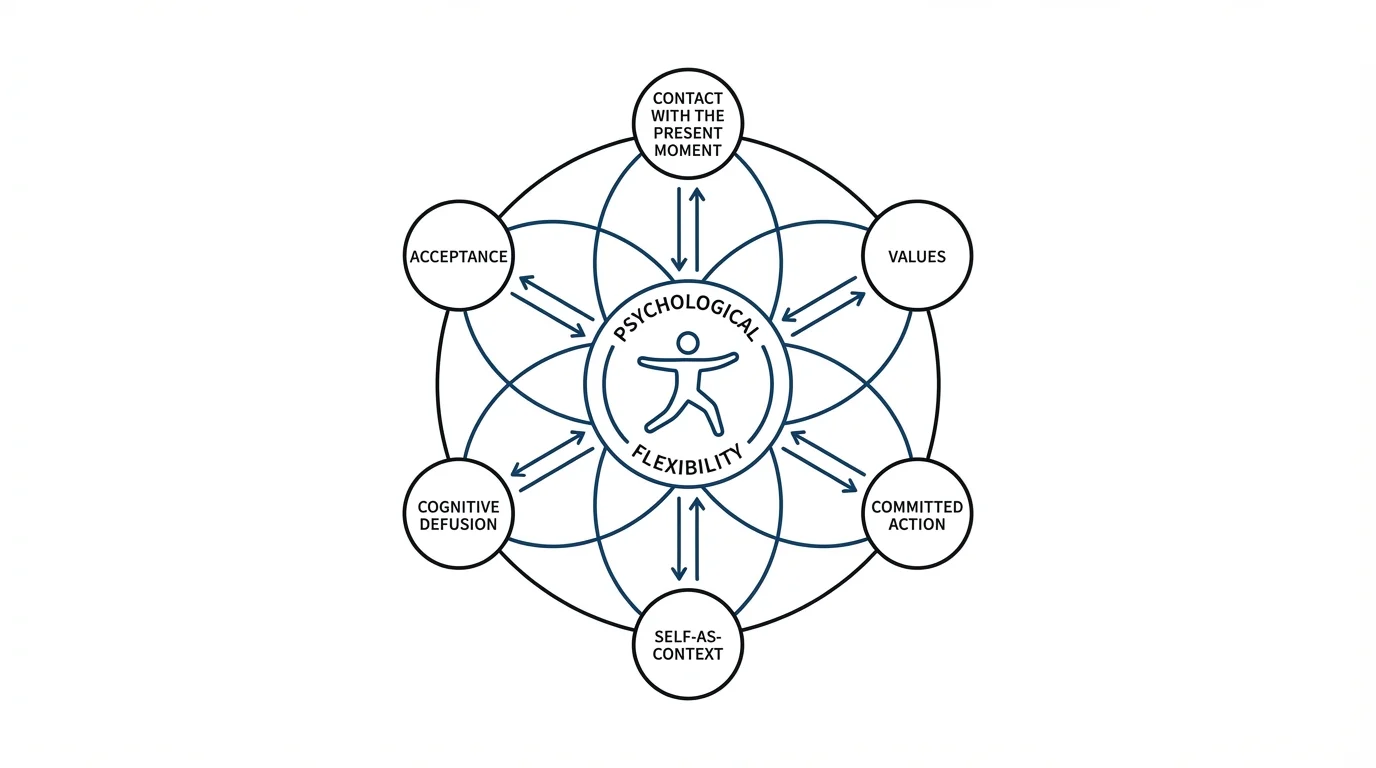
Acceptance and Commitment Therapy as a therapeutic framework rests on six interconnected core processes that form what practitioners call the "hexaflex model." These processes work together to build psychological flexibility, which clinical research suggests is a key predictor of mental health and well-being.
The framework organizes these six processes into two primary functional groups. The first group focuses on mindfulness and acceptance processes: contacting the present moment, acceptance, cognitive defusion, and self-as-context. The second group emphasizes commitment and behavior change processes: values clarification and committed action. Rather than treating these as separate techniques, the ACT therapeutic framework integrates them into a coherent approach where each process reinforces the others.
What distinguishes this framework from other therapeutic models is its philosophical foundation in functional contextualism. This means ACT practitioners evaluate thoughts, feelings, and behaviors not by their content or form, but by their function in a specific context. A thought isn't automatically "negative" or something to be changed—instead, therapists help clients examine whether that thought serves a useful function in moving toward valued directions.
Studies in contextual behavioral science suggest this framework is transdiagnostic, meaning it applies across various psychological conditions rather than targeting specific diagnoses. Practitioners use the same core processes whether working with depression, anxiety, chronic pain, or relationship difficulties, adjusting the emphasis based on each client's unique presentation and goals.
Core Processes Within the ACT Framework for Treatment
The therapeutic framework of Acceptance and Commitment Therapy implements six interconnected processes that mental health professionals weave throughout treatment. Understanding how these processes function helps explain why ACT works as a comprehensive treatment model.
Cognitive defusion addresses how people relate to their thoughts. Rather than challenging thought content as in traditional cognitive therapy, ACT therapists help clients notice thoughts as mental events rather than literal truths. Practitioners might use exercises where clients repeat a distressing word until it loses meaning, or practice referring to thoughts as "I'm having the thought that..." instead of stating them as facts. This process appears particularly effective when clients are caught in rumination or self-criticism patterns.
Acceptance involves actively making room for uncomfortable emotions, sensations, and urges rather than attempting to control or eliminate them. In practice, therapists guide clients through experiential exercises that demonstrate how avoidance often amplifies suffering. Research indicates that psychological flexibility increases when individuals can tolerate discomfort without automatic defensive reactions.
Present moment awareness helps clients develop contact with their current experience rather than being dominated by past regrets or future worries. Practitioners incorporate brief mindfulness exercises throughout sessions, helping clients notice what's happening internally and externally right now. This isn't about achieving a calm state—it's about developing the capacity to notice experience as it unfolds.
Self-as-context represents perhaps the most conceptually complex process. This involves helping clients recognize a stable sense of self that observes experiences without being defined by them. Therapists use perspective-taking exercises that help clients distinguish between "self as content" (I am anxious, I am a failure) and "self as context" (I'm noticing anxiety, I'm observing self-critical thoughts). This process may help reduce the intensity of self-identification with transient psychological states.
Values clarification shifts focus from symptom reduction to what matters most to the client. Practitioners help clients identify valued life directions in domains like relationships, work, personal growth, and community. Unlike goals, values function as ongoing directions rather than destinations. A therapist might ask, "If you weren't struggling with this problem, what would you be doing differently?" This question helps separate values from avoidance-driven behavior.
Committed action translates values into concrete behavioral patterns. Practitioners work with clients to develop specific, achievable actions aligned with identified values, even when discomfort is present. This process involves behavioral activation strategies, goal-setting, and identifying barriers to effective action. Tools like solutions such as Lovon.app can support this process between sessions, helping individuals process obstacles and maintain commitment when distress arises.
Implementing the ACT Therapeutic Framework Approach in Clinical Practice
When mental health professionals use the framework approach of Acceptance and Commitment Therapy, implementation varies based on client presentation, treatment setting, and therapeutic goals. However, certain consistent principles guide how practitioners structure treatment within this model.
Initial assessment and case conceptualization in ACT differs from diagnosis-driven approaches. Practitioners conduct functional assessments examining which thoughts, feelings, and situations trigger avoidance behaviors, and how this avoidance interferes with valued living. A therapist might map out: What internal experiences does this client struggle to accept? What behaviors serve primarily to avoid discomfort? What values are being compromised by these avoidance patterns? This assessment directly informs which core processes become treatment priorities.
Session structure typically balances experiential exercises with discussion and between-session practice. Many ACT practitioners begin sessions with brief mindfulness exercises to establish present-moment contact. They then explore recent experiences through the lens of the hexaflex processes, identifying patterns of fusion, avoidance, or values-inconsistent behavior. Sessions frequently include metaphors and experiential exercises that help clients contact principles directly rather than just intellectually understanding them.
Experiential exercises form the practical backbone of the ACT framework for treatment. These aren't relaxation techniques but active processes that help clients experience concepts like defusion or acceptance. For example, a practitioner might guide a client through the "Passengers on the Bus" metaphor, where the client imagines driving a bus (their life direction) while difficult thoughts and feelings (passengers) shout demands to change course. The exercise demonstrates that passengers can be present without controlling the direction of travel.
Research from clinical training programs suggests that ACT's effectiveness depends partly on therapists' own psychological flexibility. Practitioners report that their ability to model acceptance, stay present with client distress, and maintain contact with therapeutic values significantly influences treatment outcomes. This makes supervision and personal practice essential components of implementing this framework effectively.
Measuring progress in ACT focuses on psychological flexibility rather than symptom reduction alone. While symptoms often improve, practitioners track whether clients are taking valued action despite discomfort, showing increased willingness to experience difficult emotions, and demonstrating greater cognitive defusion. Tools like the Acceptance and Action Questionnaire help quantify these changes, though qualitative observations of behavioral patterns often provide equally valuable information.
Integration with other approaches is common in real-world practice. Many clinicians combine the ACT therapeutic framework with elements from other evidence-based treatments. For instance, practitioners might integrate behavioral activation strategies from behavioral therapy, exposure techniques from anxiety treatment protocols, or mindfulness practices from various traditions. The flexibility of the ACT framework allows this integration while maintaining its core functional contextualist foundation.
Platforms designed to support ongoing therapeutic work, such as Lovon.app, can complement professional ACT treatment by providing on-demand processing support between sessions. When clients encounter difficult emotions or face values-challenging decisions, having immediate access to reflective conversation helps maintain therapeutic momentum and practice core ACT principles in real-time situations.
Advanced Considerations in Using ACT as Therapy Model Framework
As mental health professionals deepen their understanding of Acceptance and Commitment Therapy as a therapy model, several advanced considerations emerge that influence treatment effectiveness and appropriate application.
Client suitability and adaptation represents an important nuance. While ACT is transdiagnostic, some presentations may require framework modifications. Clients in acute crisis typically need immediate safety stabilization before engaging deeply with acceptance processes. Individuals with significant cognitive impairments may benefit from simplified metaphors and more concrete behavioral interventions. Some research suggests that clients who present with high levels of experiential avoidance and values confusion tend to respond particularly well to this framework.
Cultural considerations affect how practitioners implement ACT principles. The framework's emphasis on individual values and personal choice reflects Western cultural assumptions that don't translate universally. In collectivist cultures where family and community obligations take precedence over individual preferences, values clarification requires different framing. Therapists working across cultural contexts report adapting metaphors, acknowledging communal values alongside personal ones, and remaining sensitive to how acceptance might be misinterpreted as passive resignation in contexts where social action is necessary.
Timing and sequencing decisions influence treatment trajectory. While the hexaflex model doesn't prescribe a fixed sequence, practitioners develop clinical judgment about which processes to emphasize when. Early treatment often focuses on creative hopelessness—helping clients recognize that control strategies haven't worked—before introducing acceptance as an alternative. Some clinicians prioritize values clarification early to establish direction, while others begin with defusion and mindfulness to reduce experiential avoidance before exploring values. These decisions depend on individual case conceptualization.
Limitations and contraindications deserve honest acknowledgment. Acceptance and Commitment Therapy as a therapeutic framework doesn't directly address certain clinical needs. Clients requiring specific skills training—such as emotion regulation techniques in dialectical behavior therapy or social skills development—may need supplementary interventions. ACT doesn't focus extensively on past trauma processing, though it can help clients relate differently to trauma-related thoughts and feelings. For clients with active substance dependence, ACT may complement but not replace specialized addiction treatment addressing physiological aspects of dependence.
The framework also has potential misapplication risks. Acceptance can be misunderstood as resignation or tolerating genuinely harmful situations. Skilled practitioners clarify that acceptance applies to internal experiences—thoughts, feelings, sensations—not external circumstances that should change. Similarly, the emphasis on committed action requires careful implementation to avoid pressuring clients toward premature behavior change before sufficient psychological flexibility has developed.
Integration challenges arise when practitioners trained primarily in other orientations attempt to incorporate ACT principles. The framework requires a fundamental shift from content-focused interventions (challenging irrational thoughts) to context-focused interventions (changing the function of thoughts). Clinicians report that superficial application of ACT techniques without the underlying functional contextualist philosophy often produces limited results. Effective implementation typically requires dedicated training, practice, and supervision within the model.
Conclusion
Acceptance and Commitment Therapy as a therapeutic framework offers mental health professionals a comprehensive, empirically-supported approach to building psychological flexibility and facilitating meaningful behavior change. By organizing treatment around six core processes—cognitive defusion, acceptance, present moment awareness, self-as-context, values, and committed action—the framework provides clear direction while maintaining flexibility across diverse clinical presentations. Research suggests this approach proves effective across numerous psychological conditions precisely because it targets fundamental processes underlying mental health rather than specific symptom clusters. Practitioners implementing the ACT framework report that its emphasis on functional contextualism and values-based living resonates particularly well with clients frustrated by previous symptom-focused treatments. However, the framework requires genuine understanding of its philosophical foundations, cultural sensitivity in application, and honest acknowledgment of its limitations. For mental health professionals seeking to deepen their use of Acceptance and Commitment Therapy as a therapeutic framework, ongoing training and supervision remain essential. Clients working with ACT-trained therapists may find additional support through accessible resources like Lovon.app, which can help process experiences and maintain valued action between professional sessions. The framework's ultimate value lies not in eliminating discomfort but in expanding clients' capacity to live richly and meaningfully alongside whatever internal experiences arise.
Disclaimer: This is general information, not medical advice or diagnosis. If symptoms are severe, affecting your daily life, or you're having thoughts of self-harm — seek professional help. In the US: call or text 988 (Suicide & Crisis Lifeline). For immediate danger: 911 or local emergency services.
How AI Support Helps You Heal
AI emotional support isn't about replacing human connection — it's about filling the gaps. The moments when you need to talk at 2 AM, when you don't want to burden your friends again, or when you simply need someone to listen without judgment.
Here's what happens in a typical Lovon session:
You share what's on your mind
There's no script, no intake form, no waiting room. You speak or type whatever you're feeling — in your own words, at your own pace.
Lovon validates and explores
Using frameworks from CBT (Cognitive Behavioral Therapy) and motivational interviewing, Lovon acknowledges your feelings first, then gently helps you explore them. No dismissive "just move on" advice.
You build coping skills together
Lovon doesn't just listen — it actively works with you on evidence-based techniques: thought reframing, urge surfing, behavioral experiments, and more.
What a Session with Lovon Looks Like

When to Seek Professional Help
AI support is a valuable tool, but it's not a replacement for professional care. Please consider reaching out to a licensed therapist if you experience any of the following:
- Persistent thoughts of self-harm or suicide
- Inability to perform daily activities (work, eating, sleeping) for more than 2 weeks
- Turning to alcohol or substances to cope
- Intense anger or desire to harm your ex-partner
- Complete emotional numbness that doesn't improve over time
Crisis Resources (US): If you're in immediate danger, call 988 (Suicide & Crisis Lifeline) or text HOME to 741741 (Crisis Text Line). Available 24/7, free, and confidential.
Outside the US? Find a crisis line in your country
Ready to Start?
Your healing journey can begin right now
A 7-day trial. No judgment. Just a safe space to process what you're going through.
Frequently Asked Questions
Is Lovon a replacement for a real therapist?
Is my conversation with Lovon AI private?
How is Lovon different from ChatGPT for emotional support?
Can I use Lovon if I'm already seeing a therapist?
Can I try Lovon before subscribing?
About the Author

The Lovon Editorial Team
Mental Health & Wellness Content Team
The Lovon Editorial Team develops mental health and wellness content designed to make psychological concepts accessible and actionable. Our goal is to bridge the gap between clinical research and everyday life - helping you understand why your mind works the way it does and what you can do about it....
Related articles
- The Rewrite Method Program Review: Inner Child Healing and Nervous System Regulation
Many people struggling with unresolved childhood trauma find themselves caught in cycles of emotional dysregulation…
- Understanding the Four PTSD Symptom Categories: Reexperiencing, Trigger Reactivity, Mood Alterations, and Altered Reactivity
A comprehensive guide to recognizing and understanding the core symptom groups that define post-traumatic stress…
- EMDR in Trauma Therapy — Francine Shapiro Method Integration in Clinical Practice
Eye Movement Desensitization and Reprocessing (EMDR) represents one of the most significant developments in trauma…
- Best Treatments for Depression That Doesn't Respond to Medication
When antidepressants don't provide relief, the frustration can feel overwhelming. Treatment-resistant depression affects…
See also
Quizzes
- Loneliness Test: Free 12-Question Self-Check
See which kind of loneliness is thin, in 3 minutes.
- Empath Test: Do Other People's Moods Become Yours?
See how much of other people's moods you take on.
Free tools
- 5-4-3-2-1 Grounding Exercise
A guided run through the 5-4-3-2-1 technique, with paced breathing first if you need it. No sign-up, nothing stored…
- Vent to an AI
Need to vent and there is nobody to call, or nobody you want to tell? Type it here. You are talking to an AI listener…
From the wiki
- Why do I feel lonely all of a sudden?
Sudden loneliness usually traces back to something that quietly ended in the last few months: a routine, a shared class…
Disclaimer: This article is for informational purposes only and does not constitute medical advice, diagnosis, or treatment. Always seek the advice of your physician or other qualified health provider with any questions you may have regarding a medical condition. If you are in crisis or think you may have an emergency, call 988 (Suicide & Crisis Lifeline) or go to the nearest emergency room. Outside the US? Find a crisis line in your country.