
Attachment Patterns Assessment Through Behavioral Observation
Understanding attachment patterns through behavioral observation has become an essential skill for mental health professionals, educators, and individuals

Key Takeaways
- Separation and reunion scenarios: Observing how individuals respond when separated from attachment figures and how
- Stress responses: Behavioral patterns during challenging situations show whether people seek support, withdraw, or
- Conflict navigation: How individuals approach disagreements, express needs, and repair ruptures provides insight
- Vulnerability expression: Observing comfort levels when sharing feelings, asking for help, or showing weakness
- Attachment patterns significantly impair relationship functioning or life satisfaction
Introduction
Understanding attachment patterns through behavioral observation has become an essential skill for mental health professionals, educators, and individuals seeking deeper insight into relationship dynamics. Attachment patterns assessment—identifying attachment styles through behavioral observation—offers a window into how early relational experiences shape current behaviors, emotional responses, and interpersonal dynamics. Rather than relying solely on self-report questionnaires that can be influenced by social desirability or limited self-awareness, behavioral observation provides objective data about how people actually interact in relationships. This comprehensive guide explores evidence-based methods for recognizing attachment patterns through careful observation, drawing on clinical research and expert recommendations to help you develop a nuanced understanding of attachment styles in real-world contexts.
Understanding Attachment Patterns and Observable Behaviors
Attachment theory, which examines how early relationships with caregivers shape lifelong patterns of connection, provides a framework for understanding why people behave differently in close relationships. Research suggests that attachment patterns manifest consistently across various relational contexts, making behavioral observation a valuable assessment tool when conducted systematically.
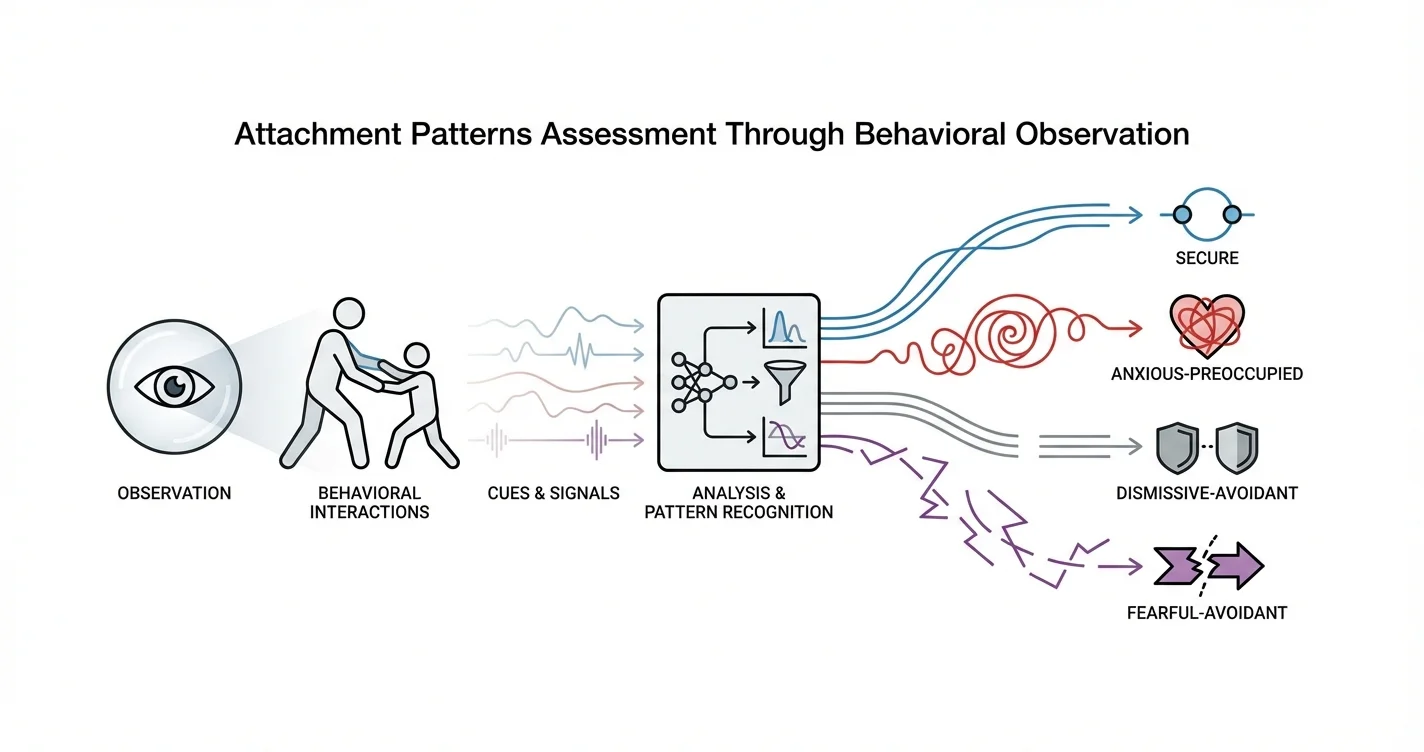
The four primary attachment styles—secure, anxious-preoccupied, dismissive-avoidant, and fearful-avoidant—each produce distinct behavioral signatures. Secure attachment typically involves comfortable proximity-seeking, effective emotion regulation, and balanced autonomy. Anxious-preoccupied patterns often show as heightened vigilance to relationship threats, frequent reassurance-seeking, and difficulty with separation. Dismissive-avoidant attachment may present as emotional distance, discomfort with vulnerability, and excessive self-reliance. Fearful-avoidant patterns combine approach and avoidance behaviors, creating inconsistent relational patterns.
Clinical research indicates that these patterns remain relatively stable across the lifespan, though they can shift with significant relational experiences or therapeutic intervention. Understanding this stability helps observers recognize consistent patterns rather than isolated incidents.
Key Behavioral Observation Methods for Attachment Patterns Assessment
Effective attachment patterns assessment through behavioral observation requires structured approaches that minimize observer bias while capturing meaningful interaction patterns. Several evidence-based methods have emerged from developmental and clinical psychology research.
Structured Observation Contexts
The most reliable behavioral data emerges from observing interactions during emotionally significant moments. Research in attachment assessment has identified several key contexts:
- Separation and reunion scenarios: Observing how individuals respond when separated from attachment figures and how they reconnect reveals core attachment dynamics
- Stress responses: Behavioral patterns during challenging situations show whether people seek support, withdraw, or become dysregulated
- Conflict navigation: How individuals approach disagreements, express needs, and repair ruptures provides insight into attachment security
- Vulnerability expression: Observing comfort levels when sharing feelings, asking for help, or showing weakness illuminates attachment patterns
Specific Behavioral Markers
When conducting attachment patterns assessment, practitioners observe particular behaviors that differentiate attachment styles. Secure attachment typically includes direct communication about needs, comfort with both closeness and independence, and effective self-soothing combined with appropriate support-seeking. Individuals demonstrate consistent emotional availability and can tolerate distress without becoming overwhelmed or completely shut down.
Anxious-preoccupied patterns often manifest as hyperactivation of the attachment system. Observable behaviors may include excessive contact-seeking, difficulty concentrating when relationship concerns arise, heightened emotional reactivity to perceived distance, and challenges with self-soothing. These individuals may demonstrate protest behaviors when separation occurs and show ambivalence during reunions.
Dismissive-avoidant attachment frequently presents as deactivation strategies. Behavioral indicators include minimizing distress expression, maintaining physical and emotional distance during stress, appearing overly self-sufficient, and showing discomfort when others express vulnerability or seek closeness. These patterns reflect early adaptations to environments where emotional needs were consistently unmet or dismissed.
Fearful-avoidant attachment creates mixed behavioral signals. Observers may notice approach-avoidance conflicts, unpredictable responses to closeness, heightened anxiety combined with distancing behaviors, and difficulty establishing consistent relational patterns. This style reflects a desire for connection coupled with fear of the vulnerability it requires.
Systematic Assessment Approaches in Real-World Settings
Translating observational methods into practical assessment requires systematic approaches that work across different contexts. Mental health professionals have developed several frameworks for conducting attachment patterns assessment through behavioral observation in clinical, educational, and everyday settings.
The Contextual Observation Framework
Rather than assessing behavior in isolation, effective observation considers multiple contexts over time. This approach involves tracking behavioral patterns across at least three distinct situations: calm baseline interactions, mild stressors, and significant emotional moments. Consistency across contexts strengthens attachment style identification, while variability may indicate situational factors or mixed attachment patterns.
For example, someone with secure attachment will typically maintain consistent relational behaviors whether discussing pleasant topics, navigating minor disagreements, or addressing significant concerns. In contrast, insecure attachment patterns often show greater variability, with behavioral shifts becoming more pronounced under stress.
Longitudinal Pattern Recognition
Single observations provide limited information. Attachment patterns become clearer when observers track behavioral consistency over weeks or months. This longitudinal approach helps distinguish attachment-based patterns from temporary mood states, situational stress responses, or individual personality traits unrelated to attachment.
Tools like Lovon.app can support this longitudinal observation process by providing consistent conversational opportunities where individuals can explore their relational patterns. Through regular voice-based sessions, patterns in how someone discusses relationships, responds to perceived rejection, or navigates vulnerability become apparent over time. This on-demand accessibility allows pattern recognition across various emotional states and circumstances.
Relational Dynamics Analysis
Since attachment patterns emerge in relationships, observing dyadic interactions provides richer data than monitoring individuals in isolation. Practitioners assess how two people's behaviors influence each other, noting complementary patterns, conflict cycles, and co-regulation abilities.
Research suggests that attachment patterns create predictable interaction sequences. An anxiously-attached person's pursuit often intensifies a dismissively-attached partner's withdrawal, creating a demand-withdraw cycle. Recognizing these patterns requires observing both individuals' behaviors and the sequence in which they occur.
Advanced Considerations in Attachment Patterns Assessment
Skilled behavioral observation for attachment patterns assessment requires awareness of factors that complicate straightforward identification. Multiple influences shape observable behaviors, and sophisticated assessment accounts for this complexity.
Cultural and Contextual Variables
Attachment behaviors exist within cultural contexts that shape what constitutes "normal" proximity-seeking, emotional expression, and independence. Research indicates that while attachment patterns exist across cultures, their behavioral manifestations vary significantly. What appears as avoidant behavior in one cultural context might represent appropriate emotional regulation in another.
Effective observers recognize these contextual influences and avoid imposing culture-specific norms when interpreting behaviors. This requires understanding the individual's background and considering whether observed patterns create distress or dysfunction within their own cultural framework.
Trauma, Neurodevelopmental Differences, and Medical Factors
Behavioral patterns that resemble insecure attachment may actually reflect trauma responses, neurodevelopmental differences like autism spectrum conditions, or medical factors affecting emotional regulation. Distinguishing attachment-based patterns from these other influences requires comprehensive assessment.
For instance, someone with post-traumatic stress may show hypervigilance and difficulty trusting others—behaviors that can resemble anxious or fearful attachment—but stem from specific traumatic experiences rather than early relational patterns. Similarly, individuals with certain neurodevelopmental profiles may show social behaviors that superficially resemble avoidant attachment but reflect different underlying mechanisms.
Earned Security and Attachment Pattern Shifts
Attachment patterns can change through significant relational experiences, therapeutic work, or conscious effort—a phenomenon researchers call "earned security." When conducting attachment patterns assessment, observers may notice behavioral inconsistencies that reflect someone in transition between attachment styles.
These individuals might show insecure attachment patterns in some contexts while demonstrating more secure behaviors in others. Recognizing this possibility prevents oversimplified categorization and acknowledges that attachment represents a dimensional spectrum rather than fixed categories.
Observer Bias and Projection
The observer's own attachment patterns influence what they notice and how they interpret behaviors. Research on assessment accuracy indicates that observers sometimes project their own relational patterns onto those they're observing or misinterpret behaviors through their attachment lens.
Effective behavioral observation requires ongoing self-reflection, awareness of personal biases, and consultation with others when possible. Multiple observers or structured assessment tools can help reduce individual bias. For those seeking to understand their own attachment patterns, working with resources like Lovon.app provides a reflective space where an AI listener can help identify recurring relational themes without the projection risks inherent in human observation.
Integrating Behavioral Observation with Other Assessment Methods
While behavioral observation provides valuable data for attachment patterns assessment, comprehensive understanding typically requires multiple assessment approaches. Combining observation with self-report measures, structured interviews, and narrative analysis creates a more complete picture.
Self-Report and Behavioral Convergence
Comparing what people say about their attachment patterns with how they actually behave reveals important information. Strong convergence between self-report and observed behavior suggests good self-awareness and potentially more secure attachment. Significant discrepancies may indicate limited insight, social desirability responding, or complex attachment patterns.
For example, someone might describe themselves as comfortable with intimacy on questionnaires but consistently demonstrate distancing behaviors when actual vulnerability is required. This discrepancy itself provides meaningful information about attachment functioning.
Narrative Assessment Integration
How people tell stories about relationships—including coherence, emotional integration, and perspective-taking—offers complementary data to behavioral observation. Studies indicate that narrative patterns correlate with attachment behaviors, with secure individuals typically providing coherent, balanced relationship narratives while insecure patterns show characteristic narrative disruptions.
Combining behavioral observation with narrative analysis strengthens assessment accuracy. Someone whose behaviors suggest anxious attachment should typically also show narratives preoccupied with relationship concerns, fear of abandonment, and heightened focus on others' emotional states.
When to Seek Professional Assessment and Support
While informal behavioral observation can enhance relationship understanding, formal attachment patterns assessment requires professional training, particularly when results will inform treatment decisions or when complex trauma histories exist. Licensed mental health professionals specializing in attachment theory can conduct comprehensive assessments using validated measures alongside behavioral observation.
Professional assessment becomes especially important when:
- Attachment patterns significantly impair relationship functioning or life satisfaction
- Trauma history complicates attachment pattern identification
- Formal diagnosis would inform treatment planning
- Legal or custody decisions depend on attachment assessment
- Behavioral patterns suggest disorganized attachment, which requires specialized intervention
For individuals seeking to understand their own patterns outside formal assessment contexts, tools providing structured reflection opportunities can help. Lovon.app offers accessible conversations where you can explore relationship patterns, process attachment-related concerns, and gain insight into recurring behavioral themes through regular voice-based sessions.
Conclusion
Attachment patterns assessment through behavioral observation provides invaluable insight into how early relational experiences continue shaping adult relationships. By systematically observing behaviors across contexts—particularly during separation, stress, conflict, and vulnerable moments—you can identify the attachment patterns that influence relationship dynamics. The most effective assessment combines multiple observation contexts over time, accounts for cultural and individual differences, acknowledges complexity beyond simple categorization, and integrates behavioral data with other assessment methods. Whether you're a professional conducting formal assessments or someone seeking to understand your own relational patterns, developing observational skills enhances relationship awareness and creates opportunities for positive change. If you recognize insecure patterns causing distress, remember that attachment styles can shift through therapeutic work, secure relationships, and conscious effort—offering hope for developing more satisfying connections.
Disclaimer: This is general information, not medical advice or diagnosis. If symptoms are severe, affecting your daily life, or you're having thoughts of self-harm — seek professional help. In the US: call or text 988 (Suicide & Crisis Lifeline). For immediate danger: 911 or local emergency services.
How AI Support Helps You Heal
AI emotional support isn't about replacing human connection — it's about filling the gaps. The moments when you need to talk at 2 AM, when you don't want to burden your friends again, or when you simply need someone to listen without judgment.
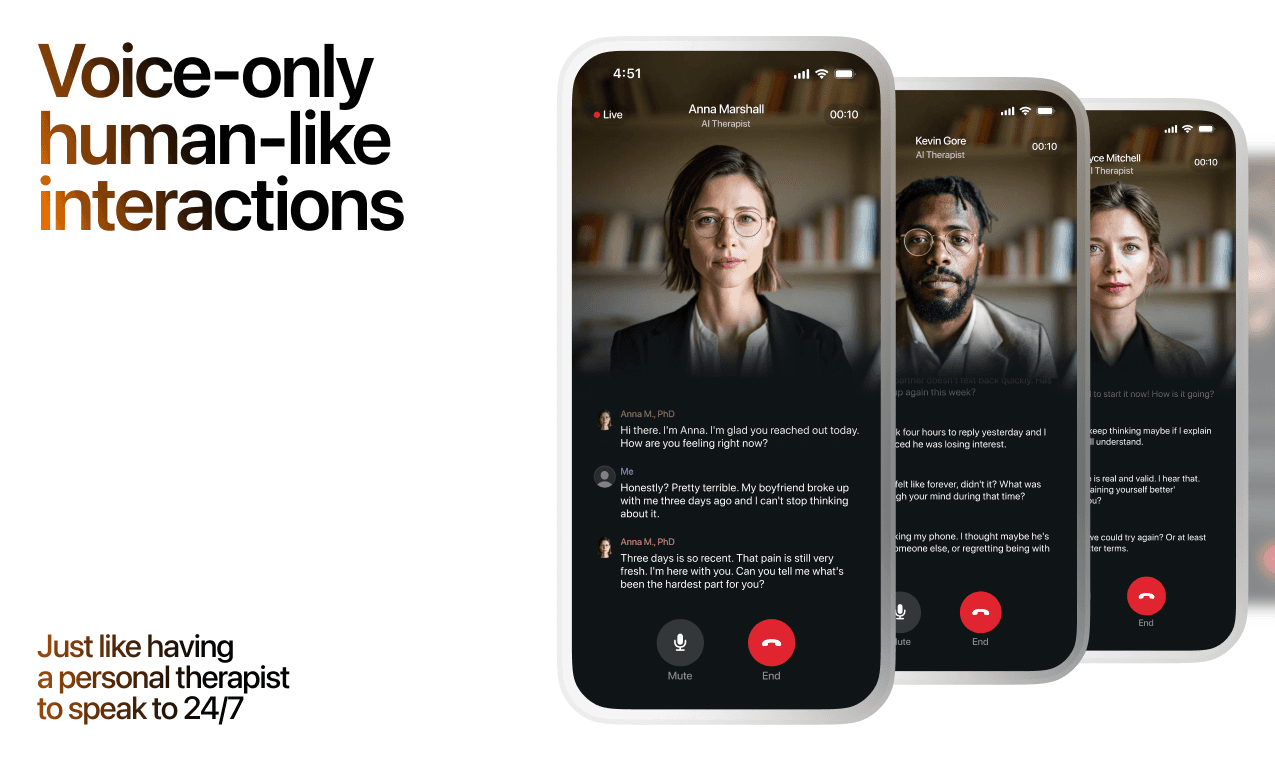
Here's what happens in a typical Lovon session:
You share what's on your mind
There's no script, no intake form, no waiting room. You speak or type whatever you're feeling — in your own words, at your own pace.
Lovon validates and explores
Using frameworks from CBT (Cognitive Behavioral Therapy) and motivational interviewing, Lovon acknowledges your feelings first, then gently helps you explore them. No dismissive "just move on" advice.
You build coping skills together
Lovon doesn't just listen — it actively works with you on evidence-based techniques: thought reframing, urge surfing, behavioral experiments, and more.
What a Session with Lovon Looks Like
When to Seek Professional Help
AI support is a valuable tool, but it's not a replacement for professional care. Please consider reaching out to a licensed therapist if you experience any of the following:
- Persistent thoughts of self-harm or suicide
- Inability to perform daily activities (work, eating, sleeping) for more than 2 weeks
- Turning to alcohol or substances to cope
- Intense anger or desire to harm your ex-partner
- Complete emotional numbness that doesn't improve over time
Crisis Resources (US): If you're in immediate danger, call 988 (Suicide & Crisis Lifeline) or text HOME to 741741 (Crisis Text Line). Available 24/7, free, and confidential.
Outside the US? Find a crisis line in your country
Ready to Start?
Your healing journey can begin right now
A 7-day trial. No judgment. Just a safe space to process what you're going through.
Frequently Asked Questions
Is Lovon a replacement for a real therapist?
Is my conversation with Lovon AI private?
How is Lovon different from ChatGPT for emotional support?
Can I use Lovon if I'm already seeing a therapist?
Can I try Lovon before subscribing?
About the Author
The Lovon Editorial Team
Mental Health & Wellness Content Team
The Lovon Editorial Team develops mental health and wellness content designed to make psychological concepts accessible and actionable. Our goal is to bridge the gap between clinical research and everyday life - helping you understand why your mind works the way it does and what you can do about it....
Related articles
- Secure Attachment in Relationships: What It Looks Like (2026)
See exactly what secure attachment in relationships looks like in 2026 — 6 real signs, common misreads, and how to build…
- BPD Treatment Specialization: Four Parent Types Affecting Emotional Regulation
For individuals with borderline personality disorder (BPD), emotional regulation difficulties rarely emerge in…
- Feedback in Relationship Therapy When Avoidant Partners Fear Failure
When avoidant partners enter relationship therapy, feedback often becomes a minefield. What therapists intend as…
- Understanding Anxious Attachment Patterns in Relationships
If you find yourself constantly checking your phone for messages, worrying whether your partner still cares, or feeling…
See also
Quizzes
- Relationship Schema Test: Are Your Feelings Welcome?
See which belief edits what you share, in 3 minutes.
- Am I Sabotaging My Relationship? 12-Question Quiz
Find the move you reach for, in 2 minutes.
Free tools
- Love Paragraphs for Her or Him, Built From Your Own Story
Love paragraphs for her or him, written from your own story rather than copied from a list. Tell it how they make you…
- Would You Rather Questions for Couples
A round built for your pair rather than for a general audience. Tell it how long you two have been together, where you…
From the wiki
- What does clingy mean in a relationship?
Clingy is what people call behavior that asks for more contact or reassurance than the other person wants to give…
Disclaimer: This article is for informational purposes only and does not constitute medical advice, diagnosis, or treatment. Always seek the advice of your physician or other qualified health provider with any questions you may have regarding a medical condition. If you are in crisis or think you may have an emergency, call 988 (Suicide & Crisis Lifeline) or go to the nearest emergency room. Outside the US? Find a crisis line in your country.