
BPD Attachment Patterns: Giving Everything to Prevent Abandonment
When your entire sense of self revolves around giving everything you have to keep people from leaving, you're experiencing one of the most challenging aspects

Key Takeaways
- Preemptive sacrifice: Offering help, resources, time, or emotional labor before anyone asks, anticipating needs to
- Identity fusion with utility: Measuring self-worth exclusively through what you provide to others, feeling worthless
- Exhaustive availability: Being constantly accessible, dropping everything immediately, and experiencing intense
- Self-negation: Systematically minimizing or dismissing your own needs, preferences, and boundaries to avoid any
- When the urge to give is driven by genuine care versus fear of abandonment
Introduction
When your entire sense of self revolves around giving everything you have to keep people from leaving, you're experiencing one of the most challenging aspects of borderline personality disorder attachment patterns. This isn't occasional people-pleasing or the occasional sacrifice made in healthy relationships—it's a core identity structure built on the belief that your value exists only in what you provide to others. For many individuals with BPD, preventing abandonment through constant giving becomes not just a behavior, but who they fundamentally believe they are.
This pattern reflects a deeply ingrained attachment style where self-worth is inseparable from usefulness, availability, and sacrifice. Research from the field of personality disorders indicates that these attachment patterns often develop as adaptive responses to early relational environments, though genetic factors and individual temperament also contribute to how these patterns form. Understanding this connection between BPD, attachment behavior, and identity formation can help you recognize these patterns in yourself and begin the challenging work of building a sense of self that doesn't depend on constant giving.
The Core Pattern: When Giving Becomes Your Identity
In borderline personality disorder attachment patterns, over-giving isn't merely a strategy—it becomes the foundation of identity itself. Clinical observations suggest that individuals with BPD often operate from what practitioners describe as an "if I give everything, you won't leave" framework. This isn't a conscious negotiation or manipulation; it's a deeply held belief about how relationships function and where personal value originates.
This pattern manifests in several distinctive ways:
- Preemptive sacrifice: Offering help, resources, time, or emotional labor before anyone asks, anticipating needs to prove indispensability
- Identity fusion with utility: Measuring self-worth exclusively through what you provide to others, feeling worthless when you're not actively giving
- Exhaustive availability: Being constantly accessible, dropping everything immediately, and experiencing intense anxiety when unable to respond to others' needs
- Self-negation: Systematically minimizing or dismissing your own needs, preferences, and boundaries to avoid any possibility of being "too much"
Research on attachment styles in personality disorders suggests that this pattern typically develops when early caregiving relationships were inconsistent, conditional, or required the child to manage adult emotional needs. However, it's important to note that while early experiences play a significant role, genetic predispositions and individual temperament also contribute to how these patterns develop.
The critical distinction here is that in BPD attachment patterns, giving isn't simply a behavior you can modify—it's intertwined with your fundamental sense of who you are. This makes change particularly challenging because reducing over-giving can feel like erasing yourself entirely.
How Abandonment Prevention Shapes Self-Identity
The fear of abandonment in borderline personality disorder isn't simply anxiety about being alone—it's often experienced as a threat to existence itself. When this fear becomes the organizing principle of your personality, your entire identity structure arranges itself around preventing that outcome. Stopping abandonment through constant giving becomes the central organizing theme of your self-concept.
This identity formation process typically includes several interconnected elements:
Conditional Self-Worth: You may genuinely believe you have no inherent value apart from what you provide. Your right to exist in relationships feels entirely dependent on your utility. When you're not actively giving, helping, or meeting someone's needs, you may experience a profound sense of emptiness or nonexistence.
Hypervigilance to Relational Shifts: Your attention constantly scans for signs of withdrawal, disappointment, or distance in others. This isn't paranoia—it's a deeply ingrained survival mechanism that developed when relational security was genuinely unpredictable. Your identity as "the one who gives to prevent leaving" requires constant assessment of whether you're giving enough.
Self-Abandonment as Prevention: Paradoxically, you may abandon your own needs, preferences, and boundaries as a strategy to prevent others from abandoning you. Your sense of self becomes organized around the absence of self—you are defined by what you're willing to sacrifice, not by what you value or desire.
According to practitioners specializing in personality disorders, this pattern is fundamentally different from secure attachment, where individuals maintain their sense of self while also being responsive to others' needs. In secure relationships, you don't need to shrink your needs or erase yourself to maintain connection. But when your identity is built on giving everything to avoid abandonment, asking for anything feels dangerous.
The Relationship Between BPD and Attachment Behavior
Borderline personality disorder attachment styles create a specific relational dynamic where your behavior patterns and internal experience both revolve around abandonment prevention. Understanding this connection helps clarify why simply deciding to "stop over-giving" isn't effective—the behavior is expressing a deeply held identity structure, not just a bad habit.
The Cycle of Over-Giving and Identity Reinforcement
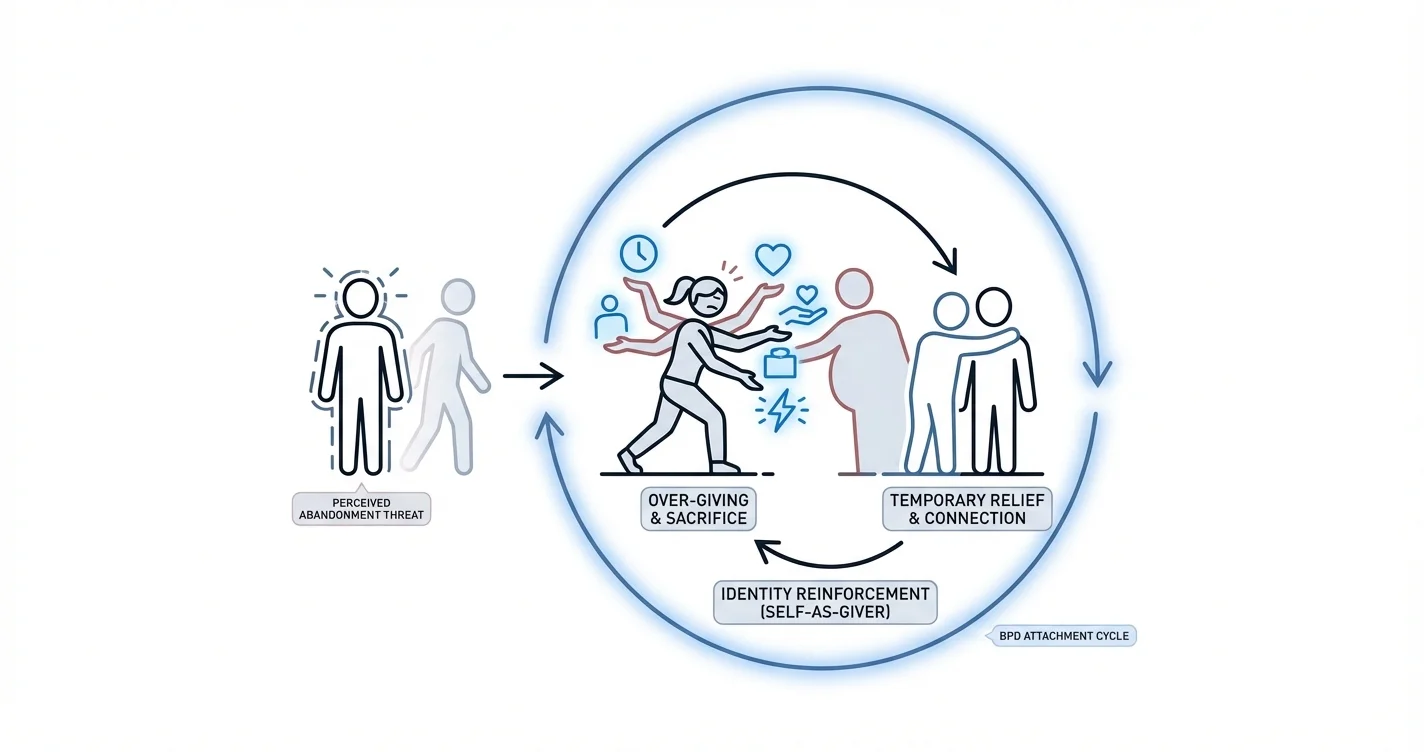
When giving to prevent abandonment is central to your self-identity, a self-perpetuating cycle typically develops:
- Perceived threat: You notice (or imagine) a sign that someone might be pulling away or losing interest
- Identity activation: Your core self-concept ("I am someone who gives everything to prevent abandonment") immediately activates
- Compulsive giving: You offer help, attention, resources, emotional labor—often more than was requested or appropriate
- Temporary relief: The person responds positively (or simply doesn't leave immediately), which temporarily reduces your anxiety
- Identity reinforcement: The "success" of your giving confirms your belief that this is what keeps people around, strengthening the pattern
This cycle makes the pattern increasingly rigid over time. Each instance where giving appears to prevent abandonment reinforces your identity as "the giver," making it harder to imagine existing any other way.
Distinguishing BPD Attachment from Other Patterns
While other attachment styles involve challenges with closeness and autonomy, BPD attachment patterns have distinctive characteristics. Research on attachment in personality disorders suggests several key differences:
Unlike avoidant attachment (which is rooted in fear of dependence and losing autonomy), BPD attachment involves intense fear of abandonment combined with difficulty maintaining a stable sense of self separate from relationships. Avoidant individuals may initially pursue connection but pull away when closeness increases, often minimizing needs and shutting down when asked for emotional presence. In contrast, individuals with BPD attachment patterns typically pursue closeness intensely while simultaneously fearing it will inevitably lead to abandonment.
Unlike anxious attachment (which involves preoccupation with relationship security), BPD attachment includes identity diffusion—your sense of who you are fundamentally shifts based on relational context and perceived stability. The giving isn't just about reducing anxiety; it's about maintaining a sense of self that only exists in the context of being needed.
Recognizing When Over-Giving Has Become Your Core Identity
Distinguishing between healthy generosity, anxious attachment behaviors, and the BPD pattern where giving defines your entire identity requires careful self-examination. Several indicators suggest that abandonment prevention through giving has become a core identity component rather than simply a behavioral pattern:
Identity Dissolution Without Giving: When you're not actively providing for someone, you experience profound emptiness, confusion about who you are, or feelings of nonexistence. Your sense of self literally requires the role of giver to feel real.
Inability to Imagine Alternative Value: When you try to consider what makes you valuable apart from what you give, you encounter a genuine blank. You may intellectually understand that people can have inherent worth, but you cannot apply this concept to yourself.
Relationship Role Rigidity: You consistently occupy the same role across different relationships—always the helper, the listener, the one who sacrifices—regardless of whether the other person actually needs or wants this dynamic.
Self-Betrayal as Automatic: You automatically prioritize others' needs, not as a conscious choice but as an involuntary response. Considering your own needs feels foreign, selfish, or genuinely impossible.
Panic When Unable to Give: Situations where you cannot give (due to illness, circumstances, or someone refusing your help) trigger intense anxiety, shame, or identity crisis rather than simply disappointment.
Practitioners who work with BPD attachment patterns note that individuals often describe feeling like they "disappear" or "stop existing" when they're not actively needed. This goes beyond anxiety about relationship security—it reflects a fundamental identity structure organized around preventing abandonment through constant availability and sacrifice.
Practical Approaches for Building Identity Beyond Giving
Shifting from an identity built on giving everything to prevent abandonment to a more stable sense of self is complex, long-term work that typically requires professional support. However, understanding the process and specific approaches can help you begin this challenging journey:
Starting with Awareness and Pattern Recognition
The first step involves developing the capacity to observe the pattern without immediately acting on it. This doesn't mean stopping the behavior right away—that's often impossible and can trigger overwhelming anxiety. Instead, it means beginning to notice:
- When the urge to give is driven by genuine care versus fear of abandonment
- What you feel when you imagine not immediately meeting someone's need
- How your sense of self-worth shifts based on whether you're being "useful"
- The specific moments when your identity feels most dependent on giving
Tools like Lovon.app can provide accessible support for processing these observations, offering on-demand conversations when you're working to understand these patterns between therapy sessions. The ability to talk through what you're noticing as it happens can help you develop awareness without judgment.
Developing Distress Tolerance for "Not Giving"
A crucial skill involves gradually building capacity to tolerate the intense discomfort that arises when you don't immediately give. This isn't about forcing yourself to stop giving—that typically backfires by triggering overwhelming anxiety—but rather slowly expanding your ability to sit with the discomfort.
Some approaches that may help include:
- Delayed response practice: Waiting even a few minutes before responding to a request, gradually increasing the delay
- Need articulation exercises: Identifying and naming one of your own needs daily, even if you don't act on it
- Small-scale boundary experiments: Setting one very small boundary in a relatively safe relationship and observing what happens
These practices are typically most effective when done with professional guidance, as the anxiety they provoke can be intense. Dialectical Behavior Therapy (DBT), originally developed for BPD, includes specific distress tolerance skills designed for this type of work.
Exploring Identity Elements Beyond Utility
Building a sense of self that doesn't depend entirely on giving to prevent abandonment requires gradually identifying other aspects of identity. This process is often more difficult than it sounds when your entire self-concept has been organized around being needed.
Approaches that some people find helpful include:
- Values clarification: Identifying what matters to you independent of others' approval or needs
- Preference exploration: Noticing small preferences (food, environment, activities) without immediately deferring to others
- Interest cultivation: Engaging with activities purely for personal interest, not to share with or offer to others
- Self-descriptors exercise: Listing ways to describe yourself that don't reference your relationships or what you provide
This exploration often feels artificial or empty initially. That's normal when you're building something fundamentally new. The goal isn't to immediately feel a robust sense of self, but rather to create space where one might gradually develop.
When to Seek Professional Help
While self-awareness and personal efforts are valuable, BPD attachment patterns where giving to prevent abandonment has become core to identity typically require professional treatment. These patterns developed over years in response to complex relational environments, and shifting them safely usually needs specialized support.
Consider seeking help from a therapist specializing in BPD or attachment issues if you experience:
- Intense fear of abandonment that significantly impacts daily functioning
- Identity confusion or feelings of emptiness that persist even when relationships are stable
- Impulsive or self-damaging behaviors when you fear someone is leaving
- Difficulty maintaining consistent sense of self across different relationships
- Extreme emotional reactions to perceived rejection or criticism
- Patterns of unstable relationships characterized by intense idealization and devaluation
Therapists trained in DBT, mentalization-based therapy (MBT), or transference-focused psychotherapy (TFP) can provide specific interventions for these patterns. These approaches address not just the behaviors but the underlying identity structures and attachment styles that maintain them.
Resources like Lovon.app may serve as supplementary support for processing emotions and recognizing patterns between therapy sessions, but they complement rather than replace professional treatment for borderline personality disorder.
Understanding the Path Forward
Recognizing that your identity has been built around giving everything to prevent abandonment is both painful and potentially transformative. This awareness doesn't immediately change the pattern—identity structures developed over years don't shift quickly—but it creates the possibility of something different.
The work ahead involves simultaneously two seemingly contradictory tasks: developing compassion for why you developed this pattern (it likely helped you survive genuinely difficult relational circumstances) while also gradually building a sense of self that doesn't depend entirely on preventing abandonment through sacrifice. While early experiences play a significant role in these patterns, genetic factors and individual temperament also contribute, meaning there's no single cause to blame or fix.
This process rarely follows a linear path. You'll likely move between periods of increased self-awareness and times when the old pattern reasserts itself completely. That's normal and expected, not evidence of failure. Building a new identity foundation while the old one is still operating is inherently unstable work.
Understanding BPD attachment patterns where preventing abandonment through excessive giving becomes your core identity is the essential first step toward change. With appropriate support—professional therapy, potentially supplemented with accessible tools for processing insights as they emerge—it's possible to gradually develop a sense of self that exists beyond what you give. You can learn that your value isn't conditional on your utility, though truly believing this will likely take time, patience, and specialized support.
Disclaimer: This is general information, not medical advice or diagnosis. If symptoms are severe, affecting your daily life, or you're having thoughts of self-harm—seek professional help. In the US: call or text 988 (Suicide & Crisis Lifeline). For immediate danger: 911 or local emergency services.
How AI Support Helps You Heal
AI emotional support isn't about replacing human connection — it's about filling the gaps. The moments when you need to talk at 2 AM, when you don't want to burden your friends again, or when you simply need someone to listen without judgment.
Here's what happens in a typical Lovon session:
You share what's on your mind
There's no script, no intake form, no waiting room. You speak or type whatever you're feeling — in your own words, at your own pace.
Lovon validates and explores
Using frameworks from CBT (Cognitive Behavioral Therapy) and motivational interviewing, Lovon acknowledges your feelings first, then gently helps you explore them. No dismissive "just move on" advice.
You build coping skills together
Lovon doesn't just listen — it actively works with you on evidence-based techniques: thought reframing, urge surfing, behavioral experiments, and more.
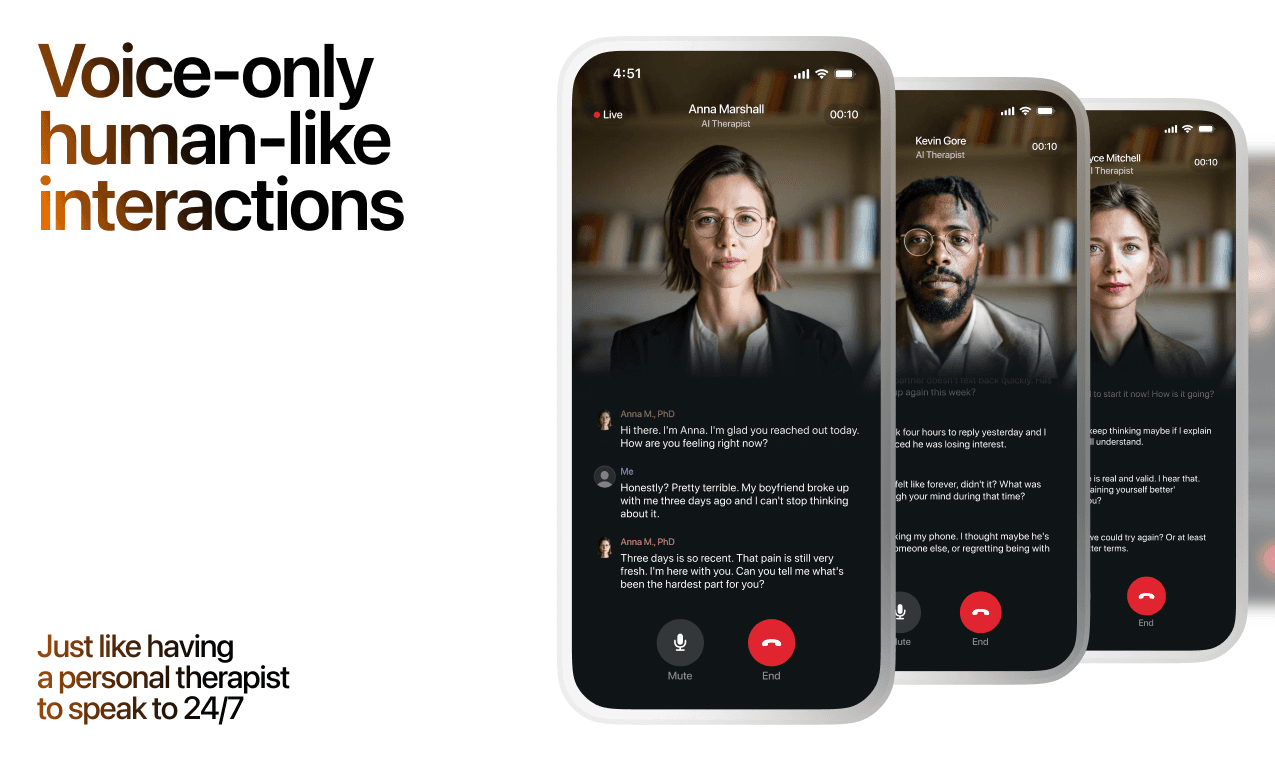
What a Session with Lovon Looks Like
When to Seek Professional Help
AI support is a valuable tool, but it's not a replacement for professional care. Please consider reaching out to a licensed therapist if you experience any of the following:
- Persistent thoughts of self-harm or suicide
- Inability to perform daily activities (work, eating, sleeping) for more than 2 weeks
- Turning to alcohol or substances to cope
- Intense anger or desire to harm your ex-partner
- Complete emotional numbness that doesn't improve over time
Crisis Resources (US): If you're in immediate danger, call 988 (Suicide & Crisis Lifeline) or text HOME to 741741 (Crisis Text Line). Available 24/7, free, and confidential.
Outside the US? Find a crisis line in your country
Ready to Start?
Your healing journey can begin right now
A 7-day trial. No judgment. Just a safe space to process what you're going through.
Frequently Asked Questions
Is Lovon a replacement for a real therapist?
Is my conversation with Lovon AI private?
How is Lovon different from ChatGPT for emotional support?
Can I use Lovon if I'm already seeing a therapist?
Can I try Lovon before subscribing?
About the Author
The Lovon Editorial Team
Mental Health & Wellness Content Team
The Lovon Editorial Team develops mental health and wellness content designed to make psychological concepts accessible and actionable. Our goal is to bridge the gap between clinical research and everyday life - helping you understand why your mind works the way it does and what you can do about it....
Related articles
- Attachment Styles and Avoidant Attachment Rooted in Fear of Dependence
Avoidant attachment is often misunderstood as emotional coldness or an inability to care about others. In reality, this…
- Anxious Attachment Healing Through Grief Work
Anxious attachment doesn't develop in a vacuum. Beneath the hypervigilance, the need for constant reassurance, and the…
- Pulling Away When They Get Close: 7 Steps to Stay Present
Closeness can trigger the urge to withdraw. Learn what sets off avoidant attachment, what to do in the moment, and how…
- Anxious Attachment Style: Signs & Coping Steps (2026)
Anxious attachment style affects ~20% of adults. Learn the exact signs, 6 coping steps, and daily tools that create…
See also
Quizzes
- Do I Have Abandonment Issues? 12-Question Self-Check
See how loudly the fear of being left runs things.
- Relationship Schema Test: Are Your Feelings Welcome?
See which belief edits what you share, in 3 minutes.
Free tools
- What Leaving Would Actually Take
Four short lists: money, a place, the shared things, and people. Mark each item sorted or not. You get the itemized…
- How to Ask for Space Without Ending It
A chat for when you need distance but not a breakup. Say the sentence you keep rehearsing and what you are afraid they…
From the wiki
- What does clingy mean in a relationship?
Clingy is what people call behavior that asks for more contact or reassurance than the other person wants to give…
Disclaimer: This article is for informational purposes only and does not constitute medical advice, diagnosis, or treatment. Always seek the advice of your physician or other qualified health provider with any questions you may have regarding a medical condition. If you are in crisis or think you may have an emergency, call 988 (Suicide & Crisis Lifeline) or go to the nearest emergency room. Outside the US? Find a crisis line in your country.