
ADHD Core Belief Patterns and the Persistent Inadequacy Narrative
For many adults living with ADHD, the phrase "I'm not good enough" isn't just occasional self-doubt—it's a persistent undercurrent that colors their

Key Takeaways
- Inadequacy beliefs significantly impair functioning in important life areas (avoiding relationships, not pursuing
- These beliefs persist despite developing effective ADHD management strategies
- You experience frequent or intense feelings of shame, hopelessness, or worthlessness
- Inadequacy beliefs are accompanied by depression, severe anxiety, or thoughts of self-harm
- Past experiences of trauma or invalidation require specialized processing
Introduction
For many adults living with ADHD, the phrase "I'm not good enough" isn't just occasional self-doubt—it's a persistent undercurrent that colors their experiences across multiple life domains. These ADHD core belief patterns often emerge as deeply ingrained narratives that influence how individuals perceive themselves as parents, partners, students, and professionals. Research suggests that the executive function challenges inherent to ADHD create repeated experiences of falling short of expectations, which over time can crystallize into core beliefs of inadequacy. Understanding how these belief systems develop and persist is essential for breaking the cycle of chronic self-criticism that affects relationships, academic performance, and parenting confidence. This article examines the psychological mechanisms behind these patterns and explores evidence-based approaches to addressing them.
How ADHD Creates Core Belief Patterns Around Inadequacy
Core beliefs are fundamental assumptions we hold about ourselves, others, and the world. In ADHD, these beliefs frequently center on themes of inadequacy, incompetence, or defectiveness. Clinical research indicates that individuals with ADHD experience significantly higher rates of negative core beliefs compared to neurotypical populations, particularly beliefs related to personal failure and social inadequacy.
The formation of these ADHD core belief patterns typically begins in childhood. Children with undiagnosed or misunderstood ADHD often receive consistent feedback that they're "not trying hard enough," "too careless," or "unmotivated." When a child with working memory difficulties repeatedly forgets homework assignments despite genuine effort, or when impulsivity leads to social missteps that damage friendships, these experiences accumulate. The child's developing brain begins to construct explanations: "Something is wrong with me" rather than "My brain processes information differently."
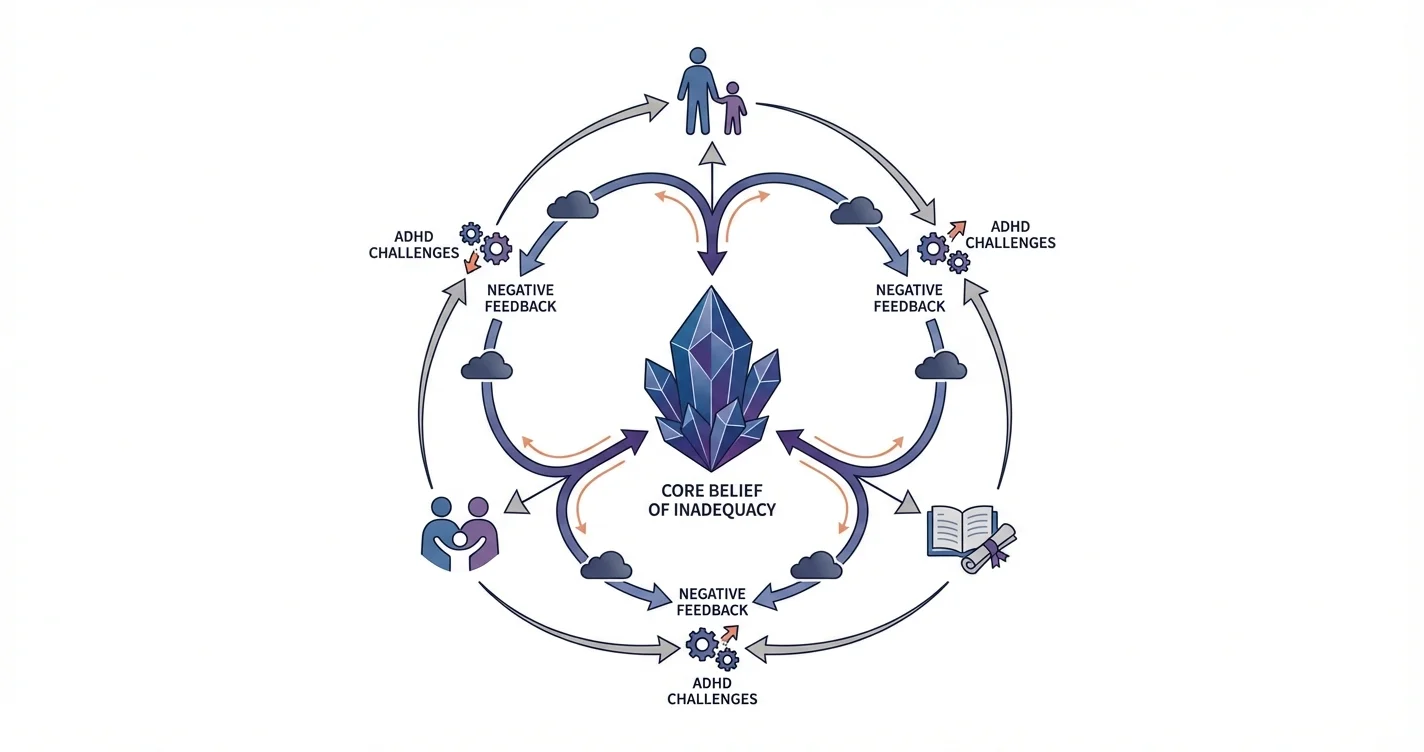
What makes these beliefs particularly resistant to change is their self-reinforcing nature. A person who believes they're fundamentally inadequate may approach new challenges with heightened anxiety, which impairs executive function performance further. This creates a cycle where the belief generates behaviors that seem to confirm the belief's validity. Studies suggest that this pattern can persist even when individuals develop effective coping strategies, because the emotional memory of repeated "failures" remains powerful.
The neurobiological aspects of ADHD contribute directly to experiences that feed inadequacy beliefs. Dopamine regulation differences affect motivation and reward processing, making it genuinely harder to initiate and sustain effort on tasks that don't provide immediate interest or novelty. When someone with ADHD struggles to maintain focus during important conversations or cannot seem to follow through on commitments they genuinely intended to keep, the gap between intention and execution becomes painful evidence that something is "wrong" with them.
The Inadequacy Narrative in Parenting With ADHD
Parenting demands sustained attention, emotional regulation, organizational skills, and the ability to shift flexibly between tasks—precisely the executive functions that ADHD affects most significantly. For parents with ADHD, the persistent not good enough thoughts often center on specific parenting failures: forgetting permission slips, losing patience too quickly, struggling to maintain consistent routines, or feeling overwhelmed by the organizational demands of managing a household.
The cultural idealization of the patient, organized, fully present parent creates an impossible standard against which many ADHD parents measure themselves. When a parent with time blindness consistently runs late for school pickup, or when emotional dysregulation leads to reactive responses they later regret, each incident becomes evidence supporting the core belief: "I'm failing my children."
Research on parenting stress indicates that parents with ADHD experience significantly higher levels of parenting-related stress and self-doubt compared to neurotypical parents, even when objective measures of parenting quality show minimal differences. This suggests that the internal narrative of inadequacy may be more punishing than the actual parenting challenges themselves.
Many parents with ADHD describe a particular form of grief—watching their children develop organizational or emotional regulation difficulties and wondering if they've passed on not just genetic predispositions, but also modeled ineffective behaviors. This layered guilt compounds the inadequacy belief: "I'm not just failing as a parent; I've damaged my child's future."
What complicates this further is that ADHD parents often have genuine strengths that don't fit conventional parenting narratives. They may bring creativity, spontaneity, empathy for children's struggles, and an ability to engage with children's interests intensely. However, when someone holds a core belief of inadequacy, these strengths become invisible or discounted, while every forgotten appointment or moment of impatience is catalogued as proof of fundamental failure.
Academic Settings and ADHD-Related Inadequacy Beliefs
The academic environment is particularly fertile ground for developing ADHD core belief patterns of inadequacy. Educational systems typically reward sustained attention, organization, timely completion of multi-step assignments, and the ability to demonstrate learning through specific formats—all areas where ADHD creates significant challenges.
Students with ADHD often experience a painful disconnect between their actual intellectual capabilities and their academic performance. A student might understand complex concepts quickly but struggle to complete assignments that require sustained effort over time. They might contribute insightful comments in discussion but perform poorly on standardized tests that demand sustained focus. This pattern creates confusion and frustration: "If I'm smart enough to understand this, why can't I just do it?"
Educational research suggests that students with ADHD are significantly more likely to internalize academic difficulties as personal deficiencies rather than recognizing them as symptoms of a neurological difference in executive function. A neurotypical student who struggles with mathematics might think, "I'm not good at math." A student with ADHD who struggles to complete any long-term project on time is more likely to conclude, "I'm lazy and undisciplined"—a character judgment rather than a skill assessment.
The repeated experience of understanding material but failing to demonstrate that understanding through conventional assessment methods erodes academic self-confidence. Over time, many people with ADHD develop academic anxiety that persists long after formal education ends. Adults decades removed from school describe feeling physically anxious when facing tasks that remind them of academic demands, as the core belief "I can't finish what I start" or "I'll inevitably disappoint people" gets triggered.
For students pursuing higher education or professional development, these ADHD-related core belief systems around being inadequate in academic contexts can become significant barriers. The belief "I'm not smart enough" may prevent someone from applying for positions they're qualified for, or the belief "I'll fail anyway" may lead to self-sabotage through procrastination, which then confirms the feared outcome.
Inadequacy Narratives in Relationships and Social Connections
Interpersonal relationships require consistent attention, emotional regulation, active listening, and reliable follow-through—areas where ADHD symptoms frequently interfere. The chronic feelings of inadequacy with ADHD in relationship contexts often develop from accumulated experiences of social missteps: interrupting conversations, forgetting important dates, missing social cues, or saying impulsive things that hurt others.
Many adults with ADHD describe a pattern of initial relationship enthusiasm followed by gradual awareness that they're "too much" or "not enough" for their partners. The ADHD tendency toward hyperfocus during the novelty phase of relationships can create initial intensity that's unsustainable once the relationship becomes more routine. When that intensity naturally moderates, both partners may experience disappointment—the neurotypical partner feeling abandoned, the ADHD partner feeling like they've failed again.
Studies on ADHD and romantic relationships indicate higher rates of relationship dissatisfaction and conflict, particularly around issues of perceived inattention, forgotten commitments, and emotional reactivity. For the person with ADHD, each conflict can reinforce the core belief: "I'm too difficult to love" or "I destroy good things."
The social challenges extend beyond romantic partnerships. Friendships require remembering to reach out, following through on plans, and demonstrating reciprocal interest—all areas where ADHD symptoms interfere. Many people with ADHD describe painful patterns of friendships fading because they forget to respond to messages or repeatedly cancel plans due to overwhelm. The core belief becomes: "I'm a bad friend" rather than "I need better external systems for maintaining connections."
Emotional dysregulation adds another layer to relationship inadequacy beliefs. When someone with ADHD experiences rapid emotional shifts or intense reactions that seem disproportionate to situations, they often feel ashamed of their emotional responses. Partners, family members, or friends may describe them as "overreacting" or "too sensitive," which reinforces the belief that their emotional experience is fundamentally wrong or excessive.
Tools like Lovon.app can provide on-demand support for processing relationship conflicts and identifying these recurring patterns without the scheduling constraints of traditional therapy. Having access to immediate reflection when emotions are heightened helps some people with ADHD catch and examine inadequacy thoughts before they solidify into entrenched beliefs.
The Intersection of Multiple Inadequacy Narratives
The ADHD and constant inadequacy beliefs affecting parenting, academics, and personal relationships don't exist in isolation—they interact and amplify each other. A parent struggling to manage household organization while also working may experience intensified inadequacy beliefs when their child brings home poor grades. The thought pattern becomes: "I'm failing at work because I can't focus, failing as a parent because I can't help my child succeed, and failing my partner because I'm always overwhelmed."
This intersection creates what some researchers describe as a "global inadequacy narrative"—a pervasive sense that one is fundamentally insufficient across all important life domains. When inadequacy beliefs span multiple contexts, they become more resistant to change because positive experiences in one area don't transfer to update beliefs in other areas. A person might receive recognition at work but still maintain unchanged beliefs about being an inadequate parent or partner.
The emotional weight of carrying multiple inadequacy narratives simultaneously contributes to the significantly higher rates of anxiety and depression observed in ADHD populations. When someone believes they're failing in the areas most central to identity and values—being a good parent, partner, friend, student, or professional—the resulting shame and hopelessness can be profound.
Many people with ADHD describe a exhausting internal experience of constant self-monitoring and self-criticism. They're perpetually braced for the next mistake, the next forgotten obligation, the next disappointment they'll cause. This hypervigilance itself impairs executive function performance, creating another self-fulfilling cycle where anxiety about inadequacy makes adequate performance even more difficult.
Recognizing and Challenging ADHD Core Belief Patterns
Changing deeply rooted core beliefs requires first recognizing them, which is more difficult than it might seem. Core beliefs operate largely automatically—they're the lens through which we interpret experiences, not conclusions we consciously reach. Someone with an inadequacy core belief will automatically interpret neutral or even positive events through that filter. A neutral comment from a supervisor becomes evidence of disappointment; a partner's quietness becomes proof of relationship failure.
Cognitive approaches to addressing these belief patterns typically begin with identifying automatic thoughts—the moment-to-moment interpretations that flow from core beliefs. When someone with ADHD forgets an appointment and immediately thinks "I'm completely irresponsible," that automatic thought can be traced back to a deeper core belief about being fundamentally inadequate or defective.
Once these thoughts become visible, evidence-gathering techniques can help examine their accuracy. This involves looking for experiences that contradict the inadequacy belief, though people with strong negative core beliefs often discount positive evidence through various mental mechanisms: "That success was just luck," "They're just being nice," or "It doesn't count because it wasn't perfect."
Schema therapy approaches recognize that challenging beliefs intellectually often isn't sufficient—these beliefs have emotional roots in accumulated experiences, particularly childhood experiences of repeated correction, criticism, or failure. Some therapeutic approaches focus on processing these formative memories to reduce their emotional charge, which can make the associated beliefs less compelling.
Practical strategies that improve actual functioning also indirectly address inadequacy beliefs by reducing the frequency of ADHD-related difficulties that seem to confirm those beliefs. When someone develops external organizational systems that help them remember appointments and follow through on commitments, they accumulate experiences that contradict the belief "I'm completely unreliable." This experiential evidence can be more persuasive than rational arguments against the belief.
Building Alternative Narratives and Self-Compassion
Replacing inadequacy narratives with more accurate and compassionate self-understanding is a gradual process. It involves developing what researchers call a "neurodiversity-affirming" perspective—recognizing ADHD as a difference in neurological functioning rather than a character defect or moral failure.
This reframing doesn't mean dismissing genuine challenges or avoiding responsibility for behaviors that affect others. Rather, it means attributing difficulties to their actual source. The distinction between "I forgot your birthday because I'm a selfish, terrible partner" and "I forgot your birthday because time perception and prospective memory are executive functions my ADHD significantly impairs" is meaningful. The second statement acknowledges the real impact while opening space for problem-solving rather than shame.
Self-compassion practices specifically adapted for ADHD can help interrupt the automatic self-criticism that reinforces inadequacy beliefs. This involves recognizing that the challenges of ADHD are genuinely difficult—that struggling with them doesn't indicate weakness or inadequacy. Research on self-compassion interventions suggests they can reduce shame and improve wellbeing, though people with strong inadequacy beliefs often initially resist self-compassion as "making excuses" or "letting myself off the hook."
Connecting with others who share ADHD experiences can provide powerful counter-evidence to inadequacy beliefs. When someone realizes that challenges they attributed to personal failure are nearly universal ADHD experiences, the narrative begins to shift from "Something is uniquely wrong with me" to "My brain works differently, and these are predictable challenges that many people navigate."
Platforms like Lovon.app offer opportunities to verbally process experiences and identify patterns without the scheduling limitations of traditional therapy. For someone working to challenge inadequacy narratives, having accessible support to examine distorted thinking in real-time can supplement other treatment approaches.
When to Seek Professional Help
While self-directed strategies can be valuable, persistent core beliefs of inadequacy often benefit from professional treatment. Consider seeking support from a mental health professional when:
- Inadequacy beliefs significantly impair functioning in important life areas (avoiding relationships, not pursuing career opportunities, struggling with parenting confidence)
- These beliefs persist despite developing effective ADHD management strategies
- You experience frequent or intense feelings of shame, hopelessness, or worthlessness
- Inadequacy beliefs are accompanied by depression, severe anxiety, or thoughts of self-harm
- Past experiences of trauma or invalidation require specialized processing
Therapists who specialize in ADHD and understand how executive function challenges interact with emotional and cognitive patterns can provide targeted support. Therapeutic approaches that combine ADHD psychoeducation, cognitive restructuring, and skills development tend to be most effective for addressing the intersection of ADHD symptoms and inadequacy beliefs.
For some individuals, inadequacy beliefs are severe enough to meet criteria for personality-level patterns or may be complicated by co-occurring conditions like depression or anxiety disorders. These situations typically require comprehensive treatment that addresses both ADHD symptoms and the associated emotional difficulties.
Conclusion
ADHD core belief patterns of inadequacy develop through accumulated experiences of executive function challenges across parenting, academic, and relationship contexts. These persistent "not good enough" narratives aren't character flaws or accurate self-assessments—they're understandable psychological responses to genuinely difficult experiences in a world designed for neurotypical executive function. The feeling not good enough with ADHD in relationships, school, and parenting situations reflects real challenges, but the global inadequacy conclusions drawn from these challenges are cognitive distortions that can be recognized and revised.
Understanding how these belief systems develop is the first step toward changing them. By distinguishing between ADHD-related executive function challenges and personal worth, developing compassionate self-understanding, and building practical supports that reduce difficulties, it becomes possible to construct more accurate and balanced self-narratives. Whether through professional therapy, peer support, accessible resources like Lovon.app, or structured self-reflection, examining and challenging inadequacy beliefs is essential work for reclaiming self-worth across all life domains affected by ADHD.
Disclaimer: This is general information, not medical advice or diagnosis. If symptoms are severe, affecting your daily life, or you're having thoughts of self-harm—seek professional help. In the US: call or text 988 (Suicide & Crisis Lifeline). For immediate danger: 911 or local emergency services.
How AI Support Helps You Heal
AI emotional support isn't about replacing human connection — it's about filling the gaps. The moments when you need to talk at 2 AM, when you don't want to burden your friends again, or when you simply need someone to listen without judgment.
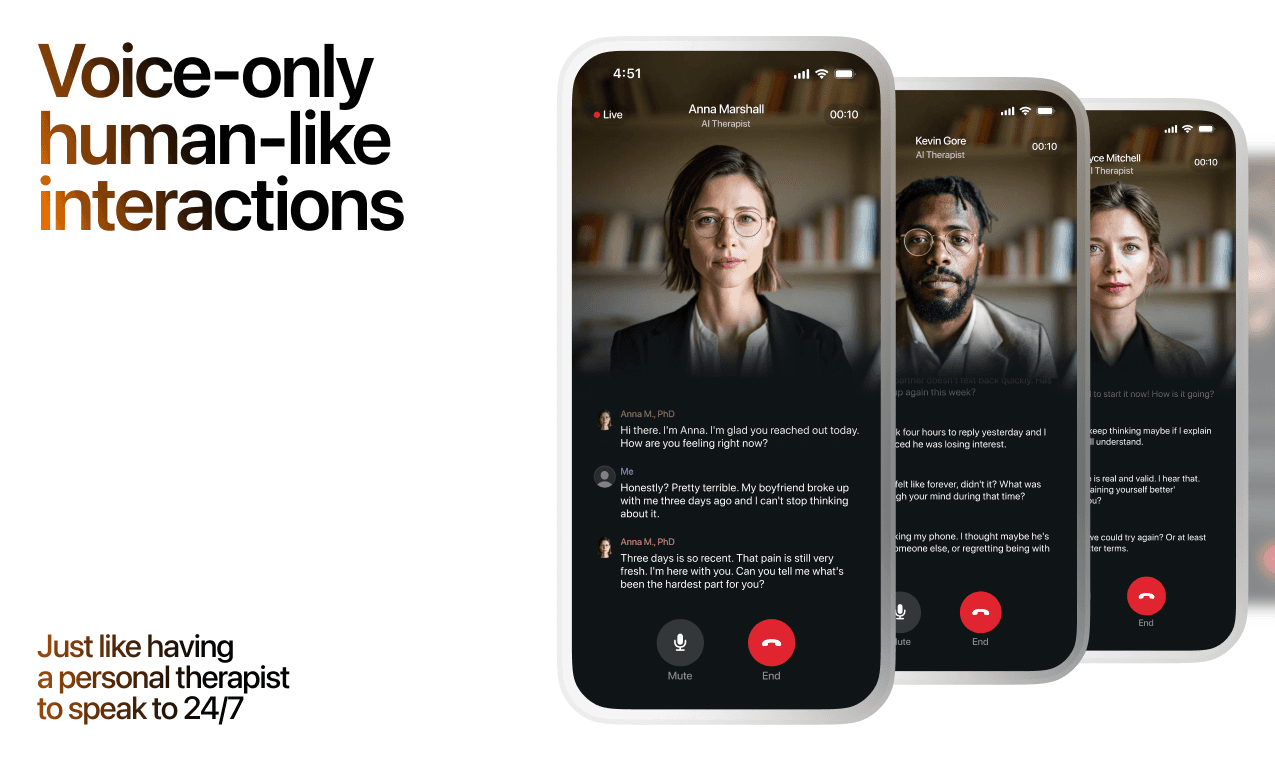
Here's what happens in a typical Lovon session:
You share what's on your mind
There's no script, no intake form, no waiting room. You speak or type whatever you're feeling — in your own words, at your own pace.
Lovon validates and explores
Using frameworks from CBT (Cognitive Behavioral Therapy) and motivational interviewing, Lovon acknowledges your feelings first, then gently helps you explore them. No dismissive "just move on" advice.
You build coping skills together
Lovon doesn't just listen — it actively works with you on evidence-based techniques: thought reframing, urge surfing, behavioral experiments, and more.
What a Session with Lovon Looks Like
When to Seek Professional Help
AI support is a valuable tool, but it's not a replacement for professional care. Please consider reaching out to a licensed therapist if you experience any of the following:
- Persistent thoughts of self-harm or suicide
- Inability to perform daily activities (work, eating, sleeping) for more than 2 weeks
- Turning to alcohol or substances to cope
- Intense anger or desire to harm your ex-partner
- Complete emotional numbness that doesn't improve over time
Crisis Resources (US): If you're in immediate danger, call 988 (Suicide & Crisis Lifeline) or text HOME to 741741 (Crisis Text Line). Available 24/7, free, and confidential.
Outside the US? Find a crisis line in your country
Ready to Start?
Your healing journey can begin right now
A 7-day trial. No judgment. Just a safe space to process what you're going through.
Frequently Asked Questions
Is Lovon a replacement for a real therapist?
Is my conversation with Lovon AI private?
How is Lovon different from ChatGPT for emotional support?
Can I use Lovon if I'm already seeing a therapist?
Can I try Lovon before subscribing?
About the Author

The Lovon Editorial Team
Mental Health & Wellness Content Team
The Lovon Editorial Team develops mental health and wellness content designed to make psychological concepts accessible and actionable. Our goal is to bridge the gap between clinical research and everyday life - helping you understand why your mind works the way it does and what you can do about it....
Related articles
- Acceptance and Commitment Therapy for Trauma Responses
Trauma responses don't always look like flashbacks or nightmares. Sometimes they appear as persistent avoidance…
- PTSD vs CPTSD: Single Trauma vs Repeated Trauma Symptom Differences
Learn how PTSD from a single traumatic event differs from CPTSD shaped by repeated trauma, including symptom patterns…
- Can ADHD be managed without medication?
Can ADHD be managed without medication? Yes, for some adults. Learn which therapy, routines, and supports help, where…
- ADHD and Procrastination: Why It Happens (2026 Guide)
ADHD and procrastination linked to dopamine and task-initiation gaps, not laziness. Get the 2026 step-by-step fix: body…
See also
Quizzes
- Relationship Schema Test: Are Your Feelings Welcome?
See which belief edits what you share, in 3 minutes.
- Confidence Test: Do You Act Before You Feel Ready?
See which part of your confidence is thin.
Free tools
- How to Stop Overthinking in a Relationship
Not a list of habits. Tell it the specific thing you are going round on, and it separates what actually happened from…
- Write a Letter to Your Best Friend
A chat for a letter to your best friend that only they could have received. Tell it how long you have been friends, one…
From the wiki
- What is inhibited grief?
Inhibited grief is grief that never gets out. The loss happened, you kept functioning, and the feeling stayed sealed…
Disclaimer: This article is for informational purposes only and does not constitute medical advice, diagnosis, or treatment. Always seek the advice of your physician or other qualified health provider with any questions you may have regarding a medical condition. If you are in crisis or think you may have an emergency, call 988 (Suicide & Crisis Lifeline) or go to the nearest emergency room. Outside the US? Find a crisis line in your country.