
Inner Child Work for Consistency Issues Through Nervous System Regulation
If you struggle to maintain consistency in your daily routines, relationships, or personal goals, you've likely been told it's a motivation problem. Perhaps

Key Takeaways
- Sustainable capacity rather than forced output: Nervous system regulation builds your actual capacity to engage
- Responsive flexibility instead of rigid adherence: A regulated nervous system allows you to meet different needs on
- Safety-based engagement rather than threat-driven performance: Inner child work helps your system recognize that
- Integration of rest as part of consistency: Nervous system approaches recognize that true consistency includes
- Nervous system need for rest versus protective collapse: Rest from a regulated state feels restorative; collapse
Introduction
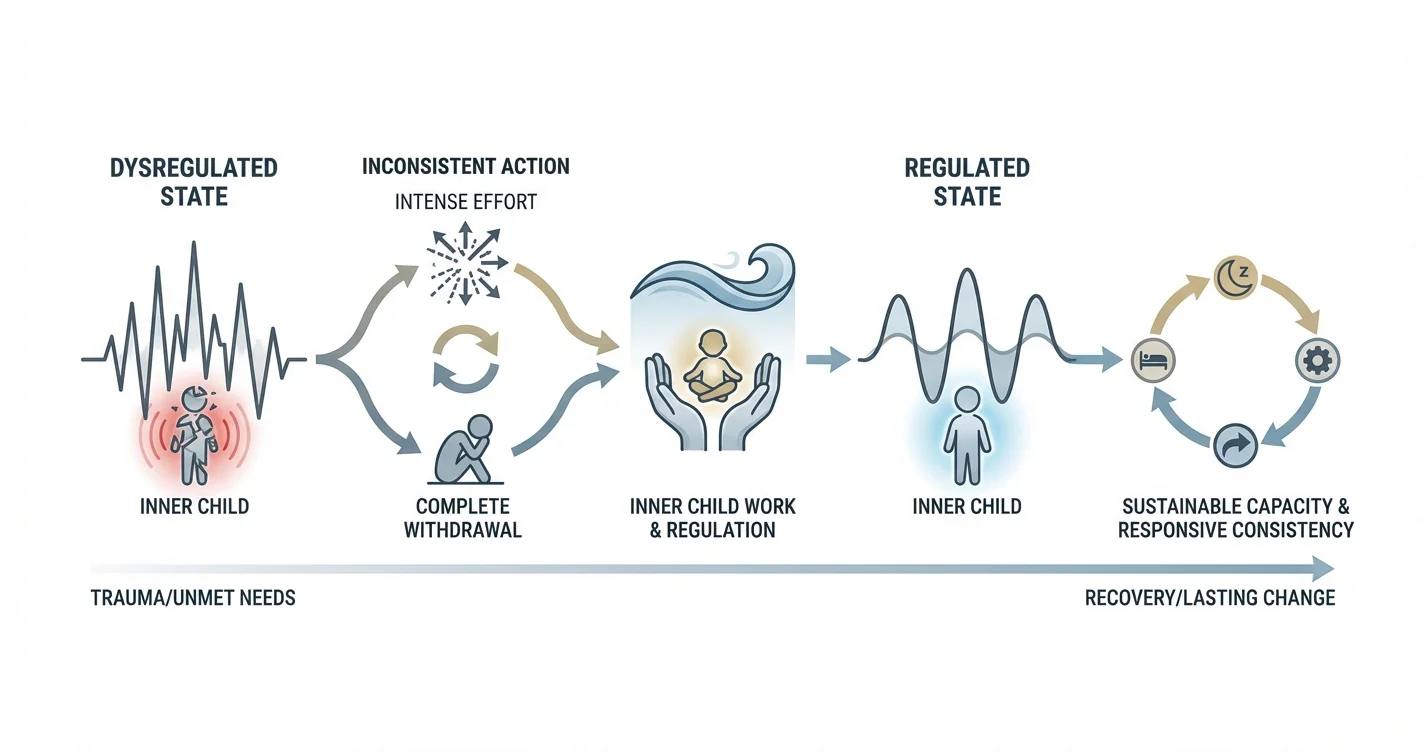
If you struggle to maintain consistency in your daily routines, relationships, or personal goals, you've likely been told it's a motivation problem. Perhaps you've tried countless productivity systems, read motivational books, or set ambitious goals—only to find yourself cycling between intense effort and complete withdrawal. This pattern may have nothing to do with motivation. Instead, consistency issues often stem from nervous system dysregulation rooted in unhealed inner child wounds. When you understand that your nervous system's state determines your capacity for consistent action far more than willpower ever could, you can approach the problem from an entirely different angle. This article explores how inner child work focused on nervous system regulation provides a more effective pathway to genuine consistency than traditional motivation-based approaches.
Understanding the Inner Child and Nervous System Connection
Your inner child represents the emotional residue of early experiences—particularly the unmet needs, unprocessed emotions, and survival strategies you developed in childhood. These patterns don't simply disappear as you age; they become encoded in your nervous system's automatic responses. When practitioners work with clients experiencing consistency problems, they frequently discover that what appears as lack of follow-through is actually a nervous system responding to perceived threats based on childhood programming.
The nervous system operates through several states: a regulated state where you can engage with tasks and relationships effectively, a hyperaroused state where you feel overwhelmed and scattered, and a hypoaroused state characterized by shutdown and collapse. Research in polyvagal theory suggests that our autonomic nervous system constantly scans for safety or danger, influencing our capacity to engage with the world. When early experiences taught your nervous system that certain situations are unsafe—whether showing vulnerability, taking up space, or even resting—your body responds with protective patterns that undermine consistency.
This connection explains why you might start projects enthusiastically only to abandon them suddenly, or why you can maintain routines for weeks before inexplicably stopping. These aren't failures of character or motivation; they're nervous system responses attempting to keep you safe based on outdated childhood data.
Why Nervous System Regulation Matters More Than Motivation
The conventional approach to consistency problems focuses on building motivation: setting inspiring goals, creating accountability systems, or manufacturing urgency through deadlines. While these strategies may produce short-term results, they fundamentally misunderstand the mechanism underlying inconsistency. Motivation exists in your conscious mind, but your nervous system operates largely outside conscious awareness, overriding your best intentions when it perceives threat.
Consider what happens when you decide to establish a morning routine. Your conscious mind recognizes the benefits and feels motivated to begin. However, if your nervous system associates early morning activity with childhood experiences of harsh demands or insufficient rest, it will activate protective responses—making you oversleep, feel inexplicably exhausted, or find urgent distractions. No amount of motivation can override a nervous system in a protective state.
When working with consistency issues through nervous system work instead of motivation, several key differences emerge:
- Sustainable capacity rather than forced output: Nervous system regulation builds your actual capacity to engage consistently, while motivation pushes you beyond your window of tolerance until collapse occurs
- Responsive flexibility instead of rigid adherence: A regulated nervous system allows you to meet different needs on different days, while motivation-based approaches often create all-or-nothing patterns
- Safety-based engagement rather than threat-driven performance: Inner child work helps your system recognize that consistency can be safe, while motivation often relies on fear of consequences
- Integration of rest as part of consistency: Nervous system approaches recognize that true consistency includes responsive rest periods, whereas motivation frameworks often frame rest as failure
Practitioners observe that clients who shift from motivation-focused strategies to nervous system regulation report feeling less exhausted by their efforts and experiencing fewer dramatic cycles between high performance and complete withdrawal.
True Consistency Means Meeting Different Needs Daily
One of the most important reframes in inner child work for consistency issues involves redefining what consistency actually means. The traditional view equates consistency with sameness—doing the same things in the same ways regardless of circumstances. This rigid definition sets up most people for failure because it ignores the reality of changing needs and nervous system states.
From a nervous system perspective, authentic consistency means showing up for yourself in ways that match your current state and genuine needs. Some days your system has the capacity and craving for movement, stimulation, and productivity. Other days your nervous system requires quiet, rest, and minimal demands. Both states can be met with consistent care, but that care looks different depending on what your system needs.
An unhealed inner child often makes rest feel unsafe. If childhood experiences taught you that rest led to criticism, abandonment, or danger, your nervous system will resist stillness. This creates a pattern where you oscillate between pushing yourself into hyperarousal (working compulsively, staying constantly busy) and collapsing into hypoarousal (complete withdrawal, inability to engage with anything). Neither state represents genuine consistency.
When you develop the capacity to read your nervous system's signals and respond with appropriate care—sometimes that means engaging with your goals, sometimes it means genuine rest—you build a more sustainable form of consistency. This approach requires learning to distinguish between:
- Nervous system need for rest versus protective collapse: Rest from a regulated state feels restorative; collapse from dysregulation feels disconnected and shameful
- Authentic lack of capacity versus avoidance patterns: Sometimes you genuinely need less stimulation; other times avoidance maintains dysregulation
- Responsive adjustment versus abandonment: Modifying your approach based on current state differs from abandoning commitments entirely
Tools like Lovon.app can help you develop this discernment by providing on-demand support when you're trying to understand whether what you're experiencing is a genuine nervous system need or a protective pattern that no longer serves you.
Practical Inner Child Work for Nervous System Regulation
Addressing consistency problems through inner child work involves specific practices that help regulate your nervous system while healing the childhood wounds that created dysregulation patterns. These techniques focus on building safety, developing awareness of your nervous system states, and creating new neural pathways that support genuine consistency.
Building Foundational Safety
Your nervous system needs to perceive safety before it can shift from protective patterns to engaged presence. This safety-building happens through several channels:
Somatic awareness practices help you recognize the physical sensations associated with different nervous system states. When you can identify the early signs of dysregulation—perhaps tension in your chest, a scattered feeling in your thoughts, or sudden exhaustion—you can intervene before patterns fully activate. Simple practices like placing your hand on your heart, feeling your feet on the ground, or taking slow breaths signal safety to your nervous system.
Identifying childhood origins allows you to recognize when current inconsistency patterns connect to past experiences. Perhaps you learned that follow-through led to increased demands rather than recognition, teaching your nervous system that consistency creates danger. Or maybe childhood unpredictability made you hypervigilant, leaving you with insufficient energy for sustained effort. Understanding these connections helps you separate past from present.
Creating choice where there was none addresses the reality that children often experience demands without agency. As an adult working with your inner child, you can practice making choices that honor your current state—deciding to rest when genuinely needed, modifying approaches rather than abandoning them entirely, or experimenting with different ways of maintaining connection to your goals.
Regulating Through Relationship
Since nervous system dysregulation and inner child wounds typically develop in relational contexts, healing often requires relational support. This doesn't mean you can only heal through traditional therapy, though working with trauma-informed therapists specializing in nervous system regulation can be valuable.
Relational regulation can also occur through:
- Co-regulation with safe people: Spending time with individuals whose nervous systems are relatively regulated can help your own system find greater stability
- Therapeutic conversations: Services like Lovon.app provide accessible options for processing emotions and patterns as they arise, particularly useful when you're trying to understand why you're suddenly unable to maintain a commitment you value
- Community practices: Group experiences focused on nervous system awareness create opportunities to witness different regulation strategies and feel less isolated in your struggles
Developing Responsive Consistency Practices
Rather than imposing rigid routines, inner child work supports developing flexible frameworks that honor nervous system needs while maintaining connection to what matters. This might include:
Intention-based rather than outcome-based consistency: Maintaining the intention to care for yourself or work toward goals even when the specific actions vary based on your state. Perhaps your writing practice looks like drafting some days and simply sitting with your notebook other days.
Scaling options for different states: Creating versions of important activities that match various capacity levels. Your movement practice might be an intense workout when your system has capacity, gentle stretching when you need something moderate, or simply noticing your body's sensations when you're in a lower-energy state.
Check-in practices: Regular moments throughout your day to assess your nervous system state and make responsive choices. These brief pauses help you catch dysregulation early and adjust your approach before reaching collapse.
When Professional Support Becomes Essential
While inner child work for consistency issues can be practiced independently, certain situations benefit significantly from professional guidance. Trauma-informed therapists, somatic practitioners, and specialists in attachment and nervous system regulation bring expertise that can accelerate healing and provide crucial support during difficult moments.
Consider seeking professional help when:
- Consistency issues significantly impair your functioning: If inconsistency prevents you from maintaining employment, relationships, or basic self-care, professional assessment can identify whether underlying conditions require specific treatment approaches
- You experience significant trauma responses: Flashbacks, severe dissociation, or overwhelming emotional flooding when attempting to work with inner child material indicates you would benefit from professional support to process these experiences safely
- Patterns persist despite sustained self-directed efforts: Sometimes nervous system dysregulation requires therapeutic interventions like EMDR, somatic experiencing, or other specialized modalities that trained practitioners can provide
- You recognize but cannot shift protective patterns: Understanding why you abandon commitments doesn't automatically create the capacity to do differently; therapists can help you develop and practice new responses in a supported environment
Mental health professionals specializing in attachment, developmental trauma, or polyvagal-informed therapy understand how childhood experiences shape nervous system patterns. They can help you identify specific inner child wounds affecting your consistency, develop personalized regulation practices, and gradually expand your window of tolerance for sustained engagement.
Integrating Nervous System Awareness Into Daily Life
The shift from motivation-based to nervous system-based consistency requires ongoing practice and patience. Your nervous system developed its current patterns over years or decades; creating new patterns takes time and repetition. However, as you integrate this understanding into daily life, most people find that consistency becomes easier and feels fundamentally different—less like forcing yourself and more like cooperating with your system's genuine needs and capacities.
Start by noticing your current patterns without judgment. When do you typically abandon routines or commitments? What's happening in your body and emotions at those moments? What might your nervous system be trying to protect you from? This curiosity-based approach helps you gather information rather than reinforcing shame about inconsistency.
Experiment with meeting yourself differently in moments of resistance. Instead of pushing harder (which often activates more protection) or giving up entirely (which reinforces the pattern), try asking what your inner child needs right now. Sometimes the answer is genuine rest. Sometimes it's reassurance that this situation is different from childhood. Sometimes it's permission to do things imperfectly or differently than planned.
Celebrate moments of responsiveness rather than only measuring traditional outcomes. Did you notice your nervous system state and make a choice based on that awareness? That's success, regardless of whether you completed your planned task. Did you choose rest without collapsing into shame? That represents genuine progress in healing your inner child's relationship with rest.
Conclusion
Understanding that consistency issues stem from nervous system dysregulation and inner child wounds rather than lack of motivation fundamentally changes how you approach this challenge. Instead of trying to manufacture more willpower or create elaborate accountability systems, you can focus on the actual source: helping your nervous system feel safe enough to maintain engagement and honoring genuine needs rather than cycling between pushing and collapse. Inner child work for consistency issues invites you to develop a more compassionate relationship with yourself—one that recognizes your struggles as adaptive responses to early experiences rather than personal failures. As you practice nervous system regulation, build safety, and learn to meet different needs on different days, you may find that consistency becomes less about forcing yourself to perform and more about showing up for yourself with responsive care. This shift creates the foundation for sustainable change that doesn't require constant effort to maintain.
Disclaimer: This is general information, not medical advice or diagnosis. If symptoms are severe, affecting your daily life, or you're having thoughts of self-harm—seek professional help. In the US: call or text 988 (Suicide & Crisis Lifeline). For immediate danger: 911 or local emergency services.
How AI Support Helps You Heal
AI emotional support isn't about replacing human connection — it's about filling the gaps. The moments when you need to talk at 2 AM, when you don't want to burden your friends again, or when you simply need someone to listen without judgment.
Here's what happens in a typical Lovon session:
You share what's on your mind
There's no script, no intake form, no waiting room. You speak or type whatever you're feeling — in your own words, at your own pace.
Lovon validates and explores
Using frameworks from CBT (Cognitive Behavioral Therapy) and motivational interviewing, Lovon acknowledges your feelings first, then gently helps you explore them. No dismissive "just move on" advice.
You build coping skills together
Lovon doesn't just listen — it actively works with you on evidence-based techniques: thought reframing, urge surfing, behavioral experiments, and more.
What a Session with Lovon Looks Like

When to Seek Professional Help
AI support is a valuable tool, but it's not a replacement for professional care. Please consider reaching out to a licensed therapist if you experience any of the following:
- Persistent thoughts of self-harm or suicide
- Inability to perform daily activities (work, eating, sleeping) for more than 2 weeks
- Turning to alcohol or substances to cope
- Intense anger or desire to harm your ex-partner
- Complete emotional numbness that doesn't improve over time
Crisis Resources (US): If you're in immediate danger, call 988 (Suicide & Crisis Lifeline) or text HOME to 741741 (Crisis Text Line). Available 24/7, free, and confidential.
Outside the US? Find a crisis line in your country
Ready to Start?
Your healing journey can begin right now
A 7-day trial. No judgment. Just a safe space to process what you're going through.
Frequently Asked Questions
Is Lovon a replacement for a real therapist?
Is my conversation with Lovon AI private?
How is Lovon different from ChatGPT for emotional support?
Can I use Lovon if I'm already seeing a therapist?
Can I try Lovon before subscribing?
About the Author
The Lovon Editorial Team
Mental Health & Wellness Content Team
The Lovon Editorial Team develops mental health and wellness content designed to make psychological concepts accessible and actionable. Our goal is to bridge the gap between clinical research and everyday life - helping you understand why your mind works the way it does and what you can do about it....
Related articles
- Flexible Consistency Framework for Meeting Different Daily Needs
The traditional approach to building habits relies on rigid routines—wake up at the same time, exercise at 6 AM sharp…
- How to Heal Inner Child Trauma with Somatic Therapy Guide
Many adults carry unresolved childhood wounds that manifest as anxiety, relationship difficulties, or emotional…
- Best AI Life Coach for Burnout in 2026
The best AI life coach for burnout in 2026: Lovon leads with on-demand voice therapy and CBT tools. Compare top picks…
- ADHD Motivation: Why You Freeze and How to Start (2026)
ADHD motivation stalls because of how the brain regulates dopamine, not willpower. Learn 7 steps to break the freeze and…
See also
Quizzes
- Resilience Test: How Fast Do You Bounce Back?
See how you recover from setbacks, in 3 minutes.
- Empath Test: Do Other People's Moods Become Yours?
See how much of other people's moods you take on.
Free tools
- Am I Overreacting, or Is This a Big Deal?
A chat for the small thing you cannot stop turning over. Say what happened and what you have already told yourself about…
- How to Reconnect With an Old Friend
A chat for how to reconnect with an old friend, starting with the text you have been meaning to send for a year. Tell it…
From the wiki
- Why do I feel sad when I'm alone?
Being alone does not create the sadness. It removes the noise that was keeping it out of earshot, so whatever queued up…
Disclaimer: This article is for informational purposes only and does not constitute medical advice, diagnosis, or treatment. Always seek the advice of your physician or other qualified health provider with any questions you may have regarding a medical condition. If you are in crisis or think you may have an emergency, call 988 (Suicide & Crisis Lifeline) or go to the nearest emergency room. Outside the US? Find a crisis line in your country.