
Role Reversal With Narcissistic Parents: When Children Become Emotional Caretakers
When narcissistic parents create role reversal where the child becomes the emotional caretaker, the fundamental structure of the parent-child relationship

Key Takeaways
- Being asked to take sides in parental conflicts or serve as a messenger between parents
- Receiving confessions about the parent's romantic relationships, financial problems, or past traumas
- Being expected to provide reassurance about the parent's worth, appearance, or decisions
- Serving as the parent's primary emotional support during crises
- Feeling responsible for preventing the parent's emotional breakdowns
Role Reversal With Narcissistic Parents: When Children Become Emotional Caretakers
Understanding parentification and emotional role reversal in families with narcissistic dynamics
role-reversal-narcissistic-parents-emotional-caretaker
Introduction
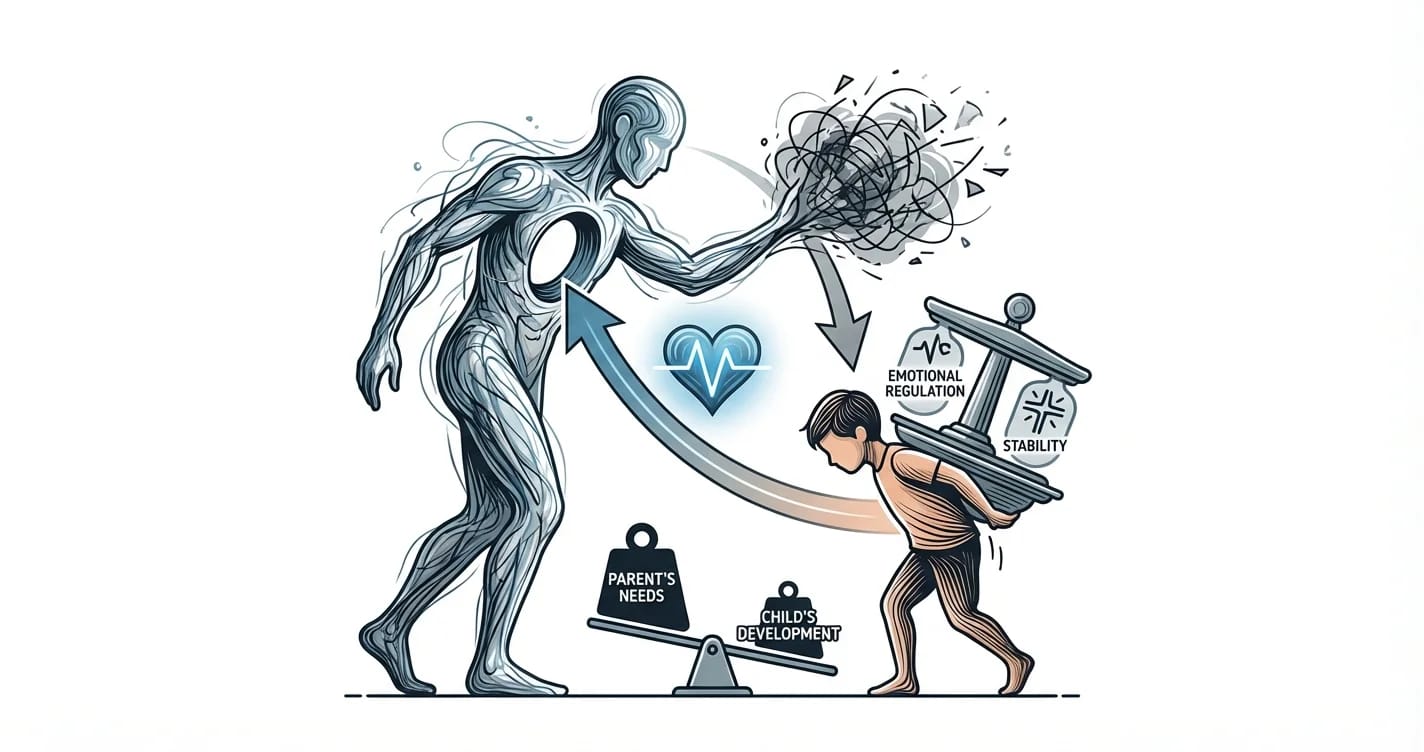
When narcissistic parents create role reversal where the child becomes the emotional caretaker, the fundamental structure of the parent-child relationship inverts. Instead of parents providing emotional support, guidance, and stability to their children, the child becomes responsible for managing the parent's feelings, needs, and psychological well-being. This dynamic, known as emotional parentification, forces children into a caretaking role they're developmentally unprepared for and fundamentally alters their sense of self and relationships throughout life.
Research suggests that this role reversal represents one of the most damaging aspects of growing up with narcissistic parents, as it denies children the developmental support they need while simultaneously burdening them with inappropriate emotional responsibilities. Therapists who specialize in toxic family dynamics note that this pattern can persist well into adulthood, with grown children continuing to serve as emotional support systems for parents who never learned to regulate their own emotions. Understanding these dynamics is the first step toward recognizing their impact and beginning to establish healthier relational patterns.
What Role Reversal Looks Like in Narcissistic Family Systems
Role reversal with narcissistic parents occurs when the natural parent-child hierarchy becomes inverted, with the child assuming responsibilities for the parent's emotional state. In healthy families, parents provide a secure base from which children can develop their own identities, learn emotional regulation, and gradually take on age-appropriate responsibilities. In families with narcissistic dynamics, this developmental framework collapses.
The child becomes attuned to the parent's moods, needs, and emotional states rather than receiving attunement from the parent. They learn to read subtle signals indicating the parent's emotional weather and adjust their behavior accordingly. A parent may explicitly turn to their child for comfort during distress, share inappropriate details about adult problems, or rely on the child to validate their experiences and decisions. In some cases, the narcissistic parent positions the child as a confidant or therapist, discussing their relationship problems, financial stress, or grievances against the other parent.
Practitioners who work with adults raised in these environments observe that many clients describe feeling like they "raised themselves" or served as the parent to their own parent. Some recall being told they were "wise beyond their years" or an "old soul"—phrases that often mask the inappropriate burden placed on developing children. The child may have been praised for their emotional maturity while simultaneously being criticized for any expression of their own needs, creating a confusing double bind that shapes their understanding of relationships.
This dynamic differs from the mutual support that can develop in healthy families facing hardship. The distinguishing feature is the consistent pattern where the parent's needs consistently take precedence, the child's developmental needs remain unmet, and the child experiences anxiety or guilt when they cannot successfully manage the parent's emotional state.
How Narcissistic Parents Turn Children Into Their Therapists
When narcissistic parents turn children into their therapists, they establish a pattern of emotional dumping that violates appropriate boundaries between parent and child. The parent may share detailed accounts of marital conflicts, express fears and insecurities, or seek validation for decisions that children have no capacity to evaluate. This creates what specialists in dysfunctional family systems describe as a "spousification" of the child, where they occupy a quasi-partner role rather than a child role.
Children in these situations often report several common experiences:
- Being asked to take sides in parental conflicts or serve as a messenger between parents
- Receiving confessions about the parent's romantic relationships, financial problems, or past traumas
- Being expected to provide reassurance about the parent's worth, appearance, or decisions
- Serving as the parent's primary emotional support during crises
- Feeling responsible for preventing the parent's emotional breakdowns
- Being praised for being "understanding" or "supportive" in ways that feel uncomfortable
The narcissistic parent may frame this dynamic as evidence of a special bond or unique closeness. They might say things like "you're the only one who understands me" or "I can tell you things I can't tell anyone else." While these statements might initially make a child feel valued, they simultaneously create pressure to maintain this role and anxiety about what might happen if they fail to provide adequate support.
Therapists who work with survivors of these family dynamics note that the pattern typically intensifies during stressful periods. Holidays and family gatherings can be particularly challenging times for those breaking generational patterns, as these occasions often trigger old dynamics and expectations. The narcissistic parent may increase their demands for emotional support during times when they feel threatened, lonely, or facing external stress, regardless of what's happening in the child's life.
Tools like Lovon.app can provide on-demand support for adults processing these patterns, offering a space to talk through the confusion and emotional overload that comes from recognizing these dynamics without requiring the person to wait for a scheduled therapy appointment.
The Mechanisms Behind Parentification by Narcissistic Parents
Parentification by narcissistic parents making kids their emotional support operates through several interconnected mechanisms. At the core is the narcissistic parent's difficulty with emotional regulation and their need for external validation to maintain their sense of self. Rather than developing internal resources for managing difficult emotions, the narcissistic parent externalizes this responsibility onto those around them—most consistently, their children.
Dysfunctional families often operate through power and control dynamics rather than addressing actual issues or developing genuine problem-solving strategies. The narcissistic parent maintains control by positioning themselves as the central figure whose needs determine the family's emotional climate. Family members learn to walk on eggshells around members who struggle to regulate emotions, constantly adjusting their behavior to prevent emotional outbursts or withdrawal.
The child learns implicit rules about emotional expression and caretaking:
- The parent's feelings are more important and valid than the child's
- Expressing your own needs is selfish or burdensome
- Your value comes from your ability to support and soothe others
- Love is conditional on meeting the other person's emotional needs
- You are responsible for other people's emotional states
These beliefs typically operate outside conscious awareness, becoming the background assumptions that shape how the person approaches all relationships. The child may excel at reading others' emotions and needs while remaining disconnected from their own internal experience. They might struggle to identify what they feel or want, having spent their developmental years focused outward rather than inward.
Studies on childhood emotional neglect indicate that children require consistent emotional attunement to develop secure attachment and healthy emotional regulation. When parents are consistently unavailable for this attunement—instead requiring the child to provide it to them—it may contribute to difficulties with self-esteem, boundary-setting, and relationship patterns that persist into adulthood. However, it's important to note that genetic factors, temperament, and other environmental influences also contribute to how these patterns develop; early experiences represent one significant factor among several.
Breaking Free From Emotional Caretaking Role Reversal
Breaking free from emotional caretaking role reversal in families with narcissistic parents requires recognizing the pattern, understanding its impact, and gradually establishing boundaries that honor your own developmental needs—even retroactively as an adult. This process often involves grieving the childhood you needed but didn't receive, and acknowledging that you cannot change the past or force your parent to develop emotional regulation skills they lack.
The first step involves clearly identifying what happened and naming it as inappropriate. This might seem obvious, but many adults raised in these dynamics have thoroughly internalized the belief that their role was normal, special, or evidence of maturity rather than a burden they shouldn't have carried. Recognizing that you were placed in a role reversal where you became the parent's emotional caretaker—rather than simply being "close" or "mature"—creates clarity about what happened and why it affects you now.
Establishing boundaries represents a core challenge. The narcissistic parent typically responds to boundaries with escalation: guilt-tripping, emotional outbursts, accusations of selfishness, or withdrawal of affection. They may claim that setting boundaries means you don't love them or that you're abandoning them in their time of need. These responses are predictable reactions to losing their established emotional supply, not evidence that your boundaries are wrong.
Practical strategies for boundary-setting include:
- Limiting the topics you'll discuss, redirecting when the parent begins emotional dumping
- Ending phone calls or visits when the dynamic shifts into caretaking mode
- Declining requests to mediate parental conflicts or serve as a confidant
- Reducing the frequency of contact if the parent cannot respect boundaries
- Preparing responses in advance for predictable guilt-inducing statements
- Seeking support from a therapist, support group, or tools like Lovon.app when facing difficult family interactions
It's crucial to recognize that setting boundaries often means tolerating the discomfort of the parent's displeasure—something that triggers deep anxiety for those conditioned to prioritize the parent's emotional state. The narcissistic parent will not typically validate your boundaries or acknowledge their appropriateness. The validation must come from your own understanding that you deserve relationships where your needs matter, and from support systems that reinforce this truth.
Many people find it helpful to work with a therapist who specializes in narcissistic family dynamics, as they can provide both validation and specific strategies for navigating these complex relationships. The process of disentangling from role reversal patterns is challenging work that benefits from professional guidance and consistent support.
Long-Term Impact and Recovery
The long-term impact of serving as an emotional caretaker for narcissistic parents extends into multiple life domains. Adults who experienced this role reversal often struggle with:
- Difficulty identifying and expressing their own needs in relationships
- Attraction to partners or friends who require excessive caretaking
- Perfectionism and harsh self-criticism rooted in conditional acceptance
- Anxiety or guilt when prioritizing their own wellbeing
- Trouble receiving care or support from others without feeling indebted
- Hypervigilance to others' emotional states and excessive responsibility for managing them
These patterns don't reflect personal failure or weakness; they represent adaptive strategies that helped you survive a challenging developmental environment. A child who becomes attuned to a parent's emotional needs is developing a skill that was necessary in that context. The challenge comes when these strategies continue into adult relationships where they're no longer necessary and may actually prevent genuine intimacy and reciprocity.
Recovery involves gradually learning that relationships can operate differently. This means:
- Practicing identifying your own feelings, needs, and preferences
- Tolerating the discomfort of expressing needs and making requests
- Noticing when you slip into automatic caretaking mode and making conscious choices
- Seeking relationships with people capable of reciprocity and emotional maturity
- Challenging internalized beliefs about your worth being tied to your usefulness
- Developing self-compassion for the child you were and the adult you're becoming
Emerging research on relational trauma recovery suggests that healing occurs through corrective relational experiences—relationships where your needs matter, where you're valued for who you are rather than what you provide, and where emotional support flows in both directions. These experiences gradually build new neural pathways and relational templates, though the old patterns may resurface during stress or in interactions with your family of origin.
Some people find that reducing or eliminating contact with the narcissistic parent becomes necessary for their wellbeing, while others establish limited contact with firm boundaries. There's no single right answer; the appropriate level of contact depends on your specific situation, the parent's behavior, and your own needs and capacity. What matters is that you make these decisions based on what serves your wellbeing rather than guilt or obligation.
When to Seek Professional Help
If you recognize these patterns in your own history and are experiencing difficulties in your current life, professional support can be invaluable. Consider seeking help from a therapist who specializes in narcissistic family dynamics, childhood emotional neglect, or complex trauma if you're experiencing:
- Persistent relationship difficulties or patterns of unsatisfying relationships
- Anxiety or depression that interferes with daily functioning
- Difficulty setting boundaries or chronic feelings of guilt
- Problems identifying your own emotions, needs, or desires
- Patterns of self-sacrifice that leave you depleted and resentful
- Considering reducing contact with family and need support navigating this decision
Look for therapists who specifically mention expertise in family systems, narcissistic abuse recovery, or adult children of dysfunctional families. These specialists understand the unique dynamics you experienced and can provide targeted strategies for healing.
Between therapy sessions or when you need immediate support processing difficult family interactions, accessible tools provide additional resources. When something has just happened—a challenging phone call with your parent, guilt after setting a boundary, or recognition of an old pattern emerging—having an outlet to process these experiences can prevent them from intensifying or derailing your progress.
Conclusion
Understanding role reversal with narcissistic parents—where children become emotional caretakers—provides a framework for making sense of confusing and painful childhood experiences. When narcissistic parents create this inverted dynamic, they deny children the developmental support they need while burdening them with inappropriate responsibilities for managing adult emotions. Recognizing this pattern, validating its impact, and gradually establishing healthier relational patterns represents challenging but transformative work.
Recovery is possible. It involves unlearning the belief that your worth depends on your ability to meet others' needs, establishing boundaries that protect your wellbeing, and building relationships characterized by reciprocity rather than one-sided caretaking. While the process can be difficult—particularly during triggering times like holidays when family dynamics intensify—each step toward honoring your own needs represents progress toward the life you deserve.
If you're navigating these dynamics, remember that you're not alone, your experiences were real and their impact is valid, and you have every right to prioritize your own emotional health even if the narcissistic parent responds with displeasure. The work of breaking these generational patterns is profound, and it benefits not only you but potentially future generations who will experience different relational models because of the courage you showed in doing this difficult work.
Disclaimer: This is general information, not medical advice or diagnosis. If symptoms are severe, affecting your daily life, or you're having thoughts of self-harm—seek professional help. In the US: call or text 988 (Suicide & Crisis Lifeline). For immediate danger: 911 or local emergency services.
How AI Support Helps You Heal
AI emotional support isn't about replacing human connection — it's about filling the gaps. The moments when you need to talk at 2 AM, when you don't want to burden your friends again, or when you simply need someone to listen without judgment.
Here's what happens in a typical Lovon session:
You share what's on your mind
There's no script, no intake form, no waiting room. You speak or type whatever you're feeling — in your own words, at your own pace.
Lovon validates and explores
Using frameworks from CBT (Cognitive Behavioral Therapy) and motivational interviewing, Lovon acknowledges your feelings first, then gently helps you explore them. No dismissive "just move on" advice.
You build coping skills together
Lovon doesn't just listen — it actively works with you on evidence-based techniques: thought reframing, urge surfing, behavioral experiments, and more.
What a Session with Lovon Looks Like

When to Seek Professional Help
AI support is a valuable tool, but it's not a replacement for professional care. Please consider reaching out to a licensed therapist if you experience any of the following:
- Persistent thoughts of self-harm or suicide
- Inability to perform daily activities (work, eating, sleeping) for more than 2 weeks
- Turning to alcohol or substances to cope
- Intense anger or desire to harm your ex-partner
- Complete emotional numbness that doesn't improve over time
Crisis Resources (US): If you're in immediate danger, call 988 (Suicide & Crisis Lifeline) or text HOME to 741741 (Crisis Text Line). Available 24/7, free, and confidential.
Outside the US? Find a crisis line in your country
Ready to Start?
Your healing journey can begin right now
A 7-day trial. No judgment. Just a safe space to process what you're going through.
Frequently Asked Questions
Is Lovon a replacement for a real therapist?
Is my conversation with Lovon AI private?
How is Lovon different from ChatGPT for emotional support?
Can I use Lovon if I'm already seeing a therapist?
Can I try Lovon before subscribing?
About the Author

The Lovon Editorial Team
Mental Health & Wellness Content Team
The Lovon Editorial Team develops mental health and wellness content designed to make psychological concepts accessible and actionable. Our goal is to bridge the gap between clinical research and everyday life - helping you understand why your mind works the way it does and what you can do about it....
Related articles
- Recognizing Narcissistic Abuse Patterns in Relationships
Narcissistic abuse patterns represent a constellation of manipulative behaviors that systematically undermine a person's…
- BPD Treatment Specialization: Four Parent Types Affecting Emotional Regulation
For individuals with borderline personality disorder (BPD), emotional regulation difficulties rarely emerge in…
- Narcissistic and Emotionally Immature Parents — Communication Manipulation Patterns
Growing up with narcissistic and emotionally immature parents often means navigating a minefield of confusing…
- Toxic Parent Patterns: Signs & How to Set Limits (2026)
Recognize toxic parent patterns — manipulation, enmeshment, conditional love — and follow 7 concrete steps to set limits…
See also
Quizzes
- Is My Relationship Healthy? 15-Question Check-In
Check your relationship health in 3 minutes.
- Am I Dating a Narcissist? 15-Trait Quiz
Understand the pattern in 3 minutes.
Free tools
- What to Say Back to a Hostile Co-Parent
A chat, not a form. Paste the message your ex sent about the kids, say what actually has to be decided, and you get a…
- How to Confront a Narcissistic Parent
Most of these conversations fail because you went in wanting three things at once. Tell it what you want to raise, and…
From the wiki
- How to leave a toxic relationship?
Leaving a toxic relationship is rarely a decision problem — you usually know. What stops you is that the pull toward…
Disclaimer: This article is for informational purposes only and does not constitute medical advice, diagnosis, or treatment. Always seek the advice of your physician or other qualified health provider with any questions you may have regarding a medical condition. If you are in crisis or think you may have an emergency, call 988 (Suicide & Crisis Lifeline) or go to the nearest emergency room. Outside the US? Find a crisis line in your country.