
Toxic Family Dynamics Operating Through Power and Control Triggering Old Coping Patterns During Holidays
The holiday season can feel like stepping into a time machine for many people navigating toxic family dynamics. When you return home for gatherings, you may

Key Takeaways
- Emotional manipulation instead of direct communication: Guilt, shame, and obligation replace honest conversations
- Rigid role assignments: The scapegoat, golden child, caretaker, and lost child roles remain fixed regardless of
- Reality distortion: Gaslighting, minimization, and denial make it difficult to trust your own perceptions
- Punishment for authenticity: Expressing genuine feelings, setting boundaries, or challenging the status quo results
- Absence of repair: Conflicts end through time passing or forced reconciliation rather than genuine acknowledgment
Toxic Family Dynamics Operating Through Power and Control Triggering Old Coping Patterns During Holidays
Understanding how controlling family systems reactivate childhood survival behaviors and what you can do to protect yourself
toxic-family-dynamics-power-control-holiday-coping-patterns
Introduction
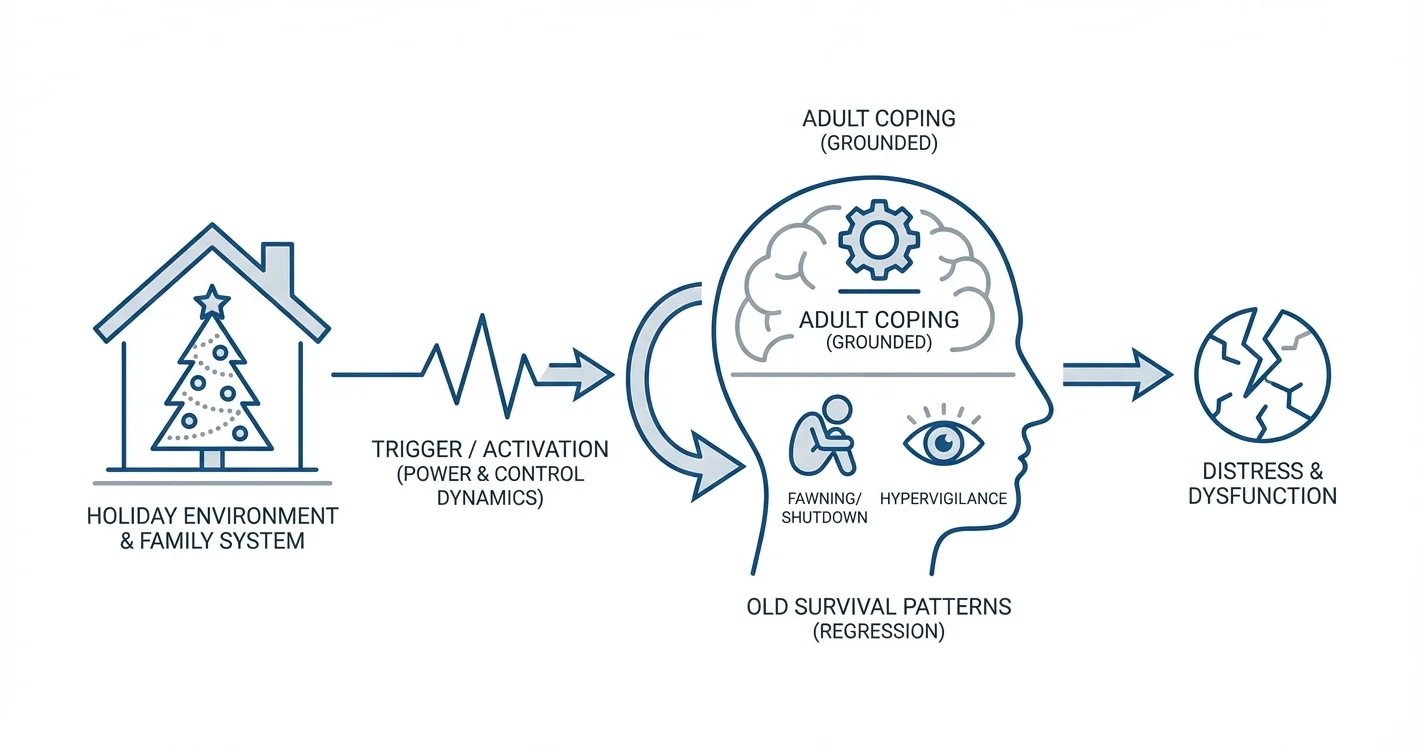
The holiday season can feel like stepping into a time machine for many people navigating toxic family dynamics. When you return home for gatherings, you may notice yourself slipping into old patterns—people-pleasing, emotional shutdown, hypervigilance, or conflict avoidance—even though you've spent years working on healthier behaviors. This isn't a failure of personal growth. Research suggests that dysfunctional family systems operating through power and control rather than healthy communication can trigger old coping patterns during holidays, reactivating the survival strategies you developed in childhood.
Mental health professionals who specialize in family trauma note that holidays are an especially difficult time for people breaking generational patterns. The concentrated exposure to controlling family dynamics, combined with the cultural pressure to maintain harmony and tradition, creates a perfect storm for regression. Understanding why this happens—and having concrete strategies to navigate it—can help you protect your mental health while deciding how and whether to engage with family gatherings.
How Power-Based Family Systems Function
Dysfunctional families often operate through power and control rather than addressing actual issues directly. Unlike healthy family systems where members can express needs, set boundaries, and negotiate conflicts openly, toxic families maintain stability through hierarchies, manipulation, and emotional regulation outsourcing.
Therapists who work extensively with toxic family situations explain that these systems rely on specific mechanisms to maintain control. Family members may walk on eggshells around those who struggle to regulate emotions, creating an environment where everyone's behavior is oriented toward managing one person's feelings. The actual problems—unresolved trauma, untreated mental health conditions, substance abuse, or deeply ingrained dysfunction—remain unaddressed while the family focuses energy on maintaining a facade of normalcy.
Key characteristics of power-based family systems include:
- Emotional manipulation instead of direct communication: Guilt, shame, and obligation replace honest conversations about needs and boundaries
- Rigid role assignments: The scapegoat, golden child, caretaker, and lost child roles remain fixed regardless of individual growth
- Reality distortion: Gaslighting, minimization, and denial make it difficult to trust your own perceptions
- Punishment for authenticity: Expressing genuine feelings, setting boundaries, or challenging the status quo results in withdrawal of affection, criticism, or escalated conflict
- Absence of repair: Conflicts end through time passing or forced reconciliation rather than genuine acknowledgment and behavioral change
Research on family systems theory suggests that these patterns serve a homeostatic function—maintaining the family's equilibrium even when that equilibrium is unhealthy. When you've changed but the system hasn't, your presence as a "different" version of yourself threatens that stability, often intensifying controlling behaviors.
Why Holidays Reactivate Childhood Survival Mechanisms
The holiday gathering environment is uniquely positioned to trigger regression to old coping patterns. Several factors converge to create conditions where your nervous system may respond as though you're back in your childhood home, even if you're now an independent adult with your own life.
Environmental and sensory cues play a significant role. Returning to your childhood home or gathering in familiar settings activates implicit memories stored in your nervous system. The smell of your mother's perfume, the layout of the living room, the sound of your father's voice in a particular tone—these sensory details can trigger automatic responses before your conscious mind fully registers what's happening. Neuroscience research indicates that implicit memories, especially those formed during emotionally significant experiences, can influence behavior without conscious awareness.
Role regression happens rapidly when you're surrounded by people who knew you as a child. Even if you've established yourself as a capable professional, parent, or partner in your daily life, family members may still relate to you through the lens of outdated roles. When your sister treats you like the incompetent younger sibling, or your father dismisses your opinions as he did when you were twelve, your nervous system may automatically activate the coping strategies that helped you survive those dynamics originally.
The concentrated intensity of holiday gatherings compresses interactions that might normally be spaced out over months. Spending several consecutive days in close quarters with controlling family members doesn't allow for the recovery time you might have when visits are shorter or more infrequent. This sustained exposure can overwhelm even well-established coping resources.
Cultural and emotional pressure surrounding holidays adds another layer of difficulty. The societal narrative that holidays should be joyful family time creates cognitive dissonance when your actual experience is stressful or painful. This can trigger shame about your genuine feelings, leading to the suppression of authentic responses—itself a common coping pattern from dysfunctional childhoods.
According to practitioners specializing in trauma and family dynamics, being surrounded by toxic family during holidays can trigger old coping patterns including:
- Fawning or people-pleasing to prevent conflict
- Emotional numbing or dissociation to manage overwhelm
- Hypervigilance and constant scanning for danger signals
- Regression to childhood communication patterns (becoming silent, deferential, or combative)
- Physical symptoms like stomach problems, headaches, or exhaustion
- Increased anxiety, depression, or substance use
Recognizing Your Personal Coping Pattern Activation
Understanding your specific coping patterns—and how you'll know when they're being triggered—is essential for navigating holiday gatherings. Different people develop different survival strategies based on their family role, temperament, and what behaviors were rewarded or punished in childhood.
The fawn response involves becoming excessively accommodating, agreeable, and focused on others' needs at the expense of your own. If you developed this pattern, you might notice yourself automatically offering to help with everything, laughing at jokes you don't find funny, agreeing with opinions you don't share, or minimizing your own needs and preferences. Physical signs may include tension in your chest or throat from suppressing authentic responses, or exhaustion from constant emotional monitoring of others.
Emotional shutdown or dissociation is a coping mechanism where you disconnect from your feelings to avoid being overwhelmed. You might notice yourself feeling foggy, spacey, or like you're watching events from outside your body. You may struggle to remember conversations afterward or feel emotionally flat despite being in situations that would typically provoke strong feelings.
Hypervigilance manifests as constant monitoring of others' emotional states, tone of voice, and body language to predict and prevent conflict. If this is your pattern, you might notice physical tension, difficulty relaxing, racing thoughts about what might happen next, or exhaustion from the constant vigilance. You may also find yourself immediately noticing small changes in others' moods and automatically adjusting your behavior in response.
Reverting to childhood communication styles can look like becoming unusually quiet and withdrawn, speaking in a different tone of voice, or engaging in conflicts with the same dynamics you had as a teenager. Some people notice themselves becoming sarcastic, defensive, or argumentative in ways they never are in their adult relationships.
Tools like Lovon.app can help you process these patterns as they emerge. Having access to on-demand support when you notice coping mechanisms activating—perhaps late at night after a difficult dinner or between holiday events—allows you to talk through what you're experiencing and understand your responses without waiting for your next therapy appointment.
Strategies for Managing Power and Control Dynamics
While you cannot change your family system, you can develop strategies to protect yourself and maintain your equilibrium during holiday gatherings. Effective approaches acknowledge the reality of controlling dynamics while implementing boundaries that preserve your wellbeing.
Preview and planning before the gathering helps your nervous system prepare rather than being caught off-guard. Consider which specific interactions or topics are likely to trigger controlling behaviors. Identify your exits—both physical (having your own transportation, staying in a hotel rather than in the family home) and conversational (prepared responses to redirect or end problematic conversations). Some people find it helpful to have a "safe person" they can text or call during the gathering for reality-checking and support.
Real-time grounding techniques help you stay connected to your adult self rather than regressing fully into childhood patterns. These might include:
- Periodic body scans to notice tension and consciously relax muscles
- Touching an object that connects you to your current life (your wedding ring, a photo of your children on your phone)
- Excusing yourself for bathroom breaks where you can take several deep breaths and reconnect with your own perspective
- Mentally noting "I'm 35 years old, I have my own home, I'm choosing to be here" to counter the feeling of being a powerless child
Boundary implementation in controlling systems requires accepting that you may face pushback. When family members are accustomed to operating through power and control, your boundaries threaten the established system. Research on boundary-setting in dysfunctional families indicates that boundaries are most sustainable when you focus on your own behavior rather than trying to control others' responses. This means deciding what you will and won't do, rather than demanding that others change.
For example, rather than "You need to stop criticizing my parenting," a boundary might be "I'm not open to discussing my parenting choices. If it comes up, I'll change the subject, and if it continues, I'll end the conversation." Then following through consistently, even when met with escalation, guilt-tripping, or other controlling responses.
Strategic superficiality is sometimes the most realistic approach for gatherings you've chosen to attend despite knowing the family system won't change. This involves engaging at a surface level—discussing weather, food, neutral current events—while declining to engage in deeper, more vulnerable conversations that are likely to activate controlling dynamics. Some practitioners describe this as "grey rocking"—being present but uninteresting as a target for manipulation or control.
When and How to Consider Limiting Contact
For people breaking generational patterns, the decision about whether and how much to engage with toxic family during holidays is deeply personal and often evolving. There is no universal "right answer," but there are frameworks for making decisions aligned with your values and wellbeing.
Assessing the cost-benefit honestly involves acknowledging both the real costs to your mental health and any genuine benefits or values served by attendance. Some people find that after implementing strong boundaries, brief holiday contact is manageable and allows them to maintain connections with certain family members they value. Others realize that the toll—days or weeks of recovery time, reactivation of symptoms they've worked hard to manage, or modeling unhealthy dynamics for their own children—outweighs any benefits.
Therapists who specialize in toxic families note that holidays are especially difficult for cycle breakers because the cultural script around family obligation is so powerful. It's important to recognize that choosing to limit contact, decline invitations, or leave early isn't a failure—it's a boundary based on honest assessment of what you can handle while maintaining your wellbeing.
Alternative approaches to holiday engagement can honor your needs while still acknowledging family connections in some way:
- Attending for a shorter period (stopping by for a few hours rather than spending the entire day)
- Meeting individual family members separately rather than attending large gatherings
- Connecting via video call rather than in person
- Sending a card or gift without attending in person
- Creating entirely new holiday traditions with chosen family or your own household
When professional support becomes essential, recognizing the signs matters. If you're experiencing severe anxiety in the weeks leading up to holidays, having intrusive thoughts about family interactions, noticing significant increases in depression symptoms, or finding yourself using unhealthy coping mechanisms (substance use, disordered eating, self-harm) in response to family contact, working with a therapist who specializes in family trauma is important.
Services like Lovon.app can provide accessible support when you're processing the decision about holiday engagement or working through difficult feelings after a gathering. Having the ability to talk through these complex emotions when they're most acute—perhaps late at night when anxiety is highest, or immediately after a triggering interaction—can help you process experiences more effectively than waiting days or weeks for a scheduled therapy appointment.
Processing and Recovery After Holiday Exposure
What happens after the holiday gathering is as important as how you navigate the event itself. Exposure to toxic family dynamics operating through power and control triggering old coping patterns during holidays can have lingering effects that require intentional processing and recovery.
Expect a recovery period rather than assuming you should immediately feel normal. Research on stress responses suggests that nervous system activation takes time to regulate after sustained exposure to threatening or stressful environments. You might notice continued anxiety, emotional sensitivity, fatigue, or physical symptoms for days or even weeks after a difficult family gathering.
Deliberate processing activities help integrate the experience rather than suppressing it:
- Journaling about what happened, how you responded, and what you noticed about your coping patterns
- Talking with a trusted friend, partner, or therapist about specific interactions
- Identifying moments where you successfully maintained boundaries or stayed grounded in your adult self
- Acknowledging where you regressed into old patterns without self-judgment—simply observing and understanding the triggers
Reality-checking is particularly important after exposure to family systems that operate through distortion and manipulation. You might find yourself questioning whether your perceptions were accurate, whether you overreacted, or whether you should have handled things differently. Talking with someone outside the family system who can reflect back your reality helps counter gaslighting effects.
Physical recovery supports nervous system regulation. This might include adequate sleep, gentle movement or exercise, time in nature, reduced caffeine or alcohol, and activities that bring you genuine pleasure and connection to your current life. Some people find somatic practices like yoga, massage, or body-based therapies particularly helpful for processing family stress that gets stored physically.
Evaluating future engagement based on this experience gives you information for next time. What strategies worked? What would you do differently? Did this level of contact feel sustainable, or do you need to adjust your approach for future holidays? This isn't about achieving perfection but about making incremental adjustments based on honest assessment of your capacity and wellbeing.
When to Seek Professional Help
If you're recognizing these patterns in your own holiday experiences, professional support can make a significant difference in understanding your responses and developing sustainable strategies for navigating toxic family dynamics.
Consider seeking therapy if you're experiencing:
- Severe anxiety or depression in anticipation of or following family gatherings
- Intrusive thoughts about family interactions that interfere with daily functioning
- Noticeable regression in coping skills or mental health symptoms after family contact
- Difficulty maintaining boundaries despite multiple attempts
- Uncertainty about whether your family dynamics are actually problematic or if you're overreacting
- Challenges in your current relationships that seem connected to family-of-origin patterns
- Thoughts of self-harm or feeling like the situation is unbearable
Mental health professionals who specialize in family trauma, complex PTSD, or narcissistic family systems can help you:
- Understand how power and control dynamics in your specific family operate
- Identify your personal coping patterns and their origins
- Develop concrete strategies for boundary-setting
- Process grief about the family you needed but didn't have
- Make informed decisions about future contact
- Heal the underlying wounds that make you vulnerable to these triggers
Look for therapists who explicitly list experience with family trauma, narcissistic abuse, or family systems work in their profiles. Modalities that are particularly relevant include Internal Family Systems (IFS), EMDR for trauma processing, and Cognitive Behavioral Therapy (CBT) for developing practical coping strategies.
Conclusion
Understanding that toxic family dynamics operating through power and control trigger old coping patterns during holidays helps normalize an experience that many people find confusing and shameful. The regression you might experience during family gatherings isn't evidence that you haven't grown or that your healing work has failed—it's a natural response to being placed back in the environment and relationships where those survival strategies originally developed.
The key is recognizing these patterns as they activate, implementing boundaries and grounding strategies to stay connected to your adult self, and giving yourself adequate recovery time after exposure to controlling family systems. Whether you choose to attend gatherings with strong boundaries, limit contact, or decline participation entirely, the decision that honors your wellbeing and values is the right one for you.
Breaking generational patterns is challenging work, and holidays can be particularly difficult moments in that journey. Having support—whether through therapy, trusted relationships, or accessible tools like Lovon.app—makes the process more manageable. You deserve to move through the holiday season in a way that protects your mental health while aligning with your values, even when that looks different from cultural expectations about family togetherness.
Disclaimer: This is general information, not medical advice or diagnosis. If symptoms are severe, affecting your daily life, or you're having thoughts of self-harm—seek professional help. In the US: call or text 988 (Suicide & Crisis Lifeline). For immediate danger: 911 or local emergency services.
How AI Support Helps You Heal
AI emotional support isn't about replacing human connection — it's about filling the gaps. The moments when you need to talk at 2 AM, when you don't want to burden your friends again, or when you simply need someone to listen without judgment.
Here's what happens in a typical Lovon session:
You share what's on your mind
There's no script, no intake form, no waiting room. You speak or type whatever you're feeling — in your own words, at your own pace.
Lovon validates and explores
Using frameworks from CBT (Cognitive Behavioral Therapy) and motivational interviewing, Lovon acknowledges your feelings first, then gently helps you explore them. No dismissive "just move on" advice.
You build coping skills together
Lovon doesn't just listen — it actively works with you on evidence-based techniques: thought reframing, urge surfing, behavioral experiments, and more.
What a Session with Lovon Looks Like

When to Seek Professional Help
AI support is a valuable tool, but it's not a replacement for professional care. Please consider reaching out to a licensed therapist if you experience any of the following:
- Persistent thoughts of self-harm or suicide
- Inability to perform daily activities (work, eating, sleeping) for more than 2 weeks
- Turning to alcohol or substances to cope
- Intense anger or desire to harm your ex-partner
- Complete emotional numbness that doesn't improve over time
Crisis Resources (US): If you're in immediate danger, call 988 (Suicide & Crisis Lifeline) or text HOME to 741741 (Crisis Text Line). Available 24/7, free, and confidential.
Outside the US? Find a crisis line in your country
Ready to Start?
Your healing journey can begin right now
A 7-day trial. No judgment. Just a safe space to process what you're going through.
Frequently Asked Questions
Is Lovon a replacement for a real therapist?
Is my conversation with Lovon AI private?
How is Lovon different from ChatGPT for emotional support?
Can I use Lovon if I'm already seeing a therapist?
Can I try Lovon before subscribing?
About the Author

The Lovon Editorial Team
Mental Health & Wellness Content Team
The Lovon Editorial Team develops mental health and wellness content designed to make psychological concepts accessible and actionable. Our goal is to bridge the gap between clinical research and everyday life - helping you understand why your mind works the way it does and what you can do about it....
Related articles
- Narcissistic and Emotionally Immature Parents — Communication Manipulation Patterns
Growing up with narcissistic and emotionally immature parents often means navigating a minefield of confusing…
- Stepparent Stress Blended Family: 2026 Coping Guide
Stepparent stress in a blended family peaks around authority and loyalty conflicts. Get 6 steps to cope, troubleshooting…
- Narcissist Gaslighting: Narcissistic Gaslighting Signs and Examples
You had good arguments, but by the end of the discussion, you were apologizing and wondering if you are the problem.
- Emotionally Immature Parents Recovery: A Practical Guide
Growing up with emotionally immature parents leaves lasting imprints on the nervous system that extend far beyond…
See also
Quizzes
- Boundaries Test: Free 12-Question Self-Check
See where your boundaries slip, in 3 minutes.
- Are They a Red Flag? 10 Questions to Check Your Partner
Check your partner in 3 minutes.
Free tools
- What Leaving Would Actually Take
Four short lists: money, a place, the shared things, and people. Mark each item sorted or not. You get the itemized…
- How to Come Out to Your Parents
A chat about how to come out to your parents that starts with whether now is safe, not with the speech. Tell it your…
From the wiki
- How to leave a toxic relationship?
Leaving a toxic relationship is rarely a decision problem — you usually know. What stops you is that the pull toward…
Disclaimer: This article is for informational purposes only and does not constitute medical advice, diagnosis, or treatment. Always seek the advice of your physician or other qualified health provider with any questions you may have regarding a medical condition. If you are in crisis or think you may have an emergency, call 988 (Suicide & Crisis Lifeline) or go to the nearest emergency room. Outside the US? Find a crisis line in your country.