
Cyclothymia Rapid Mood Shifts: Understanding 2-3 Day Cycles
Experiencing intense emotional highs and lows that shift every few days can be confusing and exhausting. For many people, these cyclothymia rapid mood

Key Takeaways
- Episode duration: Cyclothymia involves brief 2-3 day fluctuations rather than week-long or month-long episodes
- Symptom severity: Cyclothymic symptoms are milder, never reaching full manic or major depressive episode criteria
- Pattern consistency: Cyclothymia shows chronic instability with frequent shifts, while bipolar disorder has discrete
- Functional impairment: Cyclothymia creates cumulative disruption from constant shifting rather than crisis-level
- Monday-Tuesday: Elevated mood, high productivity, reduced sleep, optimistic outlook, sociable
Introduction
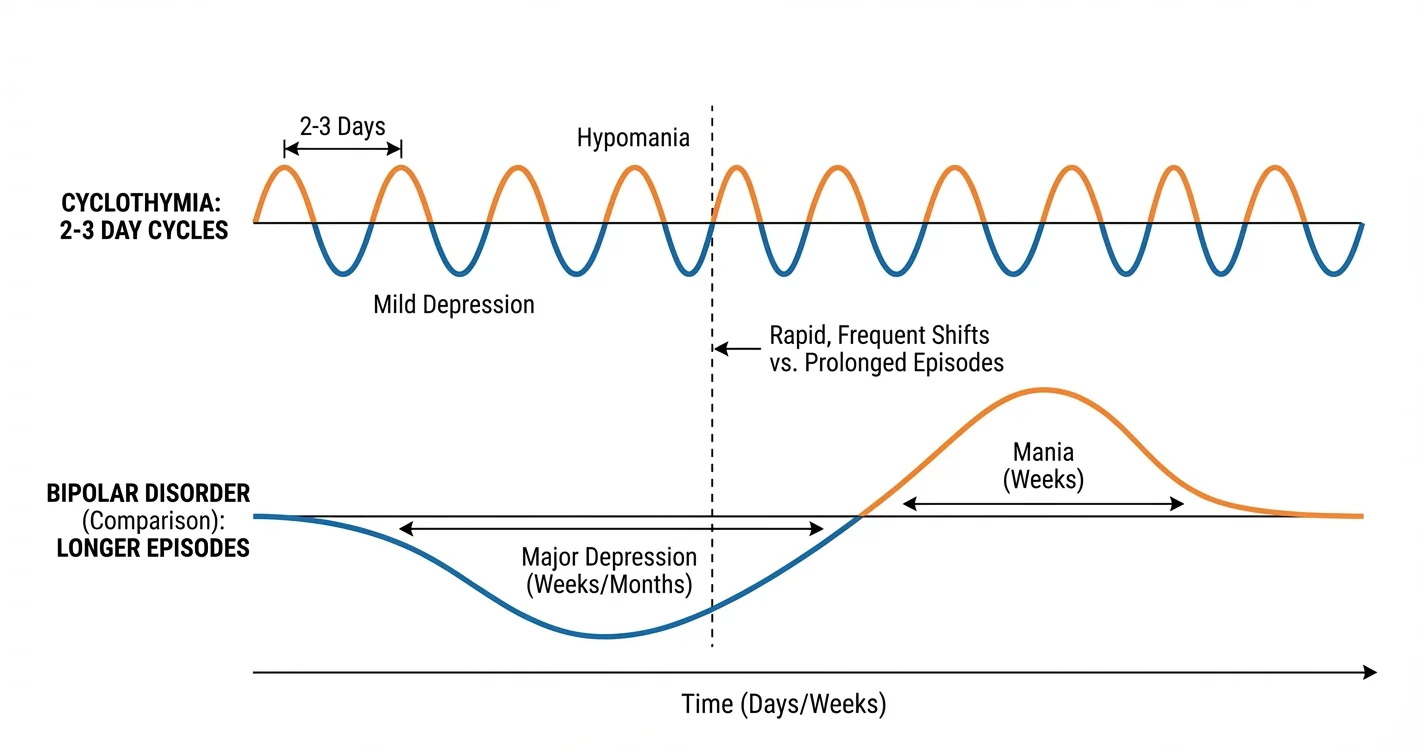
Experiencing intense emotional highs and lows that shift every few days can be confusing and exhausting. For many people, these cyclothymia rapid mood shifts—often occurring in 2-3 day cycles—create a pattern that feels unpredictable yet strangely consistent. Unlike the longer mood episodes characteristic of bipolar disorder, cyclothymia involves more frequent fluctuations between periods of mild depression and hypomania, typically without the severe episodes that define bipolar I or II. Understanding these rapid cycling patterns is essential for accurate diagnosis and appropriate treatment approaches. This article examines the distinctive characteristics of cyclothymia's short-cycle mood changes, how they differ from bipolar disorder, and what these patterns reveal about this often misunderstood condition.
Understanding Cyclothymia Rapid Mood Shifts and Their Unique Pattern
Cyclothymia is characterized by chronic mood instability with hypomanic and depressive symptoms that fluctuate more frequently than in classic bipolar disorder. The defining feature of cyclothymia rapid mood shifts involves cycles that typically last 2-3 days, though they may occasionally extend slightly longer. During hypomanic phases, individuals may experience increased energy, reduced need for sleep, racing thoughts, and heightened creativity or productivity. Within days, these symptoms can shift to depressive periods marked by low energy, difficulty concentrating, feelings of inadequacy, and social withdrawal.
Clinical research indicates that cyclothymia involves numerous periods of hypomanic and depressive symptoms occurring over at least two years in adults, with symptoms present more than half the time and no symptom-free period lasting longer than two months. The rapid alternation between mood states—often within 2-3 day windows—distinguishes cyclothymia from bipolar disorder, where mood episodes typically persist for weeks or months.
These short-cycle mood fluctuations can significantly impact daily functioning despite being less severe than full manic or major depressive episodes. The unpredictability of when moods will shift creates challenges in maintaining consistent work performance, relationships, and self-care routines. Many individuals with cyclothymia describe feeling caught in a perpetual emotional rollercoaster, never quite knowing which version of themselves will show up from one day to the next.
How 2-3 Day Mood Cycles Differentiate Cyclothymia from Bipolar Disorder
The temporal pattern of mood episodes serves as a critical diagnostic differentiator between cyclothymia and bipolar disorder. In bipolar I disorder, manic episodes last at least seven days or are severe enough to require hospitalization, while depressive episodes typically persist for at least two weeks. Bipolar II disorder involves hypomanic episodes lasting at least four consecutive days and depressive episodes of similar duration to bipolar I. In contrast, cyclothymia's rapid mood shifts occur in much shorter cycles—frequently changing every 2-3 days without meeting the duration criteria for full bipolar episodes.
Key diagnostic distinctions include:
- Episode duration: Cyclothymia involves brief 2-3 day fluctuations rather than week-long or month-long episodes
- Symptom severity: Cyclothymic symptoms are milder, never reaching full manic or major depressive episode criteria
- Pattern consistency: Cyclothymia shows chronic instability with frequent shifts, while bipolar disorder has discrete episodes separated by periods of stability or opposite-polarity episodes
- Functional impairment: Cyclothymia creates cumulative disruption from constant shifting rather than crisis-level impairment during acute episodes
The rapid cycling subtype of bipolar disorder—defined as four or more mood episodes within a 12-month period—is sometimes confused with cyclothymia. However, even rapid cycling bipolar disorder involves distinct episodes lasting weeks, not the 2-3 day pattern characteristic of cyclothymia. Studies suggest that individuals with cyclothymia experience mood shifts approximately 8-15 times more frequently than those with rapid cycling bipolar disorder.
This distinction matters significantly for treatment planning. While both conditions may respond to mood stabilizers, the constant fluctuation in cyclothymia often requires different therapeutic approaches focused on emotional regulation skills and lifestyle stabilization rather than acute episode management.
Recognizing Short Cycle Mood Fluctuations in Daily Life
Identifying 2-3 day mood cycle patterns requires attention to both emotional states and associated behavioral changes. During hypomanic phases, individuals might notice they're sleeping 1-2 hours less than usual yet feeling energized, taking on multiple projects simultaneously, speaking more rapidly, or feeling unusually confident or irritable. Their thoughts may feel faster and more creative, and they might engage in spontaneous activities or spending they later regret.
When the shift occurs—often quite suddenly—depressive symptoms emerge. Energy drops noticeably, motivation disappears for activities that seemed exciting days earlier, concentration becomes difficult, and self-doubt intensifies. Social interactions that felt effortless during the hypomanic phase now feel overwhelming and exhausting. Sleep patterns may shift toward sleeping more than usual or experiencing disrupted, unrefreshing sleep.
Tracking these patterns can reveal the characteristic 2-3 day cycling:
- Monday-Tuesday: Elevated mood, high productivity, reduced sleep, optimistic outlook, sociable
- Wednesday-Thursday: Mood crashes, low energy, self-critical thoughts, social withdrawal, difficulty completing tasks
- Friday-Saturday: Mood begins lifting again, energy increases, engagement returns
Many people with cyclothymia describe brief "normal" periods between shifts, sometimes lasting just hours to a day, where they feel neither particularly up nor down. These transitional periods can provide temporary relief but also contribute to the exhausting unpredictability of the condition.
For those struggling to understand these rapid emotional changes, speaking with support tools like Lovon.app can help process the confusion and frustration that accompanies frequent mood shifts. Having on-demand access to talk through what's happening—especially during the transition periods or when trying to identify patterns—can provide clarity and reduce the isolation many people with cyclothymia experience.
The Neurobiological Basis of Rapid Cycling in Cyclothymia
Research suggests that cyclothymia rapid mood shifts involve differences in mood regulation systems compared to bipolar disorder. Neuroimaging studies indicate that individuals with cyclothymia may show altered activity in brain regions involved in emotional processing and regulation, including the prefrontal cortex, amygdala, and anterior cingulate cortex. However, these differences appear to involve dysregulation rather than the more pronounced structural and functional changes sometimes observed in bipolar disorder.
The rapid 2-3 day cycling pattern may reflect heightened sensitivity in mood regulation systems, where smaller triggers produce faster mood shifts. This sensitivity might involve multiple interconnected systems:
- Circadian rhythm sensitivity: Individuals with cyclothymia often show greater mood responsiveness to sleep disruption, light exposure changes, and daily schedule variations
- Stress response systems: The hypothalamic-pituitary-adrenal (HPA) axis may show altered reactivity, contributing to rapid mood fluctuations in response to daily stressors
- Neurotransmitter dynamics: Faster fluctuations in serotonin, dopamine, and norepinephrine systems may contribute to more frequent mood shifts
Emerging research suggests that cyclothymia may represent a distinct neurobiological condition rather than simply a milder form of bipolar disorder. The rapid cycling pattern appears to be intrinsic to the condition rather than a temporary phase or treatment complication. This understanding supports treating cyclothymia as a separate diagnosis requiring tailored approaches rather than applying bipolar treatment protocols at lower intensities.
Individual differences in genetic factors, temperament, and early environmental influences all appear to play roles in how cyclothymia develops and manifests. The condition often emerges in adolescence or early adulthood, though the rapid mood shifts may initially be dismissed as personality traits or normal mood variability until the persistent pattern becomes apparent over time.
Managing Cyclothymia's Distinctive Rapid Mood Changes
Effective management of 2-3 day mood cycle patterns requires strategies specifically adapted to the rapid fluctuation characteristic of cyclothymia. Unlike approaches for bipolar disorder that focus on preventing or managing discrete episodes, cyclothymia management emphasizes stabilizing the baseline and reducing the amplitude of mood swings.
Lifestyle stabilization forms the foundation:
- Sleep consistency: Maintaining regular sleep-wake times even when energy levels vary significantly helps reduce mood volatility
- Routine structure: Consistent daily schedules for meals, exercise, and activities provide external stability that can buffer against internal fluctuations
- Activity pacing: Learning to moderate activity levels during hypomanic phases prevents exhaustion during subsequent depressive swings
- Stress management: Since stress can trigger faster or more intense cycling, developing daily stress reduction practices helps maintain greater stability
Psychotherapy approaches that emphasize emotion regulation skills prove particularly valuable. Dialectical behavior therapy (DBT) techniques for tolerating distress and managing emotional intensity can help individuals navigate rapid shifts without becoming overwhelmed. Cognitive-behavioral therapy (CBT) adapted for mood disorders helps identify thought patterns that amplify mood swings and develop more balanced perspectives that persist across mood states.
For some individuals, medications may help reduce the frequency or intensity of mood fluctuations. Mood stabilizers are commonly considered, though the optimal pharmacological approach for cyclothymia remains an area of ongoing clinical research. Working closely with a psychiatrist experienced in cyclothymia allows for careful monitoring of whether medication interventions are providing benefit without causing problematic side effects.
Tools like Lovon.app can complement professional treatment by providing accessible support during the frequent transitions between mood states. Having the ability to talk through what's happening during a sudden mood shift—processing the frustration, identifying triggers, or simply naming the experience—can reduce the secondary distress that often accompanies these rapid changes. This kind of immediate processing can help interrupt patterns where mood shifts lead to behaviors that further destabilize routines.
When Professional Evaluation Becomes Essential
While understanding cyclothymia rapid mood shifts provides valuable insight, professional evaluation is essential for accurate diagnosis and comprehensive treatment planning. The 2-3 day cycling pattern can sometimes overlap with other conditions, including borderline personality disorder (which involves rapid emotional shifts often in response to interpersonal triggers), attention-deficit/hyperactivity disorder (ADHD) with emotional dysregulation, or complex post-traumatic stress disorder (CPTSD).
Seek professional evaluation if:
- Mood fluctuations occur more days than not over an extended period (several months or longer)
- Rapid mood shifts significantly impair work performance, relationships, or daily functioning
- You're engaging in impulsive behaviors during elevated mood periods that create problems
- Depressive phases involve thoughts of hopelessness or self-harm
- You're uncertain whether your mood patterns represent a diagnosable condition or normal variation
A comprehensive evaluation typically includes detailed history-taking about mood patterns, symptom duration and severity, functional impact, family psychiatric history, and ruling out medical conditions that can cause mood instability. Mood tracking over several weeks or months provides valuable diagnostic information, revealing whether the 2-3 day cycling pattern is consistently present.
Mental health professionals specializing in mood disorders—including psychiatrists, psychologists, and licensed clinical social workers—can provide accurate diagnosis and evidence-based treatment recommendations. Because cyclothymia differs from bipolar disorder in important ways, working with clinicians who understand these distinctions ensures treatment approaches are appropriately tailored to the rapid cycling pattern.
Conclusion
Cyclothymia rapid mood shifts following 2-3 day cycles represent a distinct pattern that differentiates this condition from bipolar disorder. These short-cycle mood fluctuations—alternating between hypomanic and depressive symptoms more frequently than the week-long or month-long episodes characteristic of bipolar disorder—create unique challenges requiring specialized management approaches. Understanding that these rapid changes reflect a neurobiological condition rather than personal instability or character flaws provides an important foundation for self-compassion and effective treatment engagement.
Recognizing the specific temporal pattern of cyclothymia supports accurate diagnosis and helps individuals develop strategies tailored to rapid mood cycling. While the frequent fluctuations can feel exhausting and unpredictable, appropriate treatment combining psychotherapy, lifestyle stabilization, and when indicated, medication can significantly reduce the amplitude of mood swings and improve quality of life. The key lies in acknowledging the distinctive nature of these 2-3 day cycles and working with professionals who understand cyclothymia as a separate condition rather than simply a milder version of bipolar disorder.
Disclaimer: This is general information, not medical advice or diagnosis. If symptoms are severe, affecting your daily life, or you're having thoughts of self-harm—seek professional help. In the US: call or text 988 (Suicide & Crisis Lifeline). For immediate danger: 911 or local emergency services.
How AI Support Helps You Heal
AI emotional support isn't about replacing human connection — it's about filling the gaps. The moments when you need to talk at 2 AM, when you don't want to burden your friends again, or when you simply need someone to listen without judgment.
Here's what happens in a typical Lovon session:
You share what's on your mind
There's no script, no intake form, no waiting room. You speak or type whatever you're feeling — in your own words, at your own pace.
Lovon validates and explores
Using frameworks from CBT (Cognitive Behavioral Therapy) and motivational interviewing, Lovon acknowledges your feelings first, then gently helps you explore them. No dismissive "just move on" advice.
You build coping skills together
Lovon doesn't just listen — it actively works with you on evidence-based techniques: thought reframing, urge surfing, behavioral experiments, and more.
What a Session with Lovon Looks Like

When to Seek Professional Help
AI support is a valuable tool, but it's not a replacement for professional care. Please consider reaching out to a licensed therapist if you experience any of the following:
- Persistent thoughts of self-harm or suicide
- Inability to perform daily activities (work, eating, sleeping) for more than 2 weeks
- Turning to alcohol or substances to cope
- Intense anger or desire to harm your ex-partner
- Complete emotional numbness that doesn't improve over time
Crisis Resources (US): If you're in immediate danger, call 988 (Suicide & Crisis Lifeline) or text HOME to 741741 (Crisis Text Line). Available 24/7, free, and confidential.
Outside the US? Find a crisis line in your country
Ready to Start?
Your healing journey can begin right now
A 7-day trial. No judgment. Just a safe space to process what you're going through.
Frequently Asked Questions
Is Lovon a replacement for a real therapist?
Is my conversation with Lovon AI private?
How is Lovon different from ChatGPT for emotional support?
Can I use Lovon if I'm already seeing a therapist?
Can I try Lovon before subscribing?
About the Author

The Lovon Editorial Team
Mental Health & Wellness Content Team
The Lovon Editorial Team develops mental health and wellness content designed to make psychological concepts accessible and actionable. Our goal is to bridge the gap between clinical research and everyday life - helping you understand why your mind works the way it does and what you can do about it....
Related articles
- Cyclothymia and Rapid Mood Swings Under Four Days
Cyclothymia represents one of the most challenging mood disorders to diagnose accurately, largely because its defining…
- Breaking Rumination Cycles by Shifting from Why to What Do I Need
Rumination often traps people in endless mental loops where the same distressing thoughts replay without resolution…
- Seasonal Affective Disorder: Signs & Coping Tools 2026
Spot seasonal affective disorder signs early and use coping tools proven to work in 2026 — light therapy, movement, and…
- Complex PTSD: Understanding Symptoms, Causes, and Treatment
Complex PTSD (C-PTSD) represents a distinct form of trauma response that emerges from prolonged, repeated exposure to…
See also
Quizzes
- Am I Codependent? 12-Question Self-Check
See how much of you is left over, in 2 minutes.
- What's My Attachment Style? Free 12-Question Quiz
Find your attachment pattern in 3 minutes.
Free tools
- Write a Condolence Message for This Person
Get one condolence message written for your situation instead of a list of a hundred to choose from. Tell it who died…
- What to Say to Someone Who Is Grieving
Get sentences that fit this person and this week, not a list of things people say at funerals. Describe who they lost…
From the wiki
- Why do I feel sad when I'm alone?
Being alone does not create the sadness. It removes the noise that was keeping it out of earshot, so whatever queued up…
Disclaimer: This article is for informational purposes only and does not constitute medical advice, diagnosis, or treatment. Always seek the advice of your physician or other qualified health provider with any questions you may have regarding a medical condition. If you are in crisis or think you may have an emergency, call 988 (Suicide & Crisis Lifeline) or go to the nearest emergency room. Outside the US? Find a crisis line in your country.