
Doom Scrolling as Dissociation and Trauma Response Rather Than Lack of Willpower
You've done it again—opened your phone for "just a minute" and emerged an hour later, drained and disoriented, wondering why you couldn't just stop. The

Key Takeaways
- Predictable unpredictability: The feed constantly changes, maintaining attention without requiring active engagement
- Emotional intensity without personal risk: You experience strong reactions to content without direct involvement in
- Infinite availability: Unlike substances or other escape mechanisms, your phone is always accessible
- Social normalization: Everyone scrolls, making the behavior feel less concerning than other dissociative patterns
- Cognitive absorption: The combination of text, images, and video demands enough attention to crowd out other thoughts
Doom Scrolling as Dissociation and Trauma Response Rather Than Lack of Willpower
Understanding why compulsive scrolling may be a psychological coping mechanism, not a personal failure
doom-scrolling-dissociation-trauma-response
Introduction
You've done it again—opened your phone for "just a minute" and emerged an hour later, drained and disoriented, wondering why you couldn't just stop. The dominant narrative tells you this is a willpower problem, a character flaw, or simple laziness. But emerging perspectives from mental health practitioners suggest something radically different: doom scrolling as dissociation and trauma response rather than lack of willpower may better explain this compulsive behavior. Research suggests that what looks like a lack of self-control might actually be an automatic nervous system response to overwhelming emotions or unprocessed stress. This reframing isn't about excusing the behavior—it's about understanding the underlying mechanisms so you can address them effectively. This article examines the psychological foundations of compulsive scrolling, explores why trauma-informed approaches provide clearer answers than willpower-based models, and offers practical strategies grounded in expert insights.
Understanding Doom Scrolling as a Dissociative Process
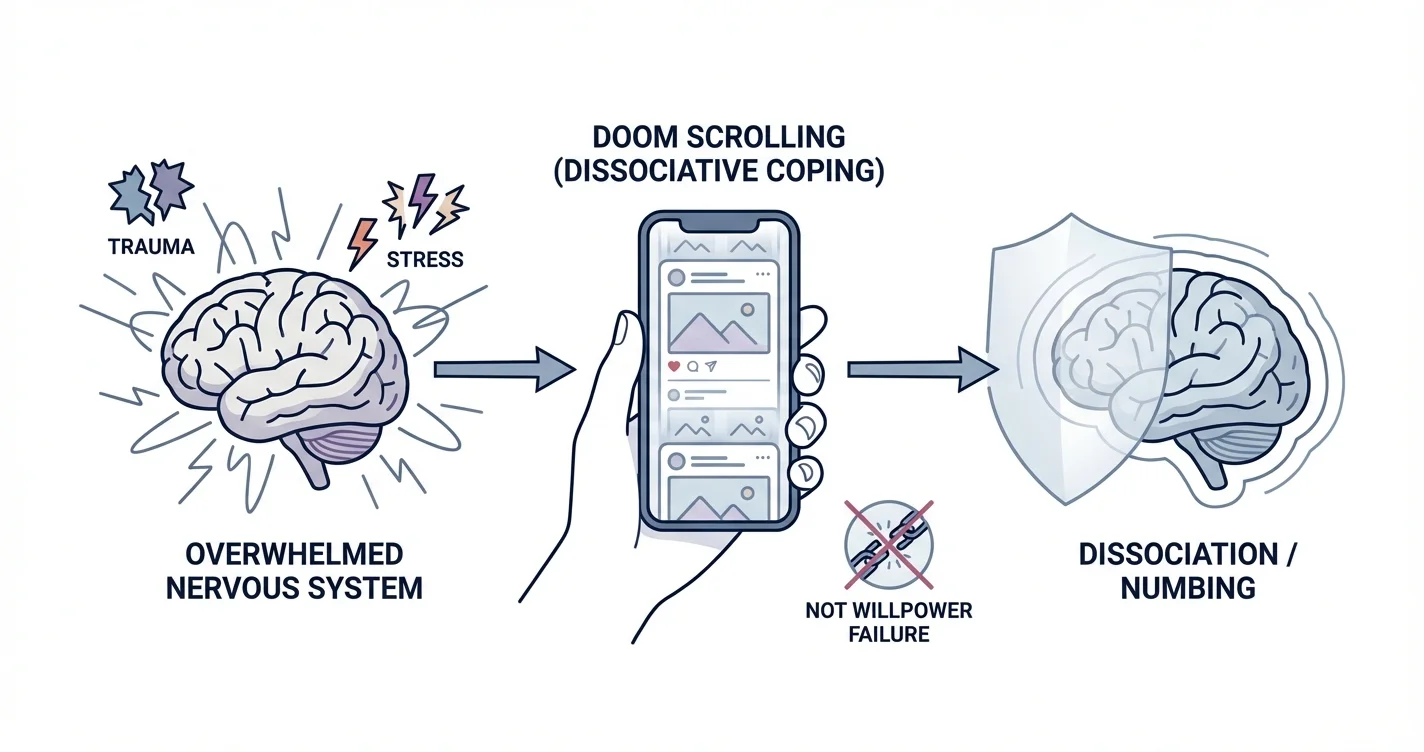
Dissociation exists on a spectrum, from everyday experiences like "highway hypnosis" to more significant disconnections from present-moment awareness. When you scroll compulsively, your conscious decision-making often goes offline while your attention narrows to the endless feed. Mental health practitioners increasingly recognize this state as a form of dissociation—a psychological process where you disconnect from immediate physical or emotional experience.
Studies indicate that dissociation serves a protective function, allowing the nervous system to escape overwhelming sensations or emotions it cannot process in the moment. When you're anxious about an upcoming conversation, exhausted from relational conflict, or carrying background stress from financial concerns, your brain may default to scrolling as an automatic escape route. The content itself becomes almost irrelevant—what matters is the numbing effect, the temporary disappearance of uncomfortable feelings.
This perspective shifts doom scrolling from a moral failure to a trauma response rather than lack of willpower. Your nervous system isn't broken; it's doing exactly what it evolved to do when faced with threats it perceives as inescapable: it checks out. The problem emerges when this protective mechanism becomes your primary coping strategy, leaving underlying stressors unaddressed while the behavior itself creates additional shame and dysfunction.
Why Trauma and Dissociation Explain Doom Scrolling Better Than Willpower Models
The willpower model assumes that behavioral change primarily requires increased self-control and conscious decision-making. This framework works reasonably well for behaviors driven by conscious choice. But when you're dealing with automatic nervous system responses, willpower-based approaches often fail—not because you're weak, but because you're addressing the wrong system.
Trauma-informed perspectives recognize that compulsive behaviors often represent the nervous system's attempts at regulation. Research suggests that trauma and chronic stress can dysregulate the autonomic nervous system, making it harder to maintain emotional equilibrium without external aids. Social media platforms, with their variable reward schedules and endless novelty, provide precisely the stimulation needed to keep an overwhelmed nervous system temporarily occupied.
Consider the typical experience: you feel anxious, pick up your phone, scroll for thirty minutes, and feel worse—yet repeat the pattern hours later. This isn't a logic problem that more willpower can solve. Your conscious mind knows scrolling doesn't help, but your nervous system has learned that it provides momentary relief from intolerable feelings. The behavior persists because it's serving a function, however maladaptive.
Several factors make doom scrolling particularly effective as a dissociative tool:
- Predictable unpredictability: The feed constantly changes, maintaining attention without requiring active engagement
- Emotional intensity without personal risk: You experience strong reactions to content without direct involvement in the situations depicted
- Infinite availability: Unlike substances or other escape mechanisms, your phone is always accessible
- Social normalization: Everyone scrolls, making the behavior feel less concerning than other dissociative patterns
- Cognitive absorption: The combination of text, images, and video demands enough attention to crowd out other thoughts
Mental health practitioners note that clients often describe scrolling sessions in language typically associated with dissociation: "I lost time," "I wasn't really there," "It felt like autopilot." These descriptions suggest doom scrolling functions as a dissociative trauma response versus personal weakness—a nervous system strategy rather than a character defect.
Recognizing Doom Scrolling as a Coping Mechanism for Trauma
Understanding doom scrolling as coping mechanism for trauma not laziness requires examining what triggers the behavior and what needs it meets. Most people don't scroll compulsively when they're feeling genuinely relaxed and connected. The behavior typically emerges during specific nervous system states:
Hyperarousal states: When your nervous system is activated—anxious, angry, restless—scrolling provides stimulation that matches your internal activation level while channeling it into a contained activity. Rather than sitting with uncomfortable energy, you give your hands and eyes something to do.
Hypoarousal states: When you're shut down, depressed, or emotionally numb, scrolling requires minimal energy while providing just enough stimulation to prevent complete collapse into immobility. It occupies the space between doing nothing and doing something meaningful when the latter feels impossible.
Transition avoidance: Scrolling often fills the gap before tasks you're avoiding—difficult conversations, work projects, sleep. It serves as a buffer against whatever feels threatening about the next thing.
Practitioners working with clients around compulsive technology use note that the behavior rarely exists in isolation. It typically appears alongside other regulatory challenges: difficulty identifying emotions, trouble asking for help, perfectionism, or histories of invalidating environments where expressing needs wasn't safe or effective. In these contexts, doom scrolling represents an available option when more relational forms of regulation (talking to someone, asking for support) feel risky or unavailable. If scrolling is one of several ways you keep feelings at a distance, an emotional avoidance test shows whether you mostly push them away, numb them or steer around what stirs them up.
The trauma connection becomes particularly clear when you consider what happens during scrolling sessions. You're often exposed to content that's genuinely distressing—global crises, interpersonal conflicts, polarizing debates—yet continue consuming it. This pattern mirrors how trauma can create a compulsion to return to threatening material, as if the nervous system is trying to process something it hasn't fully metabolized. Some research suggests that repetitive exposure to distressing content may represent an unconscious attempt to build tolerance or make sense of overwhelming experiences.
Shifting from Self-Blame to Nervous System Regulation
If doom scrolling is a dissociation and trauma response instead of self control issues, then effective interventions must address nervous system regulation rather than simply increasing restrictions. This requires a fundamentally different approach than "just put the phone down."
Build awareness without judgment: Start noticing when you reach for your phone. What were you feeling immediately before? What were you avoiding? This isn't about stopping the behavior yet—it's about gathering data on what triggers it. Many people discover they scroll during specific emotional states or when facing particular types of tasks.
Develop alternative regulation strategies: Your nervous system needs options for managing overwhelming states. If scrolling is your only available tool, you'll keep using it regardless of consequences. Practical alternatives include:
- Bilateral stimulation: Walking, tapping alternating knees, or using bilateral audio can help process stuck emotions
- Physiological sighs: Specific breathing patterns (two inhales through the nose, long exhale through the mouth) can shift autonomic state within minutes
- Sensory grounding: Cold water on your face, ice cubes in your hands, or strong sensations can bring you back to present-moment awareness
- Movement: Even brief physical activity can discharge activation that might otherwise drive compulsive scrolling
Address underlying stressors: If your nervous system is constantly overwhelmed, any regulatory strategy will eventually get overwhelmed too. This might mean having difficult conversations you've been avoiding, setting boundaries in draining relationships, or processing past experiences that continue affecting your present nervous system state. Tools like Lovon.app can provide on-demand support for working through stressors and preparing for challenging interactions, offering accessible options for processing emotions when they arise rather than numbing them through scrolling.
Practice intentional disconnection: Rather than scrolling as automatic dissociation, experiment with chosen disconnection. When you notice the urge to scroll, acknowledge what you're feeling and consciously decide whether to engage with it now or create space from it differently. This restores agency—you're choosing your response rather than defaulting to an automatic pattern.
Reframe "failure": When you find yourself in a scrolling session despite intentions otherwise, practice viewing it as information rather than failure. What was happening before you started scrolling? What need were you trying to meet? This data helps you identify patterns and develop more targeted interventions.
Mental health practitioners emphasize that healing compulsive patterns requires addressing them as trauma responses rather than willpower failures. This means approaching yourself with curiosity about what the behavior is trying to solve, rather than judgment about your inability to "just stop."
When Professional Support Becomes Essential
While self-directed strategies can help many people develop healthier relationships with technology, some situations require professional guidance. Consider seeking support from a therapist specializing in trauma or dissociative patterns if you notice:
- Scrolling sessions where you genuinely lose track of significant periods of time (hours you can't account for)
- Compulsive scrolling that persists despite serious consequences (job loss, relationship damage, health problems)
- Inability to tolerate any emotional discomfort without immediately dissociating through scrolling or other behaviors
- History of trauma that remains unprocessed and manifests through various avoidance patterns
- Depression or anxiety that significantly impairs daily functioning
Trauma-focused therapies like EMDR (Eye Movement Desensitization and Reprocessing), Somatic Experiencing, or Internal Family Systems can address the underlying nervous system dysregulation that drives compulsive behaviors. These approaches work with the automatic processes that willpower-based strategies cannot reach.
For ongoing support between therapy sessions or when professional help isn't immediately accessible, platforms like Lovon.app offer voice-based conversations that help process emotions and identify patterns as they emerge. These tools work best as complements to, rather than replacements for, professional treatment when dealing with significant trauma responses.
Conclusion
Reframing doom scrolling as dissociation and trauma response rather than lack of willpower fundamentally changes how you approach the behavior. This perspective removes the moral judgment that often keeps people stuck in shame cycles, replacing it with curiosity about what your nervous system is trying to communicate through compulsive scrolling. When you understand that your brain is attempting to solve a real problem—overwhelming emotions, unprocessed stress, or nervous system dysregulation—you can address the actual issue rather than fighting the symptom.
The path forward isn't about developing more willpower or simply deleting apps. It's about building nervous system capacity, developing alternative regulation strategies, and addressing underlying stressors that make dissociation feel necessary. Some days you'll manage this effectively; others you'll find yourself an hour into a scrolling session. Both outcomes provide useful information about what your system needs and which strategies work in which contexts.
Start by noticing your patterns without judgment, experiment with regulation alternatives that address your specific nervous system states, and seek professional support when self-directed approaches aren't sufficient. Your compulsive scrolling isn't a character flaw—it's a signal worth understanding.
Disclaimer: This is general information, not medical advice or diagnosis. If symptoms are severe, affecting your daily life, or you're having thoughts of self-harm—seek professional help. In the US: call or text 988 (Suicide & Crisis Lifeline). For immediate danger: 911 or local emergency services.
How AI Support Helps You Heal
AI emotional support isn't about replacing human connection — it's about filling the gaps. The moments when you need to talk at 2 AM, when you don't want to burden your friends again, or when you simply need someone to listen without judgment.
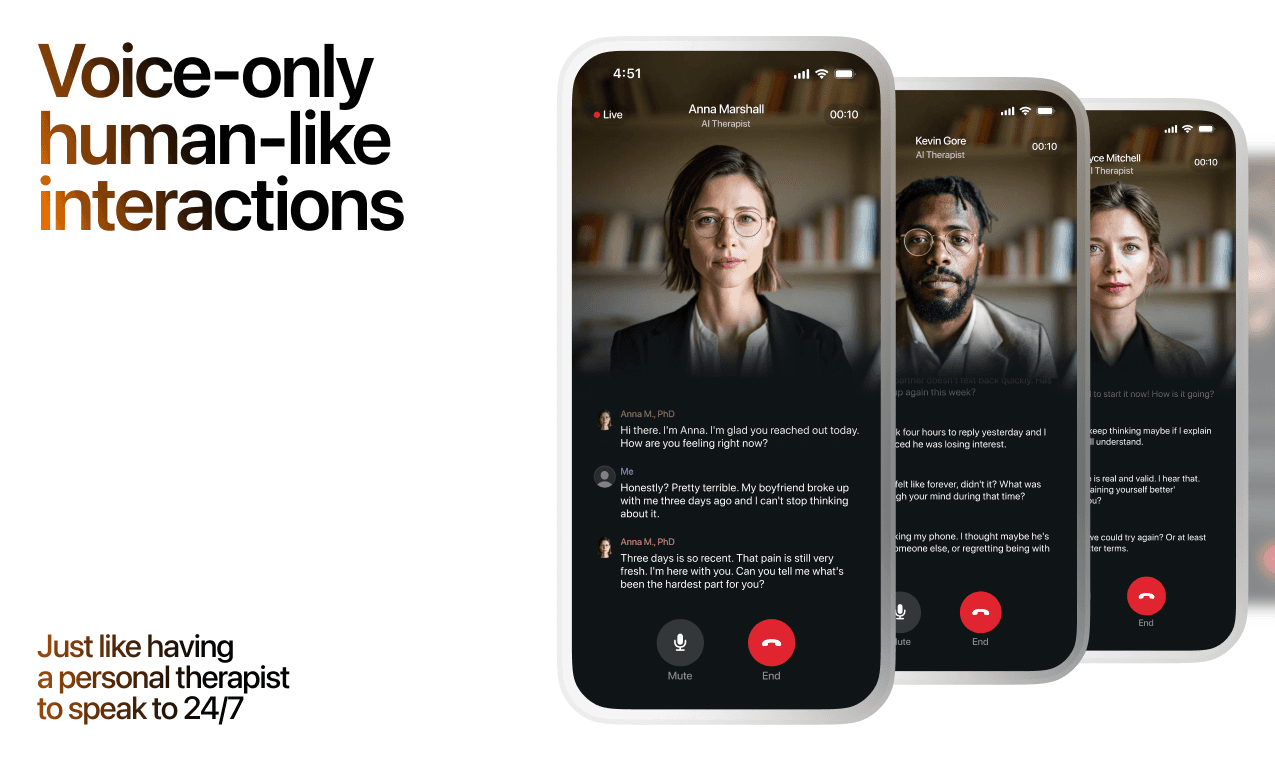
Here's what happens in a typical Lovon session:
You share what's on your mind
There's no script, no intake form, no waiting room. You speak or type whatever you're feeling — in your own words, at your own pace.
Lovon validates and explores
Using frameworks from CBT (Cognitive Behavioral Therapy) and motivational interviewing, Lovon acknowledges your feelings first, then gently helps you explore them. No dismissive "just move on" advice.
You build coping skills together
Lovon doesn't just listen — it actively works with you on evidence-based techniques: thought reframing, urge surfing, behavioral experiments, and more.
What a Session with Lovon Looks Like
When to Seek Professional Help
AI support is a valuable tool, but it's not a replacement for professional care. Please consider reaching out to a licensed therapist if you experience any of the following:
- Persistent thoughts of self-harm or suicide
- Inability to perform daily activities (work, eating, sleeping) for more than 2 weeks
- Turning to alcohol or substances to cope
- Intense anger or desire to harm your ex-partner
- Complete emotional numbness that doesn't improve over time
Crisis Resources (US): If you're in immediate danger, call 988 (Suicide & Crisis Lifeline) or text HOME to 741741 (Crisis Text Line). Available 24/7, free, and confidential.
Outside the US? Find a crisis line in your country
Ready to Start?
Your healing journey can begin right now
A 7-day trial. No judgment. Just a safe space to process what you're going through.
Frequently Asked Questions
Is Lovon a replacement for a real therapist?
Is my conversation with Lovon AI private?
How is Lovon different from ChatGPT for emotional support?
Can I use Lovon if I'm already seeing a therapist?
Can I try Lovon before subscribing?
About the Author

The Lovon Editorial Team
Mental Health & Wellness Content Team
The Lovon Editorial Team develops mental health and wellness content designed to make psychological concepts accessible and actionable. Our goal is to bridge the gap between clinical research and everyday life - helping you understand why your mind works the way it does and what you can do about it....
Related articles
- How to Manage Stress as a Shift Worker (2026 Guide)
Learn how to manage stress as a shift worker in 2026 with sleep timing, light exposure, and coping tools plus 24/7 AI…
- Confirmation Bias in Low Self-Awareness: Agreement Over Understanding
When someone struggles with low self-awareness, they often develop a predictable pattern: they seek out people who will…
- Coping With Depression Alone in 2026: What Actually Helps
Coping with depression alone in 2026: a 7-step plan for the hours between therapy sessions, troubleshooting fixes, and…
- Coping Tools for Stress: What Works in 2026
Find the coping tools for stress that actually work in 2026 — box breathing, reframing, movement, and daily processing…
See also
Quizzes
- Perfectionism Test: What Are Your Standards Costing?
See what your standards actually cost, in 3 minutes.
- What Stage of Grief Am I In? Free 12-Question Quiz
See what your grief is actually doing, in 3 minutes.
Free tools
- How to Reconnect With an Old Friend
A chat for how to reconnect with an old friend, starting with the text you have been meaning to send for a year. Tell it…
- Vent to an AI
Need to vent and there is nobody to call, or nobody you want to tell? Type it here. You are talking to an AI listener…
From the wiki
- How to stop maladaptive daydreaming?
Maladaptive daydreaming is immersive waking fantasy that eats hours, usually with music and pacing attached. You rarely…
Disclaimer: This article is for informational purposes only and does not constitute medical advice, diagnosis, or treatment. Always seek the advice of your physician or other qualified health provider with any questions you may have regarding a medical condition. If you are in crisis or think you may have an emergency, call 988 (Suicide & Crisis Lifeline) or go to the nearest emergency room. Outside the US? Find a crisis line in your country.