
Emotionally Immature Parents: Minimizing Harm and Requiring Justification
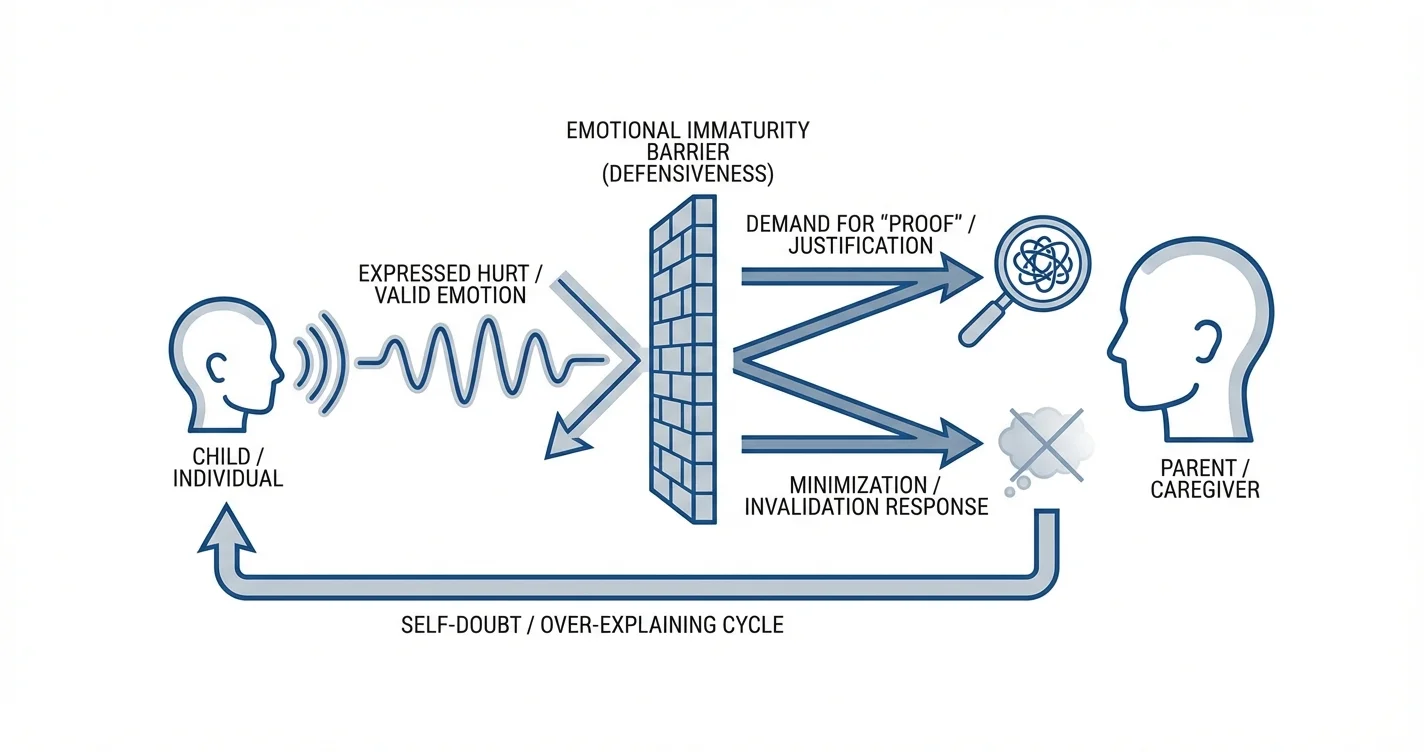
When emotionally immature parents minimize harm and require excessive justification for hurt feelings, they create a confusing reality where your pain becomes

Key Takeaways
- Deflection and counter-accusations: "Well, what about all the times you hurt me?"
- Minimization: "That was nothing," "You're overreacting," "I was just joking"
- Demanding proof: "Explain to me exactly why that hurt you," often followed by dismantling your explanation
- Emotional flooding: Crying, becoming enraged, or playing victim when confronted
- Gaslighting: Denying events occurred or insisting you misunderstood their intentions
Introduction
When emotionally immature parents minimize harm and require excessive justification for hurt feelings, they create a confusing reality where your pain becomes less important than their comfort. You might find yourself over-explaining why a comment stung, why a forgotten promise mattered, or why their behavior left you feeling small—only to be met with defensiveness, eye-rolling, or accusations of being "too sensitive." This dynamic doesn't just dismiss individual moments of pain; it teaches you to doubt your own emotional experiences and erodes your confidence in naming what hurts.
This pattern represents a specific form of emotional invalidation rooted in a parent's inability to tolerate discomfort, manage their own feelings of guilt or shame, or acknowledge impact without intent. Understanding this dynamic—and recognizing it as a reflection of parental limitations rather than evidence of your inadequacy—is essential for breaking free from patterns that may continue affecting your relationships well into adulthood.
What Emotional Immaturity Looks Like in Parent-Child Dynamics
Emotional immaturity in parents manifests as a limited capacity to regulate their own emotions, empathize with others' experiences, or hold space for feelings that challenge their self-image. Research in developmental psychology suggests that emotionally immature individuals often operate with an external locus of validation, meaning their sense of stability depends heavily on external approval and the absence of criticism or negative feedback.
When you express hurt to an emotionally immature parent, you're essentially asking them to do something they're not equipped for: acknowledge that their behavior caused harm, sit with the discomfort of that reality, and validate your experience without centering their own feelings. Instead, what typically happens is a defensive response that prioritizes their emotional equilibrium over your need for acknowledgment.
Common behaviors include:
- Deflection and counter-accusations: "Well, what about all the times you hurt me?"
- Minimization: "That was nothing," "You're overreacting," "I was just joking"
- Demanding proof: "Explain to me exactly why that hurt you," often followed by dismantling your explanation
- Emotional flooding: Crying, becoming enraged, or playing victim when confronted
- Gaslighting: Denying events occurred or insisting you misunderstood their intentions
These responses share a common thread: they redirect attention away from your experience and back to the parent's need to avoid uncomfortable feelings like guilt, shame, or inadequacy.
Why Emotionally Immature Parents Require Justification for Your Feelings
The demand for excessive justification serves multiple psychological functions for the emotionally immature parent. First, it creates a barrier to accountability—if your explanation is never "good enough," they never have to acknowledge wrongdoing. Second, it positions them as the arbiter of what constitutes legitimate hurt, maintaining control over the emotional reality of the relationship. Third, it externalizes their internal discomfort by making your reaction the problem rather than their behavior.
This pattern often stems from their own developmental history. Practitioners working with adult children of emotionally immature parents note that these parents frequently grew up in environments where emotions were treated as inconvenient, shameful, or threatening. They never learned that feelings can coexist with relationship security—that you can acknowledge causing harm without your entire identity collapsing.
From a neurobiological perspective, emotional regulation develops through co-regulation in early relationships. When caregivers consistently attune to a child's emotional states and help them process difficult feelings, the child internalizes these skills. Parents who lacked this foundation often remain in a reactive state, experiencing critique or expressions of hurt as existential threats rather than opportunities for connection and repair.
The justification demand also reveals a fundamental misunderstanding of emotions: emotionally immature parents often believe that feelings require logical justification to be valid. They may insist that if they didn't intend harm, you shouldn't feel harmed. This conflates impact with intent and denies the reality that our nervous systems respond to impact regardless of the other person's intentions.
When working through these dynamics, tools like Lovon.app can provide a space to process the confusion and self-doubt that arise when your feelings are consistently questioned. Having a reflective listener help you identify patterns—such as how often you find yourself justifying basic emotional reactions—can clarify what's happening in these interactions.
The Cost of Chronic Emotional Invalidation
Growing up with parents who dismiss your emotions while requiring you to prove your hurt creates lasting effects that extend far beyond childhood. Studies examining the impact of invalidating environments indicate associations with difficulties in emotion regulation, relationship satisfaction, and self-concept formation in adulthood.
Specific patterns that often emerge include:
- Self-invalidation: You internalize the message that your feelings need justification, leading to chronic self-doubt and difficulty trusting your own experiences
- Over-explaining: You develop a habit of providing excessive context and justification in all relationships, even with people who don't demand it
- Emotional suppression: You learn to minimize or hide feelings to avoid the exhausting process of defending them
- Relationship anxiety: You may struggle with fear of expressing needs or concerns, anticipating dismissal or having to "prove" yourself
- Difficulty setting boundaries: If your pain was never sufficient reason for behavior to change, you may struggle to assert limits as an adult
These effects don't represent personal failings—they're adaptive responses to an environment where expressing hurt was met with defensiveness rather than care. Clinical work with individuals from invalidating family systems shows that many develop a heightened sensitivity to others' emotional states (hypervigilance) while simultaneously disconnecting from their own internal experience.
The financial and relational costs can be significant: difficulty advocating for yourself in workplace conflicts, tolerating mistreatment in friendships or romantic relationships, or spending years in therapy unpacking why you feel the need to earn the right to have feelings.
Recognizing the Cycle: Common Scripts and Patterns
Emotionally immature parents who minimize harm while demanding justification tend to follow predictable patterns. Recognizing these scripts can help you see the dynamic clearly rather than getting lost in the content of individual arguments.
The "Prove It" Pattern: You express hurt. Parent demands detailed explanation. You provide explanation. Parent finds logical "holes" in your reasoning or argues their perspective should negate your feelings. You feel frustrated and unheard. Parent concludes you're being unfair or overly emotional.
The "But I Didn't Mean To" Pattern: You name the impact of their behavior. Parent immediately centers their intentions: "But I didn't mean it that way!" The conversation becomes about their good intentions rather than your experience. Your hurt is treated as an accusation rather than information.
The "You're Too Sensitive" Pattern: You share that something bothered you. Parent dismisses the severity: "That's nothing to get upset about," "You need thicker skin," "Other people wouldn't react this way." Your emotional responsiveness becomes the problem, not their behavior.
The "What About Me" Pattern: You attempt to discuss how you were hurt. Parent redirects to their own hurts, struggles, or sacrifices: "After everything I've done for you..." "You have no idea how hard I have it..." The focus shifts entirely to their emotional experience, and you end up comforting them.
Boundaries coaches working with cycle breakers—individuals working to interrupt dysfunctional family patterns—emphasize that recognizing these cycles is the first step toward responding differently. When you can name "this is the 'prove it' pattern again," you're less likely to get pulled into the content and more likely to protect your emotional energy.
Strategies for Protecting Your Emotional Well-Being
When dealing with parents who downplay your pain and demand justification, the goal isn't to change them—emotional maturity isn't something you can argue someone into. Instead, focus on protecting your own well-being and maintaining clarity about your reality.
Limit What You Share: You don't need to process every hurt feeling with the person who caused it, especially if that person consistently responds with invalidation. Consider which topics you can discuss productively and which ones reliably lead to defensiveness. It's not dishonest to maintain privacy around your emotional life with people who can't hold space for it.
Separate Impact from Intent: Remind yourself that someone can cause harm without malicious intent, and that harm still deserves acknowledgment. You don't need to prove their intentions were bad to have a valid emotional response. The formula isn't "bad intent = valid hurt"; it's simply "I experienced this as painful, and that's information about my experience."
Stop the Justification Cycle: When you notice yourself over-explaining, pause. Try responses like: "I'm not asking you to agree with how I feel, just to hear that I feel it," or "I'm sharing my experience, not building a legal case." If they continue demanding justification, you can disengage: "I can see we're not going to find common ground here. I need to step away from this conversation."
Find Validation Elsewhere: Seek relationships with people who can validate your emotional experiences without requiring extensive justification. This might be friends, partners, therapists, or support groups. When you experience consistent validation in other relationships, it becomes easier to recognize invalidation for what it is rather than internalizing it as truth.
Document Patterns: If you find yourself doubting your own experiences, keep notes after difficult interactions. Write down what happened, what you felt, and how the conversation unfolded. Over time, patterns become undeniable, which can help counter gaslighting and self-doubt.
Processing these experiences with tools like Lovon.app between difficult interactions can help you maintain clarity about your reality. Having space to talk through "here's what happened, here's how I feel about it" with a listener that reflects rather than judges can reinforce your trust in your own perceptions.
Moving Forward: Healing and Boundary Setting
Healing from a childhood with emotionally immature parents who minimized harm while requiring justification is an ongoing process, not a destination. Many adult children report that the work involves both grieving what they didn't receive and actively building new patterns in their current relationships.
Key elements of this process often include:
Developing self-validation: Learning to acknowledge your own feelings as legitimate without external approval. This might sound like internal dialogues: "That hurt, and it makes sense that it hurt, regardless of whether they acknowledge it."
Adjusting expectations: Accepting that your parents may never develop the capacity to validate your emotions doesn't mean you were wrong to need that validation—it means they have limitations. Grieving this reality allows you to stop trying to extract something they can't provide.
Setting protective boundaries: This might range from limiting contact to changing topics when conversations become invalidating. Boundaries aren't punishments; they're acknowledgments of what you need to protect your well-being.
Building skills they didn't model: Actively practicing emotional attunement with others, learning to sit with discomfort in relationships, and developing the capacity to acknowledge impact separate from intent—essentially, becoming the emotionally mature person you needed.
Therapeutic approaches that some people find helpful include schema therapy (which addresses early maladaptive patterns), internal family systems (which works with different parts of self), and attachment-focused therapy. Working with a therapist who understands family systems and invalidating environments can provide both validation and tools for change.
When to Seek Professional Help
If you're experiencing any of the following, consider reaching out to a mental health professional who specializes in family dynamics or complex trauma:
- Persistent difficulty trusting your own emotional responses across multiple relationships
- Significant anxiety or depression related to family interactions
- Intrusive thoughts or emotional flashbacks after family contact
- Difficulty maintaining boundaries despite clear intentions
- Substance use or other coping mechanisms that feel out of control
- Self-harm thoughts or behaviors
- Relationship patterns that consistently mirror the invalidation you experienced growing up
Therapists specializing in adult children of dysfunctional families, attachment issues, or complex PTSD can provide targeted support. Some modalities specifically address the internalized messages from invalidating environments and help rebuild trust in your own perceptions and feelings.
Conclusion
When emotionally immature parents minimize harm and require excessive justification for hurt feelings, they create an environment where expressing pain becomes more costly than suppressing it. This pattern reflects their own developmental limitations and inability to tolerate discomfort, not the illegitimacy of your feelings or an oversensitivity on your part. Recognizing this dynamic for what it is—a defense mechanism rooted in emotional immaturity rather than a reflection of reality—is essential for healing.
Breaking free from these patterns involves building internal validation, setting protective boundaries, seeking relationships that offer genuine emotional attunement, and sometimes grieving the reality that your parents may never provide the acknowledgment you deserved. The work isn't about fixing them or finally finding the right words to make them understand; it's about reclaiming your right to have feelings without justification and building a life where your emotional reality is honored—first by you, and then by the people you choose to keep close.
Disclaimer: This is general information, not medical advice or diagnosis. If symptoms are severe, affecting your daily life, or you're having thoughts of self-harm—seek professional help. In the US: call or text 988 (Suicide & Crisis Lifeline). For immediate danger: 911 or local emergency services.
How AI Support Helps You Heal
AI emotional support isn't about replacing human connection — it's about filling the gaps. The moments when you need to talk at 2 AM, when you don't want to burden your friends again, or when you simply need someone to listen without judgment.
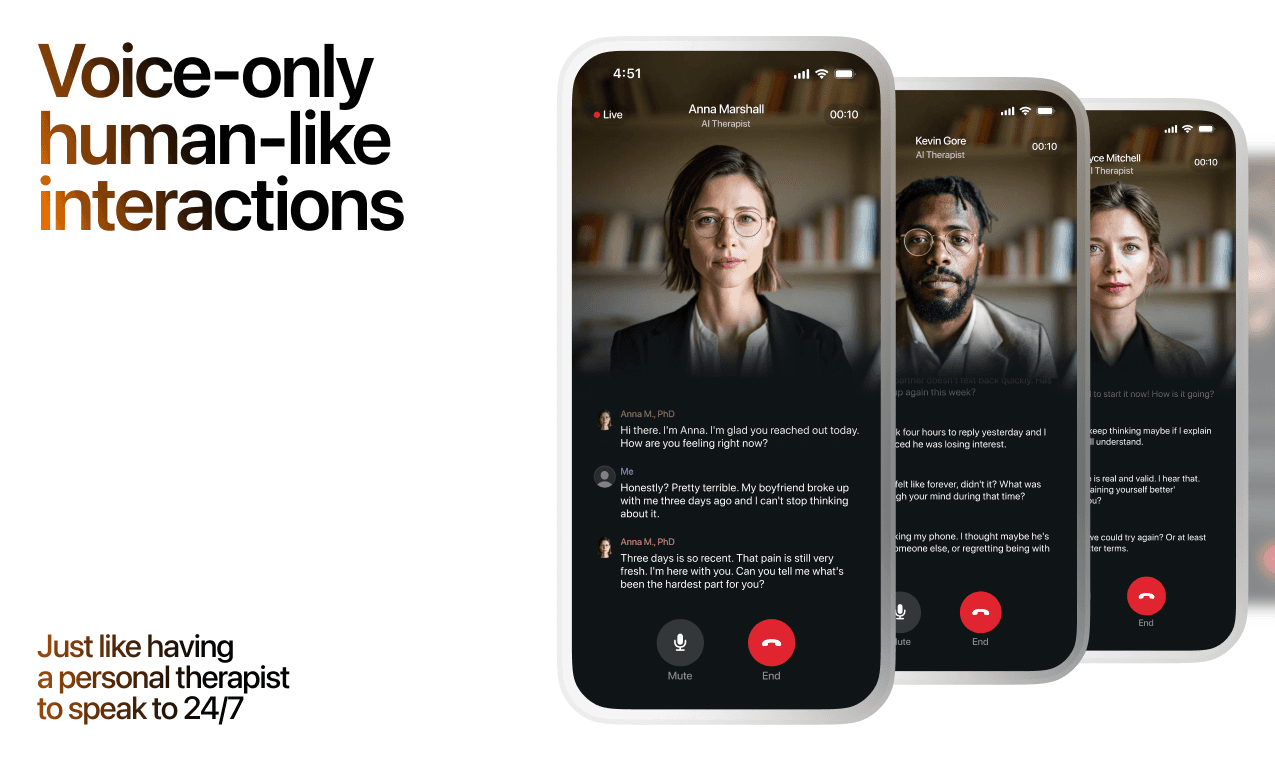
Here's what happens in a typical Lovon session:
You share what's on your mind
There's no script, no intake form, no waiting room. You speak or type whatever you're feeling — in your own words, at your own pace.
Lovon validates and explores
Using frameworks from CBT (Cognitive Behavioral Therapy) and motivational interviewing, Lovon acknowledges your feelings first, then gently helps you explore them. No dismissive "just move on" advice.
You build coping skills together
Lovon doesn't just listen — it actively works with you on evidence-based techniques: thought reframing, urge surfing, behavioral experiments, and more.
What a Session with Lovon Looks Like
When to Seek Professional Help
AI support is a valuable tool, but it's not a replacement for professional care. Please consider reaching out to a licensed therapist if you experience any of the following:
- Persistent thoughts of self-harm or suicide
- Inability to perform daily activities (work, eating, sleeping) for more than 2 weeks
- Turning to alcohol or substances to cope
- Intense anger or desire to harm your ex-partner
- Complete emotional numbness that doesn't improve over time
Crisis Resources (US): If you're in immediate danger, call 988 (Suicide & Crisis Lifeline) or text HOME to 741741 (Crisis Text Line). Available 24/7, free, and confidential.
Outside the US? Find a crisis line in your country
Ready to Start?
Your healing journey can begin right now
A 7-day trial. No judgment. Just a safe space to process what you're going through.
Frequently Asked Questions
Is Lovon a replacement for a real therapist?
Is my conversation with Lovon AI private?
How is Lovon different from ChatGPT for emotional support?
Can I use Lovon if I'm already seeing a therapist?
Can I try Lovon before subscribing?
About the Author

The Lovon Editorial Team
Mental Health & Wellness Content Team
The Lovon Editorial Team develops mental health and wellness content designed to make psychological concepts accessible and actionable. Our goal is to bridge the gap between clinical research and everyday life - helping you understand why your mind works the way it does and what you can do about it....
Related articles
- AI Therapy App for Foster Parents: 2026 Verdict
Foster parents managing compassion fatigue and secondary trauma get on-demand voice support with Lovon's AI therapy app…
- Father Wound vs Mother Wound: Key Differences (2026)
Father wound vs mother wound — not the same pain. Learn the core differences, overlapping patterns, and how to start…
- Emotionally Immature Parents Recovery: A Practical Guide
Growing up with emotionally immature parents leaves lasting imprints on the nervous system that extend far beyond…
- How to Co-Parent After Divorce in 2026: Step-by-Step Guide
How to co-parent after divorce in 2026: write the plan, script the conversations, manage your own stress. Practical…
See also
Quizzes
- Boundaries Test: Free 12-Question Self-Check
See where your boundaries slip, in 3 minutes.
- Am I a Red Flag? Honest Self-Check
Honest self-check in 5 minutes.
Free tools
- AI Relationship Coach
Get free relationship advice and family counselling guidance with our AI Relationship Coach.
- How to Confront a Narcissistic Parent
Most of these conversations fail because you went in wanting three things at once. Tell it what you want to raise, and…
From the wiki
- Why do I feel lonely all of a sudden?
Sudden loneliness usually traces back to something that quietly ended in the last few months: a routine, a shared class…
Disclaimer: This article is for informational purposes only and does not constitute medical advice, diagnosis, or treatment. Always seek the advice of your physician or other qualified health provider with any questions you may have regarding a medical condition. If you are in crisis or think you may have an emergency, call 988 (Suicide & Crisis Lifeline) or go to the nearest emergency room. Outside the US? Find a crisis line in your country.