
Feedback in Relationship Therapy When Avoidant Partners Fear Failure
When avoidant partners enter relationship therapy, feedback often becomes a minefield. What therapists intend as constructive guidance can trigger deep-seated

Key Takeaways
- Feedback targets specific behaviors, not character: Instead of "you're emotionally unavailable," the reframe becomes
- Feedback reveals impact rather than assigns blame: The focus shifts from what's wrong with the avoidant partner to
- Feedback creates collaborative problem-solving: Partners work together to understand dynamics rather than one person
- All feedback, regardless of delivery, triggers intense shame spirals or dissociation: If even perfectly-worded,
- The avoidant partner consistently interprets neutral or positive statements as criticism: This cognitive distortion
Introduction
When avoidant partners enter relationship therapy, feedback often becomes a minefield. What therapists intend as constructive guidance can trigger deep-seated fears of inadequacy, causing these individuals to shut down precisely when connection should deepen. Understanding the role of feedback in building intimacy when avoidant partners perceive it as failure represents one of the most challenging dynamics in couples counseling. This pattern stems from attachment wounds where vulnerability equated to rejection, making even gentle observations feel like proof of fundamental unworthiness. This article examines how relationship professionals navigate this delicate balance, using feedback as a tool for intimacy rather than a trigger for disconnection. Based on expert analysis of attachment dynamics and therapeutic approaches, we'll explore strategies that honor both partners' needs while creating space for genuine emotional closeness.
Understanding Avoidant Attachment and the Feedback Paradox
Avoidant attachment develops as a protective strategy, not from lack of feeling. Individuals with this attachment style learned early that dependence threatened their safety or autonomy, so they constructed elaborate defenses against needing others. This creates a fundamental paradox in relationship therapy: the feedback necessary for growth feels like the vulnerability they've spent a lifetime avoiding.
These partners often pursue connection initially but withdraw as emotional intimacy deepens. When asked for consistency or greater emotional presence, they tend to minimize and deflect with phrases like "I just need time" or "you're asking for too much." This response isn't manipulation—it's a nervous system protecting itself from perceived danger.
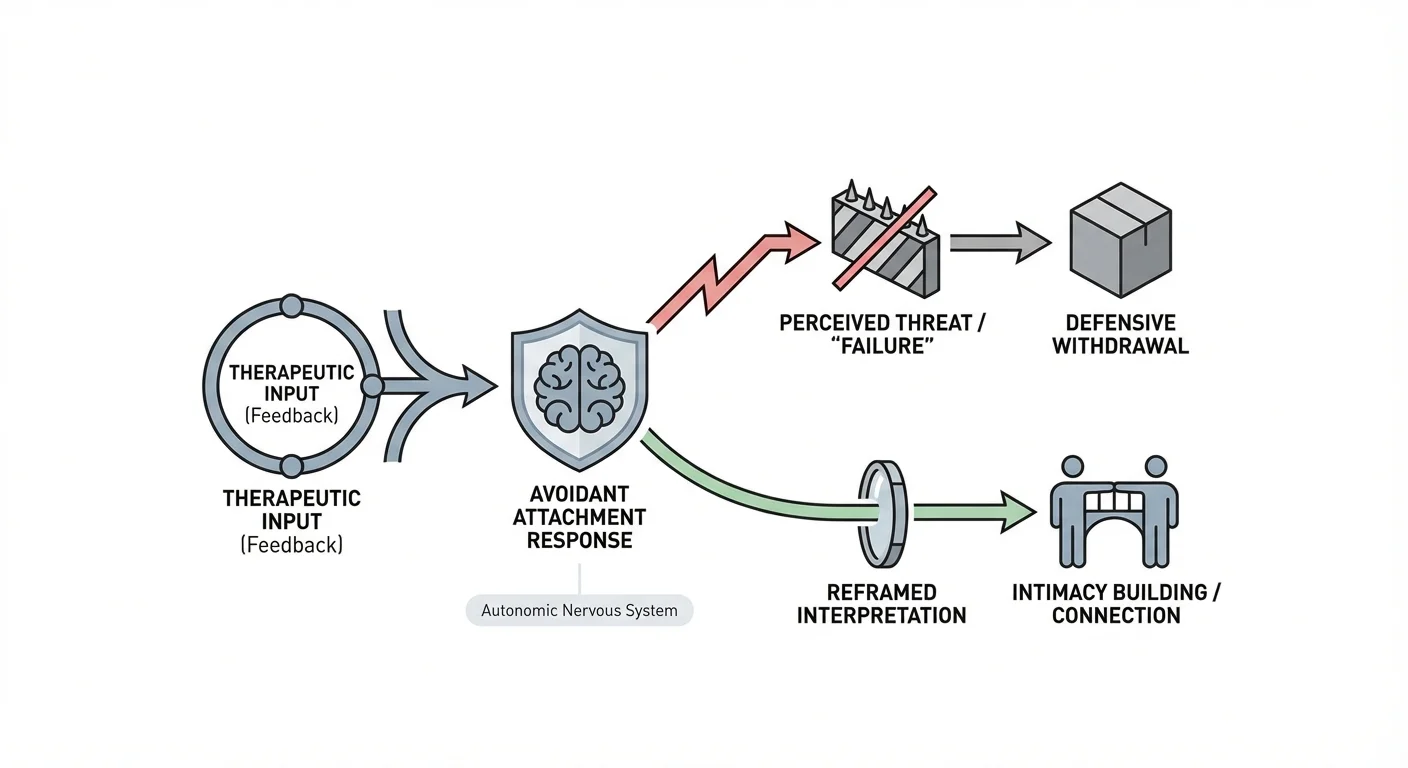
Research on attachment theory indicates that avoidant individuals experience physiological stress responses to emotional closeness similar to threat detection. Their autonomic nervous system reads vulnerability as risk, making therapeutic feedback feel like evidence they've failed at the relationship rather than an opportunity to improve it. This neurobiological reality means therapists must approach feedback with careful attention to the underlying fear driving the defensive response.
The challenge intensifies because healthy relationships require feedback loops where partners share needs, express concerns, and adjust behaviors accordingly. Without this communication, resentment accumulates and connection erodes. Yet for avoidant partners, each piece of feedback can feel like confirmation of the narrative they fear most: that they're fundamentally inadequate and their partner would be better off without them.
Reframing Feedback as Intimacy Building Rather Than Failure Identification
Effective couples therapy reframes feedback from a judgment about inadequacy to a pathway toward deeper understanding. This shift requires deliberate language and conceptual changes that help avoidant partners separate their identity from their behaviors.
Therapists working with these dynamics emphasize several key distinctions:
- Feedback targets specific behaviors, not character: Instead of "you're emotionally unavailable," the reframe becomes "when I share difficult feelings, I notice you change the subject, and I'm left feeling alone with those emotions"
- Feedback reveals impact rather than assigns blame: The focus shifts from what's wrong with the avoidant partner to how certain patterns affect both people's experience of connection
- Feedback creates collaborative problem-solving: Partners work together to understand dynamics rather than one person fixing their "broken" attachment style
This approach acknowledges that avoidant partners often perceive even gentle feedback through the lens of old trauma as personal failure. When a therapist or partner says "I need more emotional presence," the avoidant individual may hear "you're deficient and disappointing." Therapeutic reframing explicitly names this translation error and offers alternative interpretations.
One effective technique involves externalizing the pattern itself. Rather than "you shut down," the language becomes "the shutting-down pattern showed up again." This subtle shift creates psychological distance between the person and the behavior, reducing shame and increasing curiosity. The couple can then examine the pattern as something affecting both of them rather than something one person is doing wrong.
Tools like Lovon.app provide on-demand support for individuals processing these dynamics between therapy sessions. When feedback from a partner triggers overwhelming feelings of failure, having immediate access to reflective conversation can help avoidant individuals identify their emotional response and separate it from objective reality before they withdraw completely.
Practical Strategies for Delivering Feedback Without Triggering Defensive Shutdown
The delivery method for feedback significantly impacts whether avoidant partners can receive it as information rather than indictment. Relationship professionals employ specific techniques that create safety while maintaining honesty.
Sandwich feedback with affirmation and commitment: Begin by explicitly stating your continued investment in the relationship and appreciation for the person. Share the specific concern or need. Close by reaffirming that this feedback comes from wanting more closeness, not less. This structure provides reassurance that the relationship isn't threatened even as you request change.
Use "I" statements that focus on your experience: Frame observations as your internal reality rather than objective truth about your partner. "When plans change last minute, I feel anxious and start questioning whether I matter to you" creates less defensiveness than "you're unreliable and inconsiderate."
Create time buffers around feedback conversations: Avoidant partners need processing time. Schedule feedback discussions in advance rather than ambushing your partner when emotions run high. Allow space after the conversation for them to reflect before expecting immediate response or behavior change.
Acknowledge the difficulty of receiving feedback: Explicitly recognize that hearing concerns feels vulnerable and may trigger old fears. This metacommunication—talking about the process of talking—helps avoidant partners feel seen rather than pathologized for their discomfort.
Focus on small, specific changes rather than sweeping personality overhauls: Request concrete adjustments like "text me if you'll be more than 30 minutes late" rather than abstract demands like "be more considerate." Achievable changes build confidence and reduce the overwhelming sense that fundamental transformation is required.
Studies on therapeutic alliance suggest that the quality of the relationship between therapist and clients predicts outcomes more reliably than specific techniques. For avoidant partners, this means creating a therapeutic environment where they can gradually practice receiving feedback without abandonment as the consequence. Over time, this corrective experience rewires the association between vulnerability and danger.
Building Intimacy Through Micro-Moments of Positive Feedback
While addressing concerns gets attention in therapy, building intimacy with avoidant partners requires disproportionate focus on positive feedback. These individuals often have well-developed sensors for criticism and underdeveloped receptors for appreciation, having learned that positive attention was unreliable or came with strings attached.
Emotional connection accumulates through small moments of attunement repeated consistently over time, not through grand gestures or dramatic reconciliations. Relationships erode in these tiny moments of disconnection—the overlooked bid for attention, the distracted response, the minimized concern—and they're repaired the same way.
Notice and name moments of vulnerability: When your avoidant partner shares a feeling, makes a bid for connection, or takes an emotional risk, explicitly acknowledge it. "I noticed you told me about your difficult day instead of just saying 'fine'—I really appreciate you letting me in." This reinforces that vulnerability leads to positive outcomes, gradually updating their internal working model of relationships.
Express appreciation for their specific attachment-countering behaviors: When avoidant partners push through discomfort to show up emotionally, name exactly what they did. "When you stayed in the conversation even though I could tell you wanted to leave, that meant everything to me." This type of feedback helps them recognize their growth and motivates continued effort.
Separate frequency from intent: Avoidant partners may demonstrate care less frequently but with equal sincerity. Acknowledge the gestures they do make rather than only highlighting what's missing. "I know spontaneous affection isn't natural for you, which makes it even more meaningful when you initiate."
Use feedback to build competence, not just identify deficits: Share the positive impact of their actions with specificity. "When you checked in with me during your work trip, I felt so secure and cared for—it helped me relax instead of spiraling with anxiety." This teaches them what works rather than only what doesn't.
For avoidant individuals working on these patterns independently, resources like Lovon.app offer opportunities to practice receiving and processing both positive and constructive feedback in a low-stakes environment. The AI voice companion can help them explore why appreciation feels uncomfortable or suspicious, gradually increasing their tolerance for genuine acknowledgment.
When Feedback Patterns Indicate Deeper Therapeutic Work Is Needed
Some feedback dynamics signal that individual therapy for the avoidant partner should complement couples work. Recognizing these patterns helps couples avoid the common trap of relationship therapy becoming individual therapy in a couple's format, where one partner's healing needs dominate the shared work.
Consider additional individual support when:
-
All feedback, regardless of delivery, triggers intense shame spirals or dissociation: If even perfectly-worded, gentle observations cause disproportionate reactions, the individual's trauma response may require dedicated attention before they can fully participate in couples feedback processes.
-
The avoidant partner consistently interprets neutral or positive statements as criticism: This cognitive distortion suggests deeply ingrained negative self-beliefs that need direct therapeutic intervention beyond what couples work can address.
-
Feedback creates prolonged withdrawal periods that damage the relationship: When receiving feedback leads to days or weeks of emotional unavailability or relationship-threatening withdrawal, individual work on distress tolerance becomes essential.
-
The avoidant partner has no awareness of their internal experience during feedback: If they can't identify what they're feeling when feedback occurs, they need support developing basic emotional literacy before engaging in complex feedback exchanges.
Secure relationships don't require one partner to shrink their needs to keep the peace. When the accommodations necessary to avoid triggering the avoidant partner become unsustainable, both individual healing and couples work are needed. The anxious or secure partner may also need their own therapy to process the emotional impact of consistent withdrawal and to develop boundaries that protect their wellbeing.
Measuring Progress and Maintaining Momentum
Building intimacy through feedback with avoidant partners requires patience and clear markers of progress. Because change happens gradually, couples benefit from tracking small improvements that might otherwise go unnoticed.
Positive indicators include:
-
Decreased time between feedback and re-engagement: If your partner initially needed three days to process feedback and now needs three hours, that's significant progress in their nervous system regulation.
-
Increased curiosity about their own reactions: When avoidant partners begin asking "why did that comment hit me so hard?" they're developing the self-awareness necessary for change.
-
Willingness to stay in discomfort slightly longer: Tolerating uncomfortable conversations for even a few extra minutes before needing a break demonstrates expanding capacity for vulnerability.
-
Initiating feedback conversations themselves: When avoidant partners begin sharing their own needs or concerns, they're practicing the reciprocal vulnerability that builds intimacy.
-
Distinguishing between types of feedback: Recognizing the difference between harsh criticism and gentle observation shows developing discernment rather than treating all feedback as threat.
Maintain momentum by celebrating these incremental changes explicitly. Avoidant partners often dismiss their own progress or attribute it to their partner's accommodation rather than their own effort. Naming growth helps consolidate gains and motivates continued work.
Regular check-ins about the feedback process itself also help. Ask questions like "what made that conversation feel safer than similar ones in the past?" or "what would help you receive that feedback more easily next time?" This meta-level dialogue builds shared understanding of what works for your specific relationship dynamic.
When to Seek Professional Help
If you're navigating feedback challenges with an avoidant partner, professional support becomes particularly important when:
- Feedback consistently leads to relationship-threatening ruptures or extended disconnection
- Either partner experiences severe anxiety, depression, or hopelessness about the relationship
- Patterns of criticism and withdrawal have created entrenched resentment that obscures positive aspects of the relationship
- Safety concerns arise, including emotional abuse, manipulation, or threats of abandonment
- One or both partners struggle with self-harm thoughts or behaviors
Licensed therapists specializing in attachment-based couples therapy, emotionally focused therapy (EFT), or the Gottman method can provide structured support for these dynamics. Individual therapists with trauma specialization can help avoidant partners address the underlying wounds that make feedback feel like failure.
Between sessions or while waiting for therapy to begin, on-demand resources can provide immediate support. When a difficult feedback conversation leaves you feeling overwhelmed, being able to process those emotions in real-time helps prevent destructive reactions.
Conclusion
Navigating feedback in relationship therapy when avoidant partners perceive it as failure requires fundamental shifts in how couples communicate about needs and concerns. The role of feedback in building intimacy depends on reframing observations from evidence of inadequacy to opportunities for deeper connection. By understanding the neurobiological and emotional realities underlying avoidant attachment, couples can develop feedback practices that honor both partners' experiences while creating space for genuine vulnerability.
Progress happens through consistent small efforts: reframing language, acknowledging difficulty, celebrating micro-moments of connection, and maintaining patience with the non-linear nature of attachment healing. Whether working with a couples therapist, using tools like Lovon.app for between-session support, or engaging in structured self-directed work, the goal remains the same—transforming feedback from a threat into a pathway toward the intimacy both partners ultimately desire.
The journey requires courage from both individuals: the avoidant partner must risk vulnerability despite deep fears of inadequacy, while their partner practices patience with a pace of change that can feel frustratingly slow. With commitment and appropriate support, feedback can become what it was always meant to be—not proof of failure, but evidence that both people care enough to keep trying.
Disclaimer: This is general information, not medical advice or diagnosis. If symptoms are severe, affecting your daily life, or you're having thoughts of self-harm—seek professional help. In the US: call or text 988 (Suicide & Crisis Lifeline). For immediate danger: 911 or local emergency services.
How AI Support Helps You Heal
AI emotional support isn't about replacing human connection — it's about filling the gaps. The moments when you need to talk at 2 AM, when you don't want to burden your friends again, or when you simply need someone to listen without judgment.
Here's what happens in a typical Lovon session:
You share what's on your mind
There's no script, no intake form, no waiting room. You speak or type whatever you're feeling — in your own words, at your own pace.
Lovon validates and explores
Using frameworks from CBT (Cognitive Behavioral Therapy) and motivational interviewing, Lovon acknowledges your feelings first, then gently helps you explore them. No dismissive "just move on" advice.
You build coping skills together
Lovon doesn't just listen — it actively works with you on evidence-based techniques: thought reframing, urge surfing, behavioral experiments, and more.
What a Session with Lovon Looks Like

When to Seek Professional Help
AI support is a valuable tool, but it's not a replacement for professional care. Please consider reaching out to a licensed therapist if you experience any of the following:
- Persistent thoughts of self-harm or suicide
- Inability to perform daily activities (work, eating, sleeping) for more than 2 weeks
- Turning to alcohol or substances to cope
- Intense anger or desire to harm your ex-partner
- Complete emotional numbness that doesn't improve over time
Crisis Resources (US): If you're in immediate danger, call 988 (Suicide & Crisis Lifeline) or text HOME to 741741 (Crisis Text Line). Available 24/7, free, and confidential.
Outside the US? Find a crisis line in your country
Ready to Start?
Your healing journey can begin right now
A 7-day trial. No judgment. Just a safe space to process what you're going through.
Frequently Asked Questions
Is Lovon a replacement for a real therapist?
Is my conversation with Lovon AI private?
How is Lovon different from ChatGPT for emotional support?
Can I use Lovon if I'm already seeing a therapist?
Can I try Lovon before subscribing?
About the Author

The Lovon Editorial Team
Mental Health & Wellness Content Team
The Lovon Editorial Team develops mental health and wellness content designed to make psychological concepts accessible and actionable. Our goal is to bridge the gap between clinical research and everyday life - helping you understand why your mind works the way it does and what you can do about it....
Related articles
- Understanding Therapy Progress Obstacles and How to Move Forward
Many people enter therapy with high hopes for rapid transformation, only to find themselves frustrated when progress…
- If I Give Everything You Won't Leave: Understanding the BPD Relationship Pattern
"If I give everything, you won't leave": why people with BPD over-give in relationships, how the cycle backfires, and…
- Avoidant Attachment Style: Patterns & How to Change (2026)
Avoidant attachment style affects 1 in 4 adults. Learn the 7-step process to identify your patterns and build earned…
- Pulling Away When They Get Close: 7 Steps to Stay Present
Closeness can trigger the urge to withdraw. Learn what sets off avoidant attachment, what to do in the moment, and how…
See also
Quizzes
- Coping Style Test: How Do You Actually Handle Stress?
See how you really cope under stress, in 3 minutes.
- Am I Sabotaging My Relationship? 12-Question Quiz
Find the move you reach for, in 2 minutes.
Free tools
- Attachment Trigger Plan for Anxious and Avoidant Patterns
Pick your pattern, tick the moments that set it off, and finish one card for each: your body signal, the thing you will…
- Am I Overreacting, or Is This a Big Deal?
A chat for the small thing you cannot stop turning over. Say what happened and what you have already told yourself about…
From the wiki
- What does clingy mean in a relationship?
Clingy is what people call behavior that asks for more contact or reassurance than the other person wants to give…
Disclaimer: This article is for informational purposes only and does not constitute medical advice, diagnosis, or treatment. Always seek the advice of your physician or other qualified health provider with any questions you may have regarding a medical condition. If you are in crisis or think you may have an emergency, call 988 (Suicide & Crisis Lifeline) or go to the nearest emergency room. Outside the US? Find a crisis line in your country.