
Forgiveness vs Reconciliation — Internal Peace Versus Relationship Healing
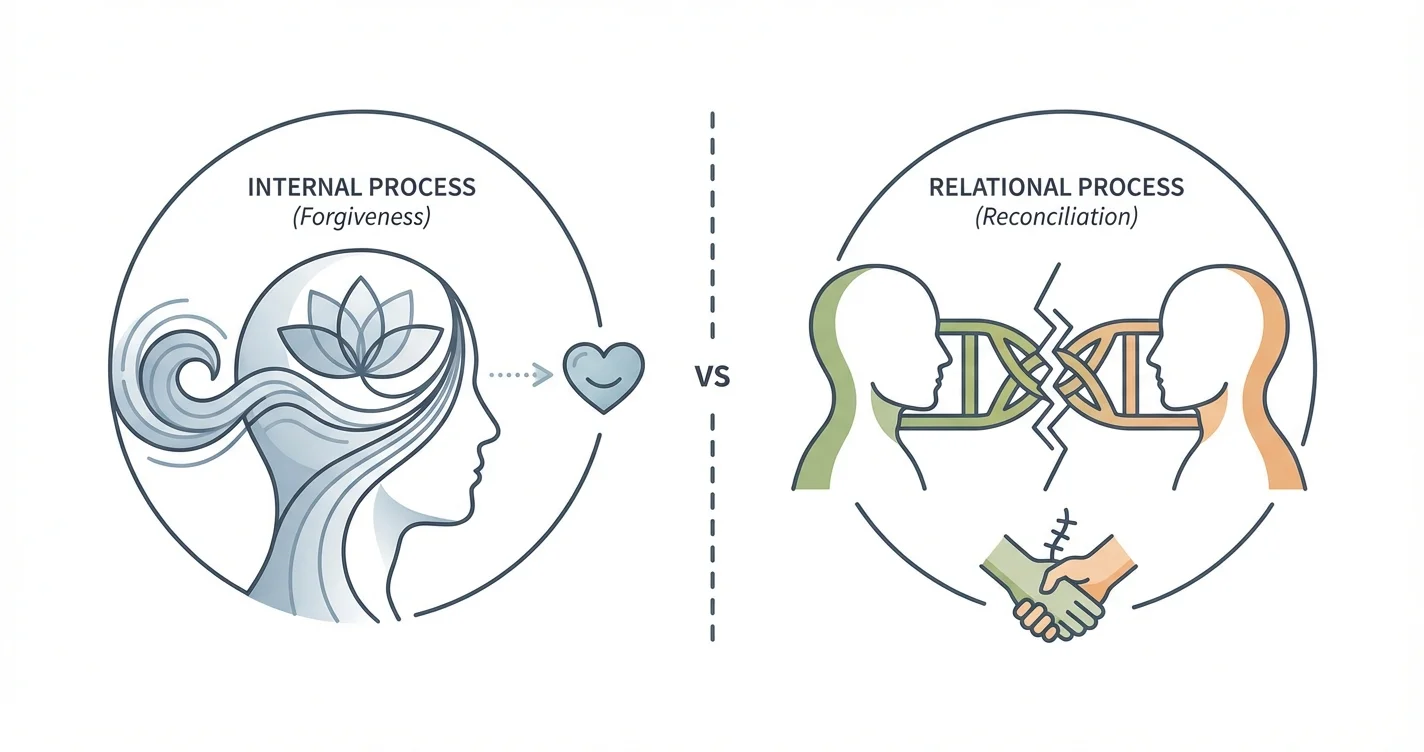
The terms "forgiveness" and "reconciliation" are often used interchangeably, yet they represent fundamentally different emotional and relational processes.

Key Takeaways
- Condoning or excusing harmful behavior
- Forgetting what happened or pretending it didn't hurt
- Allowing someone to continue harming you
- Automatically restoring trust or the relationship
- Acknowledgment of harm by the person who caused it
Introduction
The terms "forgiveness" and "reconciliation" are often used interchangeably, yet they represent fundamentally different emotional and relational processes. Understanding the distinction between forgiveness vs reconciliation — internal peace versus relationship healing — is essential for anyone navigating hurt, betrayal, or conflict. Forgiveness is an internal process that releases you from resentment and emotional burden, while reconciliation is an interpersonal process that requires mutual effort to restore trust and rebuild a relationship. This article explores the key differences between these two concepts, when each is appropriate, and how to navigate both processes in ways that support your emotional wellbeing and relational health.
If the hurt you are weighing is infidelity specifically, the should I forgive cheating quiz separates the two processes below into twelve concrete questions.
What Forgiveness Really Means
Forgiveness is fundamentally a personal, internal process of letting go of resentment, anger, and the desire for retribution against someone who has caused harm. Research in psychology indicates that forgiveness is primarily for the person who was hurt, not necessarily for the person who caused the harm. When you forgive, you're choosing to release yourself from the emotional weight of carrying anger and bitterness.
Importantly, forgiveness does not mean:
- Condoning or excusing harmful behavior
- Forgetting what happened or pretending it didn't hurt
- Allowing someone to continue harming you
- Automatically restoring trust or the relationship
Rather, forgiveness is about freeing yourself from the ongoing emotional toll of resentment. Studies suggest that chronic unforgiveness may be associated with increased stress responses, while forgiveness appears to correlate with improved emotional wellbeing. When you forgive, you acknowledge the hurt while choosing not to let it continue controlling your emotional state.
This process is entirely yours to own. You can forgive someone who never apologizes, who doesn't know they hurt you, or who has passed away. Forgiveness doesn't require the other person's participation, awareness, or change — it's an internal shift in how you relate to the pain you experienced.
Understanding Reconciliation as a Relational Process
Reconciliation, in contrast, is fundamentally about restoring a relationship that has been damaged. While forgiveness is a solo journey, reconciliation is inherently collaborative — it requires willing participation from both parties. The difference between forgiveness and reconciliation for inner peace and restored relationships becomes especially clear here: you can achieve inner peace through forgiveness alone, but you cannot reconcile a relationship without mutual effort.
Reconciliation involves several key components:
- Acknowledgment of harm by the person who caused it
- Genuine accountability and, typically, an authentic apology
- Changed behavior that demonstrates growth and different patterns
- Rebuilt trust through consistent actions over time
- Mutual willingness to work toward relationship restoration
Clinical perspectives suggest that healthy reconciliation shouldn't be rushed. Trust is rebuilt gradually through repeated experiences of safety, honesty, and follow-through. Someone might say all the right words, but reconciliation requires observing whether their actions align with their stated intentions over weeks and months.
Crucially, reconciliation isn't always possible or advisable. If someone continues harmful patterns, denies responsibility, or shows no genuine change, attempting reconciliation may expose you to further harm. In cases involving abuse, safety must take precedence over relationship restoration. Forgiving someone internally versus actually reconciling the relationship represents the difference between your personal healing work and the decision about whether that person should remain in your life.
Can You Forgive Without Reconciling?
Yes — and this is one of the most important distinctions to understand. You can absolutely forgive without reconciling, and in many situations, this is the healthiest path forward. Personal healing through forgiveness compared to healing a relationship through reconciliation operates on different timelines and serves different purposes.
Consider these scenarios where forgiveness without reconciliation is appropriate:
When the other person hasn't changed. If someone continues the same harmful patterns that hurt you originally, forgiving them for your own peace while maintaining distance protects your wellbeing. You're not obligated to keep exposing yourself to harm simply because you've worked through forgiveness internally.
When the relationship was abusive. In cases of physical, emotional, or psychological abuse, forgiveness can be a powerful step in your healing journey, but reconciliation may be unsafe or unwise. Your safety and wellbeing take precedence over relationship restoration.
When the other person is unavailable. Sometimes the person who hurt you has passed away, or contact is impossible. You can still process forgiveness for yourself, finding peace with what happened even without their participation.
When you've grown apart. Sometimes people simply move in different life directions. You can forgive past hurts while acknowledging that the relationship no longer serves either of you, and that's okay.
The concept of can you forgive without reconciling — internal peace vs fixing the relationship — acknowledges that your healing doesn't depend on whether the relationship is restored. Tools like Lovon.app can be helpful in this process, offering on-demand support as you work through the complex emotions of forgiving someone while recognizing that reconnecting isn't the right choice.
When Reconciliation Without Forgiveness Happens
Interestingly, the reverse situation also occurs: reconciliation without complete forgiveness. This might seem contradictory, but it reflects the reality that forgiveness is often a process rather than a single moment, while practical circumstances sometimes require working with someone before that emotional process is complete.
This commonly happens in situations like:
- Co-parenting relationships where you must cooperate for your children's wellbeing
- Workplace conflicts where you need to maintain professional collaboration
- Family situations where complete distance isn't feasible or desired
In these cases, you might establish workable boundaries and communication patterns with someone while still processing hurt and working toward forgiveness internally. This requires careful boundary management to ensure you're not simply suppressing feelings or exposing yourself to ongoing harm.
Research on interpersonal relationships suggests that successful long-term reconciliation typically does require eventual forgiveness for the relationship to fully heal and thrive. However, practical reconciliation — finding ways to coexist and cooperate — can sometimes precede complete emotional forgiveness.
Reconciliation and Forgiveness Differences in Practice
The practical differences between reconciliation and forgiveness differences — restoring relationships or finding inner peace — become apparent when you consider the actual work involved in each process.
Forgiveness work looks like:
- Journaling about your feelings and the impact of what happened
- Processing anger, grief, and other emotions related to the hurt
- Working toward understanding (though not excusing) why it might have happened
- Consciously choosing to release resentment when it arises
- Talking through your feelings with a therapist or trusted support person
- Gradually noticing that thinking about the situation causes less intense emotional pain
Reconciliation work looks like:
- Having direct conversations about what happened and its impact
- The person who caused harm taking genuine accountability
- Establishing new agreements about behavior and boundaries
- Starting with limited contact and gradually increasing as trust is rebuilt
- Observing whether actions match stated commitments over time
- Both parties being willing to address concerns and repair ruptures as they arise
When considering what's the difference between forgiving for yourself and reconciling with someone, notice that forgiveness work can happen entirely within yourself and your support system, while reconciliation inherently requires active participation from the other person. If they're unwilling or unable to engage in accountability and change, reconciliation simply isn't possible, regardless of how much forgiveness work you've done internally.
Speaking with support resources can help clarify which path makes sense for your situation. Lovon.app offers accessible conversations when you're processing whether to pursue reconciliation or focus on forgiveness for your own peace, helping you think through the nuances of your specific relationship and circumstances.
Navigating Both Processes Simultaneously
In some relationships, you may find yourself working on both forgiveness and reconciliation at the same time. This is common in long-term relationships where significant hurt has occurred but both parties genuinely want to repair the connection.
This dual process requires patience and realistic expectations. Forgiveness and reconciliation both unfold over time — there's rarely a single conversation or moment where everything is "fixed." Some relationships take months or even years to fully heal, with gradual rebuilding happening through countless small interactions that demonstrate changed patterns and renewed commitment.
During this process, it's important to:
Honor your own pace. Don't rush your internal forgiveness process because someone wants reconciliation immediately. Your emotional processing has its own timeline.
Watch for consistent change. Words matter, but actions over time matter more. Notice whether behavioral changes are sustained or whether old patterns reemerge once the immediate crisis passes.
Maintain boundaries. Even while reconciling, you can and should maintain boundaries that protect your wellbeing. Reconciliation doesn't mean returning to exactly how things were before.
Expect setbacks. Healing isn't linear. You might feel you've forgiven someone and then have a surge of anger. This is normal and doesn't mean you're failing at either forgiveness or reconciliation.
Stay honest about your feelings. If the reconciliation process reveals that the person hasn't truly changed or that the relationship dynamic remains unhealthy, you're allowed to reassess whether continuing is wise.
When to Seek Professional Support
Working through forgiveness and deciding about reconciliation can bring up complex, intense emotions. Professional support is especially valuable when:
- You're experiencing persistent anger, depression, or anxiety related to the hurt
- The situation involves trauma, abuse, or safety concerns
- You're struggling to make a decision about whether to reconcile
- Past hurts are significantly affecting your daily functioning or other relationships
- You notice patterns of choosing unhealthy relationships or repeatedly forgiving without changed behavior from others
Therapists specializing in relational issues, trauma, or family systems can provide frameworks and support tailored to your specific situation. They can help you distinguish between genuine accountability and manipulative apologies, recognize when reconciliation is or isn't advisable, and work through the forgiveness process at a pace that honors your healing.
Conclusion
The distinction between forgiveness vs reconciliation — internal peace versus relationship healing — offers clarity for navigating hurt in relationships. Forgiveness is your personal journey toward releasing resentment and finding peace, a process that belongs entirely to you and doesn't depend on another person's participation or change. Reconciliation is a mutual process of rebuilding trust and restoring relationship, requiring genuine accountability, changed behavior, and willing effort from both parties.
Understanding that you can forgive without reconciling empowers you to prioritize your healing and safety while releasing the burden of ongoing resentment. Not every relationship should or can be restored, and that's okay. Your path forward might involve forgiving someone while maintaining distance, working toward reconciliation while still processing forgiveness, or recognizing that neither is possible right now — and all of these are valid.
As you navigate these processes, remember that support is available. Whether through therapy, trusted friends, or accessible tools like Lovon.app that let you talk through your thoughts and feelings when you need it, you don't have to figure this out alone.
Disclaimer: This is general information, not medical advice or diagnosis. If symptoms are severe, affecting your daily life, or you're having thoughts of self-harm — seek professional help. In the US: call or text 988 (Suicide & Crisis Lifeline). For immediate danger: 911 or local emergency services.
How AI Support Helps You Heal
AI emotional support isn't about replacing human connection — it's about filling the gaps. The moments when you need to talk at 2 AM, when you don't want to burden your friends again, or when you simply need someone to listen without judgment.
Here's what happens in a typical Lovon session:
You share what's on your mind
There's no script, no intake form, no waiting room. You speak or type whatever you're feeling — in your own words, at your own pace.
Lovon validates and explores
Using frameworks from CBT (Cognitive Behavioral Therapy) and motivational interviewing, Lovon acknowledges your feelings first, then gently helps you explore them. No dismissive "just move on" advice.
You build coping skills together
Lovon doesn't just listen — it actively works with you on evidence-based techniques: thought reframing, urge surfing, behavioral experiments, and more.
What a Session with Lovon Looks Like

When to Seek Professional Help
AI support is a valuable tool, but it's not a replacement for professional care. Please consider reaching out to a licensed therapist if you experience any of the following:
- Persistent thoughts of self-harm or suicide
- Inability to perform daily activities (work, eating, sleeping) for more than 2 weeks
- Turning to alcohol or substances to cope
- Intense anger or desire to harm your ex-partner
- Complete emotional numbness that doesn't improve over time
Crisis Resources (US): If you're in immediate danger, call 988 (Suicide & Crisis Lifeline) or text HOME to 741741 (Crisis Text Line). Available 24/7, free, and confidential.
Outside the US? Find a crisis line in your country
Ready to Start?
Your healing journey can begin right now
A 7-day trial. No judgment. Just a safe space to process what you're going through.
Frequently Asked Questions
Is Lovon a replacement for a real therapist?
Is my conversation with Lovon AI private?
How is Lovon different from ChatGPT for emotional support?
Can I use Lovon if I'm already seeing a therapist?
Can I try Lovon before subscribing?
About the Author

The Lovon Editorial Team
Mental Health & Wellness Content Team
The Lovon Editorial Team develops mental health and wellness content designed to make psychological concepts accessible and actionable. Our goal is to bridge the gap between clinical research and everyday life - helping you understand why your mind works the way it does and what you can do about it....
Related articles
- Is My Boyfriend Cheating on Me? Signs of Cheating and Infidelity
When your partner is cheating, it can be a shock that not everyone knows how to handle. We will review the key facts…
- If I Give Everything You Won't Leave: Understanding the BPD Relationship Pattern
"If I give everything, you won't leave": why people with BPD over-give in relationships, how the cycle backfires, and…
- Cope With a Breakup When You Still Love Them (2026)
How to cope with a breakup when you still love them in 2026: set no-contact, process urges out loud, and rebuild…
- How long does it take to rebuild trust after cheating?
How long does it take to rebuild trust after cheating? There is no fixed timeline. Learn what real repair looks like…
See also
Quizzes
- Jealousy Test: Free 12-Question Self-Check
See which part of jealousy runs hottest, in 3 min.
- Do I Have Trust Issues? 12-Question Quiz
Check where your guard actually sits, in 2 minutes.
Free tools
- How to Stop Being Jealous in a Relationship
Two very different people search this, and advice that assumes either one is wrong half the time. This sorts what you…
- How to Forgive Someone Who Hurt You
Forgiving, reconciling, and deciding it was fine are three different things, and they get merged. Tell it what happened…
From the wiki
- What is cheating in a relationship?
Cheating is a breach of the agreement you and your partner made about who else gets your body, your attention and your…
Disclaimer: This article is for informational purposes only and does not constitute medical advice, diagnosis, or treatment. Always seek the advice of your physician or other qualified health provider with any questions you may have regarding a medical condition. If you are in crisis or think you may have an emergency, call 988 (Suicide & Crisis Lifeline) or go to the nearest emergency room. Outside the US? Find a crisis line in your country.