
Narcissistic and Emotionally Immature Parents — Communication Manipulation Patterns
Growing up with narcissistic and emotionally immature parents often means navigating a minefield of confusing communication patterns that leave you questioning

Key Takeaways
- Maintaining control: By refusing to acknowledge understanding, the parent avoids having to respond to legitimate
- Invalidating the child's reality: Persistent "confusion" implies the child's thoughts or feelings don't make sense
- Positioning themselves as reasonable: The parent can claim they're trying to understand while subtly suggesting the
- Avoiding accountability: If the parent "doesn't understand," they can't be held responsible for addressing the issue
- Create defensiveness: The child must now defend themselves against a false characterization rather than discussing
Introduction
Growing up with narcissistic and emotionally immature parents often means navigating a minefield of confusing communication patterns that leave you questioning your own perceptions and reality. These parents employ subtle and overt manipulation tactics that can make their children feel perpetually misunderstood, blamed, or "wrong" for simply expressing themselves. Understanding these communication manipulation patterns is crucial for recognizing unhealthy dynamics and beginning to establish healthier boundaries. Research suggests that children raised in these environments often develop heightened anxiety around communication and may struggle with self-expression well into adulthood. This article examines the specific tactics emotionally immature and narcissistic parents use to manipulate through communication, drawing on expert insights and clinical understanding of these complex family dynamics.
Core Communication Manipulation Patterns
Narcissistic and emotionally immature parents share overlapping manipulation tactics, though their motivations may differ slightly. Emotionally immature parents often lack the capacity for genuine perspective-taking and emotional reciprocity, while narcissistic parents actively center themselves and view their children as extensions of their own identity rather than separate individuals.
One fundamental pattern involves making children feel responsible for communication failures. Experts in boundary work note that toxic parents systematically position their children as "bad communicators" whenever disagreements arise. This tactic shifts responsibility away from the parent's unwillingness or inability to understand, placing it squarely on the child's shoulders. The message becomes: "If I don't understand you, it's because you're not explaining yourself correctly" rather than "I'm not making an effort to understand your perspective."
Emotionally immature parents characteristically demonstrate a consistent lack of effort in understanding their children's experiences, feelings, or needs. This isn't simply occasional miscommunication—it represents a persistent pattern where the parent remains fundamentally uninterested in genuinely comprehending their child's inner world. Studies on family communication patterns indicate that this dynamic can significantly impact a child's developing sense of self-worth and their confidence in their own perceptions.
The underlying dynamic in these communication manipulation patterns centers on control and self-protection. For narcissistic parents, maintaining their self-image as "right" or "good" takes precedence over genuine connection. For emotionally immature parents, the emotional effort required to truly understand another person exceeds their capacity or willingness.
Specific Manipulation Tactics
Strategic Misunderstanding and Willful Incomprehension
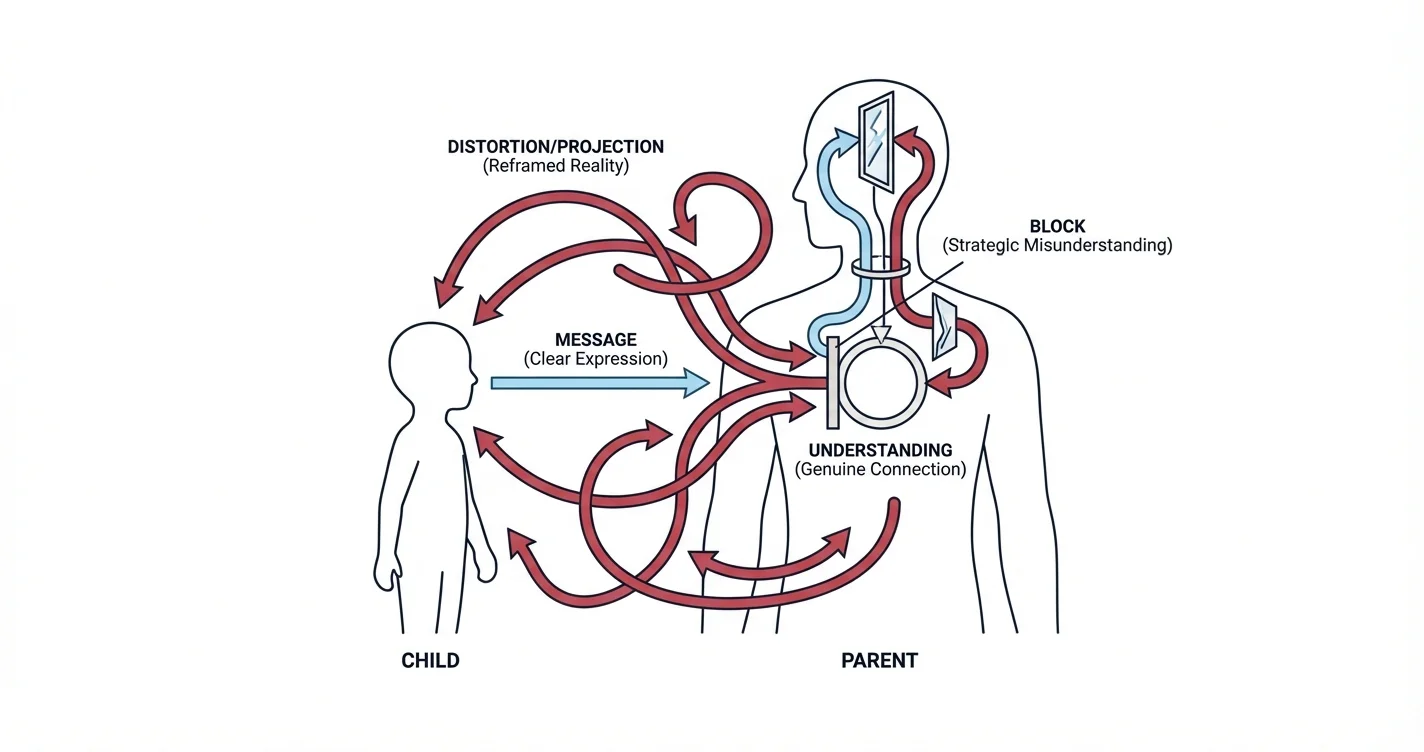
Perhaps the most psychologically damaging communication manipulation tactic involves what practitioners describe as being "set on misunderstanding." This occurs when a parent appears determined not to comprehend what their child is communicating, regardless of how clearly it's expressed. The child may rephrase, provide examples, adjust their tone, or try different approaches—yet the parent consistently "fails" to understand.
This pattern serves multiple functions for the manipulative parent:
- Maintaining control: By refusing to acknowledge understanding, the parent avoids having to respond to legitimate concerns or requests
- Invalidating the child's reality: Persistent "confusion" implies the child's thoughts or feelings don't make sense
- Positioning themselves as reasonable: The parent can claim they're trying to understand while subtly suggesting the child is the communication problem
- Avoiding accountability: If the parent "doesn't understand," they can't be held responsible for addressing the issue
Research on parent-child communication dynamics suggests that children in these situations often internalize the message that their thoughts and feelings are inherently difficult to understand or not worth understanding. This can lead to significant communication anxiety in adult relationships.
Reframing and Reality Distortion
Narcissistic and emotionally immature parents frequently employ reframing tactics that subtly or overtly distort what was actually said. A child might express a boundary: "I need you to call before visiting." The parent responds as if hearing: "You don't want me in your life." This dramatic reframing shifts the conversation from a reasonable request to defending against an accusation the child never made.
These distortions serve to:
- Create defensiveness: The child must now defend themselves against a false characterization rather than discussing the actual issue
- Position the parent as victim: The reframed version typically casts the parent as hurt or rejected
- Avoid the original boundary or concern: The actual request gets lost in defending against the distortion
- Elicit guilt: The child feels guilty for "causing" hurt they never intended
Projection and Attribution Errors
Emotionally immature and narcissistic parents often project their own feelings, motivations, or behaviors onto their children. A parent feeling angry might accuse their calm child of "being aggressive." A parent who lacks empathy accuses their child of being "selfish" for having needs.
This projection serves to externalize uncomfortable internal experiences. Rather than acknowledging their own emotions or shortcomings, the parent locates these qualities in their child. Some research on personality dynamics suggests this defense mechanism allows individuals to maintain their self-image by disowning unacceptable aspects of themselves.
How These Patterns Affect Adult Children
The long-term impact of growing up with these communication manipulation patterns can be substantial. Adult children of narcissistic and emotionally immature parents often experience:
Communication anxiety and over-explanation: Having grown up needing to repeatedly clarify, rephrase, and defend their basic communications, many adult children develop a pattern of over-explaining. They may provide excessive context, anticipate misunderstanding, or apologize preemptively for expressing themselves. This hypervigilance around communication can be exhausting and interfere with authentic self-expression.
Difficulty trusting their own perceptions: Years of having their reality questioned, reframed, or dismissed can lead to persistent self-doubt. When someone says they don't understand, the adult child may automatically assume they've communicated poorly rather than considering the other person's role in the exchange.
Conflict avoidance or high tolerance for poor communication: Some adult children become conflict-avoidant, having learned that expressing concerns leads to distortion and invalidation. Others develop an unusually high tolerance for poor communication from others, accepting treatment they shouldn't because it feels familiar.
Pattern recognition and hypervigilance: Many adult children become highly skilled at detecting manipulation tactics, sometimes to the point of hypervigilance in new relationships. This can be protective but may also create challenges in distinguishing between genuine miscommunication and manipulation.
Tools like Lovon.app can provide a supportive space for processing these patterns and working through the emotional residue of growing up with manipulative communication. Speaking with an AI therapist can help identify recurring dynamics and develop healthier communication approaches without the immediate vulnerability of discussing these sensitive family issues with others.
Breaking the Cycle: Recognition and Response
Experts working with boundary development emphasize a crucial insight: you cannot convince someone to understand you if they are fundamentally set on misunderstanding. This recognition represents a significant turning point for many adult children of narcissistic and emotionally immature parents. The persistent belief that "if I just explain it better" or "if I can find the right words" will finally break through reflects the child's perspective, not the reality of the dynamic.
Acceptance of Limitations
Breaking free from these communication manipulation patterns begins with accepting that certain people—including parents—may never provide the understanding, validation, or acknowledgment you deserve. This doesn't mean something is wrong with you or that you've failed. It reflects their limitations, not yours.
This acceptance can be emotionally challenging. Many adult children hold onto hope that their parent will eventually "get it" if they can just communicate effectively enough. Releasing this hope involves grief—mourning the parent-child relationship that should have existed but didn't.
Developing New Communication Strategies
Once you recognize these manipulation patterns, you can develop strategies that protect your emotional well-being:
Reduce explanations: With someone set on misunderstanding, extensive explanations typically provide more material to distort rather than increasing clarity. Brief, clear statements followed by disengagement often work better than elaborate clarifications.
Set boundaries on communication itself: You might limit certain topics, establish that you'll end conversations that become circular or distorted, or communicate primarily in writing where there's a record.
Separate your self-worth from their comprehension: Recognize that their failure or refusal to understand says nothing about the validity of your experience or the quality of your communication.
Seek validation elsewhere: Build relationships with people who demonstrate genuine interest in understanding your perspective, where communication feels reciprocal rather than like navigating a minefield.
Support resources like Lovon.app can help process the emotional challenges of implementing these changes, particularly when guilt, obligation, or hope make boundary-setting difficult.
When Professional Support Becomes Necessary
While understanding communication manipulation patterns is valuable, the psychological impact of growing up with narcissistic and emotionally immature parents may require professional therapeutic support. Consider seeking help from a therapist specializing in family dynamics, narcissistic abuse, or complex trauma if you experience:
- Persistent anxiety or depression related to family relationships
- Difficulty establishing or maintaining healthy relationships due to communication patterns learned in childhood
- Ongoing self-doubt that interferes with decision-making or self-advocacy
- Symptoms of complex trauma including emotional flashbacks, hypervigilance, or dissociation
- Challenges with identity formation or persistent feelings of emptiness
Therapists trained in these specific dynamics can provide targeted support that general self-help strategies cannot replace. They can help differentiate between your internalized critical voice and your authentic self, a distinction that's often blurred when you've grown up with these manipulation patterns.
Conclusion
Understanding the communication manipulation patterns used by narcissistic and emotionally immature parents represents a crucial step toward healing and establishing healthier relationships. These patterns—strategic misunderstanding, reality distortion, projection, and positioning children as communication failures—serve the parent's need for control and self-protection rather than fostering genuine connection. Recognizing that you cannot force understanding from someone determined to misunderstand you can be liberating, even as it involves grief for what should have been.
Breaking these cycles requires both recognition and the development of new communication approaches that prioritize your emotional well-being over the futile attempt to finally be understood by someone unwilling or unable to do so. Whether through professional therapy, supportive tools, or trusted relationships with people capable of reciprocal communication, healing from these patterns is possible. The confusion, self-doubt, and communication anxiety that resulted from these manipulation tactics need not define your future relationships.
Disclaimer: This is general information, not medical advice or diagnosis. If symptoms are severe, affecting your daily life, or you're having thoughts of self-harm—seek professional help. In the US: call or text 988 (Suicide & Crisis Lifeline). For immediate danger: 911 or local emergency services.
How AI Support Helps You Heal
AI emotional support isn't about replacing human connection — it's about filling the gaps. The moments when you need to talk at 2 AM, when you don't want to burden your friends again, or when you simply need someone to listen without judgment.
Here's what happens in a typical Lovon session:
You share what's on your mind
There's no script, no intake form, no waiting room. You speak or type whatever you're feeling — in your own words, at your own pace.
Lovon validates and explores
Using frameworks from CBT (Cognitive Behavioral Therapy) and motivational interviewing, Lovon acknowledges your feelings first, then gently helps you explore them. No dismissive "just move on" advice.
You build coping skills together
Lovon doesn't just listen — it actively works with you on evidence-based techniques: thought reframing, urge surfing, behavioral experiments, and more.
What a Session with Lovon Looks Like

When to Seek Professional Help
AI support is a valuable tool, but it's not a replacement for professional care. Please consider reaching out to a licensed therapist if you experience any of the following:
- Persistent thoughts of self-harm or suicide
- Inability to perform daily activities (work, eating, sleeping) for more than 2 weeks
- Turning to alcohol or substances to cope
- Intense anger or desire to harm your ex-partner
- Complete emotional numbness that doesn't improve over time
Crisis Resources (US): If you're in immediate danger, call 988 (Suicide & Crisis Lifeline) or text HOME to 741741 (Crisis Text Line). Available 24/7, free, and confidential.
Outside the US? Find a crisis line in your country
Ready to Start?
Your healing journey can begin right now
A 7-day trial. No judgment. Just a safe space to process what you're going through.
Frequently Asked Questions
Is Lovon a replacement for a real therapist?
Is my conversation with Lovon AI private?
How is Lovon different from ChatGPT for emotional support?
Can I use Lovon if I'm already seeing a therapist?
Can I try Lovon before subscribing?
About the Author

The Lovon Editorial Team
Mental Health & Wellness Content Team
The Lovon Editorial Team develops mental health and wellness content designed to make psychological concepts accessible and actionable. Our goal is to bridge the gap between clinical research and everyday life - helping you understand why your mind works the way it does and what you can do about it....
Related articles
- Role Reversal With Narcissistic Parents: When Children Become Emotional Caretakers
When narcissistic parents create role reversal where the child becomes the emotional caretaker, the fundamental…
- Toxic Family Dynamics Operating Through Power and Control Triggering Old Coping Patterns During Holidays
The holiday season can feel like stepping into a time machine for many people navigating toxic family dynamics. When you…
- Big Promises, No Plans? 7 Signs of Future Faking
Tell empty promises from real plans: the patterns that give future faking away, how to bring it up with your partner…
- Am I Dating a Narcissist Quiz (2026): 12-Point Test
Take the 12-question am I dating a narcissist quiz. Score your relationship against 6 core NPD patterns and get clear…
See also
Quizzes
- Am I Dating a Narcissist? 15-Trait Quiz
Understand the pattern in 3 minutes.
- Is My Relationship Healthy? 15-Question Check-In
Check your relationship health in 3 minutes.
Free tools
- How to Confront a Narcissistic Parent
Most of these conversations fail because you went in wanting three things at once. Tell it what you want to raise, and…
- What Leaving Would Actually Take
Four short lists: money, a place, the shared things, and people. Mark each item sorted or not. You get the itemized…
From the wiki
- How to leave a toxic relationship?
Leaving a toxic relationship is rarely a decision problem — you usually know. What stops you is that the pull toward…
Disclaimer: This article is for informational purposes only and does not constitute medical advice, diagnosis, or treatment. Always seek the advice of your physician or other qualified health provider with any questions you may have regarding a medical condition. If you are in crisis or think you may have an emergency, call 988 (Suicide & Crisis Lifeline) or go to the nearest emergency room. Outside the US? Find a crisis line in your country.