
Breaking Rumination Cycles by Shifting from Why to What Do I Need
Rumination often traps people in endless mental loops where the same distressing thoughts replay without resolution. According to clinical research, one of the

Key Takeaways
- Character-based explanations ("because I'm weak," "because I'm broken")
- Historical rumination ("because of what happened years ago")
- Circular reasoning that leads back to the original distress
- Abstract analysis disconnected from present-moment needs
- A need for movement (restlessness in your legs)
Introduction
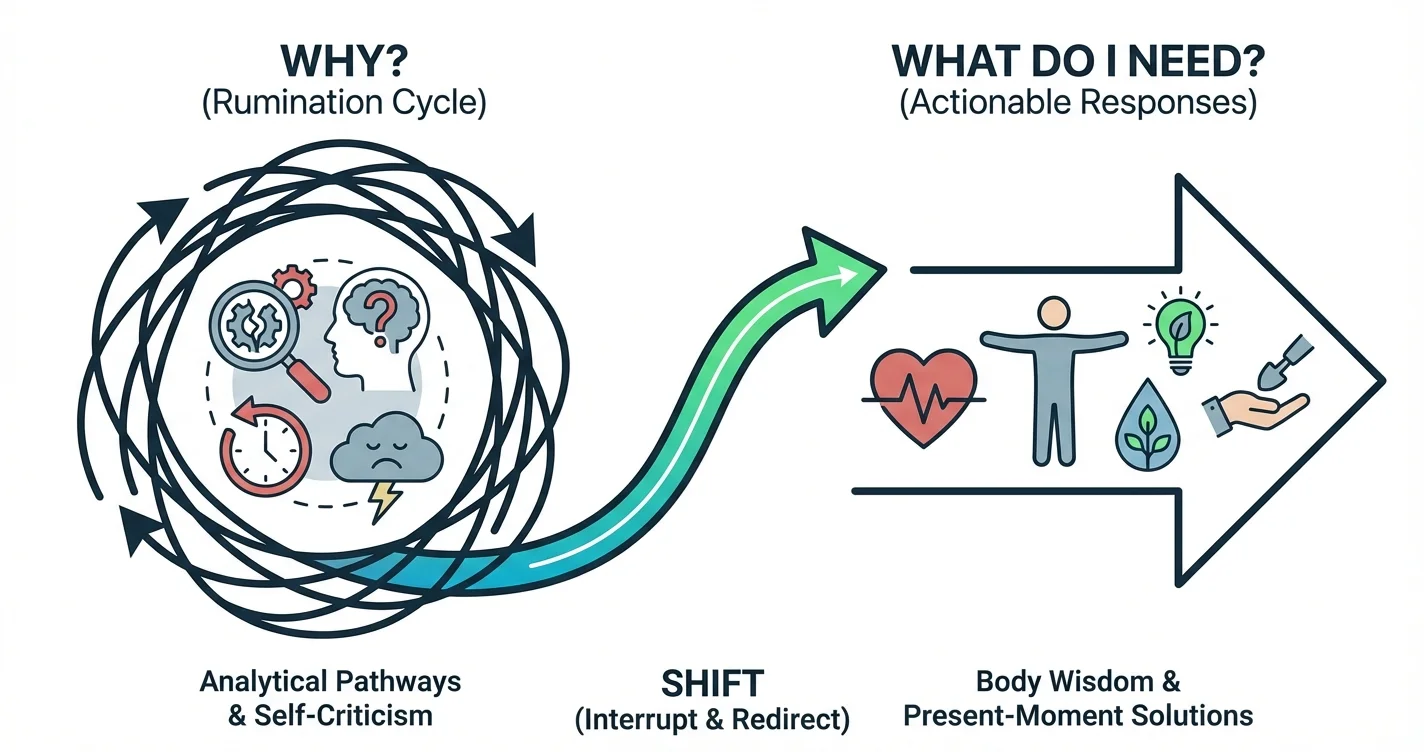
Rumination often traps people in endless mental loops where the same distressing thoughts replay without resolution. According to clinical research, one of the most effective techniques for breaking rumination cycles involves shifting from why questions to what do I need questions. This seemingly simple linguistic shift changes how your brain processes distress—moving from analytical overthinking to solution-focused awareness. When you ask "why am I like this?" or "why did this happen?", you activate analytical pathways that often lead to shame and self-criticism rather than meaningful change. By contrast, asking "what do I need right now?" engages your body's wisdom and redirects attention toward actionable responses. This article examines the neuroscience behind this technique and provides practical guidance for implementing this shift in daily life.
Understanding Why Rumination Thrives on Why Questions
Rumination represents a pattern of repetitive, passive thinking about one's distress and its possible causes and consequences. Research suggests that certain question types fuel this cycle more than others. Why questions—particularly those directed at oneself—tend to activate analytical brain regions that search for explanations, often without finding satisfying answers.
When you ask yourself "why am I so anxious?" or "why can't I handle this better?", your mind typically generates responses rooted in self-judgment rather than insight. These answers often include:
- Character-based explanations ("because I'm weak," "because I'm broken")
- Historical rumination ("because of what happened years ago")
- Circular reasoning that leads back to the original distress
- Abstract analysis disconnected from present-moment needs
Studies indicate that this analytical approach can actually intensify negative affect rather than reducing it. The brain searches for causal explanations in a way that often reinforces shame-based narratives. Mental health practitioners have observed that clients who habitually ask why questions about their emotional states frequently become trapped in cognitive loops that provide intellectual analysis but little emotional relief.
The problem isn't curiosity itself—it's that why questions during distress activate problem-solving systems that aren't well-suited for emotional regulation. Your analytical mind excels at diagnosing mechanical problems but often struggles with the complex, non-linear nature of emotional experience.
How What Do I Need Questions Interrupt Rumination Patterns
The shift from why to what do I need questions represents more than semantic preference—it fundamentally changes your relationship with distress. This reframing technique appears to activate different neural pathways associated with compassionate self-response rather than analytical judgment.
When you ask "what do I need right now?", several important shifts occur:
Orientation toward action: Unlike why questions that search for explanations, what do I need questions naturally orient toward solutions and responses. This shifts your nervous system from passive analysis to active problem-solving.
Body-based awareness: Practitioners working with rumination note that what do I need questions tend to direct attention toward physical sensations and embodied experience rather than abstract mental analysis. This body-based awareness helps regulate the nervous system more effectively than cognitive analysis alone.
Compassionate stance: The question "what do I need?" implies that your distress signals an unmet need rather than a personal deficiency. This framing reduces shame and creates psychological space for self-compassion.
Present-moment focus: While why questions often pull attention toward the past ("why did this happen?"), what do I need questions anchor you in the present moment where action becomes possible.
Research on self-compassion suggests that treating yourself with the same kindness you'd offer a struggling friend produces measurable improvements in emotional wellbeing. The what do I need framework naturally facilitates this compassionate stance by positioning distress as a signal rather than a failure.
Tools like Lovon.app can help practice this reframing by providing on-demand support when rumination begins, allowing you to verbally process the shift from analytical why questions to compassionate what do I need questions with an AI listener trained in therapeutic techniques.
Practical Techniques for Implementing the Question Shift
Moving from habitual why questions to what do I need questions requires practice, especially when rumination has become an automatic response pattern. The following approaches can help establish this new cognitive habit:
Recognize the rumination trigger: The first step involves noticing when you've entered a rumination cycle. Common signs include repetitive thoughts, mental restlessness, physical tension, and a sense of being stuck in your head. When you notice these patterns, acknowledge them without judgment: "I'm ruminating right now."
Interrupt with the question shift: Once you've recognized rumination, consciously pause and ask "what do I need right now?" rather than continuing to ask why. This interruption itself can break the automatic cycle of ruminative thinking.
Access body wisdom: After asking what you need, turn attention to physical sensations. Your body often knows what it needs before your analytical mind can articulate it. You might notice:
- A need for movement (restlessness in your legs)
- A need for rest (heaviness, fatigue)
- A need for connection (loneliness in your chest)
- A need for safety (tension in your shoulders)
Consider needs across different domains: What you need might be physical (sleep, food, movement), emotional (reassurance, expression, validation), relational (connection, boundaries, solitude), or practical (information, resources, help). Scanning across these domains helps identify specific, actionable responses.
Practice with your inner child: Therapists specializing in inner child work suggest asking "what does my inner child need right now?" can access particularly powerful compassionate responses. Some people find that looking at childhood photos while asking this question helps activate nurturing instincts that would naturally arise when caring for an actual child.
Start small and specific: Early in this practice, the question "what do I need?" might feel overwhelming or produce a blank response. If this happens, make the question more specific: "What do I need in the next five minutes?" or "What would help me feel one percent better right now?"
Validate needs without judgment: When a need arises, practice acknowledging it without immediately judging whether it's reasonable, possible, or appropriate. The practice is first to identify what you need—assessment and action planning come afterward.
Implementing This Technique in Different Rumination Contexts
The why-to-what-do-I-need shift applies across various rumination types, though implementation varies slightly depending on context.
Relationship rumination: When caught in loops about interpersonal conflicts ("why did they say that?" or "why am I always causing problems?"), shifting to "what do I need in this relationship?" or "what do I need to feel secure right now?" redirects toward actionable relationship needs like clarity, reassurance, or boundary-setting rather than endless analysis of motivations and blame. To see whether your loops mostly replay the past, rehearse the future or decode what other people meant, the overthinking test scores the three separately.
Performance rumination: After mistakes or perceived failures, why questions ("why can't I do anything right?") typically generate shame rather than improvement. Asking "what do I need to move forward?" or "what support would help me improve?" shifts toward growth-oriented responses like skill development, rest, or adjusted expectations.
Anxiety rumination: Anxious rumination often involves catastrophic why questions ("why is this happening?" or "why me?"). The shift to "what do I need to feel safer right now?" grounds you in present-moment coping resources rather than imagined future disasters.
Depression rumination: Depressive rumination frequently includes existential why questions about life's meaning or worth. "What do I need today?" or "what tiny thing might bring a moment of relief?" directs toward manageable actions rather than unanswerable philosophical questions during a depressive episode.
For situations requiring additional support, resources like Lovon.app provide accessible options for processing rumination patterns through voice conversation, helping identify specific needs when your own perspective feels clouded by repetitive thoughts.
When to Seek Professional Help
While the why-to-what-do-I-need technique can effectively interrupt many rumination patterns, some situations require professional support. Consider seeking help from a therapist or counselor when:
- Rumination persists despite consistent practice of interruption techniques
- Ruminative thoughts include self-harm or suicidal ideation
- Rumination significantly impairs daily functioning at work, school, or relationships
- You feel unable to identify or meet your own needs even after asking
- Rumination is accompanied by severe anxiety, depression, or other mental health symptoms
- You need help developing the underlying skills to recognize and respond to your needs
Mental health professionals specializing in cognitive-behavioral therapy (CBT), acceptance and commitment therapy (ACT), or compassion-focused therapy can provide structured support for changing rumination patterns. These approaches complement the question-shifting technique with additional tools for emotional regulation and cognitive flexibility.
Remember that self-help strategies like question reframing work best as part of a comprehensive approach to mental health that may include professional therapy, medication when appropriate, lifestyle factors, and social support.
Conclusion
Breaking rumination cycles by shifting from why questions to what do I need questions represents a powerful, accessible technique for interrupting unproductive mental loops. This reframing moves you from analytical judgment toward compassionate, body-based awareness of present-moment needs. The practice requires patience—habitual thought patterns don't change overnight—but many people find that consistent application of this simple question shift gradually reduces rumination frequency and intensity. Start by noticing when you've entered rumination, consciously pause to ask "what do I need right now?", and direct attention toward body wisdom and specific, actionable needs across physical, emotional, relational, and practical domains. With practice, this shift from why to what do I need becomes an automatic response that supports emotional regulation and breaks the shame cycles that often fuel persistent rumination.
Disclaimer: This is general information, not medical advice or diagnosis. If symptoms are severe, affecting your daily life, or you're having thoughts of self-harm — seek professional help. In the US: call or text 988 (Suicide & Crisis Lifeline). For immediate danger: 911 or local emergency services.
How AI Support Helps You Heal
AI emotional support isn't about replacing human connection — it's about filling the gaps. The moments when you need to talk at 2 AM, when you don't want to burden your friends again, or when you simply need someone to listen without judgment.
Here's what happens in a typical Lovon session:
You share what's on your mind
There's no script, no intake form, no waiting room. You speak or type whatever you're feeling — in your own words, at your own pace.
Lovon validates and explores
Using frameworks from CBT (Cognitive Behavioral Therapy) and motivational interviewing, Lovon acknowledges your feelings first, then gently helps you explore them. No dismissive "just move on" advice.
You build coping skills together
Lovon doesn't just listen — it actively works with you on evidence-based techniques: thought reframing, urge surfing, behavioral experiments, and more.
What a Session with Lovon Looks Like

When to Seek Professional Help
AI support is a valuable tool, but it's not a replacement for professional care. Please consider reaching out to a licensed therapist if you experience any of the following:
- Persistent thoughts of self-harm or suicide
- Inability to perform daily activities (work, eating, sleeping) for more than 2 weeks
- Turning to alcohol or substances to cope
- Intense anger or desire to harm your ex-partner
- Complete emotional numbness that doesn't improve over time
Crisis Resources (US): If you're in immediate danger, call 988 (Suicide & Crisis Lifeline) or text HOME to 741741 (Crisis Text Line). Available 24/7, free, and confidential.
Outside the US? Find a crisis line in your country
Ready to Start?
Your healing journey can begin right now
A 7-day trial. No judgment. Just a safe space to process what you're going through.
Frequently Asked Questions
Is Lovon a replacement for a real therapist?
Is my conversation with Lovon AI private?
How is Lovon different from ChatGPT for emotional support?
Can I use Lovon if I'm already seeing a therapist?
Can I try Lovon before subscribing?
About the Author
The Lovon Editorial Team
Mental Health & Wellness Content Team
The Lovon Editorial Team develops mental health and wellness content designed to make psychological concepts accessible and actionable. Our goal is to bridge the gap between clinical research and everyday life - helping you understand why your mind works the way it does and what you can do about it....
Related articles
- ADHD Masking — Long-Term Consequences and Reversal Strategies
ADHD masking—the deliberate suppression or concealment of symptoms to appear neurotypical—often develops as a survival…
- Cyclothymia Rapid Mood Shifts: Understanding 2-3 Day Cycles
Experiencing intense emotional highs and lows that shift every few days can be confusing and exhausting. For many…
- How to Break a Trauma Response Cycle (2026 Guide)
Learn how to break a trauma response cycle with 7 concrete steps, troubleshooting fixes, and where AI voice therapy fits…
- Coping Tools for Stress: What Works in 2026
Find the coping tools for stress that actually work in 2026 — box breathing, reframing, movement, and daily processing…
See also
Quizzes
- Perfectionism Test: What Are Your Standards Costing?
See what your standards actually cost, in 3 minutes.
- Alexithymia Test: Can You Name What You Feel?
See where your feelings lose their names, in 3 minutes.
Free tools
- What to Say to Someone Who Is Grieving
Get sentences that fit this person and this week, not a list of things people say at funerals. Describe who they lost…
- What to Say When a Pet Dies
Get a message you can actually send to someone whose dog or cat just died: one that uses the animal's name, treats the…
From the wiki
- Why do I have no friends?
Usually nothing is wrong with you. Adult friendship runs on proximity and repetition, and most people lose both at once…
Disclaimer: This article is for informational purposes only and does not constitute medical advice, diagnosis, or treatment. Always seek the advice of your physician or other qualified health provider with any questions you may have regarding a medical condition. If you are in crisis or think you may have an emergency, call 988 (Suicide & Crisis Lifeline) or go to the nearest emergency room. Outside the US? Find a crisis line in your country.