
Conditional Love vs Unconditional: Do You Have to Earn It?
Conditional love is affection you have to keep earning. How it differs from unconditional love, the signs in families and couples, and how to stop proving yourself.

Key Takeaways
- Conditional love includes frequent "if-then" statements: "If you really loved me, you would..." or "I'll be happy
- Unconditional love uses "even though" framing: "Even though we disagree, I still care about you" or "I'm frustrated
- Conditional affection ties praise to achievements rather than inherent worth
- Unconditional acceptance acknowledges efforts and personhood beyond outcomes
- Withdrawal of affection, attention, or communication when expectations aren't met (conditional)
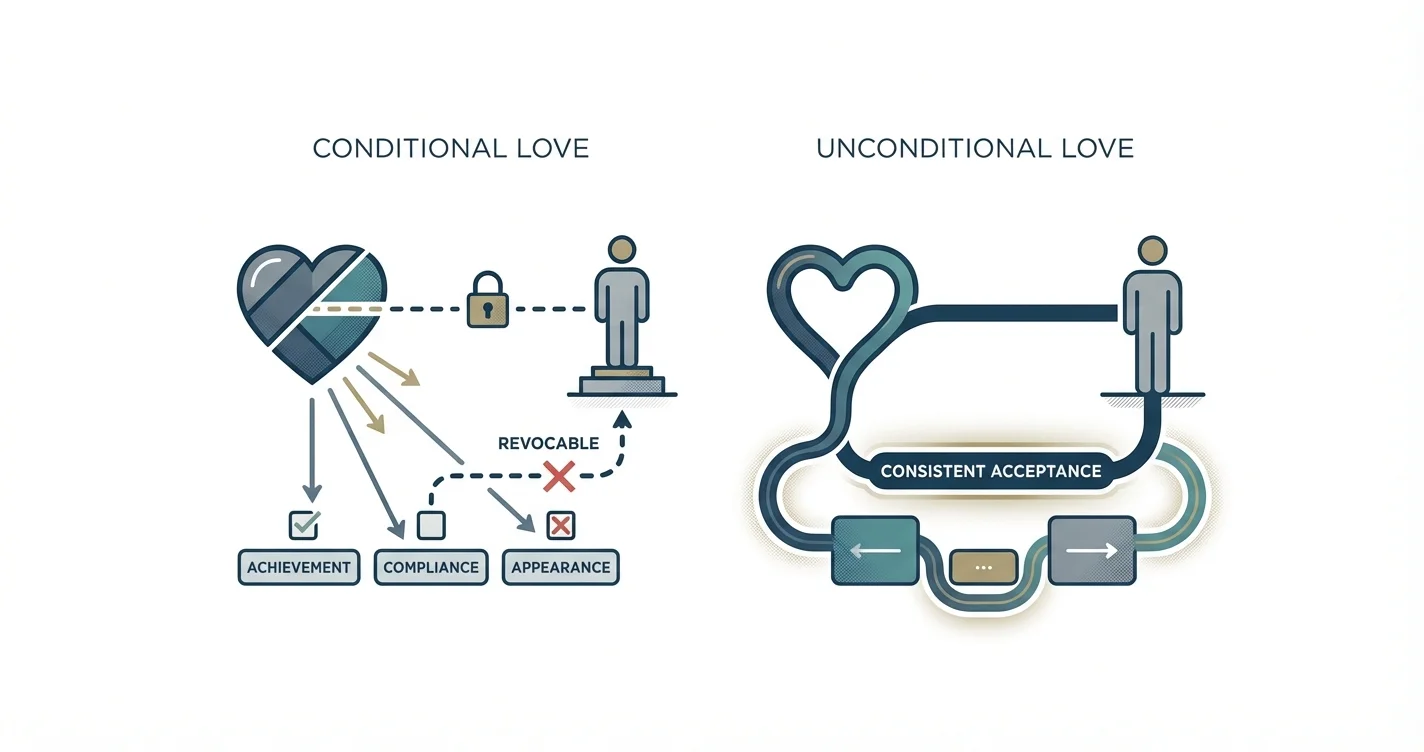
Conditional love is affection that depends on what you do: it is given when you perform, comply or meet expectations, and withdrawn when you do not. Unconditional love is care that stays steady even when someone is disappointed in you; it can still come with boundaries and consequences, but the care itself is not on the line.
| Conditional love | Unconditional love | |
|---|---|---|
| The message | "I love you when..." | "I love you, and..." |
| After a mistake | Warmth is withdrawn until you make up for it | Frustration, then repair; the bond is not in question |
| Praise | Tied to results | Includes effort and who you are |
| What it teaches | Love has to be earned and can be lost | You are worth caring about as you are |
| In adults it often shows up as | People-pleasing, fear of disappointing, over-functioning | Ease in asking for things and in saying no |
Most relationships have a little of both. The question is not whether someone ever has expectations of you, but whether their basic care disappears when you do not meet them.
Defining Conditional Love and Unconditional Love
Conditional love functions as a transactional form of affection where care and acceptance depend on meeting specific criteria. The underlying message becomes "I love you when..." or "I love you because..." followed by conditions such as achievement, compliance, appearance, or behavior. Research in attachment theory suggests that conditional love creates an unstable foundation for relationships, as affection feels contingent and potentially revocable.
In family dynamics, conditional love might manifest when parents express warmth primarily after academic success, athletic achievement, or behavioral compliance. In romantic relationships, it appears when one partner withholds affection until the other meets expectations around appearance, career success, or emotional availability. The person receiving conditional love often experiences anxiety about maintaining the conditions required to keep receiving care.
Unconditional love, by contrast, offers consistent acceptance regardless of circumstances, behaviors, or achievements. This doesn't mean accepting harmful behavior without boundaries—rather, it means the fundamental care for the person remains constant even when their actions require consequences. Studies in developmental psychology indicate that unconditional love provides the secure base children need for healthy emotional development and resilient self-esteem.
The distinction matters significantly in therapeutic contexts. When working with clients struggling with self-worth issues, therapists frequently trace these concerns to early experiences of conditional acceptance. Understanding this difference — along with knowing which attachment style is yours — allows individuals to recognize patterns that may be affecting current relationship satisfaction and mental health.
How to Identify Conditional Love Versus Unconditional Love in Relationships
Recognizing conditional versus unconditional love requires attention to specific patterns in how affection gets expressed and withdrawn. Several key indicators help distinguish these relationship dynamics.
Communication patterns reveal important clues:
- Conditional love includes frequent "if-then" statements: "If you really loved me, you would..." or "I'll be happy with you when you..."
- Unconditional love uses "even though" framing: "Even though we disagree, I still care about you" or "I'm frustrated with your decision, but that doesn't change how I feel about you"
- Conditional affection ties praise to achievements rather than inherent worth
- Unconditional acceptance acknowledges efforts and personhood beyond outcomes
Behavioral indicators include:
- Withdrawal of affection, attention, or communication when expectations aren't met (conditional)
- Consistent emotional availability even during conflict or disappointment (unconditional)
- Love expressed primarily during "good times" versus maintained through difficulties
- Whether support continues when the person makes choices the other disagrees with
Emotional atmosphere differs significantly:
- Conditional love creates anxiety about maintaining approval and fear of making mistakes
- Unconditional love fosters security, allowing vulnerability and authentic self-expression
- The former produces performance-oriented relationships; the latter supports growth-oriented connections
In family dynamics, these patterns often become most visible during transitions or challenges. A parent demonstrating unconditional love might express disappointment about a choice while maintaining warmth and connection. Conditional love in the same scenario might involve silent treatment, criticism that attacks character rather than behavior, or statements suggesting the child has become less worthy of affection.
Tools like Lovon.app can help individuals process these relationship patterns through reflective conversation. When you're uncertain whether a relationship involves conditional dynamics, talking through specific interactions with an AI voice companion helps identify recurring themes and emotional responses that signal the nature of the connection.
Conditional Love Compared to Unconditional Love in Therapy Sessions
Therapeutic relationships themselves provide important examples of unconditional positive regard—a concept central to person-centered therapy. Research from the American Psychological Association emphasizes that therapist acceptance regardless of what clients reveal creates the safety necessary for genuine therapeutic progress.
In therapy sessions addressing relationship concerns, clinicians help clients distinguish between these love types through several approaches:
Pattern recognition exercises involve reviewing relationship histories to identify when affection felt secure versus contingent. Clients often discover that conditional love patterns learned in childhood continue affecting adult relationship selection and expectations. Recognizing these patterns represents the first step toward developing healthier relationship models.
Cognitive reframing helps clients understand that receiving conditional love doesn't reflect their inherent unworthiness. Instead, it indicates limitations in the other person's capacity for unconditional acceptance—often rooted in their own unmet needs or unresolved experiences. This reframing reduces self-blame while maintaining appropriate boundaries.
Attachment style exploration connects current relationship patterns to early experiences. Those who received primarily conditional acceptance often develop anxious or avoidant attachment styles, affecting how they give and receive love in adult relationships. Therapy can help develop earned secure attachment through corrective emotional experiences.
Boundary development becomes essential, as recognizing conditional love sometimes requires establishing limits. Unconditional love doesn't mean accepting mistreatment; rather, it means caring about someone while maintaining necessary boundaries. Therapists help clients understand that protecting themselves from conditional dynamics represents self-care, not rejection.
Therapeutic work also addresses how clients themselves may offer conditional love to others, often unconsciously repeating patterns from their own experiences. Developing capacity for unconditional acceptance—starting with self-compassion—can transform relationship quality across all domains.
Understanding Conditional and Unconditional Love Examples in Practice
Real-world examples illustrate how these love types manifest across different relationship contexts. Understanding concrete scenarios helps identify patterns in your own connections.
Parent-child relationships:
A parent demonstrating unconditional love might say: "I'm disappointed you made that choice, and there will be consequences. I love you, and nothing changes that. Let's figure out what happened and how to handle this differently next time." This response separates behavior from worth, maintains connection through difficulty, and focuses on growth.
The same situation with conditional love might produce: "I can't believe you did this after everything I've done for you. You've really let me down. I don't even want to look at you right now." This response withdraws affection, ties love to behavior, and damages the sense of secure connection.
Romantic partnerships:
Unconditional love in romantic relationships doesn't mean staying regardless of circumstances—it means the care for the person persists even when the relationship structure must change. A partner might express: "I love you, and I can't continue in this relationship if the pattern continues. My boundaries aren't about punishing you; they're about what I need to be healthy."
Conditional love creates different dynamics: "I'll only stay if you change completely" or "You're only attractive to me when..." These statements make the person feel they must continuously earn affection rather than being inherently valued.
Friendship dynamics:
Friends offering unconditional love remain present through difficulties, life changes, and mistakes. They might disagree strongly with choices while maintaining the friendship. Their support doesn't require the friend to be constantly available, successful, or entertaining.
Conditional friendship reveals itself through fair-weather patterns—presence during good times, absence during struggles—or through transactional expectations where affection depends on what the friend provides.
These examples demonstrate that unconditional love includes boundaries, consequences, and honest feedback. The difference lies in whether the fundamental care remains constant or varies based on compliance with expectations. When processing these dynamics feels overwhelming, on-demand support through platforms like Lovon.app offers opportunities to work through specific situations and identify patterns between formal therapy sessions.
Signs of Conditional Love Versus Unconditional Love in Family Dynamics
Family systems often provide the first and most formative experiences of conditional or unconditional love. Recognizing these patterns within family relationships helps understand how early experiences shape current relationship expectations.
Conditional love in families frequently appears through:
- Affection primarily expressed after achievements (grades, sports, career success)
- Comparison between siblings where love seems allocated based on performance
- Parental approval withdrawn during conflicts or when children make independent choices
- Family acceptance contingent on conforming to specific values, careers, or life paths
- Emotional availability that fluctuates based on the child meeting parental expectations
Unconditional love in families manifests as:
- Consistent warmth even during disagreement or disappointment
- Separation between addressing problematic behavior and attacking character
- Continued connection when children make choices parents disagree with
- Equal affection regardless of achievement levels or life path selection
- Emotional support during failures, not just successes
Research in family systems theory indicates that conditional love patterns often transmit intergenerationally. Parents who received primarily conditional acceptance may unconsciously replicate these patterns with their own children, not from malice but from limited models of alternative approaches.
The impact on self-concept proves profound. Children raised with predominantly conditional love often develop conditional self-worth—feeling valuable only when achieving, pleasing others, or meeting external standards. This pattern contributes to perfectionism, people-pleasing tendencies, and difficulty with self-compassion.
However, it's important to note that most family relationships contain elements of both conditional and unconditional love rather than representing pure examples of either type. Parents are human and imperfect; recognizing predominantly conditional patterns doesn't require demonizing caregivers who likely did their best with their own limitations and unmet needs.
For adults recognizing conditional patterns in their family of origin, several approaches support healing. Therapy helps process these experiences without requiring family confrontation. Developing chosen family relationships that offer more unconditional acceptance provides corrective experiences. Building self-compassion creates internal unconditional regard that reduces dependence on external validation.
What Is the Opposite of Unconditional Love?
The usual answer is conditional love: care that has to be earned and can be taken away. Some people use the phrase for its harsher forms too, love that is withheld as punishment, or love that was never offered at all, which is closer to neglect than to conditions.
In practice the opposite of unconditional love rarely looks like open rejection. It looks like warmth that arrives after a good grade and vanishes after a bad one, a partner who is affectionate only when you agree with them, or silence that lasts until you apologize for something you did not do. The tell is the pattern: when affection reliably tracks your performance, you are being loved on conditions.
When to Seek Professional Help
Recognizing conditional love patterns, particularly when they've affected your sense of worth or relationship capacity, often benefits from professional support. Consider seeking therapy when you notice persistent difficulty trusting others' affection, chronic fear of abandonment, or patterns of choosing relationships that replicate conditional dynamics from your past.
Professional help becomes especially important if conditional love experiences have contributed to anxiety, depression, or difficulty maintaining healthy boundaries. Therapists specializing in attachment, family systems, or relational therapy can help process these experiences and develop healthier relationship patterns.
Signs that professional support would be valuable include feeling consistently anxious in relationships, difficulty believing you're worthy of unconditional acceptance, or recognizing that you primarily offer conditional love to others and wanting to develop greater capacity for unconditional regard. Therapy provides the safe space necessary to explore these vulnerable areas without judgment.
Conclusion
Understanding what is conditional love vs unconditional love provides essential insight into relationship health and personal well-being. Conditional love ties affection to meeting specific expectations, creating anxiety and performance-based connection. Unconditional love offers consistent acceptance regardless of circumstances, supporting secure attachment and authentic self-expression. Recognizing these patterns in your relationships—whether in family dynamics, romantic partnerships, or friendships—empowers you to make informed choices about which connections serve your growth and which require boundaries.
The distinction between conditional and unconditional love isn't about judging relationships as entirely good or bad, but about recognizing patterns that affect your emotional health. Most relationships contain elements of both types, and understanding the balance helps you cultivate more satisfying connections. If you're working to process these dynamics, consider both formal therapy and accessible support options like Lovon.app for on-demand conversations when you need to work through specific situations or patterns. Developing awareness of how you've experienced love—and how you offer it—represents a powerful step toward healthier, more fulfilling relationships.
Disclaimer: This is general information, not medical advice or diagnosis. If symptoms are severe, affecting your daily life, or you're having thoughts of self-harm — seek professional help. In the US: call or text 988 (Suicide & Crisis Lifeline). For immediate danger: 911 or local emergency services.
How AI Support Helps You Heal
AI emotional support isn't about replacing human connection — it's about filling the gaps. The moments when you need to talk at 2 AM, when you don't want to burden your friends again, or when you simply need someone to listen without judgment.
Here's what happens in a typical Lovon session:
You share what's on your mind
There's no script, no intake form, no waiting room. You speak or type whatever you're feeling — in your own words, at your own pace.
Lovon validates and explores
Using frameworks from CBT (Cognitive Behavioral Therapy) and motivational interviewing, Lovon acknowledges your feelings first, then gently helps you explore them. No dismissive "just move on" advice.
You build coping skills together
Lovon doesn't just listen — it actively works with you on evidence-based techniques: thought reframing, urge surfing, behavioral experiments, and more.
What a Session with Lovon Looks Like
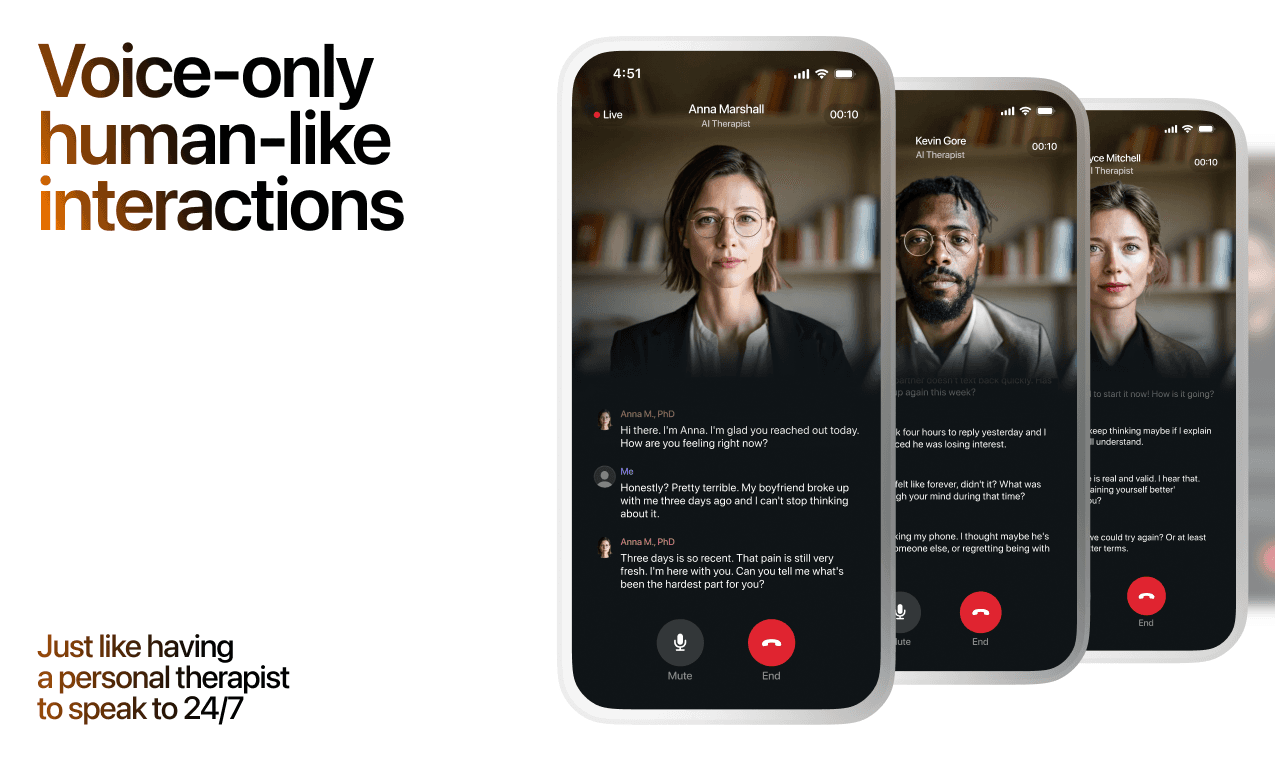
Lovon is AI support, not a replacement for professional care. If things have been hard to get through for weeks, or you are thinking about harming yourself, talk to a doctor or a licensed therapist.
Ready to Start?
Your healing journey can begin right now
A 7-day trial. No judgment. Just a safe space to process what you're going through.
Frequently Asked Questions
Is Lovon a replacement for a real therapist?
Is my conversation with Lovon AI private?
How is Lovon different from ChatGPT for emotional support?
Can I use Lovon if I'm already seeing a therapist?
Can I try Lovon before subscribing?
About the Author
The Lovon Editorial Team
Mental Health & Wellness Content Team
The Lovon Editorial Team develops mental health and wellness content designed to make psychological concepts accessible and actionable. Our goal is to bridge the gap between clinical research and everyday life - helping you understand why your mind works the way it does and what you can do about it....
Related articles
- Attachment Style Compatibility Quiz for Partners 2026
The best attachment style compatibility quiz for partners in 2026 — dual scoring, pairing analysis, and AI coaching…
- AI Relationship Coach for Newlyweds: 2026 Verdict
The best ai relationship coach for newlyweds in 2026 is voice-based and available on demand. See picks, what to avoid…
- Best compatibility quizzes for couples in 2026
Find the best compatibility quizzes for couples: start with a broad check-in, then choose communication or values…
- Green Flags in Relationships: Safety and Repair Over Drama
Many mistake intensity for intimacy and drama for passion. Green flags in relationships point elsewhere: safety, repair…
See also
Quizzes
- Love Language Test: What's My Love Language? Free Quiz
Find your love language in 2 minutes.
- Relationship Appetite Test: What Do You Want From Love?
See what you really go after in love, in 3 minutes.
Free tools
- How to Write a Love Letter That Sounds Like You
A chat, not a template, for anyone stuck on how to write a love letter. Tell it who it is for, how long you have been…
- Love Messages for Her or Him That Say Something Specific
Love messages for her or him, written from your story instead of a list of two hundred lines. Tell it what you love…
From the wiki
- How many dates before a relationship?
There is no set number. People often say five to ten dates, but that range is really describing five to ten weeks of…
Disclaimer: This article is for informational purposes only and does not constitute medical advice, diagnosis, or treatment. Always seek the advice of your physician or other qualified health provider with any questions you may have regarding a medical condition. If you are in crisis or think you may have an emergency, call 988 (Suicide & Crisis Lifeline) or go to the nearest emergency room. Outside the US? Find a crisis line in your country.