
Confirmation Bias in Low Self-Awareness: Agreement Over Understanding
When someone struggles with low self-awareness, they often develop a predictable pattern: they seek out people who will agree with them rather than those...

Key Takeaways
- Selective relationship building: Gravitating toward people who consistently agree and avoiding those who offer
- Defensive listening: Engaging in conversations not to understand but to find opportunities to defend their position
- Information filtering: Dismissing contradictory evidence while accepting supporting information uncritically
- Interpretation bias: Reframing neutral or negative feedback to align with their existing self-narrative
- Emotional regulation skills: Learning to tolerate uncomfortable feelings without immediately defending against them
Introduction
When someone struggles with low self-awareness, they often develop a predictable pattern: they seek out people who will agree with them rather than those who will help them understand themselves better. This tendency toward confirmation bias—filtering information to support existing beliefs—becomes particularly strong when self-knowledge is limited. People with poor self-awareness may surround themselves with yes-men, dismiss alternative perspectives, and listen not to comprehend but to defend their position. Understanding this dynamic is crucial, as research suggests that self-awareness forms the foundation of emotional intelligence and healthy decision-making. This article explores the relationship between limited self-knowledge and the preference for validation over truth, drawing on psychological insights and practical observations from mental health practitioners working with these patterns daily.
The Foundation: What Low Self-Awareness Actually Looks Like
Low self-awareness manifests through specific, observable behaviors that practitioners regularly identify in clinical settings. People with limited self-knowledge typically struggle to apologize genuinely, become defensive when receiving feedback, reject viewpoints that differ from their own, and consistently blame others when problems arise. These aren't character flaws but rather protective patterns that develop when someone lacks the internal framework to process uncomfortable information about themselves.
Self-awareness involves understanding your emotions, recognizing your behavioral patterns, acknowledging your impact on others, and accurately assessing your strengths and limitations. When this capacity is underdeveloped, individuals lack the mental tools to integrate information that challenges their self-concept. Studies indicate that self-awareness correlates strongly with better decision-making, healthier relationships, and improved emotional regulation—which helps explain why its absence creates such significant interpersonal challenges.
The psychological mechanism underlying low self-awareness involves the ego's protective function. When people cannot process painful emotions or uncomfortable truths about themselves, their ego deploys defense mechanisms to shield them from this psychological discomfort. This isn't conscious manipulation—it's an automatic psychological response that serves a protective purpose, even as it limits personal growth and distorts perception.
Confirmation Bias in Low Self-Awareness: The Echo Chamber Effect
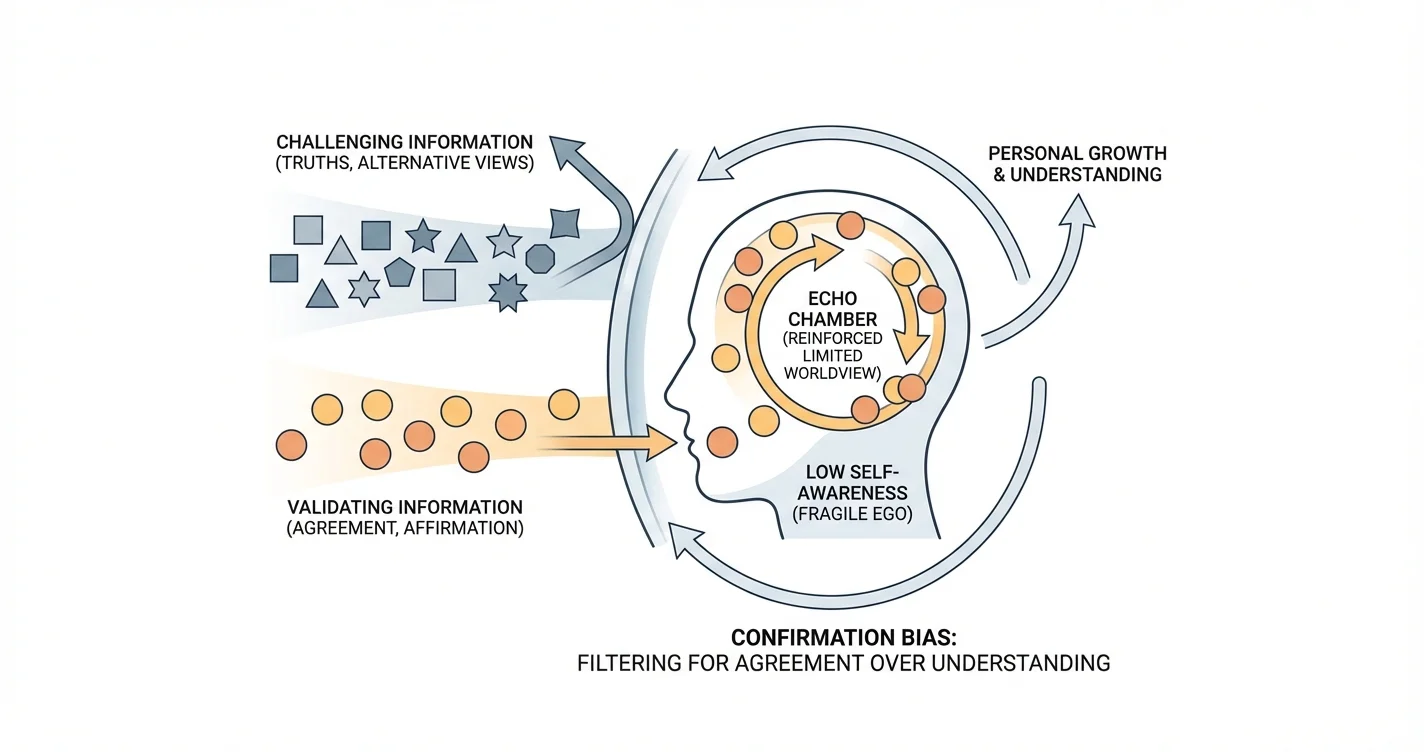
People with limited self-knowledge don't just struggle with self-awareness—they actively construct environments that reinforce their existing beliefs. This is where confirmation bias becomes particularly powerful. Rather than seeking diverse perspectives that might offer genuine insight, they gravitationally pull toward people and information sources that validate what they already believe.
This pattern plays out in several distinct ways:
- Selective relationship building: Gravitating toward people who consistently agree and avoiding those who offer alternative viewpoints
- Defensive listening: Engaging in conversations not to understand but to find opportunities to defend their position
- Information filtering: Dismissing contradictory evidence while accepting supporting information uncritically
- Interpretation bias: Reframing neutral or negative feedback to align with their existing self-narrative
Research on confirmation bias suggests that everyone engages in this selective processing to some degree, but the effect becomes significantly more pronounced when self-awareness is limited. Without the ability to step outside their own perspective and examine it critically, people with low self-knowledge lack the very tool needed to recognize they're filtering information selectively.
Mental health practitioners note that clients with this pattern often describe relationship histories characterized by dramatic breaks with people who "betrayed" them or "turned against" them. Upon closer examination, these ruptures frequently occurred when the other person offered honest feedback or failed to agree unconditionally. The person with low self-awareness experiences disagreement as a threat to their psychological equilibrium, not as an opportunity for growth.
Why Seeking Agreement Feels Safer Than Understanding
The preference for agreement over understanding isn't arbitrary—it serves a powerful psychological function. For people with limited self-awareness, their ego protects them from emotions they cannot yet process. This protective mechanism works through rationalization, projection, and other defense mechanisms that help maintain psychological stability when the alternative would be overwhelming emotional distress.
When someone with poor self-knowledge encounters information that challenges their self-concept, it triggers significant psychological discomfort. If they believe themselves to be fundamentally good and someone points out harmful behavior, accepting this feedback would require integrating the idea that they've caused harm—an emotionally complex task requiring substantial self-awareness. Without the capacity to hold both "I am generally good" and "I did something harmful" simultaneously, the ego reflexively rejects the challenging information entirely.
Seeking agreement becomes a form of emotional regulation. Surrounding yourself with people who validate your perspective provides consistent reassurance that your self-concept is accurate, your decisions are sound, and your interpretations of events are correct. This creates a feedback loop: limited self-awareness makes disagreement psychologically threatening, which drives agreement-seeking behavior, which further insulates the person from information that might increase self-awareness.
Tools like Lovon.app can sometimes help people begin recognizing these patterns by providing a non-judgmental space to process emotions and examine relationship dynamics without the interpersonal threat that makes defensive reactions so automatic.
The Practical Consequences: Relationships, Decisions, and Growth
The combination of low self-awareness and confirmation bias creates tangible consequences across multiple life domains. In relationships, this pattern frequently leads to instability. Partners, family members, and friends eventually exhaust themselves trying to maintain the agreement-only dynamic. Healthy relationships require both people to occasionally disagree, offer honest feedback, and present alternative perspectives—precisely what the person with low self-awareness finds threatening.
Professional environments present similar challenges. Workplace success typically requires accepting constructive criticism, adjusting based on feedback, and collaborating with people who see problems differently. People who can only accept agreement struggle in these environments, often interpreting normal professional feedback as personal attacks.
Decision-making quality also suffers significantly. Good decisions require weighing multiple perspectives, acknowledging potential downsides, and recognizing when you might be wrong. Someone who seeks only agreement receives consistently biased input, leading to decisions based on incomplete or distorted information.
Perhaps most significantly, this dynamic severely limits personal growth. Development requires recognizing patterns that aren't serving you, accepting uncomfortable truths about your impact on others, and integrating feedback that challenges your existing self-concept. When your psychological system is organized around avoiding exactly this kind of information, growth becomes nearly impossible.
Practitioners note that people caught in this pattern often experience repeating relationship conflicts, career difficulties that they perceive as others' fault, and a sense that they're surrounded by people who "just don't understand" them.
Breaking the Pattern: From Agreement-Seeking to Genuine Understanding
Developing greater self-awareness when you've historically sought agreement over understanding requires addressing the underlying emotional capacity that makes defensive patterns feel necessary. This isn't about forcing yourself to accept criticism or surrounding yourself with people who disagree—those approaches typically backfire, triggering even stronger defensive reactions.
Instead, emerging approaches focus on gradually building the emotional processing capacity that makes self-awareness psychologically safe. This might involve working with a therapist to develop skills for managing uncomfortable emotions, practicing self-reflection in low-stakes situations, or using tools like Lovon.app to process emotional experiences and identify patterns in a structured way.
Key elements in developing greater self-awareness include:
- Emotional regulation skills: Learning to tolerate uncomfortable feelings without immediately defending against them
- Perspective-taking practice: Gradually building capacity to consider how situations look from other viewpoints
- Pattern recognition: Identifying recurring dynamics in your relationships and life outcomes
- Feedback integration: Developing structured approaches to receiving and considering others' input
Mental health professionals emphasize that this development happens gradually. Someone with limited self-awareness cannot simply decide to become highly self-aware—the psychological capacity must be built systematically, often with professional support. Attempting to force rapid change typically activates defense mechanisms even more strongly.
For people in relationships with someone who demonstrates low self-awareness and confirmation bias, understanding the protective function of these patterns can help. This isn't about excusing harmful behavior, but rather recognizing that direct confrontation often strengthens defensive reactions.
When to Seek Professional Help
If you recognize these patterns in yourself—consistently surrounding yourself with people who agree, feeling threatened by alternative perspectives, or experiencing recurring relationship conflicts where others "betray" you—professional therapeutic support can help develop the self-awareness capacity that makes change possible. Therapists specializing in insight-oriented therapy, emotionally-focused approaches, or schema therapy have specific training in helping people develop greater self-knowledge.
Warning signs that professional help would be beneficial include:
- Relationships repeatedly ending in dramatic conflicts when others offer honest feedback
- Difficulty maintaining employment due to interpersonal conflicts you consistently attribute to others
- Growing isolation as you distance yourself from anyone who doesn't fully agree with your perspective
- Increasing rigidity in your viewpoints and decreasing tolerance for ambiguity
- Recognition that your life patterns aren't working but inability to identify your own role in these patterns
Mental health professionals can provide structured support for developing emotional regulation skills, building self-awareness capacity, and learning to integrate feedback without overwhelming your psychological system.
Conclusion
Confirmation bias in low self-awareness creates a self-reinforcing cycle: limited self-knowledge makes challenging information psychologically threatening, which drives agreement-seeking behavior, which further insulates someone from the very feedback that might increase self-awareness. This pattern manifests through defensive responses to feedback, gravitating toward yes-men rather than genuine confidants, and listening to defend rather than to understand. The protective function of the ego in shielding people from emotions they cannot yet process helps explain why this dynamic persists even when it creates obvious life difficulties.
Breaking this pattern requires gradually building the emotional processing capacity that makes self-awareness psychologically safe rather than threatening. Professional therapeutic support often proves essential for this development. For those recognizing these patterns in themselves, seeking understanding rather than just agreement—even when uncomfortable—represents the first step toward more authentic relationships, better decisions, and genuine personal growth.
Disclaimer: This is general information, not medical advice or diagnosis. If symptoms are severe, affecting your daily life, or you're having thoughts of self-harm—seek professional help. In the US: call or text 988 (Suicide & Crisis Lifeline). For immediate danger: 911 or local emergency services.
How AI Support Helps You Heal
AI emotional support isn't about replacing human connection — it's about filling the gaps. The moments when you need to talk at 2 AM, when you don't want to burden your friends again, or when you simply need someone to listen without judgment.
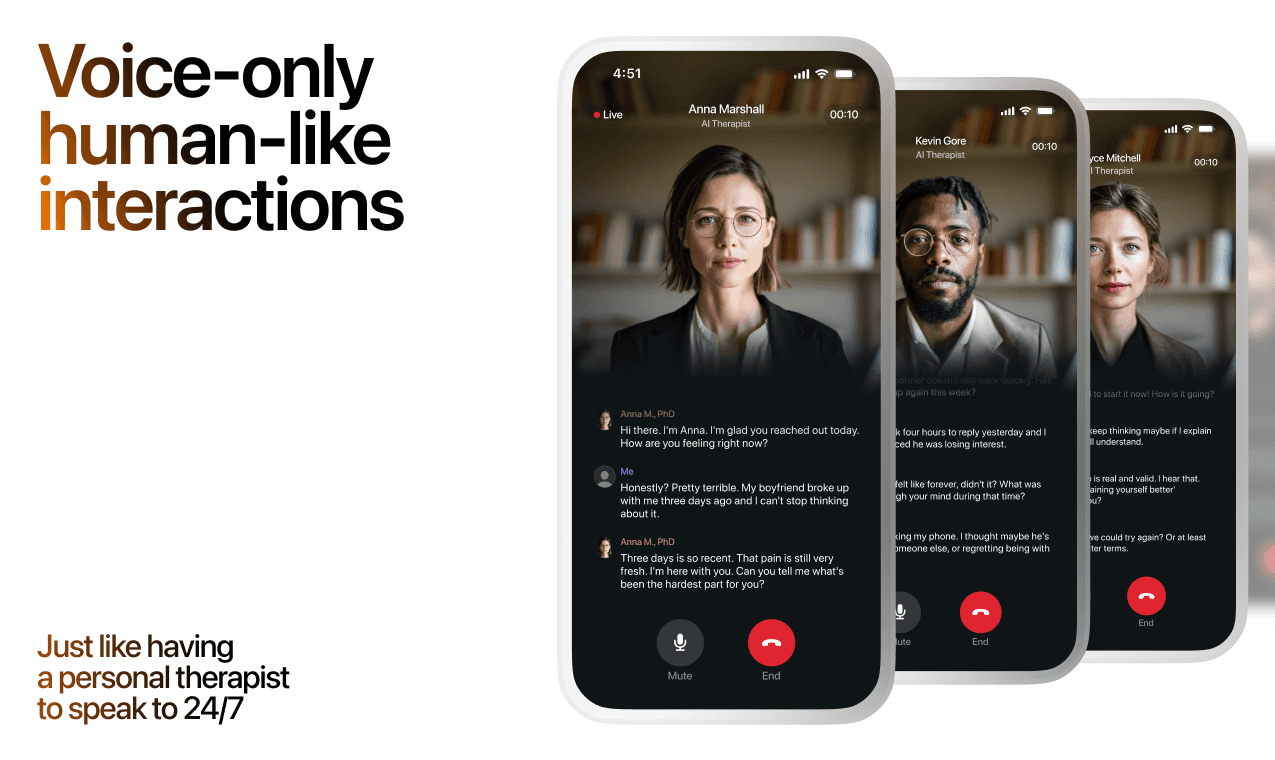
Here's what happens in a typical Lovon session:
You share what's on your mind
There's no script, no intake form, no waiting room. You speak or type whatever you're feeling — in your own words, at your own pace.
Lovon validates and explores
Using frameworks from CBT (Cognitive Behavioral Therapy) and motivational interviewing, Lovon acknowledges your feelings first, then gently helps you explore them. No dismissive "just move on" advice.
You build coping skills together
Lovon doesn't just listen — it actively works with you on evidence-based techniques: thought reframing, urge surfing, behavioral experiments, and more.
What a Session with Lovon Looks Like
When to Seek Professional Help
AI support is a valuable tool, but it's not a replacement for professional care. Please consider reaching out to a licensed therapist if you experience any of the following:
- Persistent thoughts of self-harm or suicide
- Inability to perform daily activities (work, eating, sleeping) for more than 2 weeks
- Turning to alcohol or substances to cope
- Intense anger or desire to harm your ex-partner
- Complete emotional numbness that doesn't improve over time
Crisis Resources (US): If you're in immediate danger, call 988 (Suicide & Crisis Lifeline) or text HOME to 741741 (Crisis Text Line). Available 24/7, free, and confidential.
Outside the US? Find a crisis line in your country
Ready to Start?
Your healing journey can begin right now
A 7-day trial. No judgment. Just a safe space to process what you're going through.
Frequently Asked Questions
Is Lovon a replacement for a real therapist?
Is my conversation with Lovon AI private?
How is Lovon different from ChatGPT for emotional support?
Can I use Lovon if I'm already seeing a therapist?
Can I try Lovon before subscribing?
About the Author
The Lovon Editorial Team
Mental Health & Wellness Content Team
The Lovon Editorial Team develops mental health and wellness content designed to make psychological concepts accessible and actionable. Our goal is to bridge the gap between clinical research and everyday life - helping you understand why your mind works the way it does and what you can do about it....
Related articles
- Doom Scrolling as Dissociation and Trauma Response Rather Than Lack of Willpower
You've done it again—opened your phone for "just a minute" and emerged an hour later, drained and disoriented, wondering…
- Polyvagal Theory by Stephen Porges for Understanding Stress
When you feel your heart race during a tense conversation, or notice yourself shutting down emotionally after an…
- Mental Health Decline Indicators Through Irritability Changes Appetite Shifts Low Energy Social Isolation Declining Hygiene
Mental health doesn't typically deteriorate overnight. Instead, it sends signals—subtle at first, then increasingly…
- Trauma Dump: Emotional Dumping, Oversharing & How It Harms Your Mental Health
When a person goes through traumatic events, it is natural to share them with someone. But there is a big difference…
See also
Quizzes
- Alexithymia Test: Can You Name What You Feel?
See where your feelings lose their names, in 3 minutes.
- Distress Tolerance Test: How Long Can You Sit With It?
See which kind of discomfort makes you need out first.
Free tools
- What to Say When They Are Struggling
A chat, not a list. Tell the coach who this person is to you, what they are going through, and what you already said…
- Words of Encouragement for Him When He Is Struggling
Words of encouragement for him that fit what he is actually going through, for when your usual lines are not landing…
From the wiki
- Why do I feel sad when I'm alone?
Being alone does not create the sadness. It removes the noise that was keeping it out of earshot, so whatever queued up…
Disclaimer: This article is for informational purposes only and does not constitute medical advice, diagnosis, or treatment. Always seek the advice of your physician or other qualified health provider with any questions you may have regarding a medical condition. If you are in crisis or think you may have an emergency, call 988 (Suicide & Crisis Lifeline) or go to the nearest emergency room. Outside the US? Find a crisis line in your country.