
How to Accept Unpredictability to Reduce Anxiety
Chronic anxiety often stems from an intolerance of uncertainty—the mind's relentless attempt to control outcomes that remain inherently unpredictable.

Key Takeaways
- Repeatedly asking others for confirmation that outcomes will be positive
- Feeling temporary relief followed by renewed anxiety within hours
- Difficulty making decisions without extensive validation from others
- Compulsive information-gathering that never feels sufficient
- Mental reviewing of situations to achieve complete certainty
Introduction
Chronic anxiety often stems from an intolerance of uncertainty—the mind's relentless attempt to control outcomes that remain inherently unpredictable. Learning how to accept unpredictability to reduce anxiety represents a fundamental shift in how we relate to discomfort, one that mental health practitioners increasingly recognize as essential for long-term relief. Rather than seeking constant reassurance or attempting to eliminate all unknowns, evidence-based approaches focus on gradually building tolerance for life's inevitable ambiguities. This article examines therapeutic techniques grounded in clinical experience, offering practical methods to transform your relationship with uncertainty and decrease the intensity of anxious thoughts.
Understanding Why Uncertainty Triggers Anxiety
The human brain evolved to seek patterns and predict outcomes—a survival mechanism that once protected our ancestors from immediate threats. In modern life, however, this same mechanism can misfire, causing the nervous system to treat unpredictable situations as emergencies even when no actual danger exists. Research suggests that individuals with chronic anxiety demonstrate heightened sensitivity to uncertain scenarios, with their brains processing ambiguity as a potential threat requiring immediate resolution.
Intolerance of uncertainty functions as one of the key maintaining factors in persistent anxiety. When the mind cannot tolerate not-knowing, it generates worst-case scenarios, compulsive planning, or repetitive worry cycles in an attempt to achieve certainty where none exists. This pattern creates a feedback loop: the more we resist uncertainty, the more threatening it appears, and the more our anxiety intensifies.
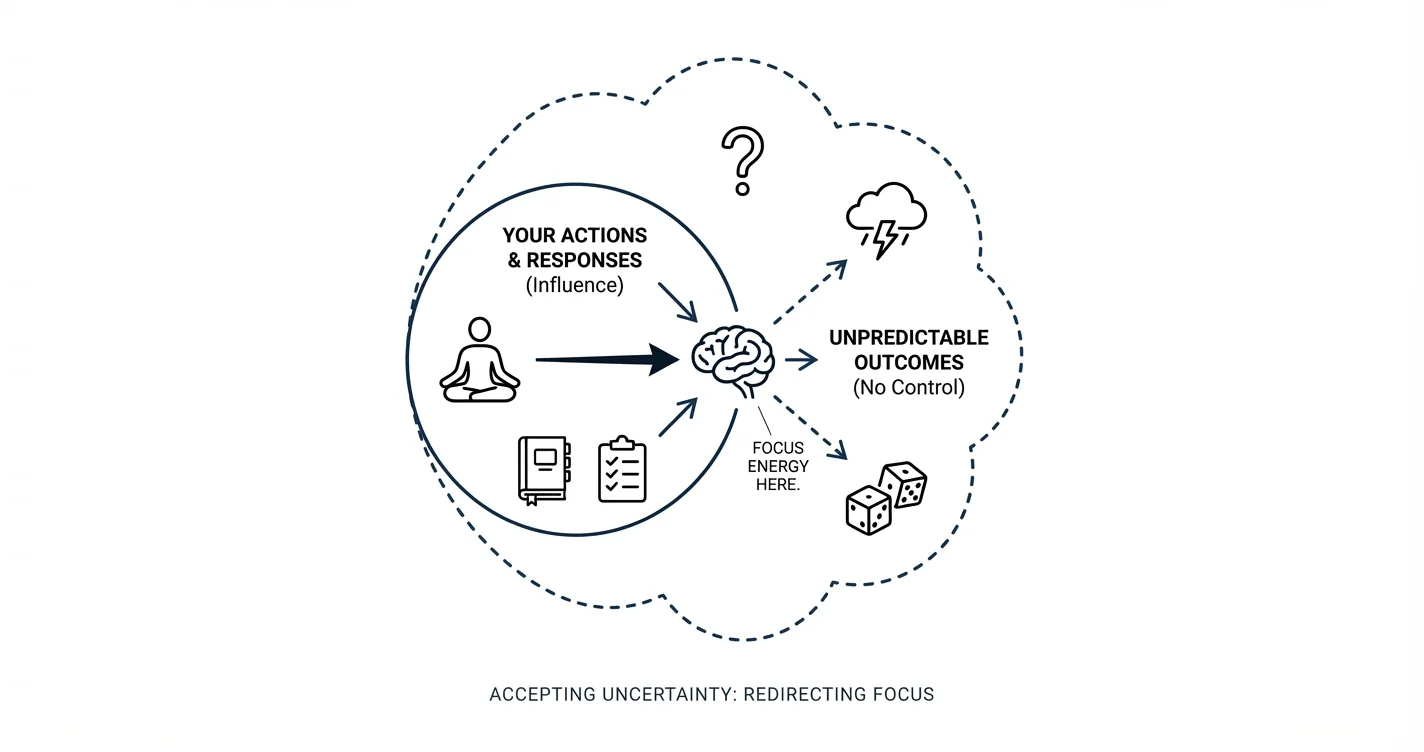
Clinical observations indicate that distinguishing between influence and control plays a critical role in anxiety management. We may have influence over certain aspects of a situation—our preparation, responses, and decisions—but absolute control over outcomes often remains beyond our grasp. Confusing these concepts leads to exhausting attempts to control uncontrollable variables, which paradoxically increases anxiety rather than resolving it.
The Reassurance-Seeking Trap and Why It Backfires
Seeking reassurance appears to offer relief from anxiety, but practitioners recognize this pattern as one of the most counterproductive coping mechanisms. Whether external reassurance from others ("Tell me everything will be okay") or internal reassurance through repetitive self-talk, this strategy provides only temporary comfort while strengthening anxiety's grip over time.
The mechanism resembles a dependency cycle: reassurance delivers a brief reduction in distress, reinforcing the behavior and creating a need for increasingly frequent doses. The brain learns that uncertainty equals danger requiring immediate soothing, rather than developing the capacity to tolerate ambiguity independently. This pattern shares characteristics with what some describe as toxic positivity—forced reassurances that the mind fundamentally doesn't believe, leading to a return of anxious thoughts often within minutes.
Internal reassurance manifests as mental rituals: repeatedly reviewing situations, seeking perfect certainty before taking action, or compulsively checking for potential problems. While these behaviors feel productive, they actually signal to the nervous system that the situation demands heightened vigilance, preventing the anxiety response from naturally decreasing.
Key indicators you may be caught in reassurance-seeking:
- Repeatedly asking others for confirmation that outcomes will be positive
- Feeling temporary relief followed by renewed anxiety within hours
- Difficulty making decisions without extensive validation from others
- Compulsive information-gathering that never feels sufficient
- Mental reviewing of situations to achieve complete certainty
Platforms like Lovon.app can help identify these patterns through reflective conversations, allowing you to recognize when reassurance-seeking has become a compulsive response rather than genuine problem-solving.
Practical Techniques for Embracing Uncertainty and Managing Anxiety
Building tolerance for unpredictability requires gradual, intentional practice rather than forced acceptance. The following evidence-based approaches help recalibrate your relationship with uncertainty without overwhelming your nervous system.
Gradual Exposure to Uncertainty
Exposure therapy principles apply powerfully to uncertainty intolerance. The process involves progressively approaching situations that trigger the need for certainty while resisting the urge to engage in reassurance-seeking or avoidance behaviors. Clinical experience demonstrates that exposure teaches the brain and nervous system that uncertainty, discomfort, and ambiguity are tolerable—not dangerous.
Begin with lower-stakes uncertainties: leaving a minor decision unmade for a specific period, resisting the urge to check your phone for updates, or deliberately choosing an activity with an unpredictable element. The goal isn't to enjoy uncertainty, but to build evidence that you can function effectively despite it.
As tolerance develops, gradually approach more challenging uncertainties. This might include making decisions with imperfect information, sending important messages without excessive review, or accepting invitations without knowing all details in advance. The key lies in staying present with the discomfort rather than immediately seeking relief through control behaviors.
Developing Emotional Pain Tolerance
Practitioners recognize that anxiety often functions as protection against emotional pain. The mind maintains high anxiety levels because they feel more manageable than facing underlying feelings of vulnerability, disappointment, or loss. Changing your relationship with emotional pain reduces the brain's perceived need to maintain constant vigilance.
This doesn't mean seeking out suffering, but rather recognizing that temporary emotional discomfort won't cause permanent damage. When anxiety arises around an uncertain situation, investigate what underlying feeling the anxiety might be protecting you from experiencing. Fear of rejection, grief over potential loss, or shame about possible failure often hide beneath surface-level worry.
Tools that facilitate emotional processing, such as journaling, therapy, or platforms like Lovon.app, can help you practice sitting with difficult emotions in manageable doses. Over time, this builds confidence that emotional pain, while genuinely uncomfortable, remains survivable and temporary.
Distinguishing Influence from Control
A practical daily exercise involves categorizing concerns into what you can influence versus what you cannot control. Write down a current worry, then honestly assess which elements fall within your sphere of influence—your actions, preparations, communication style, boundaries—and which remain outside your control, such as others' decisions, future events, or external circumstances.
Direct your mental and emotional energy exclusively toward the influence column. This doesn't eliminate anxiety about uncontrollable elements, but it prevents the exhausting pattern of attempting to control what cannot be controlled. When your mind returns to uncontrollable factors, gently redirect attention to concrete actions within your influence.
Influence vs. Control in practice:
- You can influence: Your preparation for a presentation, how you communicate your needs, healthy habits that support resilience
- You cannot control: Others' opinions of you, whether you receive a specific opportunity, exact future outcomes
- Productive focus: Improving your skills, expressing yourself clearly, managing your own nervous system
- Unproductive focus: Trying to guarantee positive outcomes, attempting to read others' minds, seeking absolute certainty
Advanced Strategies for Long-Term Anxiety Reduction
Building on foundational practices, several advanced approaches help sustain progress in accepting unpredictability and reducing chronic anxiety.
Recognizing and Resisting Avoidance Patterns
Avoidance and distraction provide immediate short-term relief but prevent long-term anxiety reduction. Each time we avoid an uncertain situation, we reinforce the message that uncertainty represents genuine danger requiring protection. The anxiety response never has the opportunity to naturally diminish through prolonged exposure.
Subtle avoidance often goes unrecognized: excessive planning that creates an illusion of control, premature decision-making to eliminate uncertainty quickly, or filling every quiet moment with distraction. These behaviors feel productive but actually maintain anxiety by preventing habituation to discomfort.
Identify your specific avoidance patterns, then experiment with deliberately not engaging them. Sit with the discomfort of an unmade decision. Allow space for not-knowing. Resist the urge to immediately fill uncertainty with planning or distraction. These moments of deliberate tolerance gradually retrain your nervous system.
Building Distress Tolerance Skills
Distress tolerance—the capacity to experience uncomfortable emotions and sensations without immediately attempting to eliminate them—represents a learnable skill. Grounding techniques help you remain present during uncertainty-triggered anxiety rather than dissociating or escalating into panic.
Physical grounding methods include: noticing five things you can see, four you can touch, three you can hear, two you can smell, and one you can taste. This sensory inventory anchors awareness in the present moment rather than catastrophic future scenarios. Controlled breathing—extending the exhale slightly longer than the inhale—activates the parasympathetic nervous system, signaling safety to the body.
Cognitive grounding involves observing anxious thoughts without engaging them: "I notice I'm having the thought that this will end badly" rather than "This will end badly." This slight distance creates space between you and your anxiety, reducing its power to dictate your actions.
Accepting Limitations of Human Knowledge
Philosophical acceptance that absolute certainty rarely exists in human experience can paradoxically reduce anxiety. We make countless decisions daily with imperfect information—which route to take, what to eat, how to interpret a conversation. Most function adequately despite this constant uncertainty because we've developed tolerance through repetition.
Expanding this acceptance to higher-stakes decisions involves acknowledging that even extensive research, planning, and analysis cannot eliminate all risk or guarantee outcomes. At a certain point, additional information-gathering produces diminishing returns and may actually represent reassurance-seeking rather than genuine preparation.
When to Seek Professional Help
While self-directed strategies can significantly reduce anxiety related to uncertainty intolerance, certain situations warrant professional support. Consider consulting a mental health professional if:
- Anxiety about unpredictability prevents you from fulfilling work, relationship, or personal responsibilities
- You experience panic attacks or physical symptoms (chest pain, difficulty breathing, dizziness) related to uncertainty
- Avoidance patterns have significantly narrowed your life activities
- You engage in compulsive behaviors (excessive checking, reassurance-seeking, mental rituals) that consume substantial time daily
- Anxiety persists despite consistent implementation of self-help strategies over several months
- You experience thoughts of self-harm or that life isn't worth living
Therapists specializing in cognitive-behavioral therapy (CBT), acceptance and commitment therapy (ACT), or exposure and response prevention (ERP) offer evidence-based treatments specifically targeting uncertainty intolerance. These approaches provide structured guidance for gradually building tolerance while addressing underlying patterns maintaining anxiety.
Moving Forward: Embracing Uncertainty as a Practice
Learning how to accept unpredictability to reduce anxiety represents an ongoing practice rather than a destination. Progress appears nonlinear—periods of increased tolerance alternate with times when uncertainty feels overwhelming again. This variability itself offers opportunities to practice acceptance rather than demanding constant improvement.
The strategies outlined here—gradual exposure, developing emotional pain tolerance, distinguishing influence from control, and resisting reassurance-seeking—work synergistically when implemented consistently. Start with whichever approach feels most accessible, gradually incorporating others as your tolerance builds.
Remember that embracing uncertainty doesn't mean enjoying it or never experiencing anxiety. It means developing confidence that you can function effectively, make reasonable decisions, and experience meaningful life even when outcomes remain unknown. This shift from demanding certainty to tolerating ambiguity fundamentally transforms your relationship with anxiety, reducing its intensity and frequency over time.
For additional support in processing uncertainty-related anxiety between therapy sessions or as part of your daily practice, consider resources that help you reflect on patterns and identify when reassurance-seeking has replaced genuine coping.
Disclaimer: This is general information, not medical advice or diagnosis. If symptoms are severe, affecting your daily life, or you're having thoughts of self-harm—seek professional help. In the US: call or text 988 (Suicide & Crisis Lifeline). For immediate danger: 911 or local emergency services.
How AI Support Helps You Heal
AI emotional support isn't about replacing human connection — it's about filling the gaps. The moments when you need to talk at 2 AM, when you don't want to burden your friends again, or when you simply need someone to listen without judgment.
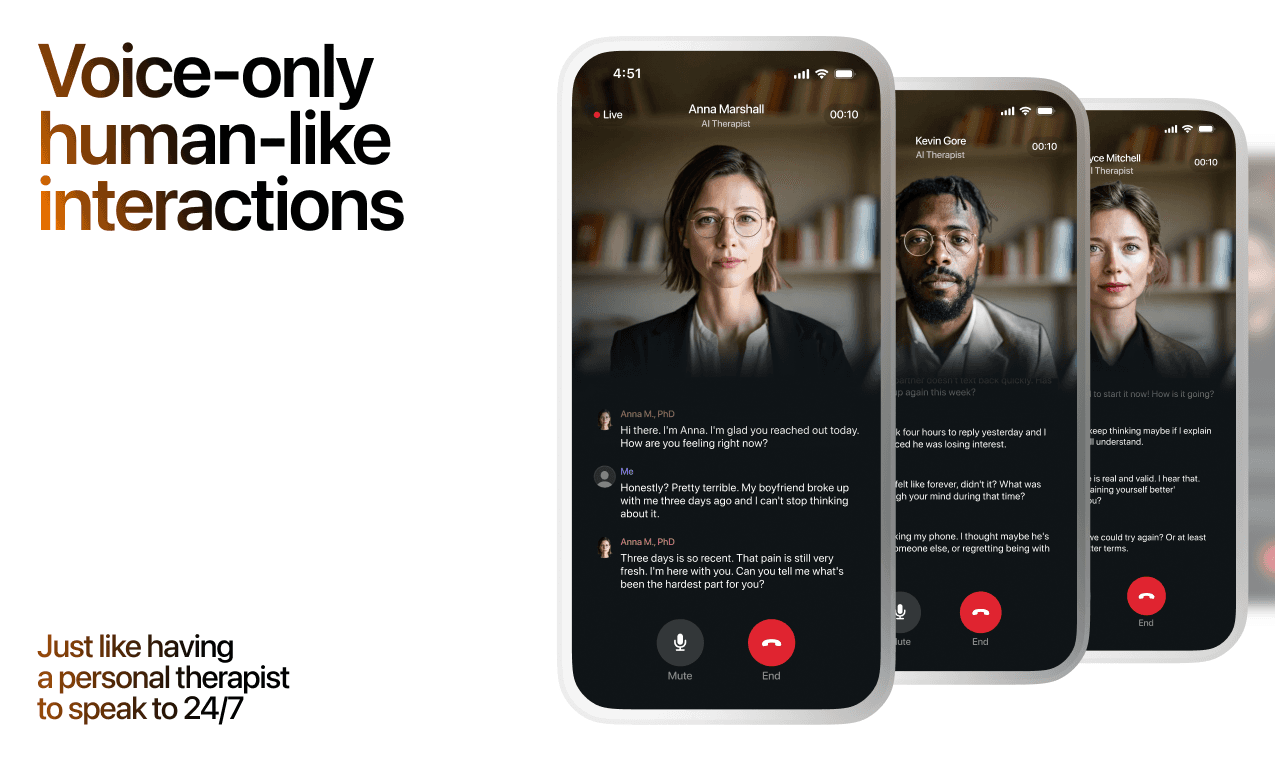
Here's what happens in a typical Lovon session:
You share what's on your mind
There's no script, no intake form, no waiting room. You speak or type whatever you're feeling — in your own words, at your own pace.
Lovon validates and explores
Using frameworks from CBT (Cognitive Behavioral Therapy) and motivational interviewing, Lovon acknowledges your feelings first, then gently helps you explore them. No dismissive "just move on" advice.
You build coping skills together
Lovon doesn't just listen — it actively works with you on evidence-based techniques: thought reframing, urge surfing, behavioral experiments, and more.
What a Session with Lovon Looks Like
Lovon is AI support, not a replacement for professional care. If things have been hard to get through for weeks, or you are thinking about harming yourself, talk to a doctor or a licensed therapist.
Ready to Start?
Your healing journey can begin right now
A 7-day trial. No judgment. Just a safe space to process what you're going through.
Frequently Asked Questions
Is Lovon a replacement for a real therapist?
Is my conversation with Lovon AI private?
How is Lovon different from ChatGPT for emotional support?
Can I use Lovon if I'm already seeing a therapist?
Can I try Lovon before subscribing?
About the Author

The Lovon Editorial Team
Mental Health & Wellness Content Team
The Lovon Editorial Team develops mental health and wellness content designed to make psychological concepts accessible and actionable. Our goal is to bridge the gap between clinical research and everyday life - helping you understand why your mind works the way it does and what you can do about it....
Related articles
- How to Heal Inner Child Trauma with Somatic Therapy Guide
Many adults carry unresolved childhood wounds that manifest as anxiety, relationship difficulties, or emotional…
- Amygdala and Prefrontal Cortex Connection: Training Emotional Regulation Through Mindfulness
How mindfulness practices reshape neural pathways to strengthen emotional control and reduce reactivity
- How to Calm Anxiety at Night in 2026: 7 Steps
Learn how to calm anxiety at night with 7 evidence-based steps — breathing techniques, body scans, and worry dumps that…
- How to Reduce Cortisol Levels Naturally in 2026
Learn how to reduce cortisol levels with 7 evidence-based steps: fix sleep, dial back intense exercise, practice daily…
See also
Quizzes
- Defense Mechanisms Test: Which Ones Do You Use Most?
See what your defenses do with hard feelings, in 3 minutes.
- Self-Control Test: Where Does Your Willpower Slip?
See where your willpower slips, in 3 minutes.
Free tools
- What to Say When a Pet Dies
Get a message you can actually send to someone whose dog or cat just died: one that uses the animal's name, treats the…
- Write a Condolence Message for This Person
Get one condolence message written for your situation instead of a list of a hundred to choose from. Tell it who died…
From the wiki
- What does it mean when you dream about your ex?
Dreaming about your ex usually reflects emotional processing, not prophecy and not a message from them. Your sleeping…
Disclaimer: This article is for informational purposes only and does not constitute medical advice, diagnosis, or treatment. Always seek the advice of your physician or other qualified health provider with any questions you may have regarding a medical condition. If you are in crisis or think you may have an emergency, call 988 (Suicide & Crisis Lifeline) or go to the nearest emergency room. Outside the US? Find a crisis line in your country.