
Covert Narcissism vs Overt Narcissism: Manipulation Tactics and Attention-Seeking Behaviors
Recognizing the difference between covert narcissism vs overt narcissism — particularly in manipulation tactics and attention-seeking behaviors — can transform

Key Takeaways
- Persistent anxiety, depression, or emotional exhaustion related to a relationship
- Questioning your sanity, memory, or perceptions regularly
- Isolation from friends, family, or support systems
- Changes in your sense of self, confidence, or decision-making ability
- Any form of intimidation, threats, or fear for your safety
Introduction
Recognizing the difference between covert narcissism vs overt narcissism — particularly in manipulation tactics and attention-seeking behaviors — can transform how you understand difficult relationships. While both types of narcissistic patterns involve a deep need for validation and control, the methods they use to achieve these goals differ dramatically. Overt narcissists demand the spotlight through grandiosity and self-promotion, while covert narcissists operate more subtly, using guilt, self-pity, and victimhood to secure attention and influence. This article examines the distinct manipulation strategies and attention-seeking patterns of each type, drawing on clinical insights and psychological research to help you identify these behaviors and respond effectively.
Understanding these differences isn't about diagnosing others — it's about recognizing patterns that may be affecting your relationships and well-being. Whether you're navigating a challenging personal relationship or simply trying to understand confusing interpersonal dynamics, knowing how these patterns manifest can provide clarity and direction.
Understanding Narcissistic Personality Patterns
Narcissistic patterns exist on a spectrum and involve a persistent need for admiration, lack of empathy, and patterns of behavior that prioritize the individual's self-image above genuine connection. Research in personality psychology suggests that narcissistic traits can manifest in dramatically different ways, leading to the distinction between overt and covert presentations.
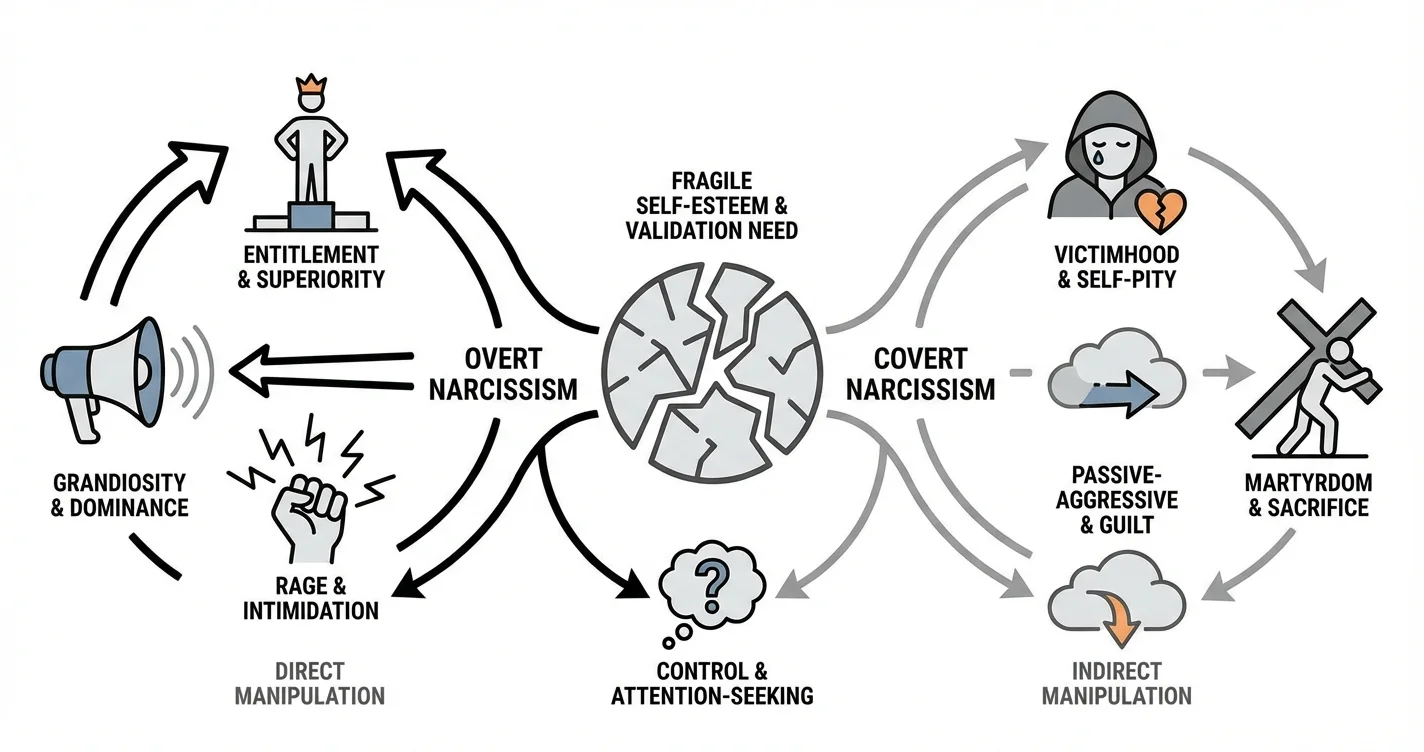
Overt narcissism, sometimes called grandiose narcissism, involves openly inflated self-image, explicit demands for attention, and visible expressions of superiority. These individuals typically appear confident, extroverted, and openly self-focused. Their need for validation is transparent — they actively seek praise, recognition, and admiration through achievement, appearance, or social status.
Covert narcissism, also known as vulnerable or hidden narcissism, operates beneath the surface. These individuals harbor the same core need for validation but express it through indirect channels. Rather than openly demanding attention, they elicit it through appearing wounded, misunderstood, or uniquely burdened. Clinical observations indicate that covert narcissists often present as sensitive, introverted, or anxious, making their manipulative patterns harder to identify.
Both patterns stem from fragile self-esteem that requires constant external validation, but the strategies for obtaining that validation differ fundamentally. Understanding this distinction is the first step in recognizing how these patterns play out in real relationships.
How Overt Narcissists Seek Attention and Manipulate
Overt narcissists employ direct, visible strategies to secure attention and control. Their manipulation tactics center on establishing and maintaining a position of superiority, often through the following approaches:
Grandiose Self-Presentation
Overt narcissists openly boast about their achievements, abilities, and importance. They dominate conversations by redirecting topics back to themselves, their accomplishments, or their opinions. This isn't occasional self-promotion — it's a consistent pattern where others' experiences are minimized or used as launching points for their own stories. The attention-seeking is transparent: they expect admiration and become visibly irritated when it's withheld.
Direct Criticism and Devaluation
When overt narcissists feel threatened or don't receive expected admiration, they may openly criticize or belittle others. This manipulation tactic serves to elevate their position by diminishing someone else's. The criticism often appears as "honesty" or "high standards," but the pattern reveals an underlying need to maintain superiority. They may publicly embarrass others, make cutting remarks disguised as jokes, or explicitly point out others' flaws.
Entitlement and Boundary Violations
Overt narcissists typically display clear entitlement — expecting special treatment, cutting in line (literally or figuratively), or demanding exceptions to rules. They manipulate by acting as though their needs naturally take precedence. When boundaries are set, they may respond with anger, dismissiveness, or escalation, making it emotionally costly for others to maintain limits.
Rage and Intimidation
When an overt narcissist's self-image is challenged, they may respond with what clinicians call "narcissistic rage" — disproportionate anger aimed at restoring their superior position. This manipulation tactic creates an environment where others learn to avoid contradicting or disappointing them. The underlying message: compliance is safer than confrontation.
These direct strategies make overt narcissism relatively easier to identify, though not necessarily easier to handle. The patterns are visible, making it clearer when manipulation is occurring, even if responding effectively remains challenging.
How Covert Narcissists Seek Attention and Manipulate
Covert narcissism vs overt narcissism becomes most apparent when examining the indirect, emotionally subtle manipulation tactics of hidden narcissists. These strategies are harder to identify because they exploit empathy and compassion rather than demanding overt compliance.
Self-Pity and Victimhood
Covert narcissists frequently position themselves as uniquely suffering or misunderstood. They share their struggles in ways that implicitly demand reassurance, attention, and special consideration. Unlike genuine vulnerability, this pattern involves consistent casting of oneself as the victim across different situations and relationships. Mental health professionals note that covert narcissists use their "suffering" as a form of currency — it obligates others to provide comfort, accommodation, and attention.
This manipulation tactic is particularly effective because withdrawing support feels cruel. When you're exhausted from constant emotional caretaking, you may question whether you're being insensitive rather than recognizing the manipulative pattern.
Passive-Aggression and Indirect Hostility
Rather than openly expressing anger or criticism, covert narcissists employ passive-aggressive behaviors: the silent treatment, "forgetting" important commitments, backhanded compliments, or martyred sighs. These indirect expressions of hostility allow them to punish or control others while maintaining plausible deniability. If confronted, they can claim innocence or further victimhood ("I can't believe you think I would do that on purpose").
Guilt Manipulation
Covert narcissists are skilled at inducing guilt as a control mechanism. They frame their needs and wants in ways that make refusal seem selfish or cruel. Phrases like "After everything I've done for you" or "I guess I'm just not important to you" redirect focus from their demands to your supposed failings. This attention-seeking behavior is disguised as hurt feelings, making it difficult to recognize the underlying manipulation.
Playing the Martyr
Covert narcissists often emphasize their sacrifices and how much they do for others, creating an implicit debt. This martyrdom serves multiple functions: it secures attention and sympathy, establishes moral superiority, and makes others feel obligated to reciprocate or accommodate. The manipulation lies in the unspoken scorekeeping and the expectation that their "sacrifices" entitle them to control or special treatment.
Subtle Competition and Undermining
While overt narcissists compete openly, covert narcissists undermine more subtly. They may offer "concern" that plants seeds of doubt ("Are you sure you're ready for that promotion?"), share others' confidences to position themselves as more trusted, or frame their own struggles as more significant than yours. This attention-seeking behavior ensures they remain central while appearing supportive.
Tools like Lovon.app can be valuable when processing the confusion that comes from these subtle manipulation patterns, offering a space to talk through the emotional impact and identify dynamics that may be difficult to name on your own.
Key Differences in Manipulation Tactics and Attention-Seeking Behaviors
When comparing covert narcissism vs overt narcissism — manipulation tactics and attention-seeking behaviors — several clear distinctions emerge:
Visibility of the Strategy
Overt narcissists' methods are transparent. Their need for admiration, displays of superiority, and angry reactions when challenged are obvious to observers. Covert narcissists operate through plausible deniability — their tactics can be explained away as sensitivity, legitimate hurt, or genuine struggle, making validation harder to obtain from others who witness the interactions.
Emotional Presentation
Overt narcissists project confidence, superiority, and entitlement, even when this masks underlying insecurity. Covert narcissists present as anxious, wounded, or insecure, using vulnerability as the vehicle for control. This difference affects how others perceive and respond to them — overt narcissists may be seen as arrogant, while covert narcissists are often viewed as victims who need protection.
Response to Criticism
Overt narcissists typically respond to perceived criticism with visible anger, dismissiveness, or counterattack. Their manipulation tactic is intimidation — making confrontation costly. Covert narcissists respond with hurt, withdrawal, or increasing displays of suffering. Their manipulation tactic is guilt induction — making confrontation feel cruel.
Source of Attention
Overt narcissists seek attention through achievement, status, appearance, or dominance. They want to be admired, envied, and recognized as superior. Covert narcissists seek attention through suffering, uniqueness of burden, or being misunderstood. They want to be comforted, rescued, and recognized as specially sensitive or wounded.
Impact on Relationships
Research on narcissistic personality patterns suggests both types significantly impair relationship quality, but through different mechanisms. Relationships with overt narcissists often feel one-sided and exhausting due to constant demands for admiration and lack of reciprocal interest. Relationships with covert narcissists feel emotionally draining due to constant caretaking, guilt, and the sense of walking on eggshells around someone who seems perpetually wounded.
Recognizing These Patterns in Your Life
Understanding manipulation and attention-seeking patterns is most valuable when applied to your own experiences. Several indicators suggest you may be dealing with narcissistic patterns, whether overt or covert:
Emotional Exhaustion Without Clear Cause
If interactions consistently leave you drained, confused, or questioning your own perceptions, manipulation may be at play. With overt narcissists, this exhaustion often comes from constant vigilance about their reactions. With covert narcissists, it stems from perpetual emotional caretaking and guilt management.
One-Sided Emotional Labor
Both types of narcissistic patterns result in relationships where your needs are consistently secondary. Overt narcissists make this explicit through dismissiveness or redirection. Covert narcissists make it implicit — your needs feel selfish when compared to their suffering, or bringing them up adds to their burden.
Difficulty Setting Boundaries
If setting reasonable boundaries consistently results in disproportionate consequences — rage, prolonged sulking, guilt trips, or punishment through withdrawal — narcissistic patterns may be present. The specific response helps distinguish the type.
Questioning Your Reality
Both overt and covert narcissists may engage in reality distortion. Overt narcissists might flatly deny events or insist their version is correct through sheer force of conviction. Covert narcissists are more likely to use subtle distortions, reframing their hurtful behavior as your misunderstanding of their good intentions.
Platforms like Lovon.app offer accessible support for processing these confusing dynamics, providing a space to articulate your experiences and work through the emotional impact between sessions with a therapist or when professional support isn't immediately available.
Responding Effectively to Different Narcissistic Patterns
Your response strategy should account for the specific manipulation tactics and attention-seeking behaviors you're facing. Some general principles apply across both types:
Maintain Clear Internal Reality
Document interactions when you find yourself questioning what happened. Keep records of commitments, statements, and events. This external validation helps counter reality distortion, whether it comes through the aggressive certainty of an overt narcissist or the hurt confusion of a covert one.
Set and Enforce Boundaries
Identify your non-negotiables and communicate them clearly. With overt narcissists, expect pushback through anger or dismissiveness — stay consistent despite the emotional intensity. With covert narcissists, expect guilt induction and displays of hurt — recognize these as manipulation tactics rather than genuine injury requiring your capitulation.
Limit Emotional Investment
Both types of narcissistic patterns involve individuals who struggle with genuine empathy and reciprocity. Adjusting your expectations protects your emotional resources. This doesn't mean cruelty — it means recognizing the relationship's limitations and investing accordingly.
Seek Outside Perspective
Narcissistic manipulation often involves isolation and reality distortion. Trusted friends, family members, or mental health professionals can offer perspective that's difficult to maintain when you're in the situation. Be specific about behaviors and patterns rather than general feelings when seeking input.
Consider the Relationship's Viability
Some relationships can be maintained with strong boundaries and limited expectations. Others — particularly intimate partnerships — may not be sustainable if narcissistic patterns are severe and the person is unwilling to acknowledge problematic behaviors. Working with a therapist can help you assess your specific situation and make informed decisions.
When to Seek Professional Help
If you're experiencing any of the following, professional support is strongly recommended:
- Persistent anxiety, depression, or emotional exhaustion related to a relationship
- Questioning your sanity, memory, or perceptions regularly
- Isolation from friends, family, or support systems
- Changes in your sense of self, confidence, or decision-making ability
- Any form of intimidation, threats, or fear for your safety
Mental health professionals specializing in relational trauma, narcissistic abuse, or personality disorders can provide targeted support. Therapeutic approaches like cognitive-behavioral therapy or schema therapy may help you process these experiences, strengthen boundaries, and rebuild your sense of self. For situations involving covert narcissism, therapists experienced in subtle emotional manipulation are particularly valuable, as these patterns can be harder to articulate and validate.
Conclusion
Understanding covert narcissism vs overt narcissism — manipulation tactics and attention-seeking behaviors — provides essential clarity for navigating difficult relationships. While overt narcissists seek validation through grandiosity, dominance, and open demands for admiration, covert narcissists pursue the same goal through victimhood, guilt induction, and subtle emotional control. Recognizing these distinct patterns allows you to identify what's happening, trust your perceptions, and respond strategically rather than reactively.
Both types of narcissistic patterns create significant relational challenges, but awareness is empowering. When you understand the manipulation tactics at play, you can make informed decisions about boundaries, emotional investment, and whether a relationship remains viable. Remember that recognizing these patterns isn't about diagnosing or changing the other person — it's about protecting your wellbeing and making choices aligned with your values and needs.
Whether you're seeking support through therapy, using accessible tools like Lovon.app to process your experiences, or simply working to understand confusing interpersonal dynamics, knowledge of these patterns provides a foundation for healthier relationships and greater emotional clarity moving forward.
Disclaimer: This is general information, not medical advice or diagnosis. If symptoms are severe, affecting your daily life, or you're having thoughts of self-harm — seek professional help. In the US: call or text 988 (Suicide & Crisis Lifeline). For immediate danger: 911 or local emergency services.
How AI Support Helps You Heal
AI emotional support isn't about replacing human connection — it's about filling the gaps. The moments when you need to talk at 2 AM, when you don't want to burden your friends again, or when you simply need someone to listen without judgment.
Here's what happens in a typical Lovon session:
You share what's on your mind
There's no script, no intake form, no waiting room. You speak or type whatever you're feeling — in your own words, at your own pace.
Lovon validates and explores
Using frameworks from CBT (Cognitive Behavioral Therapy) and motivational interviewing, Lovon acknowledges your feelings first, then gently helps you explore them. No dismissive "just move on" advice.
You build coping skills together
Lovon doesn't just listen — it actively works with you on evidence-based techniques: thought reframing, urge surfing, behavioral experiments, and more.
What a Session with Lovon Looks Like

When to Seek Professional Help
AI support is a valuable tool, but it's not a replacement for professional care. Please consider reaching out to a licensed therapist if you experience any of the following:
- Persistent thoughts of self-harm or suicide
- Inability to perform daily activities (work, eating, sleeping) for more than 2 weeks
- Turning to alcohol or substances to cope
- Intense anger or desire to harm your ex-partner
- Complete emotional numbness that doesn't improve over time
Crisis Resources (US): If you're in immediate danger, call 988 (Suicide & Crisis Lifeline) or text HOME to 741741 (Crisis Text Line). Available 24/7, free, and confidential.
Outside the US? Find a crisis line in your country
Ready to Start?
Your healing journey can begin right now
A 7-day trial. No judgment. Just a safe space to process what you're going through.
Frequently Asked Questions
Is Lovon a replacement for a real therapist?
Is my conversation with Lovon AI private?
How is Lovon different from ChatGPT for emotional support?
Can I use Lovon if I'm already seeing a therapist?
Can I try Lovon before subscribing?
About the Author
The Lovon Editorial Team
Mental Health & Wellness Content Team
The Lovon Editorial Team develops mental health and wellness content designed to make psychological concepts accessible and actionable. Our goal is to bridge the gap between clinical research and everyday life - helping you understand why your mind works the way it does and what you can do about it....
Related articles
- Recognizing Narcissistic Abuse Patterns in Relationships
Narcissistic abuse patterns represent a constellation of manipulative behaviors that systematically undermine a person's…
- Narcissistic Parent Dynamics and Power Imbalance in Relationships
The relationship between a parent and child is inherently unequal by design — but when narcissistic parent dynamics and…
- Toxic Family Apology Dynamics: How to Navigate False Peace
Toxic family apology dynamics create a confusing emotional landscape where apologies serve to maintain control rather…
- Future Faking in Relationships: Red Flags & Recovery 2026
Future faking in relationships means empty promises used to avoid real commitment. Learn the 2026 red flags…
See also
Quizzes
- Am I Dating a Narcissist? 15-Trait Quiz
Understand the pattern in 3 minutes.
- Is My Relationship Healthy? 15-Question Check-In
Check your relationship health in 3 minutes.
Free tools
- How to Respond to a Narcissist
Paste what they said. You get the part that actually needs answering separated from the part designed to pull you in, a…
- How to Confront a Narcissistic Parent
Most of these conversations fail because you went in wanting three things at once. Tell it what you want to raise, and…
From the wiki
- How to leave a toxic relationship?
Leaving a toxic relationship is rarely a decision problem — you usually know. What stops you is that the pull toward…
Disclaimer: This article is for informational purposes only and does not constitute medical advice, diagnosis, or treatment. Always seek the advice of your physician or other qualified health provider with any questions you may have regarding a medical condition. If you are in crisis or think you may have an emergency, call 988 (Suicide & Crisis Lifeline) or go to the nearest emergency room. Outside the US? Find a crisis line in your country.