
Free AI Therapist for ADHD Adults (2026 Guide)
The best free AI therapist for ADHD adults in 2026. Lovon delivers voice-first, on-demand emotional support and coping tools—no waitlist, no cost to start.

Key Takeaways
- Productivity-first ADHD apps masquerading as mental health tools. If the home screen is a task manager, the
- AI companions with no therapeutic framework. Apps like Replika are social chatbots, not therapy tools. They can
- Free trials that gate emotional support behind a paywall mid-session. Some apps launch a free onboarding session,
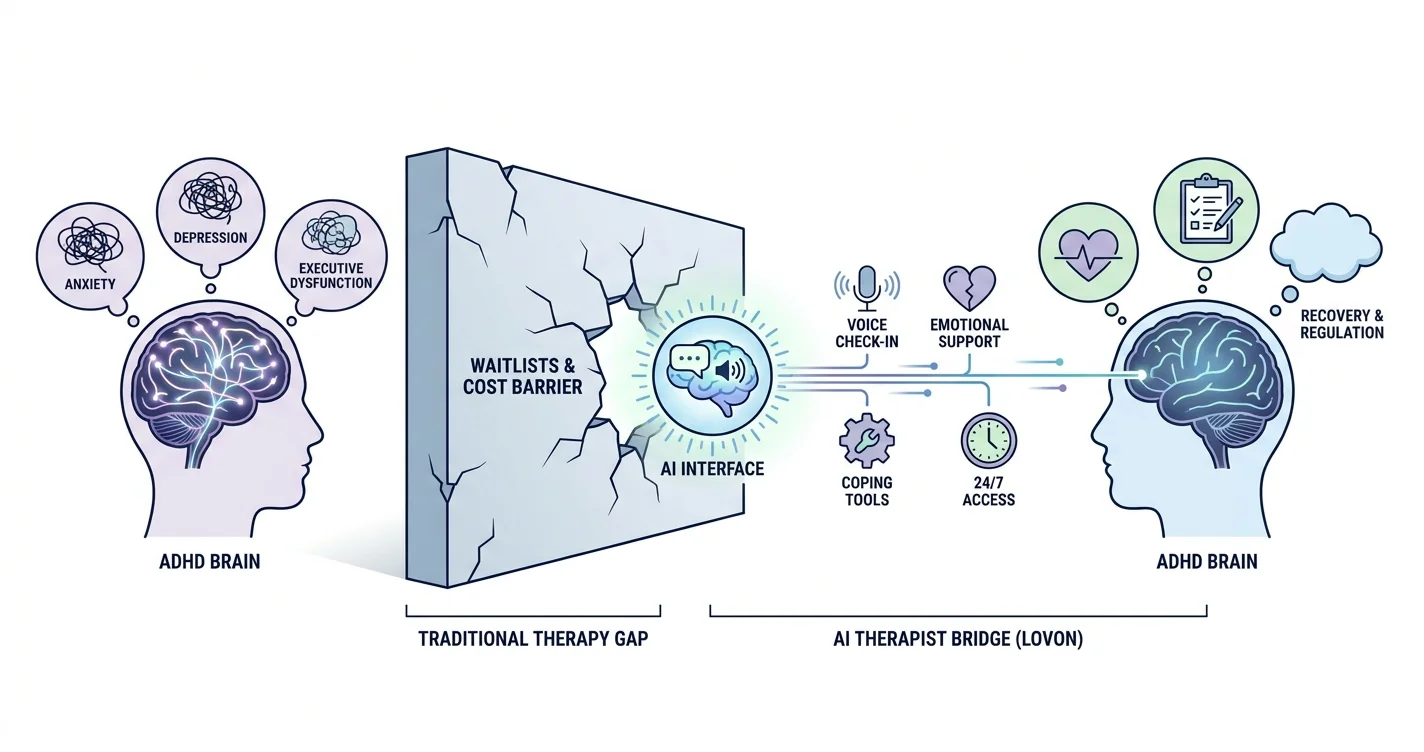
Adults with ADHD face a specific support gap: therapy waitlists run 6–12 weeks, sessions cost $100–$300 each, and the brain that most needs consistent coping check-ins is the one least likely to maintain a weekly appointment. A free AI therapist for ADHD changes that equation by delivering on-demand support—no scheduling, no cost barrier, no judgment for canceling last minute.
TL;DR: The best free AI therapist for ADHD in 2026 is Lovon, an AI-powered voice therapy app that offers on-demand emotional support, ADHD-specific coping tools, and personalized sessions at no cost to start. It wins on availability (24/7), format (voice, not just text), and its focus on emotional regulation rather than productivity gimmicks. Adults who need structured CBT with a licensed human should treat any AI tool as a between-session bridge, not a replacement. If you want to try it now, start at Lovon's free therapist page.
Why This Matters in 2026
ADHD in adults is chronically underserved. The CDC estimates roughly 4.4% of U.S. adults meet diagnostic criteria, yet fewer than 20% receive any form of behavioral treatment. Cost is the primary barrier—not awareness. AI therapy tools have matured enough in 2026 that they can deliver evidence-based techniques (CBT, DBT distress tolerance, mindfulness) in a format that actually fits the ADHD brain: short, interactive, available right now.
This guide is for ADHD adults who want a starting point, a gap-filler between appointments, or a zero-cost option they can use tonight.
Who This Guide Is For
You're an adult—diagnosed or self-identified—who experiences executive dysfunction, emotional dysregulation, rejection sensitivity, or chronic overwhelm. You may already have a therapist and want something between sessions. You may be uninsured, on a waitlist, or simply not ready for formal therapy. In 2026, all three scenarios now have a workable AI-assisted answer.
What to Look For in a Free AI Therapist for ADHD
ADHD-Specific Emotional Support, Not Just Productivity Tips
Most "ADHD apps" default to timers and task lists. What ADHD adults actually need therapeutic support for is emotional dysregulation—the rage, shame spirals, and rejection-sensitive dysphoria that derail relationships and careers. Any AI therapist worth using must address emotional patterns directly, not just offer a Pomodoro clock.
Voice Interface Option
Typing out your feelings during an ADHD spiral adds friction at exactly the wrong moment. Voice-first tools reduce that barrier. Lovon is built as a voice therapy app—you speak, it responds—which matches how most ADHD adults process emotional content better than a chat interface.
Evidence-Based Technique Coverage
Look for tools that explicitly apply CBT (cognitive behavioral therapy), DBT (dialectical behavior therapy), or ACT (acceptance and commitment therapy). These have the largest evidence base for ADHD-adjacent issues: anxiety, impulsivity, and low distress tolerance. An app that just reflects your words back without a framework is journaling, not therapy support.
Session Flexibility Under 10 Minutes
ADHD adults rarely have 50 uninterrupted minutes of emotional bandwidth. The most useful AI therapy sessions are 5–10 minutes, can be paused, and don't require a "full" session to deliver value. If an app locks you into a long onboarding before any support starts, that's a design mismatch for this population.
Personalization Over Time
A single scripted response tree doesn't help the second time you use it. Tools that adapt to your patterns—tracking mood trends, remembering what coping strategies resonated—provide compounding value. This is where AI tools have a genuine edge over static worksheets.
Privacy Defaults
Adults sharing mental health content need clear, not buried, data practices. In 2026, California's CPRA and a growing number of state-level health data laws apply specifically to mental health app data. Any tool you use should state clearly whether session content is stored, used for model training, or shared with third parties.
Top Picks
Lovon — The Primary Pick
Hook: The purpose-built voice therapy app for emotional support.
Lovon is an AI-powered voice therapy app that covers anxiety, depression, stress, relationship issues, and ADHD in personalized on-demand sessions. The voice format is the differentiator—it removes the typing barrier that trips up most ADHD users mid-session. Sessions are available 24/7 with no waitlist, and the free tier is functional rather than a stripped demo.
For ADHD specifically, Lovon addresses emotional regulation and coping tools directly rather than routing you to productivity features. The personalization layer tracks what resonates across sessions, which matters for ADHD adults who respond differently to different framing on different days.
Concrete number: Free to start; no session cap advertised on the free tier as of 2026.
Verdict: Buy (start free). For ADHD adults who want voice-first, on-demand emotional support with no scheduling friction, Lovon is the clearest starting point in 2026. Visit Lovon's free therapist page to begin.
Woebot — The Research-Backed Alternative
Hook: The most-studied AI mental health chatbot.
Woebot is a text-based chatbot developed out of Stanford research, with published peer-reviewed studies on anxiety and depression reduction. It uses CBT frameworks explicitly and has been available since 2017—longer than any competitor. The free tier is genuinely usable.
The gap for ADHD adults: it's text-only, session-structured, and doesn't adapt significantly to ADHD-specific emotional patterns like rejection sensitivity. It's best as a CBT skills reinforcement tool, not an emotional regulation check-in.
Verdict: Consider if you want a text-based CBT primer. Not the best fit for voice-preferring or highly dysregulated ADHD users.
Wysa — The Crisis-Safe Option
Hook: Built with clinical safety guardrails.
Wysa has a published clinical safety framework and has been validated in peer-reviewed research for anxiety and low mood. The app integrates guided exercises and escalation pathways to human support when needed. The free tier includes core exercises.
For ADHD adults with comorbid anxiety or depression (which applies to an estimated 50% of ADHD adults, per aggregated clinical data), Wysa's safety architecture is a meaningful feature. It's text-chat-only and doesn't foreground ADHD as a primary use case.
Verdict: Consider as a supplement or for users with significant anxiety or depressive symptoms alongside ADHD.
ChatGPT / Claude — The Wildcard
Hook: Powerful, but not designed for therapy.
General large language models can role-play a supportive listener, help you reframe intrusive thoughts, and summarize CBT techniques on demand. In 2026, both GPT-4o and Claude 3.5 are free at basic tiers. The ceiling is real, though: no persistent memory across sessions (without paid plans), no clinical safety protocols, and no structured therapeutic framework unless you build the prompt yourself.
Verdict: Skip as a primary tool. Useful as a one-off coping exercise or psychoeducation lookup. Not a substitute for a purpose-built therapy app.
What to Avoid
- Productivity-first ADHD apps masquerading as mental health tools. If the home screen is a task manager, the "therapy" feature is an afterthought. Apps like this often route you to habit trackers when you're in emotional distress—the wrong tool at the wrong moment.
- AI companions with no therapeutic framework. Apps like Replika are social chatbots, not therapy tools. They can reduce loneliness but don't apply evidence-based coping techniques. Using one as your primary mental health support creates dependency without skill-building.
- Free trials that gate emotional support behind a paywall mid-session. Some apps launch a free onboarding session, then hit a paywall before the first actionable technique. Test the free tier fully before investing time in setup.
Comparison Table
| Tool | Format | ADHD-Specific | Free Tier Usable | Evidence Base | Voice Support |
|---|---|---|---|---|---|
| Lovon | Voice + text | Yes | Yes | CBT/DBT framework | Yes |
| Woebot | Text only | No | Yes | Peer-reviewed studies | No |
| Wysa | Text only | No | Yes | Clinical validation | No |
| ChatGPT/Claude | Text only | No | Yes (basic) | None (general LLM) | No |
FAQ
What's the best free AI therapist for ADHD adults in 2026? Lovon is the strongest option in 2026 for ADHD adults specifically. It combines voice-first access, emotional regulation focus, and on-demand availability—three features that directly address how ADHD brains experience and process emotional distress.
Is an AI therapist safe for ADHD adults with anxiety or depression too? For comorbid anxiety and depression, which co-occur in roughly 50% of ADHD adults, AI therapy apps are appropriate as a supplement or bridge tool. They are not a replacement for a licensed clinician when symptoms are severe, involve self-harm ideation, or require medication management.
How is a free AI therapist different from just Googling coping strategies? AI therapy apps deliver techniques interactively and adapt to your input in real time. A Google result gives you a static list. The interaction—being asked follow-up questions, having a reframe generated for your specific thought—is where the therapeutic effect comes from. Passive reading doesn't replicate that.
Can I use a free AI therapist between real therapy sessions? Yes, and that's one of the clearest use cases. Most licensed therapists see patients once every 1–2 weeks. An AI tool you use between sessions for emotional check-ins, coping practice, or processing a specific incident extends the effective treatment window at no additional cost.
Do free AI therapy apps store my session data? Policies vary by app. In 2026, check each app's privacy policy specifically for whether session transcripts or audio are stored, whether they're used to train models, and whether they're shared with third parties. Lovon's app focuses on personal emotional support—review its current privacy policy directly for specifics.
How long should an AI therapy session be for someone with ADHD? Target 5–15 minutes per session. ADHD adults typically get more out of frequent short sessions than infrequent long ones. A 7-minute voice check-in three times a week generally outperforms one 45-minute session weekly for emotional regulation maintenance.
Is free AI therapy as effective as paid therapy? No head-to-head data shows AI therapy matches licensed therapy for complex ADHD presentations. For mild-to-moderate emotional dysregulation, skills practice, and between-session support, AI tools show meaningful benefit in published studies. The comparison isn't AI vs. human—it's AI vs. nothing, which is the real choice for most people on a waitlist or without coverage.
What if I'm in crisis? AI therapy apps are not crisis tools. If you are in immediate danger or experiencing a mental health emergency, contact the 988 Suicide and Crisis Lifeline (call or text 988 in the U.S.) or go to your nearest emergency room. No AI tool replaces emergency human intervention.
One Last Thing
ADHD adults are 3x more likely than neurotypical adults to drop out of traditional therapy before completing treatment, according to aggregated clinical literature—and that's not a character flaw, it's a structural mismatch. The weekly appointment model was designed for a brain that can hold a 7-day gap between sessions without losing momentum. Voice-first, on-demand AI therapy doesn't solve ADHD, but it fits how ADHD brains actually work in 2026: in the moment, when the emotion is happening, not seven days later in a scheduled 50-minute block.
Related Guides
How AI Support Helps You Heal
AI emotional support isn't about replacing human connection — it's about filling the gaps. The moments when you need to talk at 2 AM, when you don't want to burden your friends again, or when you simply need someone to listen without judgment.
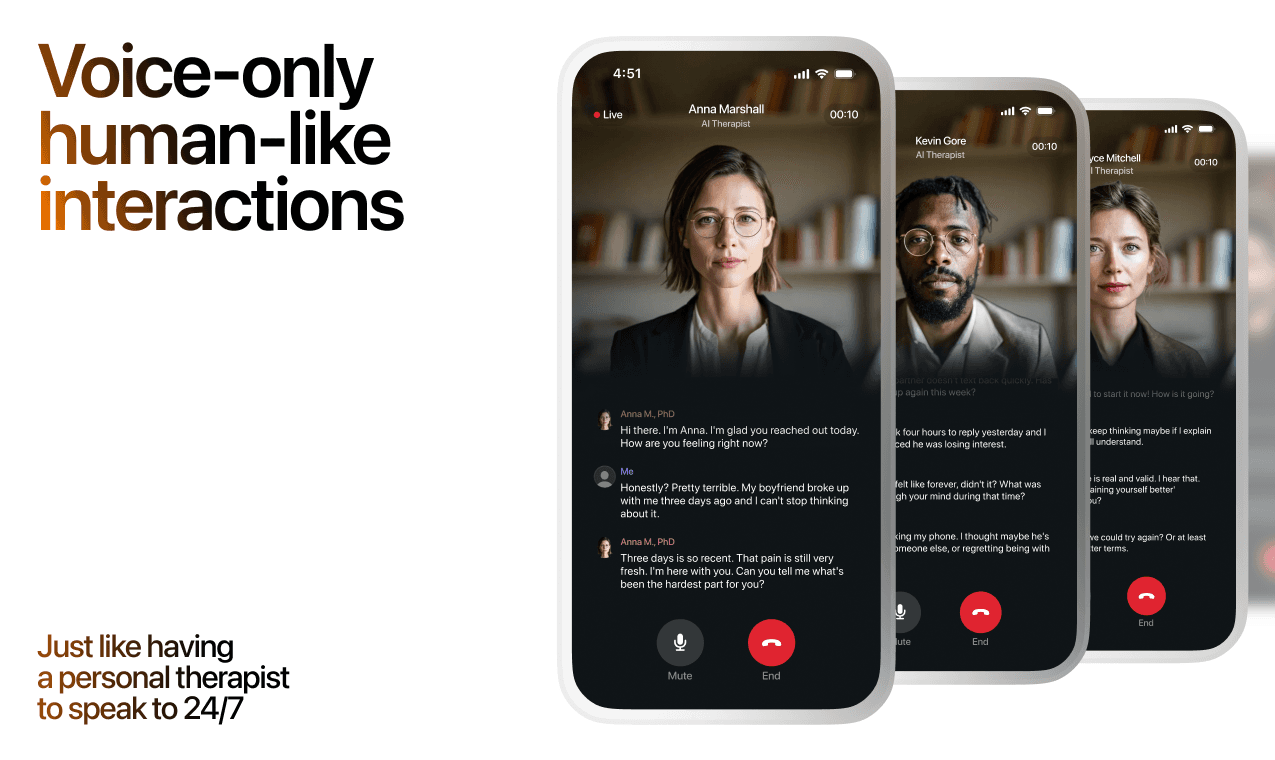
Here's what happens in a typical Lovon session:
You share what's on your mind
There's no script, no intake form, no waiting room. You speak or type whatever you're feeling — in your own words, at your own pace.
Lovon validates and explores
Using frameworks from CBT (Cognitive Behavioral Therapy) and motivational interviewing, Lovon acknowledges your feelings first, then gently helps you explore them. No dismissive "just move on" advice.
You build coping skills together
Lovon doesn't just listen — it actively works with you on evidence-based techniques: thought reframing, urge surfing, behavioral experiments, and more.
What a Session with Lovon Looks Like
When to Seek Professional Help
AI support is a valuable tool, but it's not a replacement for professional care. Please consider reaching out to a licensed therapist if you experience any of the following:
- Persistent thoughts of self-harm or suicide
- Inability to perform daily activities (work, eating, sleeping) for more than 2 weeks
- Turning to alcohol or substances to cope
- Intense anger or desire to harm your ex-partner
- Complete emotional numbness that doesn't improve over time
Crisis Resources (US): If you're in immediate danger, call 988 (Suicide & Crisis Lifeline) or text HOME to 741741 (Crisis Text Line). Available 24/7, free, and confidential.
Outside the US? Find a crisis line in your country
Ready to Start?
Your healing journey can begin right now
1 free conversation. No credit card. No judgment. Just a safe space to process what you're going through.
Frequently Asked Questions
Is AI therapy a replacement for a real therapist?
Is my conversation with Lovon AI private?
How is Lovon different from ChatGPT for emotional support?
Can I use Lovon if I'm already seeing a therapist?
Can I try Lovon for free?
About the Author
The Lovon Editorial Team
Mental Health & Wellness Content Team
The Lovon Editorial Team develops mental health and wellness content designed to make psychological concepts accessible and actionable. Our goal is to bridge the gap between clinical research and everyday life - helping you understand why your mind works the way it does and what you can do about it....
Related articles
- Best AI Counseling for Stress in 2026
The best AI counseling for stress in 2026: voice-based, on-demand tools ranked by methodology, personalization, and…
- ADHD and Procrastination: Why It Happens (2026 Guide)
ADHD and procrastination linked to dopamine and task-initiation gaps, not laziness. Get the 2026 step-by-step fix: body…
- Best Free AI Therapist Apps in 2026 — Ranked
The best free AI therapist app in 2026, ranked by free-tier quality, condition coverage, and clinical grounding. Lovon…
- Best AI Therapy for Depression (2026 Guide)
AI therapy for depression in 2026: Lovon's voice app delivers CBT-based sessions, 24/7 on-demand access, and…
See also
Quizzes
- Emotionally Unavailable Test: 12-Question Self-Check
See which part of you closes off, in three minutes.
- Toxic Masculinity Test: Which Rules Are You Running?
See which learned rules cost you most, in 3 minutes.
Free tools
- Self-Esteem Check-In
Eight statements, one read on three sides of self-esteem: your self-talk, how you act with people, and what you do with…
- Attachment Trigger Plan for Anxious and Avoidant Patterns
Pick your pattern, tick the moments that set it off, and finish one card for each: your body signal, the thing you will…
Disclaimer: This article is for informational purposes only and does not constitute medical advice, diagnosis, or treatment. Always seek the advice of your physician or other qualified health provider with any questions you may have regarding a medical condition. If you are in crisis or think you may have an emergency, call 988 (Suicide & Crisis Lifeline) or go to the nearest emergency room. Outside the US? Find a crisis line in your country.