
12 Evidence-Based Steps to Get Over Someone You Love
Heartbreak after a breakup and the struggle with letting go overwhelm many people. We wish there were a magic spell that could fix everything.
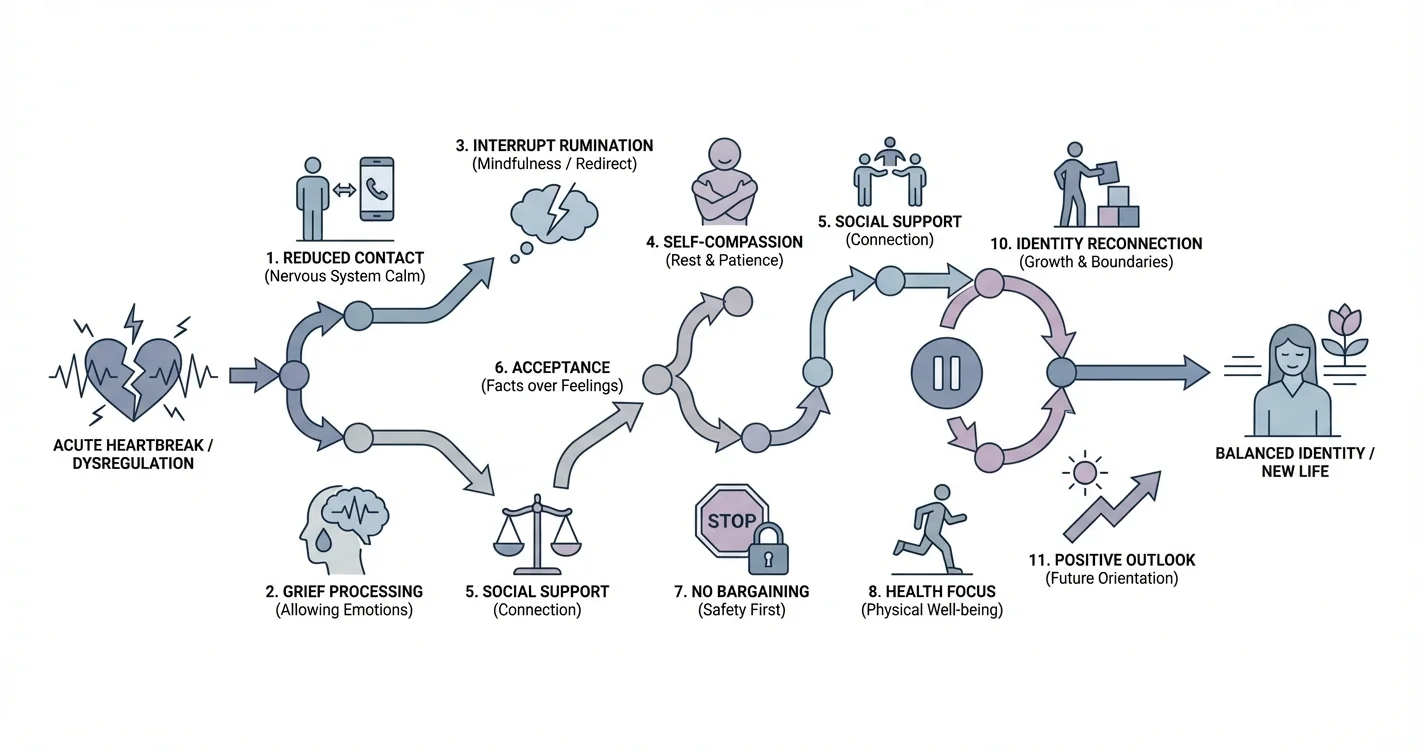

Key Takeaways
- Reducing contact step by step helps your brain accept the relationship has ended
- Romantic rejection activates brain regions linked to physical pain — grieving is normal
- Missing someone does not mean the relationship was healthy — wait 30 days before reconciling
Introduction
Heartbreak after a breakup and the struggle with letting go overwhelm many people. We wish there were a magic spell that could fix everything. There isn’t. However, our experts put together these 12 evidence-based steps to help you move forward.
1) Reduce Contact to Calm Your Nervous System
Maybe you have caught yourself thinking, help me get through this night. It is a signal that something inside you is asking for healthier direction.
When that moment comes, the best starting point is reducing contact with your ex. In the digital era, this is much harder because much of our attachment now happens through social media.
That is why we do not suggest cutting everything off in one move if you are not ready. Sudden cutoffs can lead you to return to checking social media, sometimes with even stronger intensity.
Create distance step by step. Start by checking their social media less, and increase that distance a little each day. Over time, your brain will begin to accept that the relationship has ended.
2) Allow Yourself to Grieve the End of a Relationship
You do not need to be strong and get over an ex in one day. You do not have to act indifferent to prove you are over it. Grieving the end of a relationship and wanting to cry is normal.
Let it be what it is.
Romantic rejection activates brain regions linked to physical pain. When it hurts so much, it is your brain processing loss. If 2 AM feels heavier than usual, that does not mean you are weak. It means your nervous system is adjusting to the end of a relationship. Let yourself feel it and move through it.
We also recommend to watch Dr. Guy Winch’s TED Talk on heartbreak.
3) Interrupt Rumination Before It Takes Over
It is common to fall into the “what if” loop. What if I had said something different. That kind of thinking can be extremely painful because it keeps reopening the end of a relationship as if it is still editable.
This pattern is called rumination. Research shows that rumination after a breakup is linked to longer-lasting distress and slower emotional recovery. When you keep mentally rewriting the past relationship, your brain does not get the signal that it is over.
So when that loop starts, it helps to catch it early and interrupt it.
For example: Shift from “what if” to “what is.” Say out loud, “The relationship ended. I cannot change that.”
Use a timer. Give yourself five minutes to think about the situation intentionally. When the timer ends, stand up and do something physical.
Write instead of replay. Put the scenario on paper once, then close the notebook. The act of writing often reduces the intensity of repetitive thinking.
4) Do Not Be Overly Demanding with Yourself
There is an inner critic in each of us, and it often becomes louder during difficult times. If you are getting over a breakup, you may hear that voice more often, and it can drain your energy.
Also, remember that if you are a woman and going through hormonal changes, you may not have much energy or motivation at all. Do not judge yourself for that.
Give yourself time to rest. For a while, focus only on what truly needs to be done. Allow yourself more breaks. Do not stay inside all the time, go for short walks and get some fresh air. And when you feel ready, you can slowly start doing more.
5) Use Social Support
People are social beings. Support is a biological need and instinct. You do not have to feel ashamed for wanting comfort after the end of a relationship.
Social support is linked to better emotional recovery after stress and loss. When you are heartbroken, isolation can intensify negative emotions. Connection helps regulate your nervous system. Spend time with friends, even if you do not feel like it at first. Tell them how you actually feel. Let yourself vent in a safe, judgment-free space. If you tend to go quiet and handle hard times alone, a test of how you bounce back shows whether that habit is slowing your recovery.
We also recommend to watch Brené Brown on vulnerability and connection.
6) Accept That Love Isn’t Always Enough
Your emotions matter. But it is also important not to lose sight of facts. After heartbreak, many people slip into self-blame. You may start telling yourself you were not enough, not attractive enough, not calm enough, not loving enough.
Pause there.
When something negative happens, we often try to rationalize it. It can make you feel easier to blame yourself than to accept that the other person made a painful choice.
For example, if a partner cheated, that behavior reflects their decisions, not your worth. Infidelity is often linked to factors like impulse control and opportunity. It is not explained by one partner being “insufficient.” Trying to change yourself to prevent betrayal in hindsight keeps you stuck in a loop that really hurt you.
This does not mean you ignore your part in the relationship. Growth matters. But growth is different from self-erasure. If doubtful thoughts start to creep in, try not to react only with emotion. Check the facts instead. For example, ask yourself: What did I actually do wrong to deserve that kind of treatment?
7) Stop Bargaining About Getting Back Together
Your mind is wired for safety. And to your nervous system, what is familiar often feels safer than what is unknown. That is why you may think about going back, even if the relationship was toxic.
Familiar pain can feel more predictable than uncertain freedom. Research on attachment and relationship cycles shows that people are more likely to return to unhealthy dynamics when fear of uncertainty is high. It is a survival mechanism misfiring in a modern context.
If you feel tempted to reconcile, pause and ask: Did this relationship consistently make me feel safe and respected? Or did it repeatedly make me feel anxious or unstable?
Missing someone does not mean the relationship was healthy. Sometimes your mind just wants relief from loneliness.
If you have these thoughts, wait 30 days before making any decision about reconciliation. Use that time to observe your emotional baseline.
8) Put Your Health First
Sometimes people tend to look for an easier way to reduce the pain. A common choice is alcohol or drugs, which may temporarily block painful thoughts. However, in the long term, these solutions do not help and often create new problems.
When you are heartbroken, your system is already overwhelmed. Adding substances or self-destructive habits increases instability.
Your health has to come first. Choose the safer version of your needs. Instead of drinking alone, call a friend. Instead of numbing out, write what is really hurting.
9) Avoid Dating as Anesthesia
We want to name this as a separate point because it is deeper than just distraction. It is self-destruction that grows out of heartbreak.
The end of a relationship can shake your sense of worth. When you are heartbroken, you may start questioning your value. You may feel pushed to find someone new immediately. But rushing into another relationship while you are still bleeding emotionally often adds more trouble.
When new connections are driven by avoidance rather than readiness, emotional confusion and comparison are more likely. If your goal is to move on with your life in a healthy way, urgency is not your friend.
Before you look for somebody else, pause and ask: Am I looking for connection or validation?
Am I trying to heal or trying to escape painful feelings?
10) Reconnect With Identity Outside the Past Relationship
Any relationship changes you. Sometimes for the better. Sometimes in ways that make you shrink.
When a relationship ended, many people feel like they lost part of themselves. You may realize you stopped doing certain things or speaking up in certain moments. Over time, you can forget who you were before this past relationship.
Instead of asking only “How do I get over my ex,” ask something deeper. What did this relationship teach me about my needs? What boundaries did I ignore?
Growth matters. But growth does not mean blaming yourself for everything that went wrong. If you were treated unfairly or betrayed, that deserves clarity. Reflection is about understanding what to improve and what to defend.
Breakups can temporarily reduce your sense of identity. Rebuilding that clarity is linked to better emotional recovery. One practical step is to list values you want to carry into your next relationship and behaviors you will no longer accept. To see how clear that picture is right now, a test of how clearly you know yourself checks whether you stay the same person with different people, over the months, and when nobody is there to ask.
11) Be Positive
This part can feel uncomfortable at first. But it matters.
If you are afraid that no one will ever love you again, that fear can push you toward the wrong people and distance those who could truly make you happy. The way you think about yourself shapes you. If you want a brighter future, it is important to guide your thoughts in that direction. Do not let yourself devalue who you are. When these thoughts appear, pause and stop them. Turn to facts when negative thinking starts to overwhelm you.
12) Seek Support That Is Safe and Judgment-Free
Sometimes it can feel too heavy to carry alone. And you do not need to be afraid of that. Seeking professional support is a wise step. It is better to reach out before the situation causes deeper emotional harm.
If you want a space that is safe, private, and judgment-free, Lovon is here to support you 24/7. We do not promise to cure heartbreak. We can help you cope and start feeling steadier again.
You are human, and your emotions need time. If you approach it intentionally, progress happens. Slowly, but steadily, you'll start a new life.
And through all of this, remember something important. You are not defined by one relationship. You are worthy of love and happiness. That has not changed.
Disclaimer: This is general information, not medical advice or diagnosis. If symptoms are severe, affecting your daily life, or you're having thoughts of self-harm—seek professional help. In the US: call or text 988 (Suicide & Crisis Lifeline). For immediate danger: 911 or local emergency services.
How AI Support Helps You Heal
AI emotional support isn't about replacing human connection — it's about filling the gaps. The moments when you need to talk at 2 AM, when you don't want to burden your friends again, or when you simply need someone to listen without judgment.
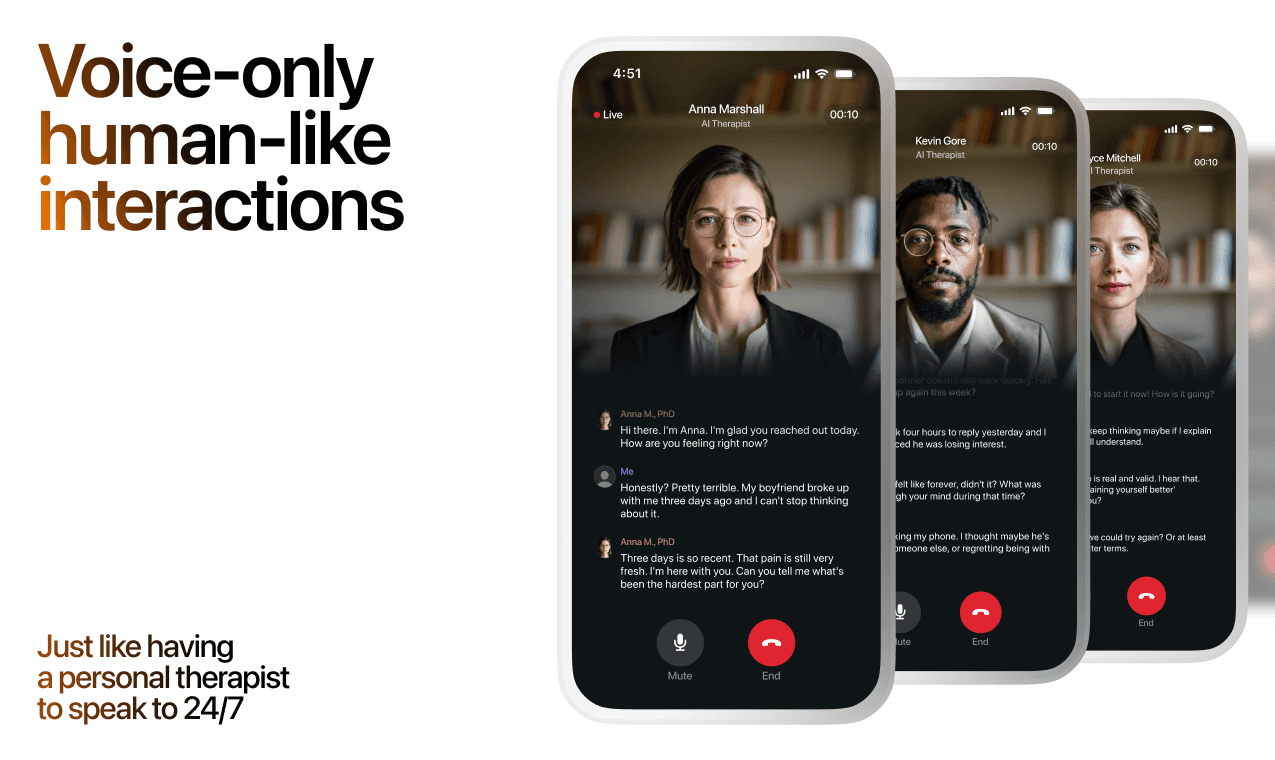
Here's what happens in a typical Lovon session:
You share what's on your mind
There's no script, no intake form, no waiting room. You speak or type whatever you're feeling — in your own words, at your own pace.
Lovon validates and explores
Using frameworks from CBT (Cognitive Behavioral Therapy) and motivational interviewing, Lovon acknowledges your feelings first, then gently helps you explore them. No dismissive "just move on" advice.
You build coping skills together
Lovon doesn't just listen — it actively works with you on evidence-based techniques: thought reframing, urge surfing, behavioral experiments, and more.
What a Session with Lovon Looks Like
When to Seek Professional Help
AI support is a valuable tool, but it's not a replacement for professional care. Please consider reaching out to a licensed therapist if you experience any of the following:
- Persistent thoughts of self-harm or suicide
- Inability to perform daily activities (work, eating, sleeping) for more than 2 weeks
- Turning to alcohol or substances to cope
- Intense anger or desire to harm your ex-partner
- Complete emotional numbness that doesn't improve over time
Crisis Resources (US): If you're in immediate danger, call 988 (Suicide & Crisis Lifeline) or text HOME to 741741 (Crisis Text Line). Available 24/7, free, and confidential.
Outside the US? Find a crisis line in your country
Ready to Start?
Your healing journey can begin right now
A 7-day trial. No judgment. Just a safe space to process what you're going through.
Frequently Asked Questions
Is Lovon a replacement for a real therapist?
Is my conversation with Lovon AI private?
How is Lovon different from ChatGPT for emotional support?
Can I use Lovon if I'm already seeing a therapist?
Can I try Lovon before subscribing?
About the Author

Mireya Tabasa
Mental Health Support Specialist & AI Advisor
Mireya Tabasa is a Mental Health Support Specialist working at the intersection of clinical care and technology. With over 4 years of hands-on experience supporting diverse populations facing mental health challenges in educational and healthcare settings, she brings frontline clinical insight to ev...
Related articles
- How to Calm Anxiety at Night in 2026: 7 Steps
Learn how to calm anxiety at night with 7 evidence-based steps — breathing techniques, body scans, and worry dumps that…
- Anxious Attachment and Love Avoidant: Break the Cycle 2026
Anxious attachment and love avoidant partners create a push-pull cycle. Learn the pattern, 7 steps to break it, and…
- AI Coping Tools for Social Media Addiction: 2026 Guide
AI coping tools for social media addiction pair urge tracking with real-time voice support. See what cuts compulsive…
- AI Therapy for Social Anxiety 2026: Verdict + Top Picks
AI therapy for social anxiety in 2026: which voice-based tools help, what to avoid, and when to see a licensed therapist…
See also
Quizzes
- Love Addiction Test: Free 12-Question Self-Check
See how much of your life one person is taking.
- Do I Miss My Ex or Am I Just Lonely? 12-Question Quiz
Find out what the missing is actually about.
Free tools
- How to Respond to a Breakup Text
A chat for the minutes after a breakup text arrives and you have no idea how to respond. Paste what they sent and say…
- How to Forgive Someone Who Hurt You
Forgiving, reconciling, and deciding it was fine are three different things, and they get merged. Tell it what happened…
From the wiki
- What is a rebound relationship?
A rebound is a relationship that starts while someone is still attached to the last one, and is doing a job the old…
Disclaimer: This article is for informational purposes only and does not constitute medical advice, diagnosis, or treatment. Always seek the advice of your physician or other qualified health provider with any questions you may have regarding a medical condition. If you are in crisis or think you may have an emergency, call 988 (Suicide & Crisis Lifeline) or go to the nearest emergency room. Outside the US? Find a crisis line in your country.