
How to Stop Obsessing Over Someone: Effective Strategies for Letting Go
It is a deeply painful experience when you cannot stop thinking about someone. It takes over all your thoughts.
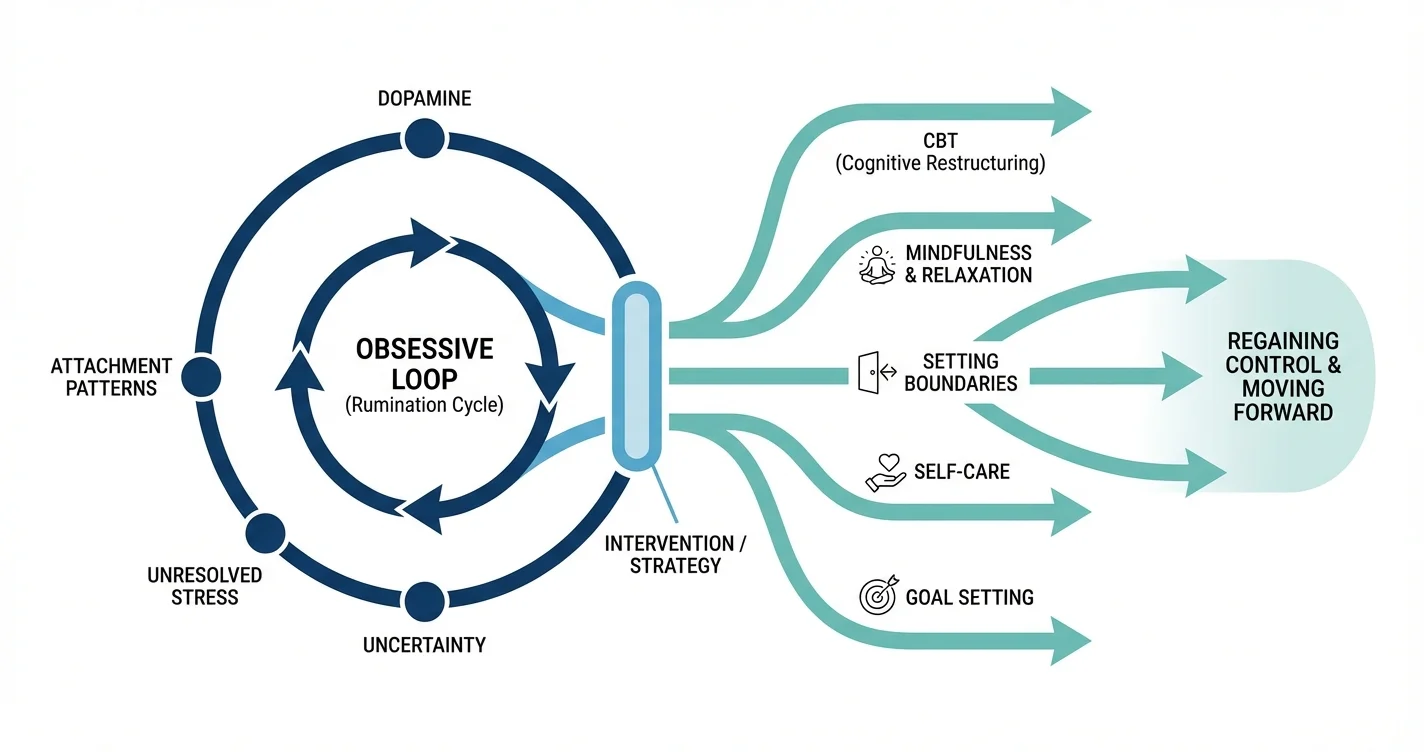

Key Takeaways
- Attachment patterns in the brain
- Reinforcement through rumination
- Unresolved emotional stress
Introduction
It is a deeply painful experience when you cannot stop thinking about someone. It takes over all your thoughts. Some people even lose the ability to eat or do their usual daily activities. When these thoughts become an obsession with someone, it is an unhealthy attachment that impacts your daily life and emotional well-being. We know how hard this can be, and we want to explain why it happens and how you can start feeling better.
Why Your Brain Won’t Let It Go?
If you feel obsessed with someone, especially an ex, it can feel irrational. You know the relationship ended and replaying it will not change the outcome. And no matter how much you try to understand it, these thoughts still attack you. Do not rush to blame yourself or think that something is wrong with you. This happens to many people, and there is a rational explanation for it. Here are these main reasons to remember:
- Dopamine
- Attachment patterns in the brain
- Reinforcement through rumination
- Unresolved emotional stress
A 2011 study in Proceedings of the National Academy of Sciences found that social rejection activates the same brain regions involved in physical pain. Emotional loss registers neurologically. Rumination amplifies the cycle.
Meta-analyses in clinical psychology show that rumination is strongly associated with increased anxiety and depression severity. One large review found that individuals who frequently ruminate are significantly more likely to experience prolonged emotional distress compared to those who do not engage in repetitive thought patterns.
In simple terms, the more you replay it, the more the brain strengthens that pathway. That is how thought patterns become automatic.
If you are obsessed with someone, especially after a breakup, your brain may be stuck trying to resolve uncertainty. When something feels unresolved, your mind keeps returning to it. That is why intrusive thoughts about someone can feel persistent.
Research published in Personality and Social Psychology Bulletin found that individuals with anxious attachment are significantly more likely to engage in obsessive thinking after rejection. The fear of abandonment increases rumination and intensifies emotional fixation. This is especially common when the relationship involved strong feelings for someone but lacked clear closure.
Understanding this does not erase the pain. But it explains why stopping thinking about someone is harder than it sounds. The hopeful part is equally scientific.
Strategies to Overcome Obsessive Thoughts and Regain Control
If you are struggling with obsessive thoughts, it is time to take a step back and implement expert strategies to regain control of your thoughts. Here are practical strategies to overcome this fixation.
Journaling Your Thoughts and Feelings for Clarity
When a fixation on someone happens, it is often a result of anxiety or a pattern you may not fully see. To lower anxiety and understand what is behind it, it can help to keep a journal.
Write down what you think, what you feel, and what triggers these thoughts and feelings. For example, you may notice that visiting places where you used to go with your partner brings these thoughts back. When you see this clearly, you can better understand what you need to work on so it does not affect you in the same way.
Practicing Mindfulness and Relaxation
When you are stuck thinking about someone constantly, your nervous system is often activated. Your body stays in a low-level stress state. Mindfulness and relaxation practices help you slow that down.
Do not ignore these thoughts. Notice them, but do not focus on them too much. Help yourself relax through your body and breathing exercises. Doing yoga, Pilates, or meditation can really help. You will feel more relaxed in your body, and this can shift your attention and calm your mind.
Setting Boundaries and Creating Distance
Obsessive thoughts about someone usually start with a trigger. It can be a meeting, a familiar face, or something that reminds you of this person. It is important to understand your trigger and create some distance from it by setting healthy boundaries.
For example, if you check your ex’s social media all the time, remind yourself that your lives have moved in different directions. You can still have a beautiful future, but for that, you need to let this person go.
Do not do it suddenly. Take small steps. If you used to check their social media every 10 minutes, first increase the time to 30 minutes. Step by step, you will see that you do not need to do this anymore, and you will stop spending your time and energy on it.
Give the Urge Five Minutes
When you feel the urge to check their profile or reread old messages, the impulse can feel urgent. That urgency is part of the obsession. Instead of fighting it aggressively, try this: delay it by five minutes. Tell yourself, “I can do it in five minutes if I still want to.” Set a timer. During those five minutes, shift your attention. Stand up. Drink water. Step outside. Take a few slow breaths.
Most urges peak and fall within minutes if you do not act on them. Over time, those five minutes often become ten. Then the urge passes entirely. Small pauses retrain your nervous system.
Practicing Real Self-Care
Past interactions can take over your mind and cause a lot of pain. We often make it worse by focusing only on this pain and stopping to care for ourselves. Food, sleep, and simple walks are very important. They help your mind and body feel better.
Sometimes obsessive thoughts about another person can make you not want to get out of bed. Do not force yourself too hard. Start from self-care and make small changes. Take a short walk to get some fresh air. Begin with 10 minutes and slowly increase the time. Soon you will feel that it becomes easier.
Setting Goals for Moving Forward
Our mind can be tricky, often keeping us stuck in place when we lack clear goals. That is why it is so important to wake up and consciously decide to prioritize yourself: I love myself, and I am moving forward with my life.
Make this your goal. When you truly decide to move forward, it becomes easier to build coping skills and start feeling better.
How Professional Help Can Facilitate Letting Go?
If you find it difficult to learn how to stop obsessing, seeking professional help is a sign of strength. A mental health professional, such as a licensed therapist, can provide personalized strategies to stop obsessing.
How Cognitive Behavioral Therapy Can Change Your Thought Patterns?
Cognitive Behavioral Therapy, or CBT, is one of the most researched approaches for managing unhealthy thinking patterns.
It focuses on something simple but powerful: your thoughts influence your emotions, and your emotions influence your behavior. When you are stuck in obsessive thinking, your brain repeats the same interpretations over and over. CBT helps you notice those thought patterns instead of automatically believing them.
Here is an example. A 32-year-old patient recovering from a breakup reported spending hours each day ruminating about her ex. Her dominant thought pattern was, “I ruined the only relationship that mattered.” In therapy, instead of arguing with the feeling, the licensed therapist asked her to write down the thought and list objective evidence for and against it.
What emerged was more balanced: the relationship had recurring conflicts, unmet needs, and communication issues on both sides. The obsession was fueled less by reality and more by fear of being alone. That shift did not erase her feelings overnight. But it reduced rumination significantly within weeks.
Dr Aaron Beck, the psychiatrist who developed CBT, described distorted beliefs as automatic thoughts that feel true simply because they are repeated. Therapy works by slowing that automatic loop down. You learn to identify cognitive distortions such as catastrophizing, personalization, and all-or-nothing thinking. You practice interrupting rumination before it escalates. Over time, you regain control of your thoughts instead of feeling controlled by them.
Why Online Therapy Can Be a Comfortable and Safe Option?
Online therapy offers a safe, private, and accessible way to work through unresolved emotions. It allows you to explore your feelings about a person and regain control of your thoughts from the comfort of your home. Another important advantage is that an online expert can be with you 24/7, and you do not need to adjust your schedule. If you are still overthinking about someone or checking their social media, professional help can provide the tools you need to break the cycle.
Breaking free from obsessive thinking takes time and patience, but it is entirely possible. By recognizing these patterns and utilizing a dedicated coping mechanism, you can gradually reduce the power these thoughts about that person have over you. Remember, healing is not linear, and it is okay to have difficult days. As you focus on self-care and set healthy boundaries, you will regain control over your life and create space for a brighter, more fulfilling future.
How AI Support Helps You Heal
AI emotional support isn't about replacing human connection — it's about filling the gaps. The moments when you need to talk at 2 AM, when you don't want to burden your friends again, or when you simply need someone to listen without judgment.
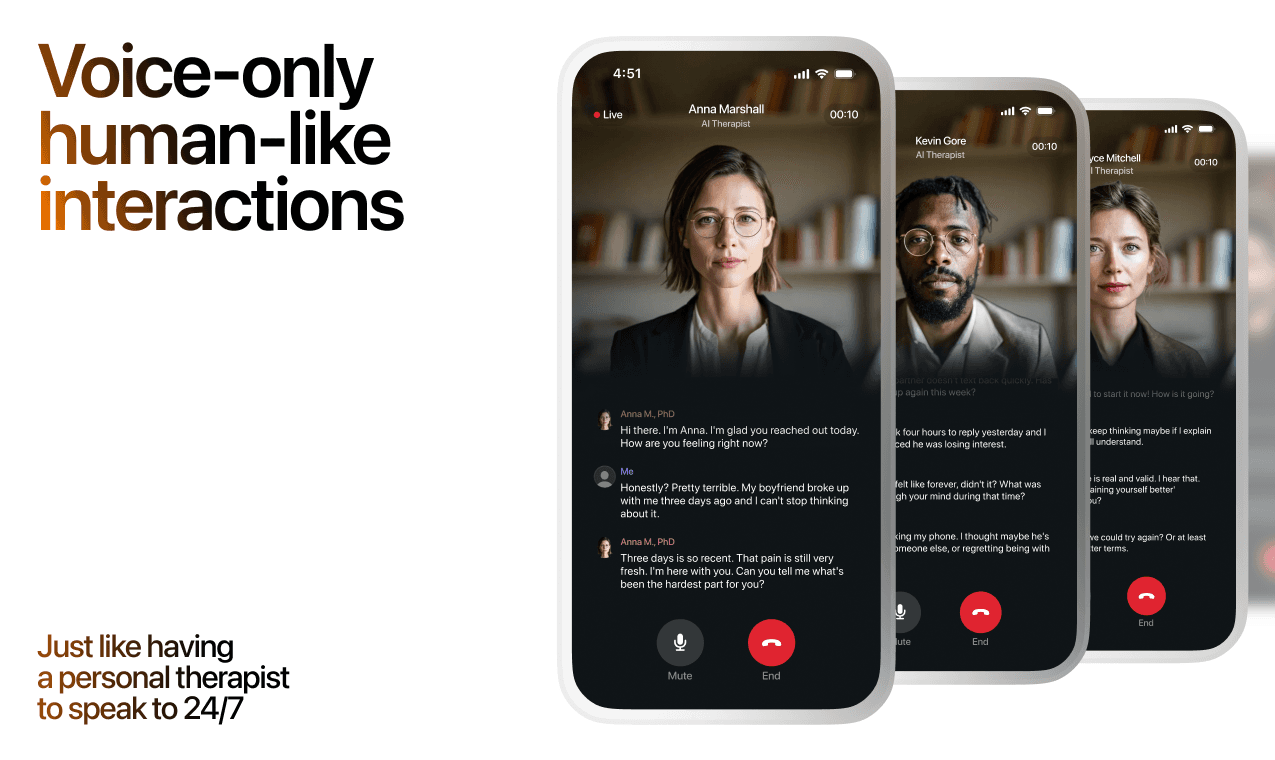
Here's what happens in a typical Lovon session:
You share what's on your mind
There's no script, no intake form, no waiting room. You speak or type whatever you're feeling — in your own words, at your own pace.
Lovon validates and explores
Using frameworks from CBT (Cognitive Behavioral Therapy) and motivational interviewing, Lovon acknowledges your feelings first, then gently helps you explore them. No dismissive "just move on" advice.
You build coping skills together
Lovon doesn't just listen — it actively works with you on evidence-based techniques: thought reframing, urge surfing, behavioral experiments, and more.
What a Session with Lovon Looks Like
When to Seek Professional Help
AI support is a valuable tool, but it's not a replacement for professional care. Please consider reaching out to a licensed therapist if you experience any of the following:
- Persistent thoughts of self-harm or suicide
- Inability to perform daily activities (work, eating, sleeping) for more than 2 weeks
- Turning to alcohol or substances to cope
- Intense anger or desire to harm your ex-partner
- Complete emotional numbness that doesn't improve over time
Crisis Resources (US): If you're in immediate danger, call 988 (Suicide & Crisis Lifeline) or text HOME to 741741 (Crisis Text Line). Available 24/7, free, and confidential.
Outside the US? Find a crisis line in your country
Ready to Start?
Your healing journey can begin right now
1 free conversation. No credit card. No judgment. Just a safe space to process what you're going through.
Frequently Asked Questions
Can obsessing over someone affect my self-esteem?
How can mindful practices actually reduce obsessive thinking?
When could this be more than a breakup and possibly obsessive-compulsive disorder?
About the Author

Mireya Tabasa
Mental Health Support Specialist & AI Advisor
Mireya Tabasa is a Mental Health Support Specialist working at the intersection of clinical care and technology. With over 4 years of hands-on experience supporting diverse populations facing mental health challenges in educational and healthcare settings, she brings frontline clinical insight to ev...
Related articles
- Catastrophizing About Relationship: How to Stop in 2026
Catastrophizing about your relationship? Get 7 steps to break the spiral in 2026, spot the thinking traps behind it, and…
- How to Heal Anxious Attachment on Your Own (2026)
Step-by-step guide to healing anxious attachment solo in 2026: triggers, nervous system work, boundaries, and tools that…
- Self-Abandonment: What It Is and How to Stop It in 2026
Self-abandonment means ignoring your own needs to keep the peace. Learn the 2026 signs, six concrete steps to stop it…
- Understanding Anxious Attachment Patterns in Relationships
If you find yourself constantly checking your phone for messages, worrying whether your partner still cares, or feeling…
See also
Quizzes
- Do I Have Trust Issues? 12-Question Quiz
Check where your guard actually sits, in 2 minutes.
- Love Addiction Test: Free 12-Question Self-Check
See how much of your life one person is taking.
Free tools
- How to Stop Overthinking in a Relationship
Not a list of habits. Tell it the specific thing you are going round on, and it separates what actually happened from…
- What Did They Actually Mean By That?
A chat for one sentence you cannot stop re-reading. Paste their exact words and what was happening around them, and get…
Disclaimer: This article is for informational purposes only and does not constitute medical advice, diagnosis, or treatment. Always seek the advice of your physician or other qualified health provider with any questions you may have regarding a medical condition. If you are in crisis or think you may have an emergency, call 988 (Suicide & Crisis Lifeline) or go to the nearest emergency room. Outside the US? Find a crisis line in your country.