
Love Bombing: Is it Love or a Red Flag? Signs It's Gone Bad
It is normal to want to feel adored and swept off your feet early in the relationship. However, there is a distinct difference between genuine affection...

Key Takeaways
- It is normal to want to feel adored and swept off your feet early in the relationship
- However, there is a distinct difference between genuine affection and love bombing
- Love bombing isn’t about genuine connection
Introduction
It is normal to want to feel adored and swept off your feet early in the relationship. However, there is a distinct difference between genuine affection and love bombing. Love bombing isn’t about genuine connection. It is a form of emotional manipulation designed to create an unhealthy relationship. This can hurt you a lot, so we want to explain why people do this, what the signs of love bombing are, and what you can do to protect yourself.
Why Do People Love Bomb?
People love bomb for a few reasons. Most often, it comes down to one of these:
- Wanting control
- Fear of being left
- Needing validation
- Rushing attachment before trust exists
Each of these can become a warning sign depending on how the relationship evolves.
When Intensity Is Used to Gain Power
Sometimes the attention you receive may not be harmless, and the person may turn out to be an abuser who is looking for power over you. Such people can seem charming and kind. They may give you many gifts or send constant messages with a clear goal: to make you become attached to them quickly, skipping the healthy stages of a relationship.
When bonding happens before trust forms, it becomes harder to step back later. Research on coercive control shows that early overinvestment can function as a setup phase in an abusive relationship. The affection creates emotional leverage. If warmth later turns into criticism or withdrawal, that early intensity becomes the hook.
When Fear Drives the Rush
Love bombing does not always happen with bad intentions. A love bomber may act this way because of insecurity or fear of losing you. Their feelings for you can be real and sincere. But if they do not work on their issues, it can still end badly for you.
Not everyone who love bombs is trying to manipulate. Attachment research shows that people with anxious attachment styles often escalate intimacy quickly. Studies published in the Journal of Social and Personal Relationships link anxious attachment to higher rumination and heightened fear of abandonment.
Here is an example. A 31 year old client once shared, “When I really like someone, I panic that they will lose interest. So I try to lock it in fast. I say big things early. I want to spend all my time with them.” He later realized this came from unresolved insecurity, not stable love.
The intention was closeness, but the impact was pressure. And pressure does not build a healthy relationship.
When Validation Feels Like Love
Many people, especially those with strong narcissistic traits, do not love you. They love the feeling of being loved. They are attached to the process of receiving admiration and attention and to how it makes them feel about themselves. It boosts their self esteem. When they feel good, they may do nice things for you, like giving you flowers or showing you a lot of affection.
But when stress or conflict appears, it can feel like a threat to their self image. Instead of handling it in a healthy way, they may create emotional ups and downs. They might blame you, shift responsibility, or make you feel guilty. The relationship can turn into emotional swings where you are left confused and trying to fix something that is not actually your fault.
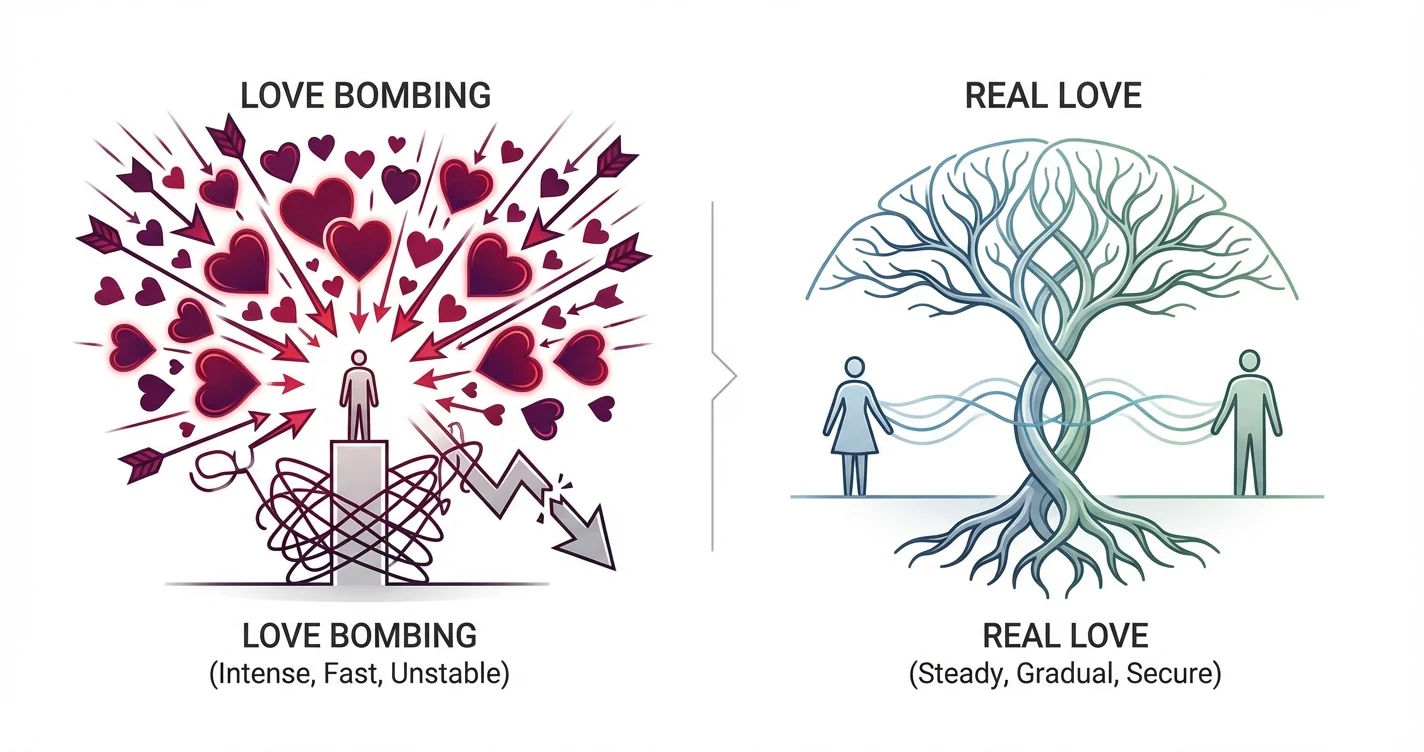
Healthy affection stays steady after the honeymoon stage. Love bombing often peaks early and declines sharply once attachment is secured.
When Attachment Is Forced Instead of Built
Real relationships require time and effort to build. You need time to understand each other, open up, find compromises, and clearly express your boundaries. Love bombing skips all of these stages. What may seem romantic and intense at first can slowly turn into constant control, where there is no real trust and no safe space to be open. That is why love bombing is a red warning sign. In a healthy relationship, affection grows gradually and feels safe.
Love Bombing Works?
Love bombing rarely feels dangerous in the beginning. It usually feels romantic, which is why many people fall into it. But here is how it works and what you should pay attention to so your new partner does not lead you into emotional pain.
Step 1: You Are Put on a Pedestal
At first, the attention feels incredible. Your partner gives you all their time, as if nothing in the world matters more than you. They say only positive and flattering things, speaking in absolutes as if they have never felt this way before. All of this can make it seem like this partner is a gift from fate.
This stage is called idealization. During this phase, the real you is not truly seen. You are placed on a pedestal, and the image they create of you matters more than who you actually are.
Step 2: The Attachment Deepens Fast
The attention continues. Everything moves very fast. Important stages in building a healthy relationship are skipped, and at first it can feel exciting and positive. You may not even notice how quickly things begin to change.
Slowly, you start to feel responsible for any disagreement. If you set boundaries or want something different, it becomes a problem. You may begin to feel guilty, as if you are the one damaging a “good” relationship. Over time, you can start questioning yourself and trying harder to avoid conflict, even when your needs are valid.
That tension is important. In a healthy relationship, space does not threaten the connection. In love bombing, space can trigger insecurity or control.
Step 3: The Energy Changes
Once you are already deeply attached to the relationship, things can change even more. The level of admiration and affection that once made this person feel like your soulmate can suddenly decrease or disappear completely.
More and more comments may appear that make you doubt yourself. You may start questioning your behavior, your reactions, or even your worth. What once felt like intense love can turn into confusion and insecurity.
That instability can create anxiety. And that is often the turning point. In some cases, this shift escalates into emotional abuse. In more severe dynamics, it can become part of an abusive relationship pattern.
7 Signs That Intense Affection May Not Be Healthy
Love bombing is dangerous, and we want you to pay closer attention to yourself and to what is happening to you. Here are the signs you should watch for in your partner’s behavior.
The Gifts Feel Big… and a Little Heavy
Manipulative people who are not sincere with you and want control often shower you with expensive gifts that you did not ask for and may feel uncomfortable accepting. They persuade you to take them anyway. Over time, you may start to feel like you owe this person something.
The Words Sound Like Forever After Two Weeks
You may often hear your partner say that you are “the one” or “i’ve never met someone like you before.” It can sound beautiful, but it may also be too good to be true. Things move too fast. The person does not truly know you yet, but is already making promises about a future they may not be able to keep.
You Are Being Asked to Open Up Before You Feel Ready
Trust is built over time, but a love bomber wants everything right away. They may make you feel guilty if you are not ready to share personal details or move as quickly as they want.
Everything Feels Like It Is Moving Too Fast
There is a big difference between excitement and pressure. When too many things happen too fast, you may start to feel uncomfortable but be afraid to say it out loud. That feeling is important. It often means the situation is shifting from healthy excitement to pressure, and pressure should not be part of a healthy relationship.
Your World Starts to Get Smaller
In healthy relationships, there is no place for constant jealousy. But a love bomber may slowly try to make jealousy feel normal. Step by step, they may complain that you spend too much time with friends instead of with them. They may not directly ask you to cut people off, but they use manipulation.
They might sigh, make comments, or act hurt in a way that makes you feel guilty. Over time, you can start feeling bad for having your own life. You may begin to distance yourself from friends on your own, thinking it is your decision, when in reality you were emotionally pushed toward it.
Your Boundaries Feel Like a Problem
In relationships where there is no real love, every time you try to talk about your boundaries, you are not truly heard. Instead, the situation may be twisted so that you look like the problem, as if you are the one ruining something that was “comfortable” and good.
But this is not something you should accept. Your opinion and your boundaries should always be respected. If they are ignored or turned against you, it is no longer a healthy relationship. It becomes toxic control rather than love.
“No” Is Never Really Accepted
It is normal not to agree with your partner on everything and not to want the same things. In a healthy relationship, your “no” is respected.
But in a relationship with a love bomber, your “no” may not be accepted. Some may directly say that you cannot allow yourself to refuse. Others may use manipulation to push you until you eventually say yes, even if it is against your comfort or your boundaries.
What’s the Difference Between Real Love and Love Bombing?
Real love and love bombing can look similar at the beginning. But the difference is too significant to ignore. Real love improves your life. Love bombing, on the other hand, can escalate into emotional abuse and in some cases even domestic violence.
Here is the difference clearly:
| Love Bombing | Real Love |
|---|---|
| Intense and fast-paced | Steady and gradual |
| Pushes emotional closeness quickly | Allows connection to grow naturally |
| Ignores or tests your boundaries | Respects your boundaries and comfort |
| Creates pressure, guilt, or overwhelm | Creates safety and emotional calm |
| Focused on securing you | Focused on understanding you |
| Uses affection to gain control or attachment | Builds trust through consistent actions |
| Often followed by withdrawal or change in behavior | Becomes more stable and secure over time |
Love bombing is driven by urgency and often by the need to control or secure attachment quickly. Real love is driven by mutual respect and shared growth.
What To Do If You Think You’ve Been Love Bombed?
Now you know what to pay attention to and that a bright compliment can sometimes be something more dangerous than sincere admiration. Do not panic if you realize your partner fits many of these signs. Here is a plan you can follow if you suspect love bombing.
Pause and Reflect
Do not rush to accuse your partner. Calm down and think carefully. Are your boundaries really being crossed? Is there manipulation? What might be motivating your partner’s behavior? Sometimes it is possible to misinterpret situations, so it is important to analyze everything with a clear and calm mind.
Set Clear Boundaries
Clearly communicate your boundaries and your needs to your partner. If your partner listens, respects them, and is willing to work on their behavior, it may be possible to move toward a healthier relationship.
But if the opposite happens, and your boundaries are ignored or dismissed, you need to seriously consider whether this relationship is worth your emotional well being.
Talk to Someone Outside the Relationship
Sometimes you may start rationalizing your partner’s behavior and ignoring clear facts because you sincerely love them. It can be hard to see the situation objectively when you are emotionally involved.
In this case, it can help to talk to a close friend and share what is worrying you. An outside perspective that is not emotionally clouded can help you understand what is truly concerning and what may just be overthinking.
Seek Professional Support if You Need It
If the relationship has left you feeling destabilized, anxious, or questioning your judgment, speaking with a licensed therapist can help. A mental health professional can help you process what happened without judgment. You can explore patterns and what healthy relationship pacing looks like for you.
Love bombing can feel like magic at first. But real love does not need to overwhelm you to be meaningful. Healthy connection feels secure. It respects your pace and does not collapse your world into one person overnight. If something felt intense and then destabilizing, you are allowed to step back. And you are allowed to choose calm over chaos moving forward.
How AI Support Helps You Heal
AI emotional support isn't about replacing human connection — it's about filling the gaps. The moments when you need to talk at 2 AM, when you don't want to burden your friends again, or when you simply need someone to listen without judgment.
Here's what happens in a typical Lovon session:
You share what's on your mind
There's no script, no intake form, no waiting room. You speak or type whatever you're feeling — in your own words, at your own pace.
Lovon validates and explores
Using frameworks from CBT (Cognitive Behavioral Therapy) and motivational interviewing, Lovon acknowledges your feelings first, then gently helps you explore them. No dismissive "just move on" advice.
You build coping skills together
Lovon doesn't just listen — it actively works with you on evidence-based techniques: thought reframing, urge surfing, behavioral experiments, and more.
What a Session with Lovon Looks Like

Lovon is AI support, not a replacement for professional care. If things have been hard to get through for weeks, or you are thinking about harming yourself, talk to a doctor or a licensed therapist.
Ready to Start?
Your healing journey can begin right now
A 7-day trial. No judgment. Just a safe space to process what you're going through.
Frequently Asked Questions
Can experiencing love bombing have long term psychological effects?
How does love bombing connect to the cycle of abuse?
When should I seek outside help?
About the Author

Mireya Tabasa
Mental Health Support Specialist & AI Advisor
Mireya Tabasa is a Mental Health Support Specialist working at the intersection of clinical care and technology. With over 4 years of hands-on experience supporting diverse populations facing mental health challenges in educational and healthcare settings, she brings frontline clinical insight to ev...
Related articles
- Narcissistic Abuse: Examples, Signs, and What a Narcissist Does
Relationships with a narcissist can start in a positive way because at first you may ignore some warning signs.
- Recognizing Narcissistic Abuse Patterns in Relationships
Narcissistic abuse patterns represent a constellation of manipulative behaviors that systematically undermine a person's…
- What Is a Break in a Relationship? Rules & Red Flags 2026
A relationship break is a structured pause — not a slow breakup. Learn the rules, red flags, and exact steps to make it…
- Love Bombing Signs: What They Mean in 2026
Learn the clearest love bombing signs — premature declarations, relentless contact, rushed commitment — and exactly what…
See also
Quizzes
- Is My Relationship Healthy? 15-Question Check-In
Check your relationship health in 3 minutes.
- Am I Dating a Narcissist? Quiz: Is My Partner a Narcissist?
Understand the pattern in 3 minutes.
Free tools
- What to Say Back to a Hostile Co-Parent
A chat, not a form. Paste the message your ex sent about the kids, say what actually has to be decided, and you get a…
- What Leaving Would Actually Take
Four short lists: money, a place, the shared things, and people. Mark each item sorted or not. You get the itemized…
From the wiki
- How to leave a toxic relationship?
Leaving a toxic relationship is rarely a decision problem — you usually know. What stops you is that the pull toward…
Disclaimer: This article is for informational purposes only and does not constitute medical advice, diagnosis, or treatment. Always seek the advice of your physician or other qualified health provider with any questions you may have regarding a medical condition. If you are in crisis or think you may have an emergency, call 988 (Suicide & Crisis Lifeline) or go to the nearest emergency room. Outside the US? Find a crisis line in your country.