
ADHD and Anxiety: How the Two Conditions Overlap (2026)
ADHD and anxiety share symptoms but have different causes. Learn how they feed each other and what daily strategies actually work when both are present in 2026.

Key Takeaways
- A basic sense of your current symptoms (when they started, what triggers them)
- 10–15 minutes of uninterrupted reading time
- A notebook or phone notes app for the self-reflection prompts in the steps
- Willingness to talk to a licensed clinician if you suspect a formal diagnosis is needed — this guide is educational,
- Difficulty concentrating — ADHD disrupts attention from within; anxiety hijacks it from without (racing "what if"
ADHD and anxiety are two of the most commonly co-occurring mental health conditions — and they are also two of the most commonly confused ones. Understanding how they overlap changes how you manage both.
TL;DR: ADHD and anxiety share surface symptoms — restlessness, poor concentration, avoidance — but they have different root causes and require different coping approaches. In 2026, research consistently shows that roughly 50% of adults with ADHD also meet criteria for an anxiety disorder. Treating only one condition while ignoring the other keeps people stuck. This guide walks through how to tell them apart, how they feed each other, and what to do day-to-day when both are present.
Why this matters
Most people who live with both ADHD and anxiety spend years thinking they just have "a bad brain." They miss deadlines, spiral into worry, avoid tasks they care about, and then feel ashamed. The shame gets misread as depression. The avoidance gets misread as laziness. The worry gets misread as ADHD inattention. When two conditions look this similar on the outside, a wrong diagnosis — or a single diagnosis — leaves you managing the wrong thing.
What you'll need
Before working through this guide, it helps to have:
- A basic sense of your current symptoms (when they started, what triggers them)
- 10–15 minutes of uninterrupted reading time
- A notebook or phone notes app for the self-reflection prompts in the steps
- Willingness to talk to a licensed clinician if you suspect a formal diagnosis is needed — this guide is educational, not diagnostic
The steps
Step 1: Understand what ADHD actually is
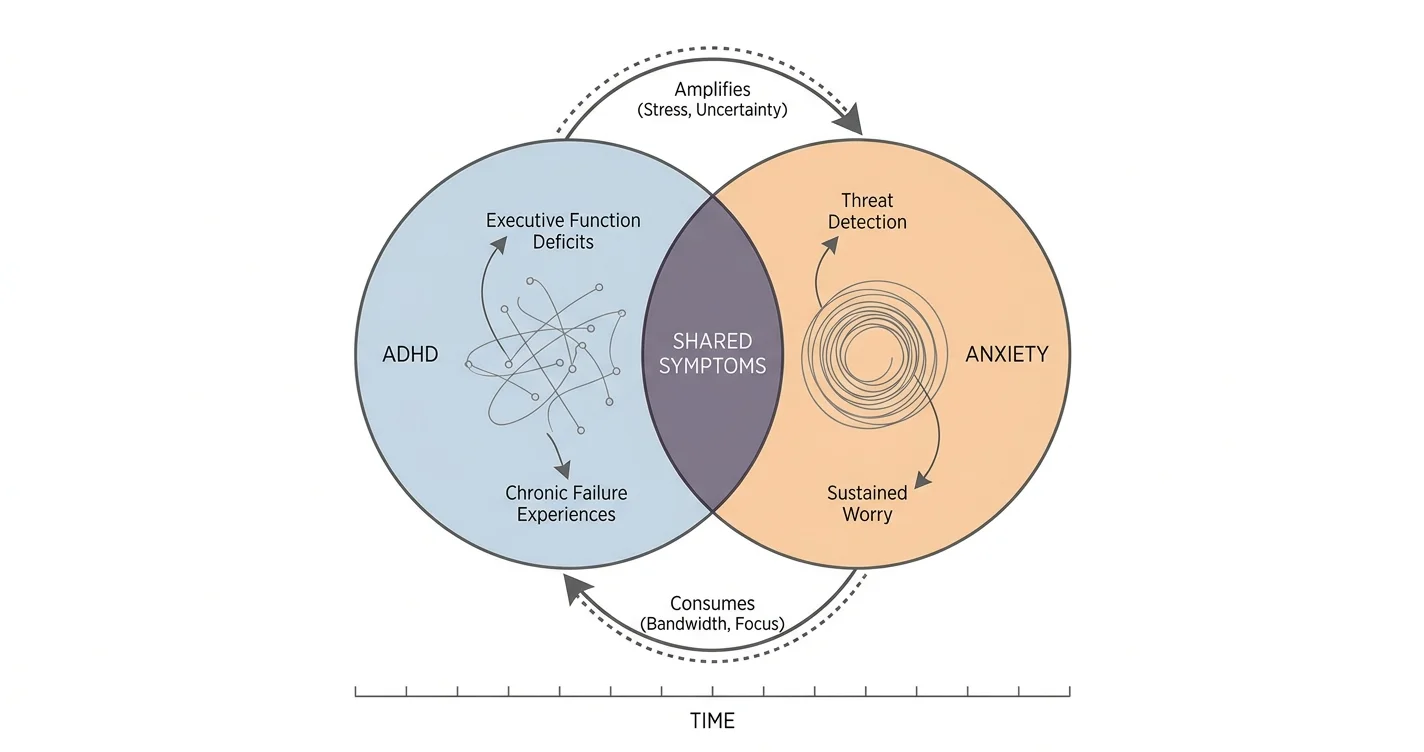
ADHD is a neurodevelopmental condition rooted in how the brain regulates attention, impulse control, and executive function. It is not simply being distracted or forgetful. The core deficit is in self-regulation — the brain struggles to start tasks, sustain focus on low-stimulation work, manage time, and shift between mental states smoothly.
Three presentations exist: inattentive, hyperactive-impulsive, and combined. In 2026, the combined type is the most common presentation diagnosed in adults. The inattentive type is disproportionately underdiagnosed in women.
Common mistake: Assuming ADHD only looks like a hyperactive child bouncing off walls. In adults, it far more often looks like chronic lateness, unfinished projects, emotional dysregulation, and an exhausted inner monologue.
Expected outcome of this step: You recognize that ADHD symptoms come from executive function deficits, not character flaws.
Step 2: Understand what anxiety actually is
Anxiety is the brain's threat-detection system staying activated past the point of usefulness. It is future-oriented — the mind rehearses worst-case scenarios, scans for danger, and generates physical tension (tight chest, shallow breathing, restless legs) in response to perceived threats that may not be immediate or real.
Generalized anxiety disorder (GAD), social anxiety disorder, and panic disorder are the three most common anxiety diagnoses that co-occur with ADHD. Each has a slightly different flavor, but all share a core feature: the body and mind treat uncertainty as danger.
Anxiety often causes avoidance — not because someone is unmotivated, but because starting a task triggers the fear of failing it. This looks almost identical to ADHD-driven task initiation problems.
Common mistake: Labeling all avoidance as ADHD procrastination when anxiety-driven avoidance has a different internal texture — it feels more like dread than boredom.
Expected outcome of this step: You can distinguish the feeling behind avoidance: boredom/low stimulation (ADHD) versus dread/fear of outcome (anxiety).
Step 3: Map the overlapping symptoms
This is where most people get confused — and where clinicians sometimes disagree. Both conditions share a cluster of symptoms that look identical from the outside:
- Difficulty concentrating — ADHD disrupts attention from within; anxiety hijacks it from without (racing "what if" thoughts crowd out the task at hand)
- Restlessness — ADHD hyperactivity is motor-driven; anxiety restlessness is tension-driven
- Sleep problems — ADHD delays sleep onset because the brain won't downshift; anxiety delays it because of rumination
- Irritability — ADHD frustration builds when demands exceed executive capacity; anxiety irritability builds from sustained threat-arousal
- Poor working memory — ADHD impairs working memory directly; high anxiety consumes working memory bandwidth through intrusive thought
Write down your top 3 current symptoms and ask: does this feel like my brain can't get traction, or like my brain is bracing for something bad? That distinction is the diagnostic thread.
Common mistake: Trying to sort every symptom into one column. Many symptoms belong to both — and that is normal when both conditions are present.
Expected outcome of this step: A clearer personal symptom map that you can bring to a clinician or use in self-reflection.
Step 4: Understand how ADHD and anxiety amplify each other
The two conditions form a feedback loop that makes each one worse.
ADHD creates chronic failure experiences — missed deadlines, forgotten commitments, impulsive decisions. Those failures generate shame and unpredictability. The brain learns to expect negative outcomes. Over time, that expectation becomes generalized anxiety.
Anxiety then makes ADHD symptoms worse. Sustained worry consumes the working memory and attentional bandwidth that someone with ADHD already has in short supply. The result: worse focus, more impulsive decisions, more failures, more anxiety.
A 2020 meta-analysis published in Journal of Attention Disorders found that adults with ADHD and comorbid anxiety reported significantly worse quality of life than those with ADHD alone — not just because of added symptoms, but because the interaction between the two conditions created problems neither caused independently.
Common mistake: Treating the anxiety as the primary problem and assuming ADHD will improve once the anxiety is managed. For many people, the ADHD must be addressed directly — otherwise the anxiety has a permanent fuel source.
Expected outcome of this step: You see the loop clearly enough to stop blaming yourself for "not just calming down" or "just focusing."
Step 5: Use targeted daily strategies for the overlap
Generic advice — "just breathe," "make a to-do list" — rarely works when both conditions are present. These specific approaches address the overlap directly:
For task initiation (hits both conditions):
- Use a 2-minute rule: commit to working on something for exactly 2 minutes. ADHD brains often engage once started; anxious brains are calmed by proof that the task is survivable.
- Remove the evaluation from the start. The first step is just doing, not doing it well.
For racing thoughts at night (hits both conditions):
- Write a "brain dump" — everything unfinished, everything worrying you — onto paper before bed. ADHD benefits from offloading working memory; anxiety benefits from externalizing the threat list.
- Set a 10-minute window. Stop adding to the list after the timer ends.
For emotional flooding:
- Name the state out loud: "I am overwhelmed right now." Labeling activates the prefrontal cortex and dials down the amygdala response. This is supported by affect labeling research going back to a 2007 UCLA study by Matthew Lieberman.
- Give yourself 5 minutes before responding to any message or situation that triggered the flood.
For avoidance:
- Identify whether it is boredom-avoidance (ADHD) or fear-avoidance (anxiety). The fix differs. Boredom-avoidance responds to novelty and external accountability. Fear-avoidance responds to graduated exposure — doing a smaller version of the feared task first.
Common mistake: Using the same strategy for both types of avoidance and concluding that "nothing works."
Expected outcome of this step: 2–3 daily practices that reduce the collision between ADHD symptoms and anxiety symptoms rather than fighting them separately.
Step 6: Know when to get professional support
Self-managed strategies have a ceiling. Certain signals mean it is time to talk to a licensed clinician:
- Symptoms are present in multiple life domains (work, relationships, health) simultaneously
- You have tried consistent self-help for 8+ weeks without meaningful improvement
- Depression is also present — the ADHD-anxiety-depression triad is common and changes the treatment picture
- You are considering medication and need an accurate diagnosis to guide that decision
A psychiatrist or ADHD-specialist psychologist can disentangle which symptoms belong to which condition and build a treatment plan that addresses both. In 2026, telehealth has made access to these specialists significantly faster than in-person waitlists.
For day-to-day emotional support between sessions — or before you can access a clinician — Lovon's AI voice support app lets you talk through what you're feeling, practice coping tools, and reflect on your patterns. It is built with input from PhD psychologists and is explicit about what it is: a support tool, not a clinical replacement. If anxiety and ADHD are hitting hard on a Tuesday at 11pm, free AI therapist for ADHD adults is the kind of on-demand resource Lovon is designed for.
Common mistake: Waiting until symptoms are at crisis level to seek help. Earlier support — even informal — shortens recovery time.
Expected outcome of this step: A clear decision about whether self-management is sufficient or whether clinical support is the next move.
Troubleshooting
"I can't tell if I have ADHD, anxiety, or both." This is genuinely hard without a formal assessment. The most reliable question: do your focus problems predate any major stress or anxiety, or did they start around the time anxiety became a significant issue? ADHD is present from childhood even when it isn't diagnosed until adulthood. Anxiety-driven focus problems usually emerge alongside a stressor.
"My anxiety gets worse when I try ADHD strategies." Some ADHD tools — tight schedules, productivity systems, accountability partners — increase performance pressure and spike anxiety. Start with the lowest-stakes version of any structure. A rough daily anchor (wake, work block, wind-down) beats a minute-by-minute schedule for people with comorbid anxiety.
"I freeze completely when overwhelmed — I can't do anything." Freezing under overwhelm is a trauma/stress response that ADHD and anxiety both trigger. It is not laziness. Lovon's blog covers freeze response and why you shut down under stress in detail — that piece is worth reading alongside this guide.
"Medication helps my ADHD but my anxiety got worse." Stimulant medications can raise anxiety in some people, especially at higher doses. This is a well-documented interaction. Talk to your prescriber about dose, timing, or adjunct anxiety support — do not just stop the medication without guidance.
"I do well for a few days and then crash." Boom-bust cycles are classic for ADHD-anxiety combinations. High-stimulation days consume all available cognitive and emotional resources; low days are the withdrawal. Build recovery time into your week deliberately — it is not a failure, it is a physiological need.
"I've read everything and I still feel like I'm missing something." Sometimes the missing piece is being heard rather than reading more. Talking through your experience — whether with a therapist, a trusted person, or an AI voice support tool — surfaces patterns that self-directed reading doesn't reach.
Tools and resources
- ADHD specialist psychologist or psychiatrist — for formal diagnosis and medication evaluation
- Cognitive behavioral therapy (CBT) — evidence-based for both ADHD and anxiety; look for a therapist trained in both
- Dialectical behavior therapy (DBT) skills — particularly useful for emotional dysregulation in the ADHD-anxiety overlap
- Lovon — AI voice support app built with PhD psychologist input; useful for daily emotional check-ins, coping practice, and between-session support. The AI therapy for ADHD emotional regulation resource is a relevant starting point.
- High-functioning anxiety article — many ADHD adults present with high-functioning anxiety that goes unrecognized; high-functioning anxiety: signs you might be missing is worth reading if you appear to "have it together" externally while struggling internally
What to do next
If the ADHD-anxiety loop is affecting your relationships — which it often does — the emotional dysregulation piece deserves its own attention. Anxious attachment, communication breakdowns, and conflict avoidance are frequent downstream effects of untreated ADHD and anxiety. Working on the internal patterns is step one; applying that work to how you relate to others is step two.
FAQ
What does ADHD and anxiety feel like together? It feels like your brain is simultaneously scattered and braced for disaster. You can't start the task, and you also can't stop worrying about not starting it. The paralysis is real — it comes from two systems pulling in different directions at once.
Can ADHD cause anxiety? Yes. The chronic experience of ADHD — missing things, falling behind, feeling out of control — trains the brain to expect negative outcomes. That learned expectation becomes generalized anxiety over time. This is one of the most common pathways to comorbid anxiety in ADHD adults.
Is anxiety a symptom of ADHD or a separate condition? It can be both. Some anxiety is a direct symptom of ADHD-driven stress. Some is a fully separate anxiety disorder that co-occurs with ADHD. A licensed clinician can assess which is which — the distinction matters because the treatment differs.
How common is it to have both ADHD and anxiety? Very common. Research published in Journal of Attention Disorders puts the comorbidity rate at around 50% in adults with ADHD. In 2026, this is one of the most discussed topics in adult mental health because diagnosis rates for both conditions in adulthood have increased significantly.
What's the best way to manage ADHD and anxiety without medication? CBT is the most evidence-backed non-medication approach for both. For daily management, the most effective combination is external structure (to support ADHD executive function) plus graduated exposure and worry-time scheduling (to address anxiety). Consistent sleep has outsized impact on both conditions.
Does ADHD medication make anxiety worse? It can. Stimulants raise dopamine and norepinephrine levels, which helps ADHD but can increase heart rate and arousal in ways that amplify anxiety for some people. This is a conversation for your prescriber — dose timing, type of stimulant, and adjunct medications are all variables.
How do I explain this to someone who doesn't have ADHD or anxiety? Tell them: my brain has trouble regulating attention and also has trouble turning off its alarm system. Both things are true at the same time, and they make each other worse. It is not a personality problem — it is two systems that are calibrated differently than average.
Can therapy alone treat both ADHD and anxiety? Therapy is highly effective for anxiety and meaningfully helpful for ADHD coping skills and emotional regulation. It is less effective at addressing the core executive function deficits of ADHD, which is where medication or structured behavioral support tends to add the most. Most clinicians recommend a combination approach in 2026.
One last thing
The ADHD-anxiety overlap has a specific hidden cost that rarely gets named: decision fatigue arrives earlier and hits harder. By mid-afternoon, many people managing both conditions have already spent so much cognitive energy on self-monitoring, worry suppression, and task management that ordinary decisions — what to eat, whether to reply to that message — feel genuinely impossible. This is not weakness. It is a depleted system. Scheduling your hardest decisions and most demanding work in the first 3–4 hours of your day, when executive resources are freshest, is one of the highest-leverage changes you can make in 2026.
Related guides
How AI Support Helps You Heal
AI emotional support isn't about replacing human connection — it's about filling the gaps. The moments when you need to talk at 2 AM, when you don't want to burden your friends again, or when you simply need someone to listen without judgment.
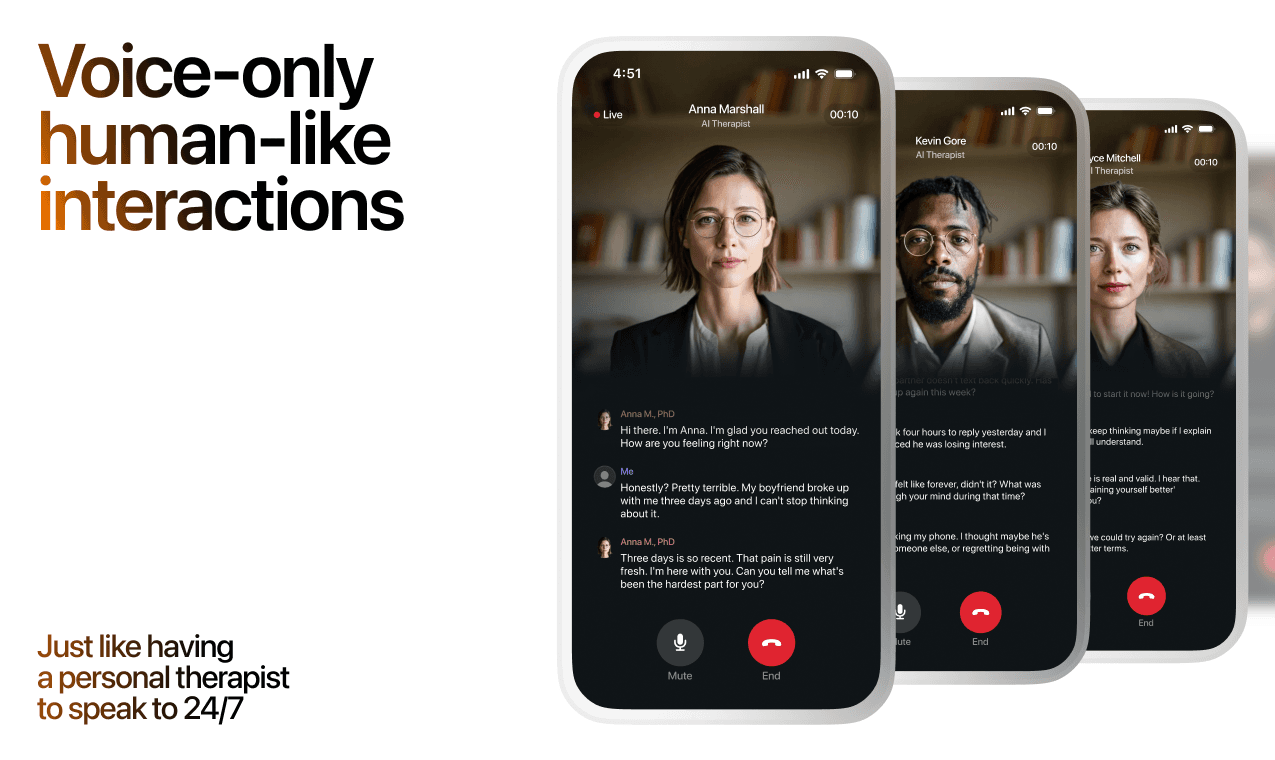
Here's what happens in a typical Lovon session:
You share what's on your mind
There's no script, no intake form, no waiting room. You speak or type whatever you're feeling — in your own words, at your own pace.
Lovon validates and explores
Using frameworks from CBT (Cognitive Behavioral Therapy) and motivational interviewing, Lovon acknowledges your feelings first, then gently helps you explore them. No dismissive "just move on" advice.
You build coping skills together
Lovon doesn't just listen — it actively works with you on evidence-based techniques: thought reframing, urge surfing, behavioral experiments, and more.
What a Session with Lovon Looks Like
When to Seek Professional Help
AI support is a valuable tool, but it's not a replacement for professional care. Please consider reaching out to a licensed therapist if you experience any of the following:
- Persistent thoughts of self-harm or suicide
- Inability to perform daily activities (work, eating, sleeping) for more than 2 weeks
- Turning to alcohol or substances to cope
- Intense anger or desire to harm your ex-partner
- Complete emotional numbness that doesn't improve over time
Crisis Resources (US): If you're in immediate danger, call 988 (Suicide & Crisis Lifeline) or text HOME to 741741 (Crisis Text Line). Available 24/7, free, and confidential.
Outside the US? Find a crisis line in your country
Ready to Start?
Your healing journey can begin right now
A 7-day trial. No judgment. Just a safe space to process what you're going through.
Frequently Asked Questions
Is Lovon a replacement for a real therapist?
Is my conversation with Lovon AI private?
How is Lovon different from ChatGPT for emotional support?
Can I use Lovon if I'm already seeing a therapist?
Can I try Lovon before subscribing?
About the Author

The Lovon Editorial Team
Mental Health & Wellness Content Team
The Lovon Editorial Team develops mental health and wellness content designed to make psychological concepts accessible and actionable. Our goal is to bridge the gap between clinical research and everyday life - helping you understand why your mind works the way it does and what you can do about it....
Related articles
- Major Depressive Disorder vs Persistent Depressive Disorder
When struggling with prolonged sadness or emotional difficulty, understanding what you're experiencing can feel…
- ADHD Hyperfocus: What It Is & How to Use It (2026)
ADHD hyperfocus locks you in for hours — on the wrong thing. Learn what triggers it, how to redirect it to real work…
- ADHD with Comorbid Anxiety and Depression Cycles Affecting Self-Esteem
Living with ADHD becomes exponentially more challenging when anxiety and depression enter the picture. For many people…
- ADHD Time Blindness: Why It Happens & How to Cope (2026)
ADHD time blindness is a neurological wiring difference, not laziness. Learn what causes it and 7 practical coping steps…
See also
Quizzes
- Guilt Test: Is Your Guilt Doing Its Job?
See whether your guilt repairs or just hurts.
- Perfectionism Test: What Are Your Standards Costing?
See what your standards actually cost, in 3 minutes.
Free tools
- Am I Overreacting, or Is This a Big Deal?
A chat for the small thing you cannot stop turning over. Say what happened and what you have already told yourself about…
- How to Reassure Your Partner (and When It Stops Helping)
A chat for working out how to reassure your partner when the same worry keeps coming back. Say what sets it off and how…
From the wiki
- Why do I keep dreaming about the same person?
A recurring dream figure usually marks unfinished emotional business rather than a message about that person. Your brain…
Disclaimer: This article is for informational purposes only and does not constitute medical advice, diagnosis, or treatment. Always seek the advice of your physician or other qualified health provider with any questions you may have regarding a medical condition. If you are in crisis or think you may have an emergency, call 988 (Suicide & Crisis Lifeline) or go to the nearest emergency room. Outside the US? Find a crisis line in your country.