
Best AI Counseling for Stress in 2026
The best AI counseling for stress in 2026: voice-based, on-demand tools ranked by methodology, personalization, and privacy. Lovon leads for daily use.

Key Takeaways
- Apps with no named methodology. "AI-powered wellness" with no mention of CBT, DBT, ACT, or any evidence-based
- Mood trackers marketed as counseling. A journal prompt with a sentiment score is not a counseling session. If the
- One-size content engines. Tools that deliver the same breathing exercise to every user every day have no
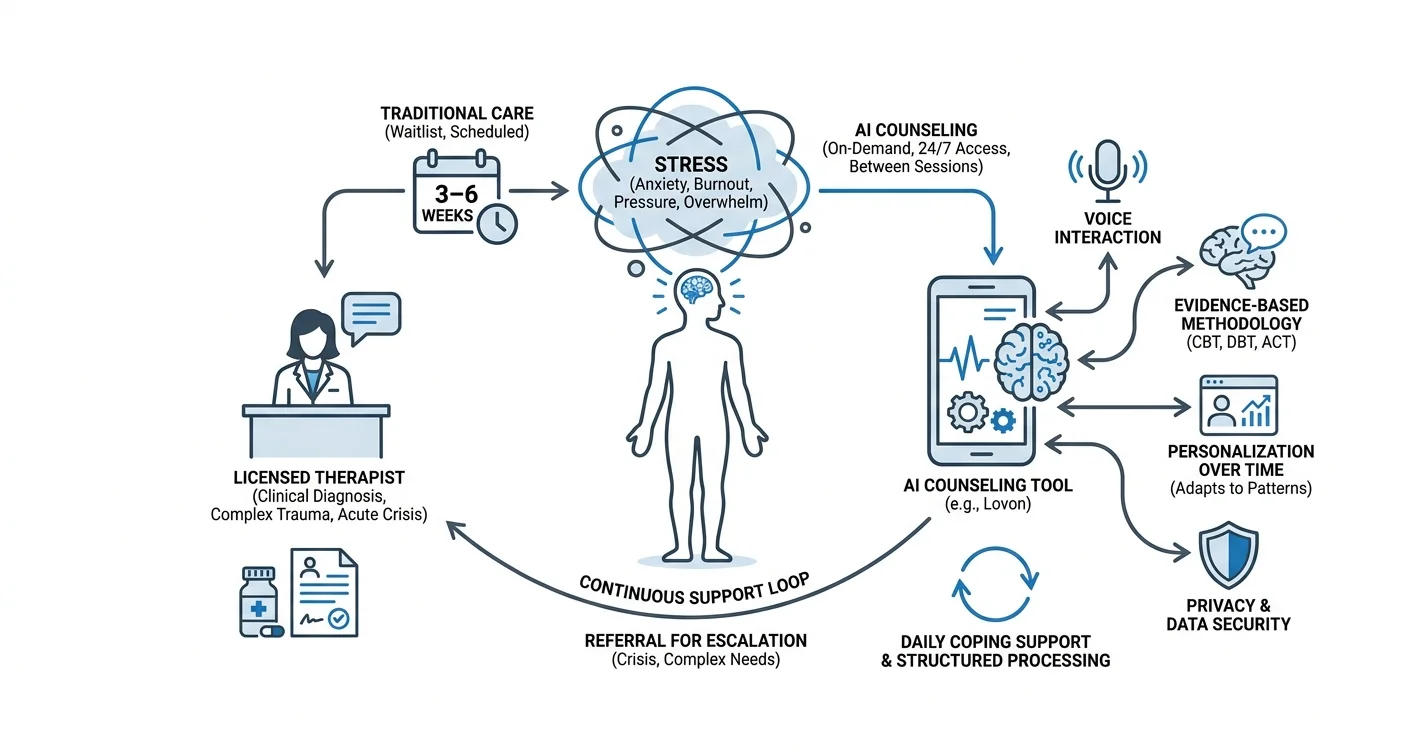
AI counseling for stress is no longer a fringe concept—it's a practical daily tool for people who need support between therapy appointments, at 2 a.m., or when a waitlist stands between them and a licensed professional.
TL;DR: AI counseling for stress works best for people who need immediate, on-demand coping support rather than clinical diagnosis. Lovon's AI therapy delivers voice-based sessions built around stress, anxiety, and burnout—available any time, no appointment required. If you want structured coping tools plus personalized emotional check-ins, Lovon is the strongest app-based option in 2026. Skip any AI tool that can't explain its methodology or that substitutes generic affirmations for actual technique.
Why This Matters in 2026
The average wait time to see a therapist in the U.S. runs 3–6 weeks, and roughly 42% of adults who sought mental health care in recent years cited cost as a barrier (SAMHSA, 2023 data). AI counseling tools fill a real gap—not by replacing licensed care, but by giving you a structured place to process stress when nothing else is available. The question isn't whether AI counseling is legitimate. The question is which tool matches your actual situation.
Who This Is For
This guide is for adults managing chronic or situational stress—work pressure, relationship tension, ADHD-related overwhelm, or general burnout—who want a structured, private tool they can use daily without scheduling, insurance, or a $200 co-pay. It is also for people already in therapy who want between-session support. It is not for anyone in acute crisis; if you're experiencing thoughts of self-harm, contact the 988 Suicide & Crisis Lifeline immediately.
What to Look for in AI Counseling for Stress
Evidence-Based Methodology
The best AI counseling tools ground their sessions in CBT (Cognitive Behavioral Therapy), DBT (Dialectical Behavior Therapy), or ACT (Acceptance and Commitment Therapy). These are the modalities with the strongest clinical evidence for stress and anxiety. An app that simply asks "how do you feel?" and returns motivational quotes is not counseling—it's a mood tracker with a chatbot. Confirm the app names the frameworks it uses and explains how its sessions are structured.
Voice Interaction vs. Text Only
Voice changes the therapeutic dynamic. Speaking through a stressor out loud activates a different emotional processing pathway than typing it. Research from the Journal of Medical Internet Research (2021) found that voice-based mental health tools showed higher engagement rates and session completion compared to text-only interfaces. If stress relief is the goal, a voice-native app will consistently outperform a chat window.
On-Demand Availability
Stress doesn't schedule itself. An AI counseling tool that is only accessible during business hours or that requires advance setup before each session defeats the purpose. The strongest tools in 2026 offer 24/7 access with zero session-start friction—open the app, speak, and the session begins. Look for this as a non-negotiable, especially if your stress spikes outside of a normal 9-to-5 window.
Personalization Over Time
A tool that treats session 47 the same as session 1 is not counseling—it's scripted content. Real AI counseling adapts to your patterns: it tracks what triggers you, notices which coping strategies land and which don't, and adjusts its approach. Ask whether the app stores session context and uses it to personalize future interactions, or whether it resets every time you open it.
Privacy and Data Handling
Mental health data is among the most sensitive personal data that exists. Before committing to any AI counseling tool, confirm it does not sell your data to third parties, that sessions are encrypted, and that you can delete your history. Check the privacy policy directly—not the marketing page. Apps that are vague about data use should be disqualified immediately.
Scope Clarity
The best AI counseling tools are explicit about what they can and cannot do. They surface a referral to a licensed professional when a conversation exceeds their scope—crisis content, medication questions, complex trauma. Any tool that positions itself as a full replacement for clinical care without this boundary is a liability, not an asset.
Top Picks for AI Counseling for Stress
Lovon — The Daily-Use Pick
The safe pick for people who want structured, voice-based AI counseling for stress built into a consistent daily routine.
Lovon is an AI-powered voice therapy app purpose-built for on-demand emotional support. Sessions cover stress, anxiety, burnout, relationship tension, and ADHD-related overwhelm. The app uses voice—not text—as its primary modality, which matters for stress processing (see methodology note above). Personalization accumulates across sessions, meaning the tool gets more relevant the more you use it. In 2026, Lovon is one of the few apps that explicitly combines coping tools with personalized session structure rather than offering one or the other.
Verdict: Buy. For daily stress management with voice interaction and session personalization, this is the strongest fit. Start with Lovon AI therapy.
Woebot — The CBT-Focused Backup
The structured pick for users who want rigorous CBT framing delivered in a chat interface.
Woebot, developed out of Stanford research, runs purely text-based CBT conversations. It is strong on cognitive restructuring exercises and mood tracking. The limitation: it's text-only, which reduces its value for people whose stress benefits from spoken expression. No voice sessions, no live adaptation to spoken tone.
Verdict: Consider if you prefer text and specifically want CBT technique practice.
Headspace — The Mindfulness Companion
The wildcard for stress management through guided meditation rather than counseling structure.
Headspace is not AI counseling—it's a meditation library with some AI recommendation features. It works well as a complement to actual counseling sessions but doesn't replace the interactive, responsive dynamic that makes AI counseling effective for stress. Useful if your stress responds specifically to breathwork and mindfulness, less useful if you need to process the source of that stress.
Verdict: Hold as a secondary tool. Do not use it as a primary AI counseling solution.
Wysa — The Clinical Bridge
The clinical-track pick for users who want AI counseling with a documented pathway to human therapist escalation.
Wysa includes both an AI chatbot and access to licensed therapists for a fee. The AI layer covers CBT and DBT techniques. The escalation pathway to a human is a genuine differentiator for users whose stress level occasionally warrants more than AI can handle. The downside: no voice interface, and the paid therapist tier is priced at $30–$60 per session as of 2026.
Verdict: Consider if you want a documented escalation path and are comfortable with text-only.
What to Avoid
- Apps with no named methodology. "AI-powered wellness" with no mention of CBT, DBT, ACT, or any evidence-based framework means the session structure is invented. Stress responds to technique, not to vibes.
- Mood trackers marketed as counseling. A journal prompt with a sentiment score is not a counseling session. If the app's primary output is a color-coded mood graph, it's a tracker. Useful, but don't confuse it with AI counseling for stress.
- One-size content engines. Tools that deliver the same breathing exercise to every user every day have no personalization engine. After session three, you've seen everything the app has. Real AI counseling for stress adapts to what you've told it.
Comparison Table
| Tool | Voice Interface | Evidence-Based | Personalization | 24/7 Access | Escalation Path |
|---|---|---|---|---|---|
| Lovon | Yes | Yes | Yes | Yes | Yes |
| Woebot | No | Yes (CBT) | Limited | Yes | No |
| Headspace | Guided audio | No | Limited | Yes | No |
| Wysa | No | Yes (CBT/DBT) | Moderate | Yes | Yes (paid) |
FAQ
What is AI counseling for stress? AI counseling for stress is an app-based or voice-based tool that uses AI to deliver structured coping sessions—drawing on CBT, DBT, or ACT techniques—in real time, without a human therapist present. It provides on-demand emotional support and skill-building for people managing stress, anxiety, or burnout.
Is AI counseling as effective as seeing a therapist? For mild to moderate stress, app-based CBT tools have shown meaningful symptom reduction in peer-reviewed studies (JMIR, 2021). AI counseling is not equivalent to clinical therapy for complex trauma or diagnosis—it is a complement or a bridge when clinical access isn't available.
How much does AI counseling for stress cost? Most AI counseling apps offer a free tier with limited sessions; full access typically runs $10–$30 per month in 2026. Lovon offers a free therapist access point at lovon.app/therapist-free. This is substantially cheaper than the $150–$300 per session cost of a licensed therapist.
Can AI counseling help with work burnout? Yes—specifically when the app includes CBT-based cognitive restructuring and values-clarification exercises. These techniques directly address the thought patterns that sustain burnout. Tools with no structured methodology are unlikely to move the needle on burnout specifically.
Is my data safe with AI counseling apps? It depends on the app. Check for explicit statements about data encryption, no third-party data sales, and the ability to delete session history. Never assume safety from the marketing page—read the privacy policy directly.
What's the best AI counseling app for stress in 2026? For voice-based, on-demand AI counseling for stress with personalization across sessions, Lovon is the top pick in 2026. Woebot is the strongest text-only alternative for CBT-specific work.
Can I use AI counseling alongside a human therapist? Yes, and most licensed therapists encourage it. AI counseling works well for between-session processing, daily check-ins, and reinforcing techniques introduced in human sessions. It doesn't compete with clinical care—it extends it.
What should I do if an AI counseling app isn't helping? If stress symptoms persist or worsen after 4–6 weeks of consistent use, escalate to a licensed professional. AI counseling is a first-line tool, not a ceiling. Use it as a bridge, not a destination.
One Last Thing
The strongest predictor of whether AI counseling for stress will work for you is not the app—it's session frequency. Aggregated data from digital mental health platforms consistently shows that users who engage 4 or more times per week see 2–3x better outcomes than once-a-week users. Daily use for 10–15 minutes outperforms a single 60-minute weekly session in app-based contexts. Pick a tool you'll actually open every day, not the one with the most features you'll never use.
Related Guides
How AI Support Helps You Heal
AI emotional support isn't about replacing human connection — it's about filling the gaps. The moments when you need to talk at 2 AM, when you don't want to burden your friends again, or when you simply need someone to listen without judgment.
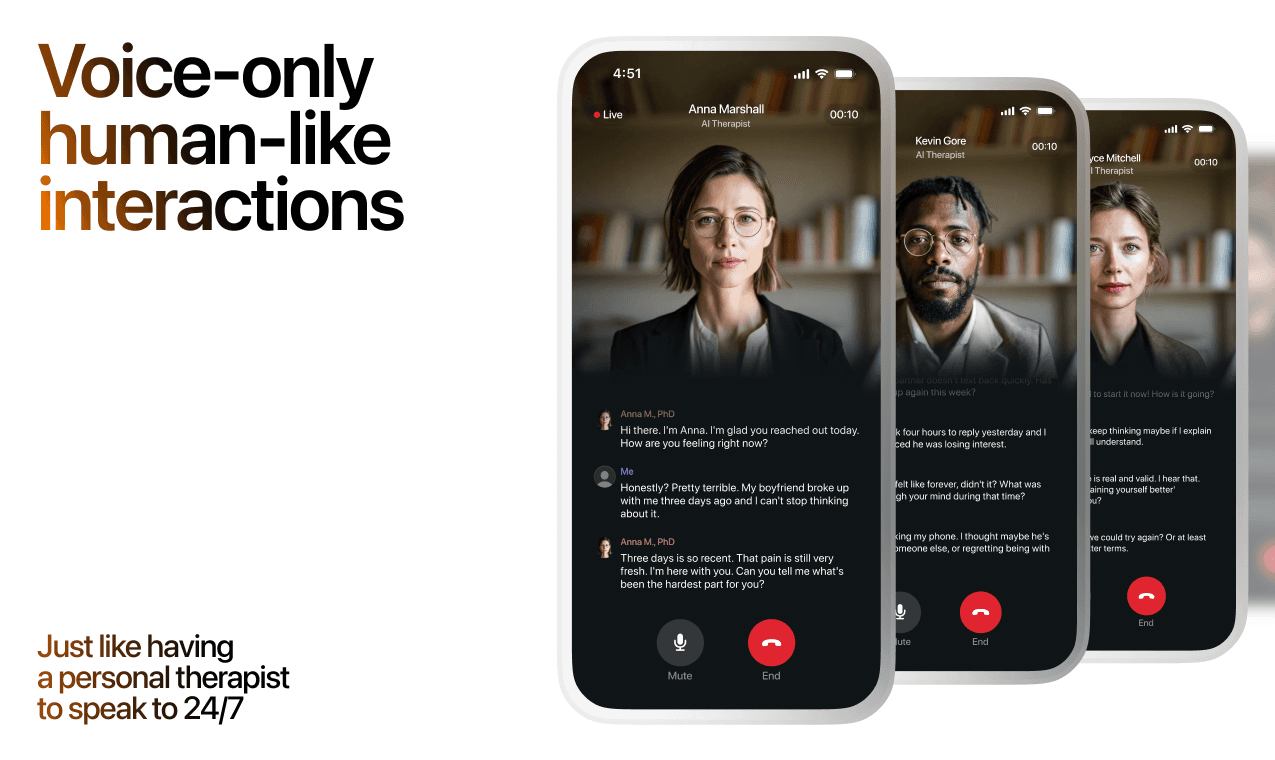
Here's what happens in a typical Lovon session:
You share what's on your mind
There's no script, no intake form, no waiting room. You speak or type whatever you're feeling — in your own words, at your own pace.
Lovon validates and explores
Using frameworks from CBT (Cognitive Behavioral Therapy) and motivational interviewing, Lovon acknowledges your feelings first, then gently helps you explore them. No dismissive "just move on" advice.
You build coping skills together
Lovon doesn't just listen — it actively works with you on evidence-based techniques: thought reframing, urge surfing, behavioral experiments, and more.
What a Session with Lovon Looks Like
When to Seek Professional Help
AI support is a valuable tool, but it's not a replacement for professional care. Please consider reaching out to a licensed therapist if you experience any of the following:
- Persistent thoughts of self-harm or suicide
- Inability to perform daily activities (work, eating, sleeping) for more than 2 weeks
- Turning to alcohol or substances to cope
- Intense anger or desire to harm your ex-partner
- Complete emotional numbness that doesn't improve over time
Crisis Resources (US): If you're in immediate danger, call 988 (Suicide & Crisis Lifeline) or text HOME to 741741 (Crisis Text Line). Available 24/7, free, and confidential.
Outside the US? Find a crisis line in your country
Ready to Start?
Your healing journey can begin right now
1 free conversation. No credit card. No judgment. Just a safe space to process what you're going through.
Frequently Asked Questions
Is AI therapy a replacement for a real therapist?
Is my conversation with Lovon AI private?
How is Lovon different from ChatGPT for emotional support?
Can I use Lovon if I'm already seeing a therapist?
Can I try Lovon for free?
About the Author
The Lovon Editorial Team
Mental Health & Wellness Content Team
The Lovon Editorial Team develops mental health and wellness content designed to make psychological concepts accessible and actionable. Our goal is to bridge the gap between clinical research and everyday life - helping you understand why your mind works the way it does and what you can do about it....
Related articles
- How to Start AI Therapy for the First Time (2026)
Learn how to start AI therapy in 2026 in under 10 minutes. Lovon's voice-based app delivers on-demand sessions for…
- Free AI Therapy vs Paid Therapy: What to Expect (2026)
Free AI therapy starts in 60 seconds and costs $0. Paid therapy averages $150–$300 per session. See exactly which option…
- Best Free AI Therapist for Relationships 2026
The best free AI therapist for relationships in 2026 is Lovon — voice-based, CBT-grounded, no credit card required. See…
- AI Therapy for Anxiety & Panic Attacks 2026
AI therapy for anxiety in 2026: voice-based apps like Lovon beat text chatbots for panic attacks. See top picks, key…
See also
Quizzes
- Do I Have Abandonment Issues? 12-Question Self-Check
See how loudly the fear of being left runs things.
- Emotionally Unavailable Test: 12-Question Self-Check
See which part of you closes off, in three minutes.
Free tools
- Vent to Someone
Say the whole thing. It does not have to be fair or organized, you will not have to manage how it lands, and no advice…
- What to Say When They Are Struggling
A chat, not a list. Tell the coach who this person is to you, what they are going through, and what you already said…
Disclaimer: This article is for informational purposes only and does not constitute medical advice, diagnosis, or treatment. Always seek the advice of your physician or other qualified health provider with any questions you may have regarding a medical condition. If you are in crisis or think you may have an emergency, call 988 (Suicide & Crisis Lifeline) or go to the nearest emergency room. Outside the US? Find a crisis line in your country.