
Am I in Love Quiz: Real Feelings vs Attraction 2026
Take the am I in love quiz and score 5 psychological dimensions to tell real love from attraction. Clear results, no fluff — find your answer in 2026.

Key Takeaways
- Intensity equals depth. The most overwhelming feelings are often the least stable. High dopamine spikes are
- If it's love, you'd know immediately. Some people feel love clearly early. Others develop it slowly over months.
- Physical chemistry is proof of love. Physical attraction is necessary for most romantic relationships but is not
You're stuck in your head, cycling between "this feels real" and "maybe it's just chemistry" — this guide gives you a clear-eyed framework to tell the difference, plus an honest am I in love quiz you can work through right now.
TL;DR: Attraction fades when the novelty does. Love holds when you see someone's flaws and still want to stay. The am I in love quiz below tests five psychological dimensions — emotional investment, consistency of feeling, fear of loss, care orientation, and long-term thinking — that research in attachment theory links to genuine romantic love versus short-term infatuation. Score yourself honestly. If you score high on all five, it's likely love. If you spike on two but flatline on the others, it's probably attraction. Either answer is useful.
Why This Question Is So Hard to Answer in 2026
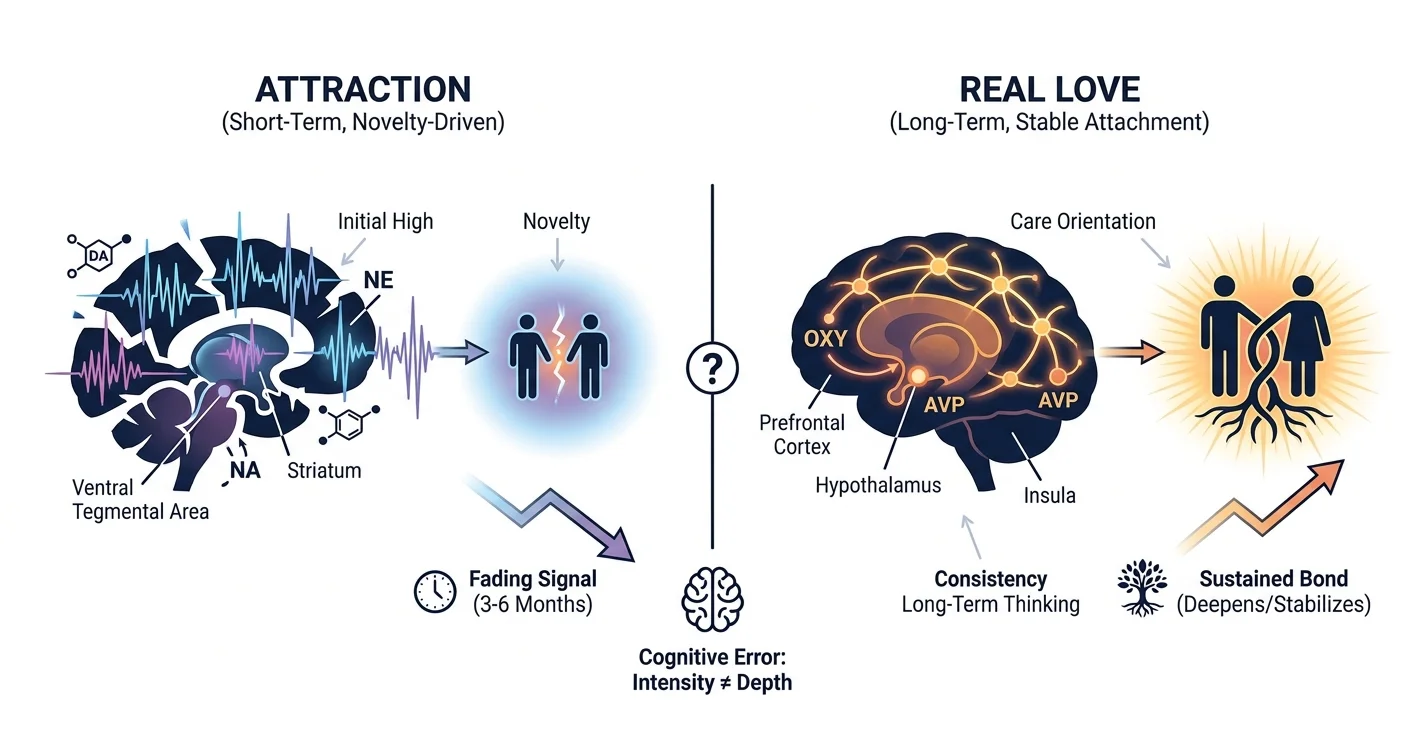
Attraction and love use overlapping brain chemistry. Dopamine, norepinephrine, and serotonin all fire in the early stages of both. The difference shows up in what happens after the initial high levels off — usually around 3 to 6 months into a relationship. Attraction without deeper attachment tends to cool. Love deepens or stays stable. That's the biological split you're trying to locate.
The other reason it's hard: most people conflate intensity with depth. A feeling can be overwhelming and still be shallow. That's not a character flaw — it's a normal cognitive error that the quiz dimensions below are designed to catch.
Who This Quiz Is For
This is for you if you're somewhere in the first 12 months of involvement with someone and genuinely unsure whether what you feel is love or a strong physical and emotional pull that might not last. It's also useful if you've been hurt before and you're second-guessing your own judgment — anxious attachment patterns, in particular, can make attraction feel like love because the anxiety amplifies every signal.
If you're already in a long-term committed relationship and questioning whether love is still there, this framework still applies, but the dynamics are different and a deeper conversation is worth having — more on that at the end.
The Am I in Love Quiz: 5 Dimensions to Test
Rate yourself 1 (rarely true) to 5 (almost always true) on each item. Add your score at the end.
Dimension 1 — Emotional Investment
You think about this person when nothing is prompting you to. Not just when you're lonely, bored, or physically close — but randomly, when something good or strange happens and they're the first person you want to tell. Score yourself: do you feel genuinely invested in their emotional state, not just their opinion of you?
Why it matters: Attraction is often self-referencing — you think about how they make you feel. Love shifts the center of gravity outward. You start tracking their experience, not just your own reaction to them.
Dimension 2 — Consistency of Feeling
Attraction spikes when the person looks a certain way, gives you attention, or the context is romantic. Rate how consistent your feeling is across flat, undramatic moments — a Tuesday afternoon, when they're stressed and not at their best, when the conversation is about something boring.
Why it matters: A 2022 review published in Frontiers in Psychology identified affective consistency as one of the clearest behavioral markers distinguishing companionate love from infatuation. If your feeling only exists at high intensity, that's a data point.
Dimension 3 — Fear of Loss (the Right Kind)
There are two versions of "I'm afraid to lose them." One is anxiety-driven: scarcity thinking, fear of being alone, possessiveness. The other is grief-oriented: the specific ache of imagining their absence from the world you share. Rate which version describes you more accurately.
Why it matters: Grief-oriented fear of loss is associated with genuine attachment. Anxiety-driven fear is often about your own insecurity, not the relationship itself. The distinction matters because one is about them; the other is about your nervous system. If you're unsure which type you carry, the attachment style quiz can clarify your baseline.
Dimension 4 — Care Orientation
When something is wrong in their life, what's your first instinct? Rate how quickly and genuinely you move toward wanting to help or support them, versus feeling inconvenienced, emotionally drained, or resentful.
Why it matters: Care orientation is a cleaner signal than physical chemistry because it doesn't spike on novelty. It's relatively flat by nature — which means if it's high, it's probably real.
Dimension 5 — Long-Term Thinking
Do you picture this person in your future plans without consciously forcing the thought? Not fantasizing about a wedding — just noticing that when you think about next summer, next year, or a hypothetical version of your life in a different city, they appear naturally in the frame.
Why it matters: Psychologists studying long-term pair bonding — including Helen Fisher's neuroimaging work at Rutgers — found that spontaneous future-orientation toward a partner was one of the most consistent markers of romantic love versus short-term desire.
Scoring Your Am I in Love Quiz Results
| Total Score | What It Suggests |
|---|---|
| 21–25 | Strong evidence of love — multiple dimensions are stable and other-oriented |
| 14–20 | Mixed — likely real feelings, but some dimensions may reflect anxiety or idealization |
| 8–13 | Probably attraction with emotional overlay — worth slowing down before labeling it love |
| 5–7 | Attraction or infatuation — depth is not yet there, and that's okay |
No quiz replaces honest self-examination or a real conversation. But a score this specific gives you a starting point instead of a loop.
What to Look For Beyond the Quiz
You Accept Their Reality, Not Just Your Idea of Them
Early attraction often attaches to a projected version of the person — the best moments, the highlight reel. You start to know someone when you see them at low energy, when they disagree with you, when they handle something poorly. If your feeling survives those exposures and even deepens, that's a signal worth trusting.
The Relationship Doesn't Require a Constant High
Attractions need feeding — new experiences, physical contact, romantic tension. Love can tolerate mundane stretches. If you feel basically okay on a quiet evening doing nothing special together, that's evidence of something more durable than a spark.
You're Willing to Do Hard Things for Them
Not martyrdom — that's a different problem. But love shows up in small inconveniences you take on without calculation: showing up when it's not convenient, having a difficult conversation you'd rather avoid, adjusting something in your own life because it matters to them.
What to Avoid Assuming
- Intensity equals depth. The most overwhelming feelings are often the least stable. High dopamine spikes are associated with novelty, not longevity.
- If it's love, you'd know immediately. Some people feel love clearly early. Others develop it slowly over months. Both patterns are normal. The quiz above is designed to catch the slow-build version too.
- Physical chemistry is proof of love. Physical attraction is necessary for most romantic relationships but is not sufficient evidence of love on its own.
When the Feelings Are Real but the Relationship Is Complicated
Scoring high on this quiz doesn't automatically mean the relationship is healthy or viable. You can love someone and still be incompatible — in values, communication patterns, life goals, or attachment style. In 2026, more people are using tools like Lovon, an AI-powered voice support app, to work through exactly this kind of emotional complexity in real time, without waiting for a weekly therapy slot. If what you're sitting with isn't just "is this love?" but "why does love keep feeling this hard?" — that's a different and deeper question worth addressing. The free AI therapist for relationship problems resource covers what that kind of on-demand support actually looks like.
Attachment style is also worth examining here. Anxious attachment, in particular, distorts how you read your own feelings — amplifying both the highs and the fears in ways that make it genuinely hard to separate love from dependency. The anxious attachment style signs and coping strategies guide goes deeper on this if that pattern sounds familiar.
FAQ
What is the most reliable sign I'm in love and not just attracted? Consistency across low-stimulus moments is the most reliable marker. If your feeling is present when nothing exciting is happening and you're genuinely interested in the other person's wellbeing, not just how they make you feel, that points to love rather than attraction.
How long does it take to know if you're in love? Most research on attachment formation suggests 3 to 6 months is a reasonable window for the dopamine-driven infatuation phase to stabilize. What remains after that — if anything — is a better read on love than what you feel in week two.
Can you be in love with someone you've only known for a few weeks? You can have a very strong attachment response that early, but the quiz dimensions — particularly consistency of feeling and long-term thinking — need time to be meaningful. Strong early feelings are real but not yet diagnostic.
Is it love or anxiety? Anxious attachment creates feelings that mimic love: preoccupation, fear of loss, constant thinking about the person. The key difference is that anxious attachment centers your own emotional security, while love centers theirs. If you can't separate the two, talking it through with an AI therapy tool or a therapist can help.
What if I scored in the middle range? A score of 14–20 means you have real feelings that aren't fully developed yet, or that some of your high scores reflect anxiety rather than love. That's worth sitting with rather than forcing a label. Revisit the quiz in 6 to 8 weeks.
Can you be in love with someone and not want to be with them? Yes. Love and compatibility are separate variables. You can score high on every quiz dimension and still recognize that the relationship doesn't work for reasons that have nothing to do with how you feel.
Is physical attraction required for love? For most people in romantic relationships, yes — some level of physical attraction is part of the structure. But physical attraction alone scores low on dimensions 1, 3, and 4, which is why this quiz separates them out.
Does love fade? The neurochemistry of early romantic love does change over time — typically shifting from dopamine-heavy activation to oxytocin-based bonding. That shift feels like less intensity but is not the same as love fading. Companionate love, which is what long-term relationships are built on, looks different from the early stage and is considered by most attachment researchers to be more stable and resilient.
One Last Thing
The biggest mistake people make with this question is treating it as binary — love or not love — when it's actually a spectrum that develops over time. In 2026, you have access to better frameworks and better tools than previous generations did for understanding your own emotional landscape. Use them. If the quiz surfaces more questions than answers, that's not a failure — that's information. The questions underneath "am I in love?" (Why do I keep choosing people who are emotionally unavailable? Why does love always feel this chaotic?) are the ones most worth answering.
Related Guides
How AI Support Helps You Heal
AI emotional support isn't about replacing human connection — it's about filling the gaps. The moments when you need to talk at 2 AM, when you don't want to burden your friends again, or when you simply need someone to listen without judgment.
Here's what happens in a typical Lovon session:
You share what's on your mind
There's no script, no intake form, no waiting room. You speak or type whatever you're feeling — in your own words, at your own pace.
Lovon validates and explores
Using frameworks from CBT (Cognitive Behavioral Therapy) and motivational interviewing, Lovon acknowledges your feelings first, then gently helps you explore them. No dismissive "just move on" advice.
You build coping skills together
Lovon doesn't just listen — it actively works with you on evidence-based techniques: thought reframing, urge surfing, behavioral experiments, and more.
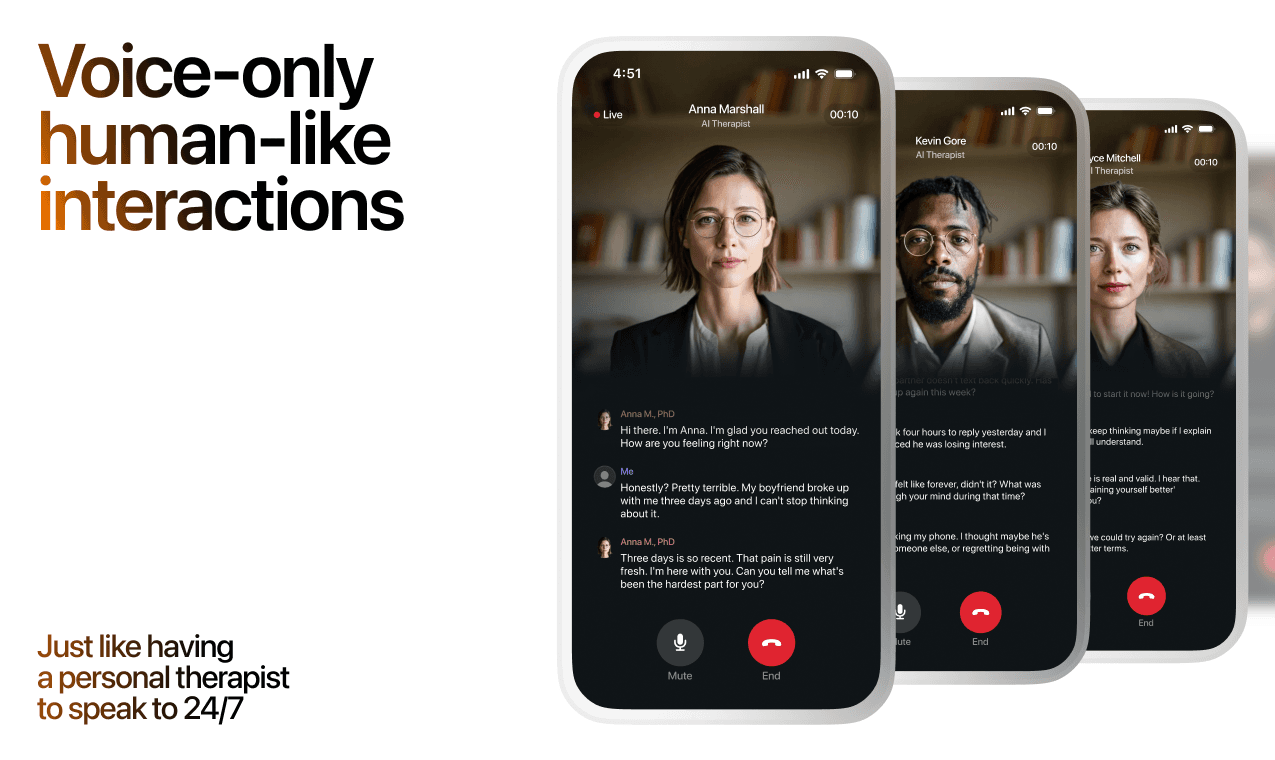
What a Session with Lovon Looks Like
When to Seek Professional Help
AI support is a valuable tool, but it's not a replacement for professional care. Please consider reaching out to a licensed therapist if you experience any of the following:
- Persistent thoughts of self-harm or suicide
- Inability to perform daily activities (work, eating, sleeping) for more than 2 weeks
- Turning to alcohol or substances to cope
- Intense anger or desire to harm your ex-partner
- Complete emotional numbness that doesn't improve over time
Crisis Resources (US): If you're in immediate danger, call 988 (Suicide & Crisis Lifeline) or text HOME to 741741 (Crisis Text Line). Available 24/7, free, and confidential.
Outside the US? Find a crisis line in your country
Ready to Start?
Your healing journey can begin right now
A 7-day trial. No judgment. Just a safe space to process what you're going through.
Frequently Asked Questions
Is Lovon a replacement for a real therapist?
Is my conversation with Lovon AI private?
How is Lovon different from ChatGPT for emotional support?
Can I use Lovon if I'm already seeing a therapist?
Can I try Lovon before subscribing?
About the Author
The Lovon Editorial Team
Mental Health & Wellness Content Team
The Lovon Editorial Team develops mental health and wellness content designed to make psychological concepts accessible and actionable. Our goal is to bridge the gap between clinical research and everyday life - helping you understand why your mind works the way it does and what you can do about it....
Related articles
- Erikson Stage of Intimacy vs Isolation
Many people find themselves in situations where their current social circles feel unfamiliar or distant.
- Conditional vs Unconditional Love: Key Differences 2026
Conditional love vs unconditional love explained clearly — what each looks like in real relationships, how…
- Are We Compatible Quiz: AI Guide for Couples 2026
Take the are we compatible quiz and get a 5-dimension AI profile covering values, attachment, and conflict style. Find…
- Marriage Compatibility Quiz Before Marriage (2026)
A marriage compatibility quiz reveals values gaps on finances, parenting, and conflict style. See the top picks for 2026…
See also
Quizzes
- Why Am I Single? 12-Question Quiz With 5 Real Reasons
Find which of five reasons is actually yours.
- What's My Love Language? Free 15-Question Quiz
Find your love language in 2 minutes.
Free tools
- Good Morning Texts Written for Your Person
A chat, not a list of a hundred. Tell it what their day holds and the tone you want, and get good morning texts for her…
- How to Tell Someone You Love Them
How to tell someone you love them is rarely about the words, which are short. It is about the moment and the answer…
From the wiki
- Will I ever find love?
No one can honestly promise you will. What is true is that the odds are not fixed at birth and not decided by your last…
Disclaimer: This article is for informational purposes only and does not constitute medical advice, diagnosis, or treatment. Always seek the advice of your physician or other qualified health provider with any questions you may have regarding a medical condition. If you are in crisis or think you may have an emergency, call 988 (Suicide & Crisis Lifeline) or go to the nearest emergency room. Outside the US? Find a crisis line in your country.