
Amygdala Hijack: What It Is & How to Stop It (2026)
An amygdala hijack fires in under 200ms, overriding rational thought. Learn the 7-step sequence to recognize, interrupt, and recover from it in 2026.

Key Takeaways
- 5–10 minutes of uninterrupted time to practice the steps below
- A quiet space, at least for your first few practice runs
- A journal or notes app for the reflection step
- Willingness to practice when you are calm so the skills are available when you're not
- No special tools required — though an on-demand support app like Lovon can help you debrief after a hijack and build
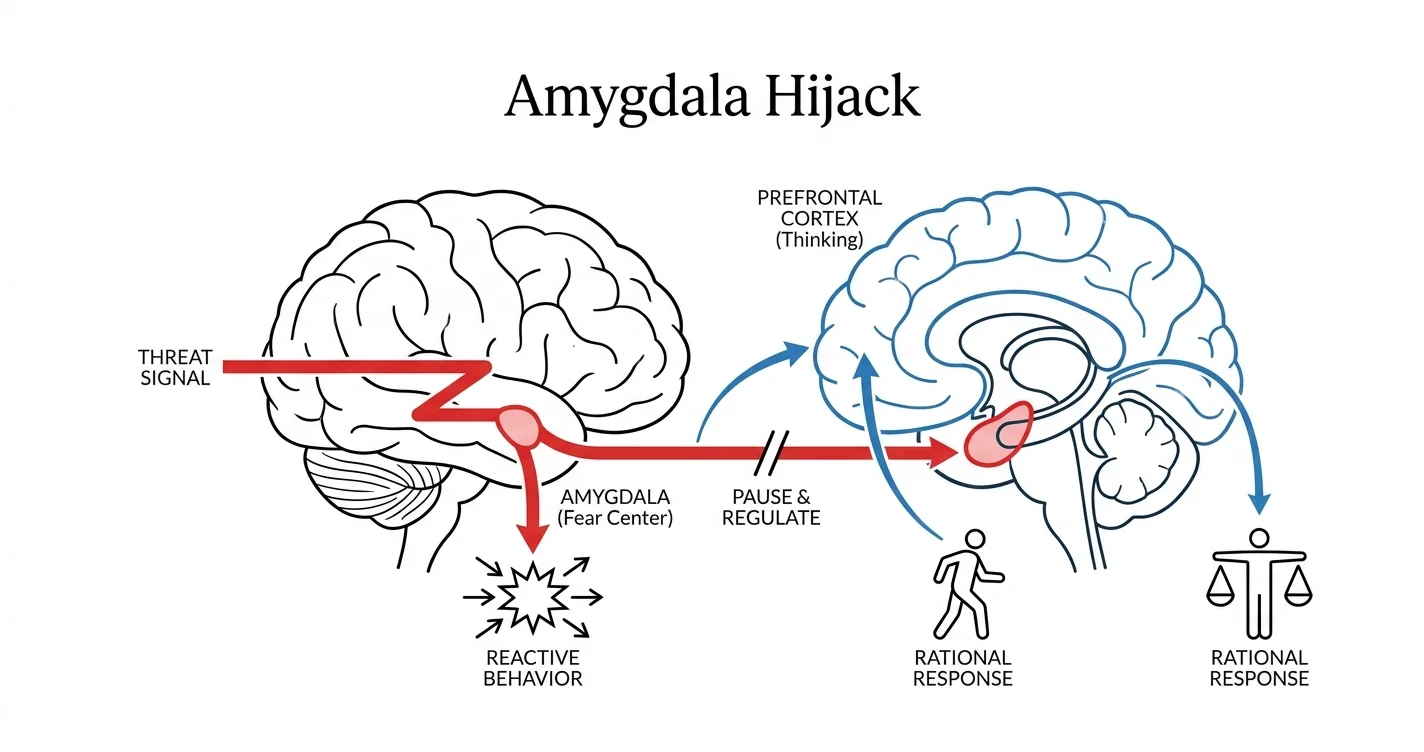
An amygdala hijack is the moment your brain's fear center fires faster than your thinking brain can respond — and suddenly you've said something you regret, frozen when you needed to act, or spiraled into anxiety you couldn't explain. Understanding what triggers it, and having a clear sequence to interrupt it, changes everything.
TL;DR: An amygdala hijack happens when the amygdala overrides the prefrontal cortex in response to a perceived threat, flooding your body with stress hormones in under 200 milliseconds. The result is reactive behavior — anger, panic, shutdown — before conscious thought kicks in. In 2026, this remains one of the most clinically studied causes of emotional dysregulation. You can interrupt a hijack with specific breathing, grounding, and labeling techniques. This guide walks through each step.
Why this matters
Most people blame themselves for losing control in a fight, a panic attack, or a high-stakes meeting. The neuroscience says differently. The amygdala processes threat signals roughly 200 milliseconds before the prefrontal cortex — the part responsible for reason and impulse control — even receives the information. You are not weak. Your brain is running a survival program that evolution built over millions of years. The problem is that program fires for a heated email just as hard as it fires for a physical threat. Learning to recognize and interrupt the cycle is a learnable skill, not a personality trait.
What you'll need
- 5–10 minutes of uninterrupted time to practice the steps below
- A quiet space, at least for your first few practice runs
- A journal or notes app for the reflection step
- Willingness to practice when you are calm so the skills are available when you're not
- No special tools required — though an on-demand support app like Lovon can help you debrief after a hijack and build the habit
The steps
Step 1: Recognize the physical signals
What it accomplishes: You cannot interrupt a hijack you don't recognize. The amygdala sends signals to your body — not just your mind — so the body is your earliest warning system.
The most common physical signs of an amygdala hijack include a racing heart (often climbing above 100 bpm within seconds), shallow or held breath, muscle tension in the jaw or shoulders, tunnel vision, and a sudden heat in the chest or face. Some people freeze rather than escalate — that shutdown is also a hijack, not calmness.
Specific instruction: Write down your personal 3 most common signals after a calm period. Knowing your pattern makes recognition faster under pressure.
Expected outcome: You catch the hijack within the first 15–30 seconds instead of after 10 minutes of reactive behavior.
Common mistake: Waiting until you feel "really" out of control. By then the stress hormones cortisol and adrenaline have already been circulating for minutes. Catch the early edge.
Step 2: Name what you're feeling
What it accomplishes: A 2007 UCLA study (Lieberman et al.) found that labeling an emotion — saying or writing "I feel angry" — reduces amygdala activation measurably on fMRI scans. Naming the feeling shifts processing from the amygdala toward the prefrontal cortex.
Specific instruction: Use a simple, specific label. Not "I feel bad" — try "I feel embarrassed," "I feel threatened," or "I feel overwhelmed." If you can't find the word immediately, say "I'm having a strong reaction" out loud or to yourself. That pause alone interrupts the automatic escalation.
Expected outcome: A small but real reduction in intensity within 20–40 seconds of accurate labeling.
Common mistake: Analyzing why you feel the emotion at this stage. Save that for later. Right now, naming is the only goal.
Step 3: Slow your exhale to 6 seconds
What it accomplishes: The exhale activates the parasympathetic nervous system through the vagus nerve, lowering heart rate and cortisol output. The inhale does the opposite. A longer exhale than inhale is the fastest physiological way to shift out of the fight-or-flight state.
Specific instruction: Inhale through the nose for 4 seconds. Exhale through the mouth for 6–8 seconds. Repeat 4 times. This single cycle takes under 50 seconds. Research on slow-paced breathing consistently shows heart rate variability improvement after just 3–5 breath cycles, with benefits appearing in 2024 and 2026 studies on emotional regulation in clinical populations.
Expected outcome: A noticeable drop in heart rate and a partial return of rational thinking within 2 minutes.
Common mistake: Skipping this step because it feels "too simple." The mechanism is physiological, not psychological. It works whether or not you believe it will.
Step 4: Ground yourself with the 5-4-3-2-1 technique
What it accomplishes: Grounding pulls attention back to the present sensory environment, which signals to the amygdala that there is no immediate physical threat. It is especially effective for anxiety spirals and panic-adjacent hijacks.
Specific instruction: Name 5 things you can see, 4 you can physically feel (feet on the floor, shirt on skin), 3 you can hear, 2 you can smell, 1 you can taste. Move through the list deliberately. If the environment doesn't offer all five, skip the missing sense — don't stop the exercise.
Expected outcome: Reduced sense of urgency and improved ability to form coherent thoughts within 3–4 minutes of starting.
Common mistake: Rushing through the list as a checkbox. The slowness is the mechanism. Spend 3–5 seconds on each item.
Step 5: Buy time before responding
What it accomplishes: The prefrontal cortex needs roughly 20 minutes to fully recover its capacity after a major stress spike. You don't always have 20 minutes — but you can almost always buy 90 seconds, which is enough to avoid the worst reactive choices.
Specific instruction: Use a phrase that signals a pause without escalating: "Give me a moment," "I need to think about this," or "Can we come back to this in ten minutes?" In written communication, close the app or tab and set a 5-minute timer before replying.
Expected outcome: Responses that you don't have to apologize for later.
Common mistake: Interpreting the urge to respond immediately as urgency that is real. Almost nothing requires a response in under 2 minutes. The urgency is the hijack talking.
Step 6: Debrief after you're calm
What it accomplishes: Reviewing the trigger after the fact builds pattern recognition. Over time, you start catching hijacks earlier — sometimes before the physical escalation begins.
Specific instruction: Within 2 hours of the episode, write or speak 3 things: what triggered it, what the first physical signal was, and what you'll do differently at that signal next time. Talking it through with an AI support tool like Lovon is one way to do this without needing another person to be available.
Expected outcome: Faster recognition in future hijacks, especially for recurring triggers like specific people, environments, or topics.
Common mistake: Skipping the debrief because the moment has passed. The debrief is where the rewiring happens.
Step 7: Build a daily regulation practice
What it accomplishes: Consistent practices — breathwork, journaling, or structured self-reflection — lower your baseline amygdala reactivity over weeks. A 2026 review in Frontiers in Human Neuroscience noted that 8 weeks of daily breathwork produced measurable changes in threat-response thresholds.
Specific instruction: Start with 5 minutes a day. Morning breathwork (box breathing: 4 seconds in, 4 hold, 4 out, 4 hold) reduces cortisol spikes for 3–4 hours afterward. Evening reflection reduces overnight rumination. You don't need both to start — pick one and do it for 14 straight days before evaluating.
Expected outcome: Noticeably less frequent hijacks and shorter recovery time when they do happen, within 4–6 weeks.
Common mistake: Starting with a 30-minute meditation practice. The drop-off rate is high. Five minutes daily beats 30 minutes twice a week for building a durable habit.
Troubleshooting
You try to breathe but the panic gets worse. This happens when breathing itself becomes the focus of anxiety. Shift to the grounding technique (Step 4) first, then layer breathing in once the sensory grounding has reduced the spike slightly.
You recognize the hijack but still say the reactive thing. Recognition and interruption are two different skills. Recognition comes first. Work on Steps 1–2 for two weeks before expecting Step 5 to work reliably. The recognition window shortens with practice.
Your triggers are almost always the same person. Recurring hijacks tied to a specific relationship often reflect a deeper pattern — anxious attachment, a trauma response, or unresolved conflict. AI therapy for anxiety and panic attacks can help you unpack what's driving the reactivity beneath the surface.
You freeze instead of escalating. The freeze response is an amygdala hijack variant — your nervous system chose immobility over fight or flight. The freeze response and why you shut down under stress is a distinct pattern worth understanding separately, because the recovery steps differ slightly from the escalation variant.
The techniques work at home but not in the moment at work or in a conflict. Skills learned in calm contexts don't automatically transfer to high-arousal contexts. Practice Step 3 (slow exhale) deliberately during low-stakes stress — a long line, a slow computer — so the habit is grooved before you need it under real pressure.
You debrief but the same trigger keeps repeating. If a pattern is recurring despite awareness, the issue is likely not technique — it's unprocessed emotional material tied to that trigger. A structured support tool like AI counseling for stress management can help you work through the underlying driver, not just the surface reaction.
Tools and resources
- Breathwork timer app — any app with configurable inhale/exhale ratios works; the 4:6 pattern is the target
- Journal or voice memo — for the Step 6 debrief; voice memos work well if writing feels too slow
- Lovon — an AI-powered voice support app designed for exactly this kind of on-demand emotional debrief; built with input from PhD psychologists and available any time a hijack leaves you needing to talk it through
- The Lieberman et al. (2007) affect labeling study remains the most-cited evidence base for Step 2; it's freely accessible via PubMed
- Frontiers in Human Neuroscience publishes ongoing 2026 research on breathwork and amygdala reactivity — useful for clinically curious readers
FAQ
What is an amygdala hijack? An amygdala hijack is when the brain's amygdala triggers a fight, flight, or freeze response faster than the prefrontal cortex can apply rational thought — resulting in reactive emotional behavior you didn't consciously choose. The term was coined by psychologist Daniel Goleman in his 1995 book Emotional Intelligence.
How long does an amygdala hijack last? The acute spike lasts 2–3 minutes. Stress hormones like cortisol and adrenaline take 20–60 minutes to fully clear the bloodstream, which is why you can still feel on edge long after the trigger has passed.
What triggers an amygdala hijack? Anything the brain reads as a threat — physical danger, social rejection, perceived humiliation, conflict, or even a tone of voice associated with past trauma. The amygdala doesn't distinguish between real danger and perceived danger.
Is an amygdala hijack the same as a panic attack? They overlap but aren't identical. A panic attack is a clinical event with diagnostic criteria; an amygdala hijack is the neurological mechanism behind many panic attacks, but also behind rage, freezing, and emotional outbursts that don't meet the threshold for a panic disorder episode.
Can therapy reduce how often amygdala hijacks happen? Yes. Cognitive behavioral therapy (CBT) and somatic therapies both show evidence of reducing hijack frequency and intensity by building new regulatory pathways in the prefrontal cortex. Daily practices and AI-assisted support tools can supplement formal therapy.
How is amygdala hijack related to trauma? Trauma lowers the threat threshold — the amygdala becomes sensitized to cues associated with past danger. This is why people with PTSD experience hijacks in response to stimuli that seem unrelated or minor to others. The amygdala is recognizing a pattern, not the objective severity of the current situation.
Can you stop an amygdala hijack before it starts? Not entirely — the initial response happens in under 200 milliseconds and is largely involuntary. What you can do is catch it within the first 15–30 seconds and interrupt the escalation before it fully takes over. That window gets wider with practice.
What's the fastest technique to stop an amygdala hijack? The slow exhale (Step 3) is the fastest physiological interrupt — four breath cycles takes under 60 seconds and directly activates the parasympathetic nervous system. Affect labeling (Step 2) is the fastest cognitive interrupt and takes under 5 seconds.
One last thing
The amygdala isn't your enemy. It kept your ancestors alive. In 2026, the goal isn't to silence it — it's to build enough of a pause between the alarm and your response that you get to choose what happens next. That pause is a skill. It starts at about 2 seconds. With practice, it can grow to 20. Those 20 seconds are the difference between the conversation you wanted to have and the one you have to repair afterward.
Related guides
How AI Support Helps You Heal
AI emotional support isn't about replacing human connection — it's about filling the gaps. The moments when you need to talk at 2 AM, when you don't want to burden your friends again, or when you simply need someone to listen without judgment.
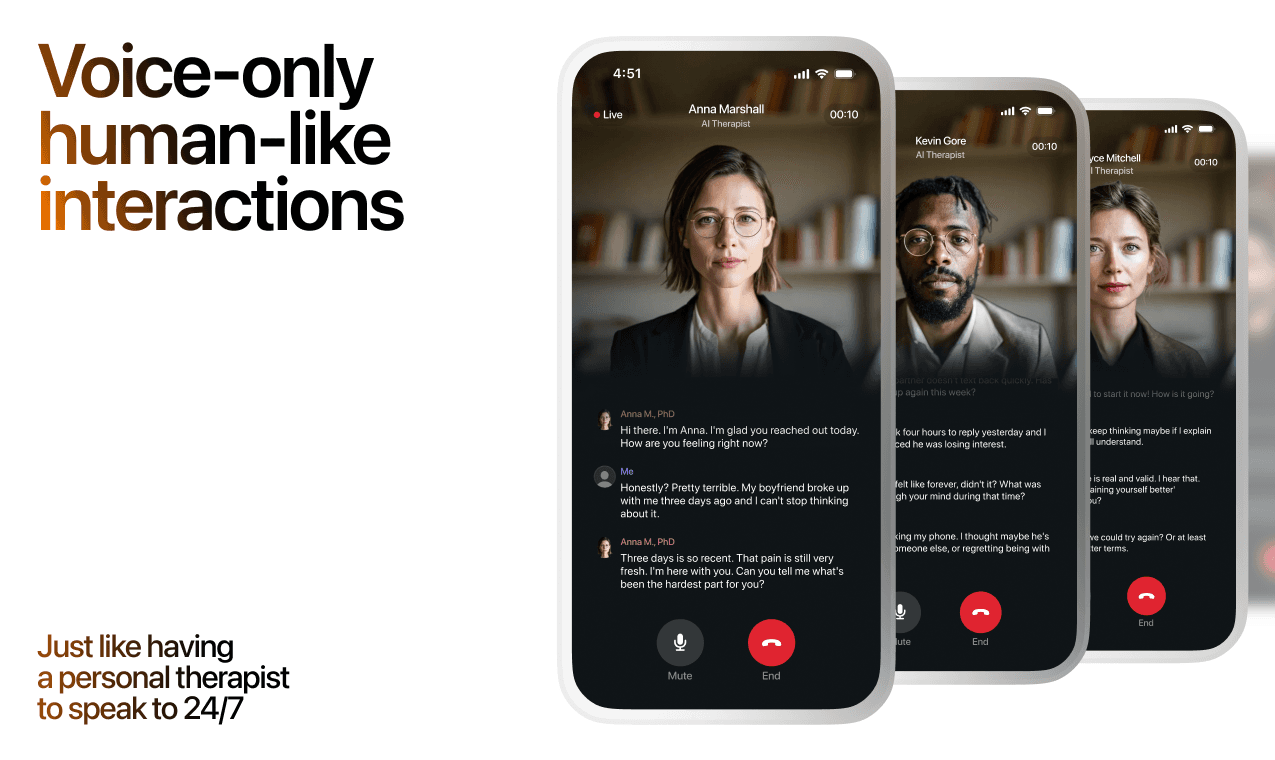
Here's what happens in a typical Lovon session:
You share what's on your mind
There's no script, no intake form, no waiting room. You speak or type whatever you're feeling — in your own words, at your own pace.
Lovon validates and explores
Using frameworks from CBT (Cognitive Behavioral Therapy) and motivational interviewing, Lovon acknowledges your feelings first, then gently helps you explore them. No dismissive "just move on" advice.
You build coping skills together
Lovon doesn't just listen — it actively works with you on evidence-based techniques: thought reframing, urge surfing, behavioral experiments, and more.
What a Session with Lovon Looks Like
When to Seek Professional Help
AI support is a valuable tool, but it's not a replacement for professional care. Please consider reaching out to a licensed therapist if you experience any of the following:
- Persistent thoughts of self-harm or suicide
- Inability to perform daily activities (work, eating, sleeping) for more than 2 weeks
- Turning to alcohol or substances to cope
- Intense anger or desire to harm your ex-partner
- Complete emotional numbness that doesn't improve over time
Crisis Resources (US): If you're in immediate danger, call 988 (Suicide & Crisis Lifeline) or text HOME to 741741 (Crisis Text Line). Available 24/7, free, and confidential.
Outside the US? Find a crisis line in your country
Ready to Start?
Your healing journey can begin right now
A 7-day trial. No judgment. Just a safe space to process what you're going through.
Frequently Asked Questions
Is Lovon a replacement for a real therapist?
Is my conversation with Lovon AI private?
How is Lovon different from ChatGPT for emotional support?
Can I use Lovon if I'm already seeing a therapist?
Can I try Lovon before subscribing?
About the Author
The Lovon Editorial Team
Mental Health & Wellness Content Team
The Lovon Editorial Team develops mental health and wellness content designed to make psychological concepts accessible and actionable. Our goal is to bridge the gap between clinical research and everyday life - helping you understand why your mind works the way it does and what you can do about it....
Related articles
- AI Coping Tools for Panic Attacks While Driving (2026)
The best AI coping tools for panic attacks while driving in 2026 — hands-free grounding, breathing cues, and voice AI…
- How to Stop Overthinking After an Argument (2026)
Stop overthinking after an argument with 7 steps that interrupt rumination fast. Includes troubleshooting for 3am…
- Can You Pass Out from a Panic Attack? (2026)
Can you pass out from a panic attack? Almost never — learn the real biology, why dizziness happens, and 7 steps to…
- Nervous System Dysregulation: Signs & Reset Guide 2026
Nervous system dysregulation signs and a 7-step reset for 2026, plus troubleshooting for panic, freeze, and sleep…
See also
Quizzes
- Fear of Intimacy Test: Free 12-Question Self-Check
See which part of closeness feels risky, in 3 min.
- Am I a People Pleaser? 12-Question Quiz
Where kindness stops and self-erasure starts.
Free tools
- Words of Encouragement for Him When He Is Struggling
Words of encouragement for him that fit what he is actually going through, for when your usual lines are not landing…
- 5-4-3-2-1 Grounding Exercise
A guided run through the 5-4-3-2-1 technique, with paced breathing first if you need it. No sign-up, nothing stored…
From the wiki
- What is inhibited grief?
Inhibited grief is grief that never gets out. The loss happened, you kept functioning, and the feeling stayed sealed…
Disclaimer: This article is for informational purposes only and does not constitute medical advice, diagnosis, or treatment. Always seek the advice of your physician or other qualified health provider with any questions you may have regarding a medical condition. If you are in crisis or think you may have an emergency, call 988 (Suicide & Crisis Lifeline) or go to the nearest emergency room. Outside the US? Find a crisis line in your country.