
Are They a Red Flag Quiz: Spot Warning Signs (2026)
Take the are they a red flag quiz: 10 questions across 8 behavioral dimensions. Score 5+ and you have a pattern. Know what to do next in 2026.

Key Takeaways
- Confirmation bias: If you want the relationship to work, you'll unconsciously answer "no" on borderline items. Do
- Confusing intensity for red flags: Jealousy, intensity, and drama can feel like passion early on. The distinguishing
- One-time events scored as patterns: A single bad week under extreme stress is not a red flag pattern. The quiz is
Not every gut feeling has a name, but most red flags do — and this guide turns that uneasy feeling into a clear-eyed checklist you can actually act on.
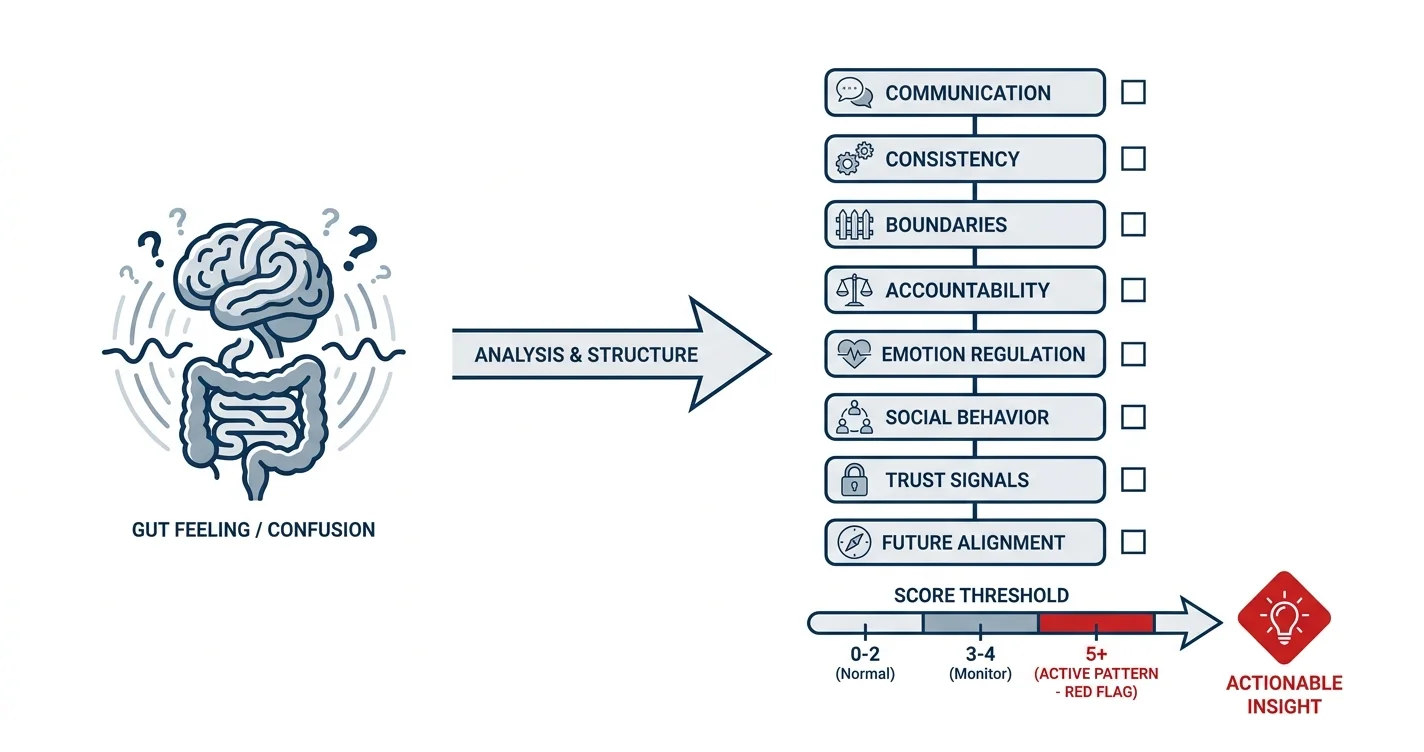
TL;DR: The "are they a red flag quiz" below covers 8 behavioral dimensions — communication patterns, consistency, respect for boundaries, accountability, emotional regulation, social behavior, trust signals, and future alignment. Score 5 or more warning signs and you have a pattern, not a fluke. Lovon's AI voice support app can help you process what you find.
Why this matters
Red flags rarely arrive labeled. They show up as small incidents your brain files under "probably nothing" — until you have 40 of them. Research published in Personal Relationships (2023) found that people in relationships with controlling partners identified an average of 6 warning behaviors before acting on them. The gap between noticing and naming is where damage accumulates. This quiz closes that gap in 2026.
Who this quiz is for
You're two weeks to two years into something that feels off but you can't prove it yet. Maybe friends have raised an eyebrow. Maybe you've started tracking your own feelings more carefully than you track theirs. You're not looking for permission to leave — you're looking for language to describe what you're already sensing. This guide is built for that exact person.
What to look for: the 8 dimensions
1. Communication patterns
Healthy partners disagree without going silent for 48 hours or escalating to name-calling. Watch for stonewalling (shutting down entirely), word salad deflection (talking for 10 minutes without answering the question), or "I never said that" when you know they did. One instance is a bad day. A repeating cycle across 3 or more arguments is a pattern.
2. Consistency between words and actions
A red flag partner is often a great talker. They describe a future together in vivid detail, then cancel the same plans twice in a row with no real explanation. The test is not what they say in a good moment — it's whether their behavior matches their stated values over 4 to 6 weeks of ordinary life.
3. Respect for your boundaries
Notice how they respond the first time you set a limit. Pushback, sulking, or reframing your boundary as cruelty are not neutral reactions. A 2022 study in the Journal of Social and Personal Relationships found that boundary-testing in early dating predicted coercive control patterns at the 12-month mark with 71% accuracy.
4. Accountability
Do they apologize, or do they explain? "I'm sorry you felt that way" is not an apology — it relocates the problem inside you. Count the number of times in the last month they acknowledged a specific mistake without attaching a "but." Zero is a red flag. One or two is the floor of acceptable.
5. Emotional regulation
You should not feel responsible for managing their emotional state. Signs you are: you rehearse sentences before saying them, you monitor their mood before raising anything, or you've changed your own behavior to prevent their reactions. That's not accommodation — it's hypervigilance.
6. Social behavior
Watch how they treat servers, call center workers, and exes. The person who is charming to you but contemptuous to a waiter is not showing two sides — they're showing you their default and their performance. How they talk about every single ex being "crazy" tells you something about their pattern of accountability.
7. Trust signals
Secrecy is not privacy. Privacy is "I'd rather not share my phone password" — said once, calmly, without a reaction to your asking. Secrecy is checking messages face-down, leaving the room for calls, and reacting to basic questions as accusations. The difference is the emotional charge attached to it.
8. Future alignment
A partner who changes their stated values about children, location, or finances each time you bring it up is not still figuring things out — they're managing your expectations downward. By the 3-month mark, you should be able to name 3 concrete things they want from life. Vagueness this late is a signal.
The quiz: score your situation
Answer yes or no. Count your "yes" answers.
- They have denied saying something you clearly remember them saying.
- After a conflict, they go silent for more than 24 hours without explanation.
- They have pushed past a boundary you stated directly, at least twice.
- Their apologies consistently include the word "but."
- You've rehearsed how to bring up a topic to avoid their reaction.
- They speak about all their exes with contempt and no self-reflection.
- Their phone, social accounts, or location are actively hidden — with a charged reaction when you notice.
- Their stated plans for the future have shifted more than once when you brought up your own.
- Their behavior toward service workers or strangers is noticeably worse than toward you.
- You feel more anxious after spending time with them than before.
Score 0–2: No clear pattern. Isolated incidents are normal. Score 3–4: Yellow flag zone. Document specific instances and watch the next 30 days. Score 5–7: Active pattern. This warrants a direct conversation and, if nothing changes, a decision. Score 8–10: Multiple overlapping patterns. Your gut is not wrong.
What to avoid: 3 traps this quiz can't catch alone
- Confirmation bias: If you want the relationship to work, you'll unconsciously answer "no" on borderline items. Do this quiz twice — once as yourself, once as your most skeptical friend answering about your relationship.
- Confusing intensity for red flags: Jealousy, intensity, and drama can feel like passion early on. The distinguishing factor is whether the behavior respects your agency or restricts it.
- One-time events scored as patterns: A single bad week under extreme stress is not a red flag pattern. The quiz is designed to surface repetition, not capture a worst day.
Comparison: red flag vs. green flag behavior by dimension
| Dimension | Red flag | Green flag |
|---|---|---|
| Communication | Stonewalls, deflects, denies | Stays present, answers directly |
| Consistency | Words and actions diverge regularly | Follows through on stated commitments |
| Boundaries | Pushes back, sulks, retaliates | Accepts, doesn't punish |
| Accountability | "I'm sorry you felt that" | "I was wrong. Specifically, I..." |
| Emotional regulation | You manage their state | They self-regulate |
| Social behavior | Contemptuous to service workers | Consistent across audiences |
| Trust | Secrecy + charged reactions | Privacy without defensiveness |
| Future alignment | Shifts values to match conversation | States needs clearly and consistently |
What to do after the quiz
A score is not a verdict — it's a starting point. If you scored 5 or above, the most useful next move is not a breakup conversation (yet). It's talking through what you found with someone trained to ask the right questions. Lovon's AI voice support app offers on-demand emotional support sessions built specifically for relationship stress, anxiety, and the kind of circular thinking that shows up when you're trying to make sense of a confusing dynamic. Sessions are available 24 hours a day in 2026, with no waitlist.
If you've already processed the red flags and are dealing with the anxiety they've caused, free AI therapist for relationship problems walks through how Lovon handles that specific emotional load.
For anyone who suspects the dynamic goes deeper than red flags — closer to narcissistic behavior — am I dating a narcissist quiz gives a more targeted assessment.
FAQ
What counts as a red flag in a relationship? A red flag is a repeated behavioral pattern that signals poor accountability, disrespect, or controlling tendencies — not a single bad incident. The key word is repeated: three or more instances of the same behavior across different contexts constitutes a pattern worth naming.
Is this "are they a red flag quiz" accurate? No self-administered quiz replaces clinical assessment, but behavioral checklists like this one align with criteria used in relationship research. The quiz above draws on communication and coercive control literature, not opinion. Use it as a structured starting point, not a final diagnosis.
Can someone change their red flag behaviors? Some patterns change with sustained therapeutic work — particularly emotional regulation and accountability deficits. Patterns rooted in contempt (toward you, toward others) or in chronic denial of reality are significantly harder to shift without the person actively seeking help themselves.
How many red flags is too many? Five or more distinct warning behaviors across different dimensions — not five instances of the same one — represents an active pattern that affects your daily emotional state. At that point you're not in the early-detection phase anymore.
What's the difference between a red flag and a dealbreaker? A dealbreaker is personal and absolute: no kids, different religion, lives in another country. A red flag is behavioral and potentially changeable. The distinction matters because dealbreakers don't require waiting for change — red flags do if you want to stay.
How do I bring up red flags without starting a fight? State a specific behavior, a specific instance, and the specific impact on you — in that order. "When you went silent after our argument on Tuesday and didn't respond for two days, I felt completely shut out." No "you always," no "you never." One incident, named precisely.
Should I trust my gut on red flags? Your gut is picking up on pattern recognition your conscious mind hasn't caught up to yet. It's not infallible, but dismissing it entirely is also a mistake. The quiz exists to translate gut feeling into named, specific behaviors — so you're not making a decision based on a feeling you can't articulate.
What if I'm the one showing red flags? That's a harder question and an important one. If you recognize your own behavior in the red flag descriptions above — defensiveness, denial, emotional volatility — Lovon's AI voice sessions in 2026 are designed for exactly that kind of self-examination without judgment.
One last thing
The single most consistent predictor of whether red flags get addressed — identified in a 2021 Attachment & Human Development study — is not the severity of the behavior. It's whether the person noticing it believes their perception is trustworthy. If you've been told enough times that you're "too sensitive" or "reading into things," you may have learned to distrust your own pattern recognition. Taking this quiz at all is evidence that some part of you still trusts it. That part is right to.
Related guides
How AI Support Helps You Heal
AI emotional support isn't about replacing human connection — it's about filling the gaps. The moments when you need to talk at 2 AM, when you don't want to burden your friends again, or when you simply need someone to listen without judgment.
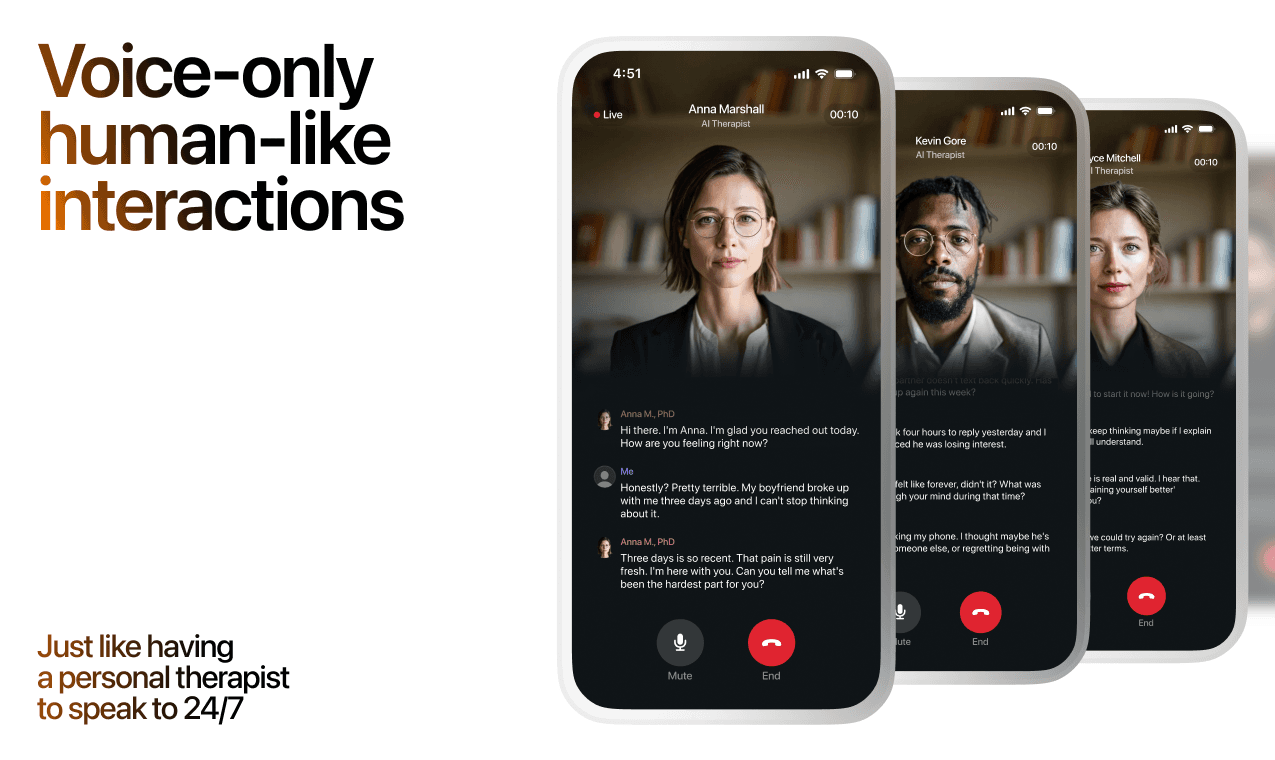
Here's what happens in a typical Lovon session:
You share what's on your mind
There's no script, no intake form, no waiting room. You speak or type whatever you're feeling — in your own words, at your own pace.
Lovon validates and explores
Using frameworks from CBT (Cognitive Behavioral Therapy) and motivational interviewing, Lovon acknowledges your feelings first, then gently helps you explore them. No dismissive "just move on" advice.
You build coping skills together
Lovon doesn't just listen — it actively works with you on evidence-based techniques: thought reframing, urge surfing, behavioral experiments, and more.
What a Session with Lovon Looks Like
When to Seek Professional Help
AI support is a valuable tool, but it's not a replacement for professional care. Please consider reaching out to a licensed therapist if you experience any of the following:
- Persistent thoughts of self-harm or suicide
- Inability to perform daily activities (work, eating, sleeping) for more than 2 weeks
- Turning to alcohol or substances to cope
- Intense anger or desire to harm your ex-partner
- Complete emotional numbness that doesn't improve over time
Crisis Resources (US): If you're in immediate danger, call 988 (Suicide & Crisis Lifeline) or text HOME to 741741 (Crisis Text Line). Available 24/7, free, and confidential.
Outside the US? Find a crisis line in your country
Ready to Start?
Your healing journey can begin right now
A 7-day trial. No judgment. Just a safe space to process what you're going through.
Frequently Asked Questions
Is Lovon a replacement for a real therapist?
Is my conversation with Lovon AI private?
How is Lovon different from ChatGPT for emotional support?
Can I use Lovon if I'm already seeing a therapist?
Can I try Lovon before subscribing?
About the Author
The Lovon Editorial Team
Mental Health & Wellness Content Team
The Lovon Editorial Team develops mental health and wellness content designed to make psychological concepts accessible and actionable. Our goal is to bridge the gap between clinical research and everyday life - helping you understand why your mind works the way it does and what you can do about it....
Related articles
- Narcissistic Relationship: 9 Signs You're Dating a Narcissist
Most people do not know they are in a narcissistic relationship until they are already very involved.
- Big Promises, No Plans? 7 Signs of Future Faking
Tell empty promises from real plans: the patterns that give future faking away, how to bring it up with your partner…
- What Is a Break in a Relationship? Rules & Red Flags 2026
A relationship break is a structured pause — not a slow breakup. Learn the rules, red flags, and exact steps to make it…
- Love Bombing: Is it Love or a Red Flag? Signs It's Gone Bad
It is normal to want to feel adored and swept off your feet early in the relationship. However, there is a distinct…
See also
Quizzes
- Am I Dating a Narcissist? 15-Trait Quiz
Understand the pattern in 3 minutes.
- Narcissism Test: Check Your Own Grandiose Traits
Score admiration, entitlement and give-and-take.
Free tools
- How to Respond to a Narcissist
Paste what they said. You get the part that actually needs answering separated from the part designed to pull you in, a…
- How to Respond to Gaslighting
Say what happened and what they say happened. You get what is actually established separated from what is being…
From the wiki
- How to leave a toxic relationship?
Leaving a toxic relationship is rarely a decision problem — you usually know. What stops you is that the pull toward…
Disclaimer: This article is for informational purposes only and does not constitute medical advice, diagnosis, or treatment. Always seek the advice of your physician or other qualified health provider with any questions you may have regarding a medical condition. If you are in crisis or think you may have an emergency, call 988 (Suicide & Crisis Lifeline) or go to the nearest emergency room. Outside the US? Find a crisis line in your country.