
Avoidant Attachment Style: Patterns & How to Change (2026)
Avoidant attachment style affects 1 in 4 adults. Learn the 7-step process to identify your patterns and build earned secure attachment in 2026.

Key Takeaways
- Honest self-observation over at least 2–3 weeks
- A journal or notes app for trigger tracking
- Willingness to tolerate 60–90 seconds of discomfort during vulnerability experiments
- Access to a therapist, AI support tool, or both
- A basic understanding of your specific avoidant subtype (dismissive vs. fearful-avoidant — they differ)
Avoidant attachment style shapes how you handle closeness, conflict, and emotional need — and in 2026, it remains one of the most researched and most misunderstood attachment patterns in adult relationships.
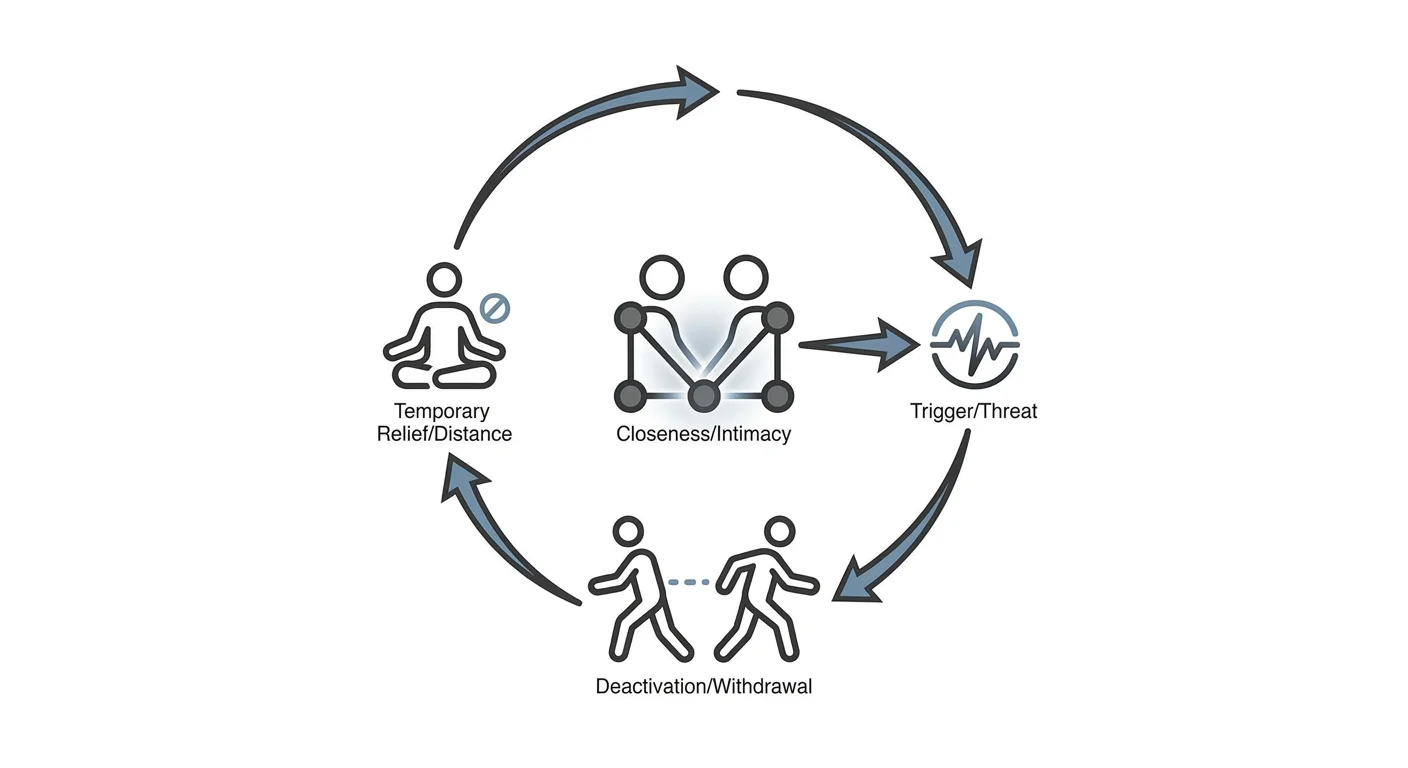
TL;DR: Avoidant attachment style is a learned emotional strategy where closeness triggers withdrawal rather than comfort. People with this pattern suppress needs, struggle to ask for help, and often feel smothered before a partner feels close. It is not permanent. Evidence-based steps — identifying your triggers, practicing graduated vulnerability, and working through the underlying beliefs — produce measurable change. AI-powered tools like Lovon can support that process between therapy sessions, on demand.
Why this matters in 2026
Attachment theory was formalized by John Bowlby in the 1960s and extended to adult relationships by Hazan and Shaver in 1987. The research base is now massive: roughly 25% of adults show dismissive-avoidant attachment patterns, according to aggregated adult attachment studies. That is 1 in 4 people running a relationship script that pushes partners away at the exact moment intimacy becomes real. The cost shows up in higher relationship dissolution rates, lower self-reported relationship satisfaction, and greater emotional suppression — all of which are well-documented in the literature.
Understanding the pattern is step one. Changing it requires a structured approach.
What you'll need
- Honest self-observation over at least 2–3 weeks
- A journal or notes app for trigger tracking
- Willingness to tolerate 60–90 seconds of discomfort during vulnerability experiments
- Access to a therapist, AI support tool, or both
- A basic understanding of your specific avoidant subtype (dismissive vs. fearful-avoidant — they differ)
The steps
Step 1: Name your specific pattern
Not all avoidant attachment looks the same. Dismissive-avoidant people suppress emotional needs and pride themselves on self-sufficiency. Fearful-avoidant people want closeness but fear being hurt — they swing between approach and withdrawal. Before you can change the pattern, you need to know which one you are running.
Spend one week noticing what happens internally when a partner tries to get closer: do you feel irritated and pull back, or do you feel pulled in and then suddenly terrified? Write that down. The distinction matters because the intervention in Step 4 differs between the two subtypes.
Common mistake: Assuming you are "just an introvert." Introversion is about energy; avoidant attachment is about safety. You can be extroverted and deeply avoidant.
Step 2: Map your deactivating strategies
Deactivating strategies are the specific behaviors you use — often automatically — to reduce intimacy when it spikes. Common ones include:
- Mentally listing your partner's flaws when you feel too close
- Going emotionally flat in arguments rather than engaging
- Picking fights before trips or milestones to create distance
- Becoming absorbed in work or hobbies when a relationship deepens
- Delaying replies to texts for hours when conversations get emotional
Write out your personal list. Research by Fraley and Shaver (1997) showed that avoidant individuals suppress emotional responses at a physiological level — meaning you may not even consciously notice the strategy until you look for it. Two weeks of journaling reveals patterns that a single therapy session can miss.
Expected outcome: A list of 3–6 recurring behaviors that function as your distance-creating toolkit.
Step 3: Trace each strategy to its original function
Avoidant attachment almost always developed because closeness was at some point unsafe, unpredictable, or met with emotional unavailability. The strategies in Step 2 were solutions before they became problems.
For each behavior on your list, ask: "When was the first time I needed to do this?" You are not looking for a dramatic origin story. Often it is as simple as learning that needing things made a parent uncomfortable, so you stopped needing things out loud.
This step is where professional support — whether a licensed therapist or a tool like Lovon's AI relationship coach for avoidant partners — meaningfully accelerates progress. Having a space to say these things without fear of judgment from a partner mirrors the exact corrective experience avoidant attachment needs.
Common mistake: Intellectualizing instead of feeling. You can explain your childhood perfectly and still not process it. The goal is to feel the original need, not just narrate it.
Step 4: Practice graduated vulnerability
This is the core behavioral intervention. Graduated vulnerability means sharing something emotionally real in a low-stakes context, tolerating the discomfort, and observing that nothing catastrophic happens. You expand the window 10% at a time — not all at once.
Start small:
- Tell a friend you are stressed about something specific (not vague)
- Text a partner "I missed you today" without immediately following it with a joke
- Say "I don't know" instead of projecting confidence in an emotionally charged moment
The 60–90 second rule applies here: most acute anxiety from vulnerability peaks within 90 seconds if you do not act on the urge to withdraw. Ride it out. In 2026, apps that offer voice-based emotional support can provide a zero-judgment rehearsal space before you try these disclosures with real people.
Expected outcome: After 3–4 weeks of daily small disclosures, most people report reduced anticipatory anxiety around intimacy — not zero, but measurably lower.
Step 5: Rewire the beliefs underneath the behavior
Avoidant attachment runs on 3–4 core beliefs: "I am fine alone," "needing others is weakness," "people will eventually disappoint me," "closeness means losing myself." Behavior change without belief work produces fragile results — you stop withdrawing but feel miserable doing it.
Evidence-based approaches for belief work include:
- Cognitive restructuring: Challenge the belief with specific counterexamples from your own life
- Schema therapy: Identifies the "emotional deprivation" or "defectiveness" schemas common in avoidant patterns
- Somatic work: Attends to where avoidance lives in the body — common sites are the chest, throat, and jaw
This step usually requires 8–12 weeks of consistent practice. Progress is not linear. A missed week is not a reset.
Common mistake: Expecting the beliefs to feel wrong before you act against them. They will not. Act first; the felt sense changes after, not before.
Step 6: Build a consistent repair habit
When avoidant withdrawal damages a relationship moment — and it will, even mid-change — repair speed matters. Research by John Gottman's institute identifies repair attempts as the single strongest predictor of relationship stability, more than conflict frequency or intensity.
A repair does not have to be elaborate. "I shut down earlier. I know that landed badly. I am still learning to stay" is enough. The repair has three parts: acknowledgment, impact, and intent. Practice the structure until it becomes automatic.
Expected outcome: Partners report feeling significantly more secure when repair happens within 24 hours versus days later. The content of the repair matters less than the timing.
Step 7: Track change, not perfection
Avoidant attachment style changes slowly and non-linearly over months, not weeks. Set a 90-day benchmark: at day 90, compare your deactivating strategy list from Step 2 with what you actually did over the prior 2 weeks. Most people find 1–3 strategies have significantly reduced in frequency even if the underlying anxiety is still present.
If self-tracking feels overwhelming, tools like Lovon's free AI therapist for relationship problems offer structured check-ins that prompt reflection without requiring you to build the framework yourself.
Troubleshooting
"I understand my avoidance completely but nothing changes." Insight without behavioral practice does not produce change. Understanding is necessary but not sufficient. Return to Step 4 and make sure you are doing at least one small vulnerability act per day, not just thinking about it.
"My partner says I am trying but they still do not feel close to me." Avoidant change is often invisible to partners for the first 6–8 weeks because the internal shifts precede external behavior changes. Have an explicit conversation about what "close" looks like behaviorally to your partner — they probably have a specific need you are guessing at.
"I tried being vulnerable and it backfired badly." One bad experience is data, not proof. Review the disclosure: was it graduated (small, low-stakes) or did you skip to high-disclosure too fast? Avoidant people often over-correct and share too much too soon when they finally decide to be vulnerable, which triggers a different problem.
"I am avoidant but my partner is anxiously attached. Every conversation becomes an argument." Anxious-avoidant pairings are extremely common and create a pursuit-withdrawal cycle that accelerates with conflict. Both partners need to work their own pattern simultaneously. Couple-level tools — including an attachment style compatibility quiz for partners — can surface the dynamic clearly before sessions with a professional.
"I do not feel avoidant in all relationships, only romantic ones." Correct — attachment patterns are relationship-context-specific. You can be securely attached to friends and dismissive-avoidant with romantic partners. This is normal and does not mean you are broken; it means the stakes in romantic attachment activated a different internal model.
"I have been working on this for months and feel worse." This is common in the middle phase of change. You are now aware of patterns you were previously numb to, which temporarily increases distress. If it persists past 3 months with no reduction, escalate to a licensed therapist — this is the threshold where AI support tools are supplements, not replacements.
Tools and resources
- A physical or digital journal for trigger tracking (Steps 1–2)
- Adult Attachment Interview or ECR-R scale for formal assessment (publicly available)
- John Gottman's repair attempt research — freely cited in The Seven Principles for Making Marriage Work (2000)
- Lovon — AI-powered voice support for on-demand support between sessions, particularly useful for rehearsing disclosures before real-world attempts
- A licensed therapist specializing in attachment or schema therapy for Step 5 belief work
What to do next
If the anxious-avoidant dynamic is your primary relationship challenge, the next layer is understanding how your pattern interacts with your partner's. An AI-guided relationship coach can walk through that dynamic in real time.
FAQ
What is avoidant attachment style? Avoidant attachment style is a pattern where emotional closeness triggers withdrawal rather than comfort. People with this pattern learned early that depending on others was unsafe, so they suppressed attachment needs. In adult relationships, this shows up as emotional distance, discomfort with vulnerability, and deactivating strategies that create space when intimacy increases.
Can avoidant attachment style be changed? Yes. It is not a fixed personality trait. Research on attachment in adulthood consistently shows that earned secure attachment is achievable through consistent behavioral practice, belief work, and corrective relational experiences. Most people see measurable change within 3–6 months of active work.
What triggers avoidant attachment? Common triggers include a partner expressing emotional need, conflict with no clear resolution, milestones that increase commitment, physical closeness after emotional distance, and perceived criticism. Individual triggers vary — mapping yours specifically (Step 2) matters more than the general list.
Is avoidant attachment style the same as being introverted? No. Introversion is about energy preference; avoidant attachment is about emotional safety. An extroverted person can have a strong avoidant attachment style. The distinction is whether you pull back from closeness because you prefer alone time or because intimacy feels threatening.
How does avoidant attachment affect relationships? It typically creates a pursuit-withdrawal dynamic, especially with anxiously attached partners. The avoidant person withdraws as the anxious partner pursues, which increases the anxious partner's pursuit — accelerating both patterns. Relationship satisfaction drops for both partners. Studies consistently link avoidant attachment to lower relationship quality and higher dissolution rates.
What is the difference between dismissive-avoidant and fearful-avoidant? Dismissive-avoidant people suppress attachment needs and maintain a positive self-view paired with a negative view of others' reliability. Fearful-avoidant people (also called disorganized) want closeness but expect pain from it — they show more volatility and often have trauma histories. The intervention differs: dismissive patterns respond well to graduated vulnerability; fearful-avoidant patterns often require trauma-informed approaches first.
How long does it take to change avoidant attachment style? Most structured change programs show measurable shifts in 3–6 months. Full movement toward earned secure attachment typically takes 1–2 years of consistent work. The 90-day benchmark in Step 7 is a realistic early checkpoint, not a finish line.
Can an AI therapy app help with avoidant attachment? AI tools work well for specific, bounded tasks: trigger journaling, rehearsing vulnerability disclosures, processing a single incident, or maintaining consistency between therapy sessions. They are not a substitute for human therapeutic relationships — which, ironically, are part of what creates change in avoidant patterns. Use both when possible.
One last thing
Researchers at the University of California, Davis found in a 2012 longitudinal study that people with avoidant attachment who entered relationships with securely attached partners shifted measurably toward security over 1–2 years — even without formal therapy. The relationship itself was the intervention. That does not mean you wait for the right partner to fix you. It means who you practice being vulnerable with matters as much as what technique you use.
How AI Support Helps You Heal
AI emotional support isn't about replacing human connection — it's about filling the gaps. The moments when you need to talk at 2 AM, when you don't want to burden your friends again, or when you simply need someone to listen without judgment.
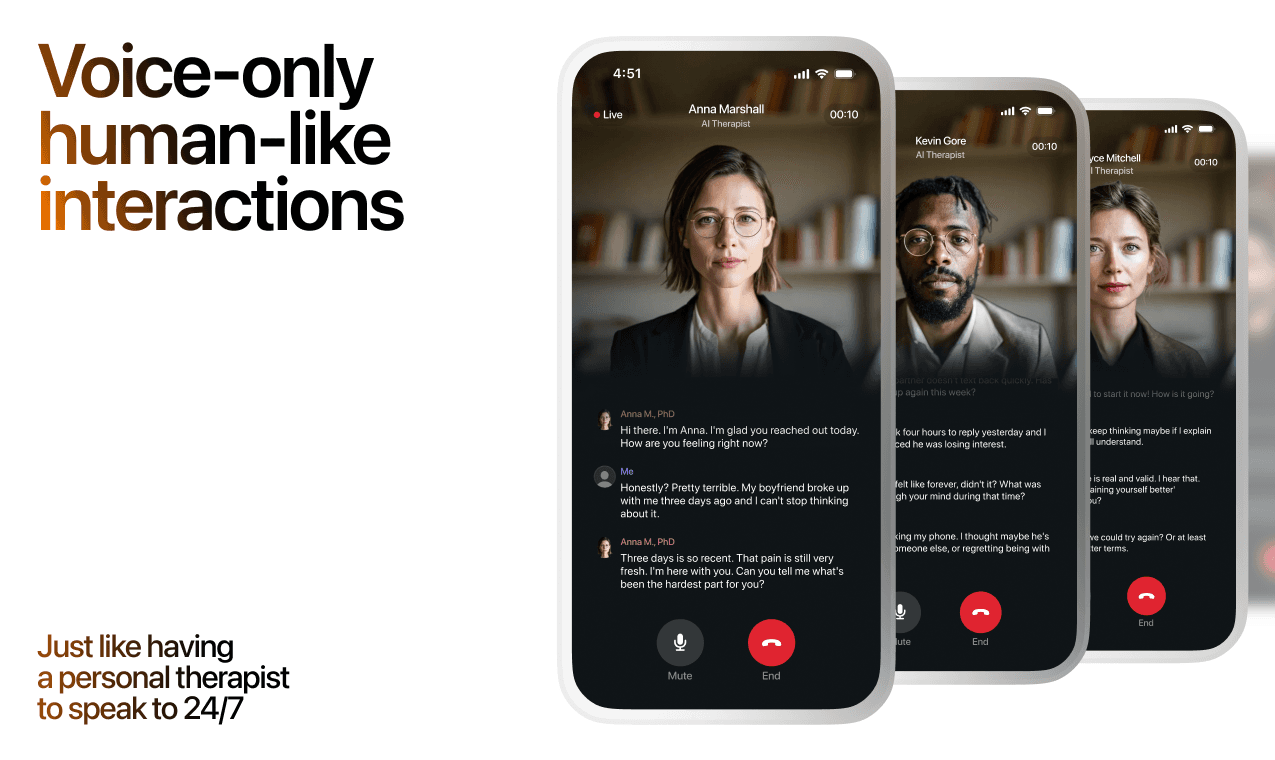
Here's what happens in a typical Lovon session:
You share what's on your mind
There's no script, no intake form, no waiting room. You speak or type whatever you're feeling — in your own words, at your own pace.
Lovon validates and explores
Using frameworks from CBT (Cognitive Behavioral Therapy) and motivational interviewing, Lovon acknowledges your feelings first, then gently helps you explore them. No dismissive "just move on" advice.
You build coping skills together
Lovon doesn't just listen — it actively works with you on evidence-based techniques: thought reframing, urge surfing, behavioral experiments, and more.
What a Session with Lovon Looks Like
When to Seek Professional Help
AI support is a valuable tool, but it's not a replacement for professional care. Please consider reaching out to a licensed therapist if you experience any of the following:
- Persistent thoughts of self-harm or suicide
- Inability to perform daily activities (work, eating, sleeping) for more than 2 weeks
- Turning to alcohol or substances to cope
- Intense anger or desire to harm your ex-partner
- Complete emotional numbness that doesn't improve over time
Crisis Resources (US): If you're in immediate danger, call 988 (Suicide & Crisis Lifeline) or text HOME to 741741 (Crisis Text Line). Available 24/7, free, and confidential.
Outside the US? Find a crisis line in your country
Ready to Start?
Your healing journey can begin right now
A 7-day trial. No judgment. Just a safe space to process what you're going through.
Frequently Asked Questions
Is Lovon a replacement for a real therapist?
Is my conversation with Lovon AI private?
How is Lovon different from ChatGPT for emotional support?
Can I use Lovon if I'm already seeing a therapist?
Can I try Lovon before subscribing?
About the Author
The Lovon Editorial Team
Mental Health & Wellness Content Team
The Lovon Editorial Team develops mental health and wellness content designed to make psychological concepts accessible and actionable. Our goal is to bridge the gap between clinical research and everyday life - helping you understand why your mind works the way it does and what you can do about it....
Related articles
- Disorganized Attachment Style: Causes & Recovery 2026
Disorganized attachment style causes constant push-pull in relationships. Learn what drives it, 6 evidence-based…
- Why Your Partner Shuts Down When You Ask for Reassurance
The shutdown is not rejection. See what avoidant attachment does to a request for closeness, how to ask so it lands, and…
- Fearful Avoidant Attachment: Triggers & Healing (2026)
Fearful avoidant attachment explained: the 4 trigger categories, a 90-second distress protocol, and a 6-step healing…
- Best AI Relationship Coach for Anxious Attachment 2026
Find the best AI relationship coach for anxious attachment in 2026. Lovon offers voice-based, on-demand emotional…
See also
Quizzes
- Fear of Intimacy Test: Free 12-Question Self-Check
See which part of closeness feels risky, in 3 min.
- Am I Sabotaging My Relationship? 12-Question Quiz
Find the move you reach for, in 2 minutes.
Free tools
- How to Stop Overthinking in a Relationship
Not a list of habits. Tell it the specific thing you are going round on, and it separates what actually happened from…
- How to Reassure Your Partner (and When It Stops Helping)
A chat for working out how to reassure your partner when the same worry keeps coming back. Say what sets it off and how…
From the wiki
- What is an attachment style?
An attachment style is the habit your nervous system formed for handling closeness: what you actually do when someone…
Disclaimer: This article is for informational purposes only and does not constitute medical advice, diagnosis, or treatment. Always seek the advice of your physician or other qualified health provider with any questions you may have regarding a medical condition. If you are in crisis or think you may have an emergency, call 988 (Suicide & Crisis Lifeline) or go to the nearest emergency room. Outside the US? Find a crisis line in your country.