
Conditional vs Unconditional Love: Key Differences 2026
Conditional love vs unconditional love explained clearly — what each looks like in real relationships, how conditionality harms mental health, and steps to shift the pattern.

Key Takeaways
- A quiet 20–30 minutes without interruption
- A journal or notes app for written reflection
- Honesty about at least one relationship — past or present — that felt emotionally uncertain
- Willingness to sit with discomfort without immediately fixing it
- Affection increases after achievements and decreases after failures
Understanding the difference between conditional love vs unconditional love can change how you see every close relationship in your life — romantic, parental, or otherwise. This guide breaks down what each type actually looks like in practice, why the distinction matters for your mental health, and what to do if you recognize an unhealthy pattern in your own relationships.
TL;DR: Conditional love is affection tied to performance, behavior, or meeting specific expectations — withdraw the conditions and the love fades. Unconditional love stays present regardless of mistakes, failures, or change. Most real-world relationships in 2026 contain both, but a heavy tilt toward conditionality — especially in childhood or romantic partnerships — is linked to anxiety, low self-worth, and difficulty trusting others. Knowing which pattern dominates yours is the first step to changing it.
Why this matters
Love is rarely labeled. Nobody sits you down and says, "I will love you only if you succeed." The conditions are usually unspoken — a withdrawal of warmth when you disappoint, praise that only lands when you perform. That subtlety is exactly why so many people carry wounds they cannot name. Research on attachment and emotional development consistently shows that early experiences of conditional versus unconditional regard shape how we relate to others well into adulthood. In 2026, with loneliness and anxiety at record levels across the U.S., understanding this distinction is not a luxury — it is practical mental health literacy.
What you'll need
Before working through the steps below, gather a few things:
- A quiet 20–30 minutes without interruption
- A journal or notes app for written reflection
- Honesty about at least one relationship — past or present — that felt emotionally uncertain
- Willingness to sit with discomfort without immediately fixing it
If any of these steps surface strong emotions, that is normal. Lovon's AI voice support is available anytime as an on-demand space to talk through what comes up.
The steps
Step 1: Define the two patterns clearly
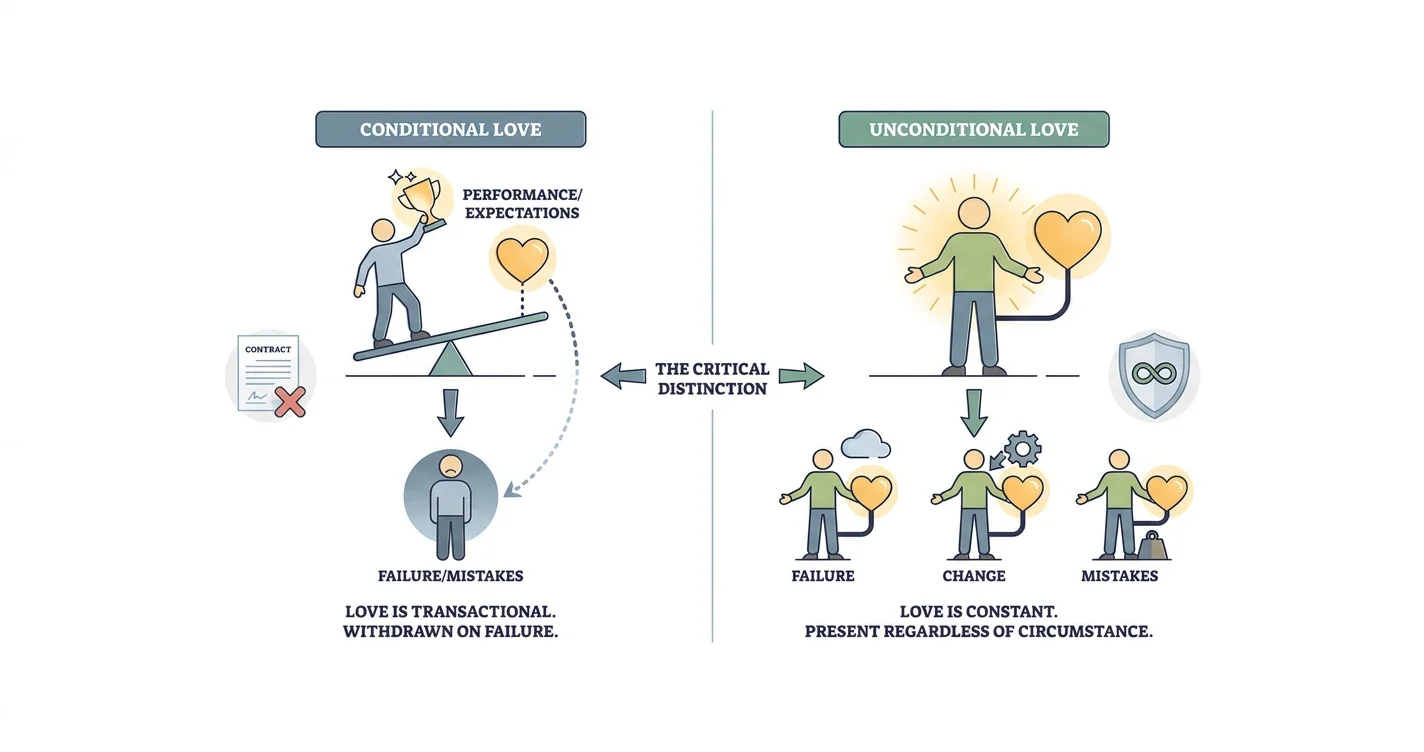
Conditional love operates on an implied contract: "I love you because you are kind, successful, agreeable, or useful to me." When those qualities disappear, the love either shrinks or becomes punishing. Unconditional love operates from a different baseline: "I love you as a person, separate from what you do or provide."
The distinction sounds clean, but lived experience blurs it. A parent who says "I'm so proud of you" only after an A grade, and goes quiet after a C, is practicing conditional love — even if they never intend harm. Write down one specific memory where affection in your life felt tied to behavior. That memory is your anchor for the rest of this process.
Common mistake: Confusing unconditional love with unconditional tolerance. Unconditional love does not mean accepting abuse, cruelty, or repeated harm. You can love someone without conditions and still hold a firm boundary.
Step 2: Spot the specific signals of conditional love
Conditional love shows up in recognizable patterns. Check which of these feel familiar:
- Affection increases after achievements and decreases after failures
- You feel loved when you agree and anxious when you disagree
- Compliments arrive only when you look, act, or perform a certain way
- The relationship feels safe only when you are at your best
- Withdrawal of warmth is used — consciously or not — as punishment
- You suppress your real feelings to maintain the other person's approval
If 3 or more of these fit a key relationship, conditionality is the dominant pattern. That is not a judgment — it is a diagnosis. And a diagnosis points toward action.
Expected outcome: By the end of this step, you have at least one specific relationship in mind and a clearer read on whether its emotional logic is transactional or accepting.
Step 3: Map how conditional love affected your self-image
This is where the real work starts. When love is conditional long enough, you stop asking "Do they love me?" and start asking "Am I lovable?" The external condition becomes an internal belief.
People raised in highly conditional environments often develop what psychologists call contingent self-worth — a self-esteem that rises and falls with external feedback. In 2026, this shows up in recognizable ways: people-pleasing at work, difficulty saying no, relationships where you feel perpetually on trial, and an inability to rest without feeling guilty.
Write down one belief you hold about yourself that you think you learned from a conditional relationship. Examples: "I have to earn my place." "If I fail, people leave." "Being needy is dangerous."
Common mistake: Jumping to self-blame. The belief was installed — you did not choose it. The goal here is identification, not self-criticism.
Step 4: Identify what unconditional love actually looks like in practice
Unconditional love is not a feeling — it is a series of consistent behaviors over time. Look for these markers:
- Conflict does not end the relationship; it gets worked through
- Mistakes are met with curiosity rather than punishment
- The other person's affection is stable across your good days and bad ones
- You can be honest without calculating the emotional cost first
- Differences in values or choices are tolerated without withdrawal
- There is no running score of debts and credits
This does not mean relationships without friction. It means friction does not threaten the foundation. A secure, unconditional attachment can hold disagreement, failure, and growth — because the relationship is not built on performance.
Expected outcome: A concrete picture of at least one relationship — past or current — that hit most of these markers. If you cannot name one, that itself is useful data about your relational history.
Step 5: Assess your current relationships honestly
Take each major relationship in your life and ask two questions:
- Do I feel safe being honest and imperfect here?
- Does this person's warmth toward me stay stable when I disappoint them?
A "no" to either does not mean the relationship is broken or that the other person is a bad person. It means conditionality is present, and you now have a name for what has been making you feel guarded.
For romantic relationships specifically, conditional love is often tangled with anxious attachment — the constant monitoring of a partner's mood, the fear that one wrong move ends things. If that sounds familiar, the AI relationship coach for anxious attachment guide covers how to work through that pattern specifically.
Common mistake: Rating relationships as all-conditional or all-unconditional. Most relationships in 2026 sit on a spectrum. The goal is to know where yours land — not to discard everything that is not perfect.
Step 6: Start shifting your own patterns
You cannot immediately change how others love you. You can change how you love yourself and what you model in relationships.
Three concrete starting points:
- Practice self-acceptance after failure. When you make a mistake, notice the urge to withdraw from yourself — the shame spiral, the harsh self-talk. Interrupt it with one factual, neutral statement about what happened instead of a verdict on your worth.
- Name conditions you place on others. If you feel cold toward a partner, friend, or family member when they disappoint you, ask whether your warmth is contingent. Awareness of your own conditionality is not self-attack — it is the first step to changing it.
- Communicate expectations directly. Many conditions stay implicit because naming them feels too vulnerable. Saying "It matters to me that you show up when you say you will" is healthier than going silent and waiting to see if the other person figures it out.
Expected outcome: Over 2–4 weeks of applying these, you will notice moments where you choose connection over withdrawal. That shift — small and repeated — is how patterns change.
Step 7: Decide what to do if a relationship is primarily conditional
Three realistic paths:
- Name it and try to shift it together. Works best in relationships where both people are willing and the conditionality is unconscious rather than deliberate.
- Adjust your expectations and invest less emotionally. Appropriate when the relationship is unavoidable (a family member, a coworker) and change is unlikely.
- Exit the relationship. Appropriate when the conditionality crosses into control, emotional abuse, or repeated punishment. Leaving is not failure. Staying in a relationship that consistently tells you you are only worth loving when you perform is a real cost to your mental health.
If you are unsure which path fits, talking it through helps more than thinking it through. Lovon's voice sessions give you a space to say it out loud — which often clarifies what you already know.
Troubleshooting
"I don't know if what I grew up with was conditional love or just high expectations." High expectations paired with consistent warmth and repair after conflict point toward secure love. High expectations paired with emotional withdrawal when you fall short is conditional. The difference is in what happens after a failure — not in whether expectations exist.
"My partner says they love me unconditionally but their behavior feels conditional." Behavior is the data. If affection is consistently withdrawn when you disappoint, the stated belief does not match the lived reality. Trust the pattern, not the declaration.
"I think I love people conditionally. Does that make me a bad person?" No. Most people raised in conditional environments replicate those patterns without realizing it. Recognizing it is the beginning of changing it, not a character verdict.
"I understand the difference intellectually but still feel anxious in relationships." Intellectual understanding and emotional rewiring are different processes. The knowledge reduces confusion; the rewiring takes repeated experience of safety in relationships — often with support. This is exactly where a tool like Lovon, designed for everyday emotional work, can help between bigger therapeutic milestones.
"Is unconditional love even realistic in adult relationships?" Fully unconditional love — with zero conditions, ever — is probably rare. But relationships where the foundation is stable, failure is survivable, and both people keep showing up? That is absolutely realistic and worth orienting toward.
"What if I'm the one putting conditions on myself?" Self-conditional love — "I'll accept myself once I lose the weight, get the promotion, fix the thing" — is common and painful. It is also directly tied to anxiety and chronic low mood. The work in Step 6 applies here too.
Tools and resources
- Journal or notes app — written reflection after Steps 1, 2, and 3 accelerates insight
- Lovon — voice-based emotional support for working through relationship patterns in real time, available anytime via lovon.app
- Free AI therapist for relationship problems — focused support if the patterns above are actively affecting a current relationship
- A licensed therapist — if childhood conditionality left significant wounds, structured trauma work with a clinical professional is worth pursuing alongside any app-based support
FAQ
What is the main difference between conditional love and unconditional love? Conditional love is affection that depends on the other person behaving, performing, or appearing a certain way — remove the condition and the warmth shrinks. Unconditional love stays stable regardless of mistakes or change. Most relationships in 2026 sit somewhere on a spectrum between the two.
Can conditional love damage mental health? Yes. Long-term exposure to conditional love — especially in childhood — is linked to contingent self-worth, anxiety, people-pleasing, and difficulty trusting others. It trains you to believe that being yourself is a risk.
Is unconditional love possible in romantic relationships? A fully conditions-free love is rare, but relationships where the foundation is secure and stable even through conflict and failure are both possible and common. The goal is not perfection — it is a baseline of consistent care.
How do I know if my parents gave me conditional love? Look at what happened after you failed or disappointed them. If warmth was withheld, if shame was the primary response, or if approval felt like something you had to earn again each time — that is conditional love. If conflict led to repair and your worth was not questioned, that points toward secure, unconditional care.
What does conditional love look like in a romantic relationship? The partner's affection fluctuates with your mood, appearance, productivity, or agreement with them. You feel safe when you are "on" and anxious when you are struggling. Disagreement feels like a threat to the relationship rather than a normal part of it.
Can you change a conditional relationship into an unconditional one? Sometimes — when both people recognize the pattern and are willing to work on it. The change requires naming the implicit conditions, communicating expectations directly, and practicing repair after conflict instead of withdrawal. One person doing all the work rarely shifts the dynamic.
How does conditional love affect children specifically? Children who receive conditional love learn that their value is tied to performance. That belief tends to persist into adulthood as low self-worth, perfectionism, and difficulty accepting care without earning it first.
What's the difference between boundaries and conditional love? Boundaries define what you will and won't accept in a relationship — they protect both people. Conditional love uses affection itself as currency, withdrawing warmth as punishment. You can have firm boundaries and still love someone unconditionally. The two are not the same thing.
One last thing
The phrase "I love you no matter what" gets used constantly — in greeting cards, at funerals, in arguments. But unconditional love is not a statement. It is a track record of showing up after the hard moments. If someone in your life has that track record, and you have been taking it for granted because secure love feels almost boring compared to anxious love — notice that. Stability is not a consolation prize. In 2026, after years of collective stress and disconnection, a relationship that holds steady when things fall apart is one of the most valuable things you can have.
Related guides
How AI Support Helps You Heal
AI emotional support isn't about replacing human connection — it's about filling the gaps. The moments when you need to talk at 2 AM, when you don't want to burden your friends again, or when you simply need someone to listen without judgment.
Here's what happens in a typical Lovon session:
You share what's on your mind
There's no script, no intake form, no waiting room. You speak or type whatever you're feeling — in your own words, at your own pace.
Lovon validates and explores
Using frameworks from CBT (Cognitive Behavioral Therapy) and motivational interviewing, Lovon acknowledges your feelings first, then gently helps you explore them. No dismissive "just move on" advice.
You build coping skills together
Lovon doesn't just listen — it actively works with you on evidence-based techniques: thought reframing, urge surfing, behavioral experiments, and more.
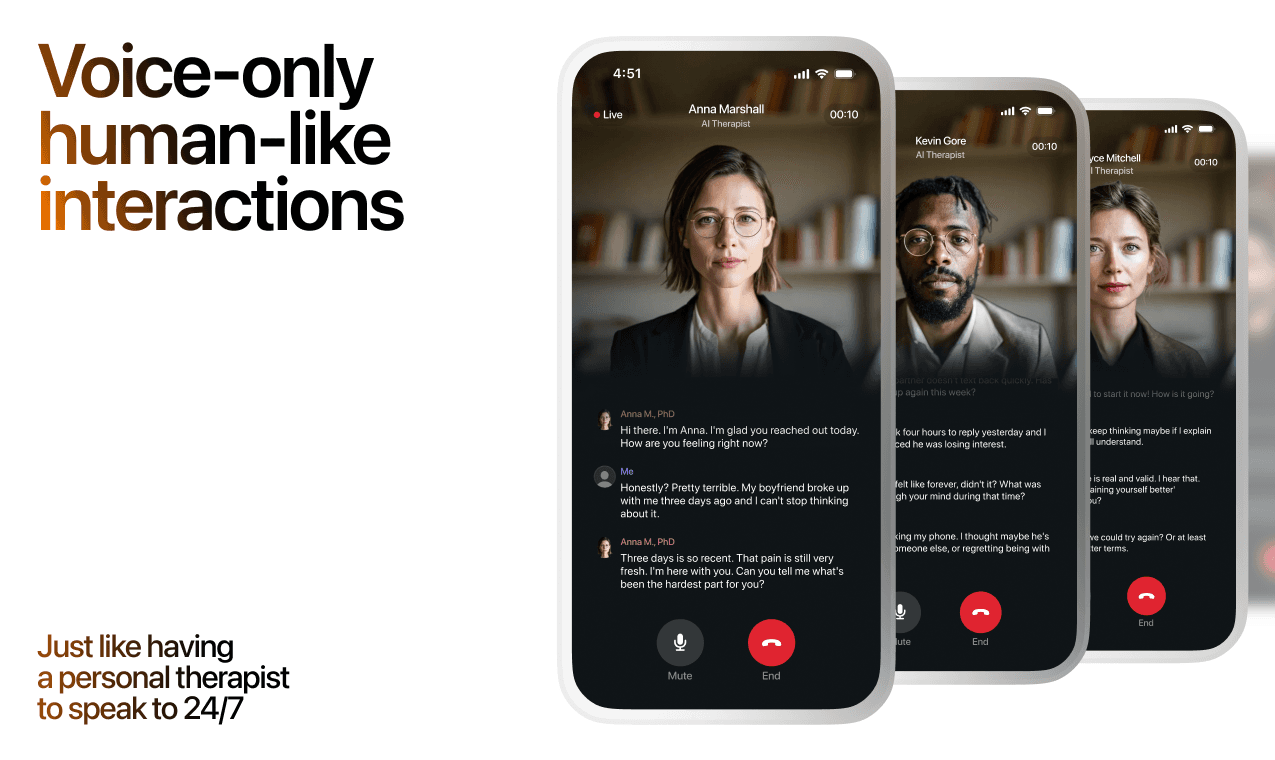
What a Session with Lovon Looks Like
When to Seek Professional Help
AI support is a valuable tool, but it's not a replacement for professional care. Please consider reaching out to a licensed therapist if you experience any of the following:
- Persistent thoughts of self-harm or suicide
- Inability to perform daily activities (work, eating, sleeping) for more than 2 weeks
- Turning to alcohol or substances to cope
- Intense anger or desire to harm your ex-partner
- Complete emotional numbness that doesn't improve over time
Crisis Resources (US): If you're in immediate danger, call 988 (Suicide & Crisis Lifeline) or text HOME to 741741 (Crisis Text Line). Available 24/7, free, and confidential.
Outside the US? Find a crisis line in your country
Ready to Start?
Your healing journey can begin right now
A 7-day trial. No judgment. Just a safe space to process what you're going through.
Frequently Asked Questions
Is Lovon a replacement for a real therapist?
Is my conversation with Lovon AI private?
How is Lovon different from ChatGPT for emotional support?
Can I use Lovon if I'm already seeing a therapist?
Can I try Lovon before subscribing?
About the Author
The Lovon Editorial Team
Mental Health & Wellness Content Team
The Lovon Editorial Team develops mental health and wellness content designed to make psychological concepts accessible and actionable. Our goal is to bridge the gap between clinical research and everyday life - helping you understand why your mind works the way it does and what you can do about it....
Related articles
- Marriage Compatibility Quiz Before Marriage (2026)
A marriage compatibility quiz reveals values gaps on finances, parenting, and conflict style. See the top picks for 2026…
- Vulnerability in Relationships: Why It Feels Unsafe 2026
Vulnerability in relationships feels dangerous because your nervous system reads it as threat, not weakness. See what…
- Feedback vs Criticism in Relationships: Healthy Intimacy or Harsh Judgment
Every intimate relationship encounters moments where partners need to address concerns, express disappointment, or…
- Erikson Stage of Intimacy vs Isolation
Many people find themselves in situations where their current social circles feel unfamiliar or distant.
See also
Quizzes
- Triangular Love Test: Intimacy, Passion, Commitment
See which side of love is thin, in 3 minutes.
- What's My Love Language? Free 15-Question Quiz
Find your love language in 2 minutes.
Free tools
- How to Write a Love Letter That Sounds Like You
A chat, not a template, for anyone stuck on how to write a love letter. Tell it who it is for, how long you have been…
- Love Paragraphs for Her or Him, Built From Your Own Story
Love paragraphs for her or him, written from your own story rather than copied from a list. Tell it how they make you…
From the wiki
- How many dates before a relationship?
There is no set number. People often say five to ten dates, but that range is really describing five to ten weeks of…
Disclaimer: This article is for informational purposes only and does not constitute medical advice, diagnosis, or treatment. Always seek the advice of your physician or other qualified health provider with any questions you may have regarding a medical condition. If you are in crisis or think you may have an emergency, call 988 (Suicide & Crisis Lifeline) or go to the nearest emergency room. Outside the US? Find a crisis line in your country.