
Father Wound vs Mother Wound: Key Differences (2026)
Father wound vs mother wound — not the same pain. Learn the core differences, overlapping patterns, and how to start healing each one in 2026.

Key Takeaways
- A basic willingness to sit with discomfort — this material surfaces real feelings
- A journal or note-taking tool for reflection between steps
- Around 20–30 minutes of uninterrupted time per step
- Optional: a therapist, counselor, or a voice-based support tool like Lovon for between-session processing
- An understanding that this is exploratory work, not diagnosis
The terms "father wound" and "mother wound" describe two distinct forms of early relational pain — and confusing one for the other can stall your healing for years.
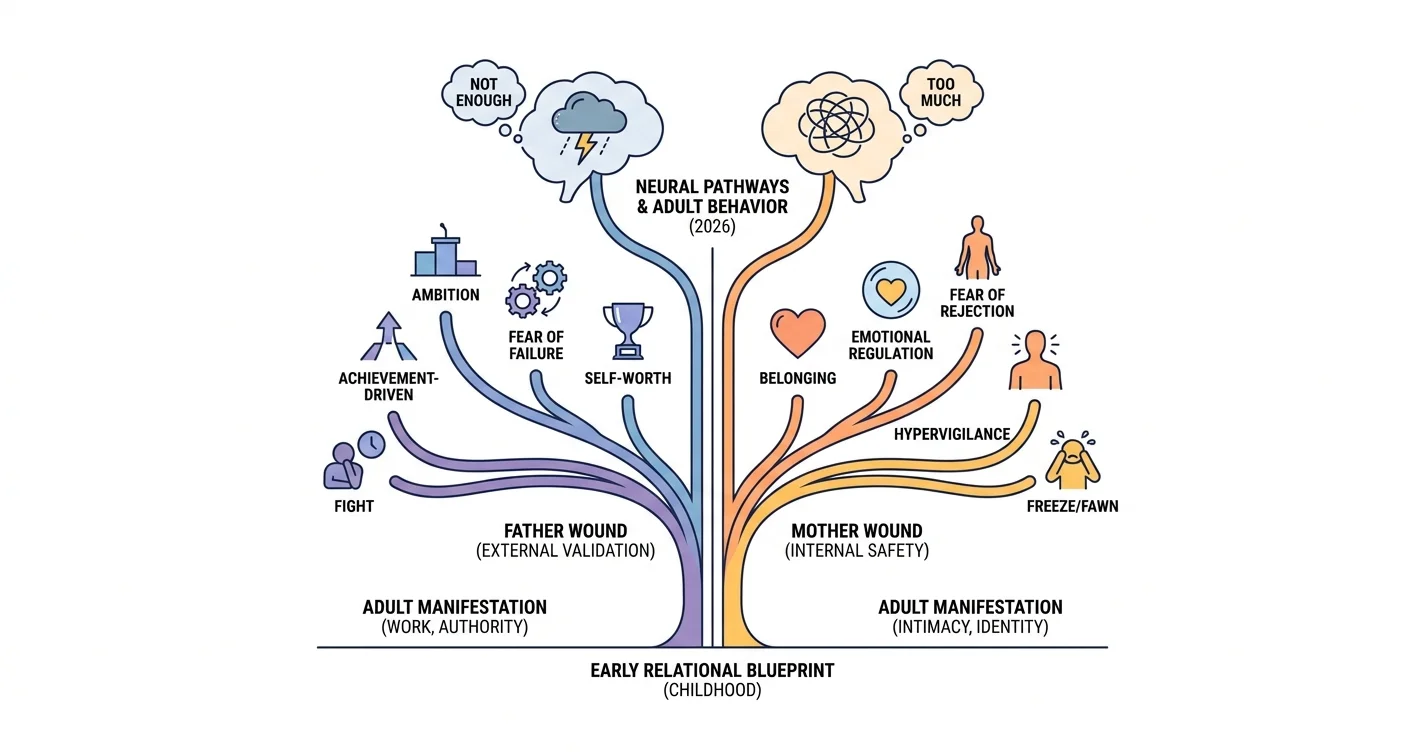
TL;DR: The father wound vs mother wound debate comes down to which relational template was broken first. A father wound typically shapes your relationship with authority, ambition, self-worth, and how safe it feels to be seen in the world. A mother wound cuts deeper into basic belonging, emotional regulation, and body-level safety. Both leave real marks on adult behavior in 2026 — but the patterns look different, the triggers differ, and the healing paths are not the same.
Why this distinction matters
Most people carrying one of these wounds don't have a name for it. They just know that certain relationships feel impossible, certain emotions won't land, or that they keep replaying the same dynamic with different people. Naming the wound is not about assigning blame — it's about understanding the blueprint that got installed before you had any say in the matter. Once you see the blueprint clearly, you can start to revise it.
Research on adverse childhood experiences (ACEs) consistently shows that relational wounds in early childhood are among the strongest predictors of adult mental health outcomes. The father wound and mother wound are not clinical diagnoses — they're frameworks developed in depth psychology and trauma-informed therapy to describe the specific imprints left by emotionally absent, critical, or inconsistent parenting.
What you'll need before you start
- A basic willingness to sit with discomfort — this material surfaces real feelings
- A journal or note-taking tool for reflection between steps
- Around 20–30 minutes of uninterrupted time per step
- Optional: a therapist, counselor, or a voice-based support tool like Lovon for between-session processing
- An understanding that this is exploratory work, not diagnosis
The steps
Step 1: Understand what a father wound actually is
The father wound originates in your relationship with your father figure — biological, adoptive, stepparent, or absent. The father's primary psychological role in early development is to usher the child into the external world: to affirm capability, to model what it means to take up space, to say "you are enough as you are."
When that affirmation is absent, conditional, or replaced by criticism, the child internalizes a core message: I have to earn my place. In adulthood in 2026, this shows up as chronic overachievement, fear of failure, difficulty with authority figures, trouble receiving praise, or a compulsive need to prove worth through productivity.
Common father wound patterns in adults:
- People-pleasing with bosses or mentors while privately resenting them
- Difficulty finishing projects because completion invites evaluation
- A harsh inner critic that sounds oddly like a parent
- Fear of claiming success — imposter syndrome with an emotional root
Common mistake: Assuming the father wound only appears in people whose fathers were visibly abusive. Emotional unavailability — a father who was physically present but unreachable — creates an equally deep imprint.
Step 2: Understand what a mother wound actually is
The mother wound originates in your relationship with your mother figure. The mother's psychological role is to be the first mirror — to reflect the child's existence back as welcome, lovable, and safe. Before language, before thought, this relationship programs the nervous system's baseline: is the world safe? Am I fundamentally okay?
When the mother is emotionally unavailable, enmeshed, dismissive, or carries her own unprocessed pain that bleeds into the relationship, the child's baseline nervous system becomes dysregulated. In adult life in 2026, this often looks like chronic anxiety, difficulty setting limits with others, an unstable sense of identity, or the feeling that needing anything from anyone is a burden.
Common mother wound patterns in adults:
- Guilt that appears instantly when you prioritize yourself
- Difficulty identifying your own needs, let alone asking for them
- Relationships where you become the emotional caretaker by default
- A body that holds stress as tightness, numbness, or low-level dread
Common mistake: Treating the mother wound as only relevant to women. Men carry mother wounds too — they often show up as difficulty with intimacy, emotional shutdown, or choosing partners who recreate the original dynamic.
Step 3: Map the core differences side by side
Understanding father wound vs mother wound gets clearer when you look at the axis each one disrupts.
| Dimension | Father Wound | Mother Wound |
|---|---|---|
| Primary developmental role | External validation, capability, worth | Belonging, safety, emotional regulation |
| Core fear installed | "I am not good enough" | "I am too much" or "I don't deserve care" |
| Where it shows up most | Work, ambition, authority relationships | Intimacy, identity, physical self |
| Typical emotional tone | Shame, anger, proving | Anxiety, guilt, hypervigilance |
| Nervous system signature | Fight or achievement-driven | Freeze, fawn, or collapse |
| Trigger moments | Criticism, being overlooked, failure | Rejection, abandonment, asking for help |
Neither wound is worse than the other. Both deserve the same seriousness.
Step 4: Identify which wound is louder for you right now
You may carry both — many people do, especially if both parental relationships were painful. But one usually has more charge in the present moment. To find it, ask yourself these questions and write your answers down:
- When someone criticizes my work or decisions, where do I feel it first — in my head (self-worth, ability) or in my body (gut drop, chest tightness)?
- Am I more afraid of being seen as incompetent or of being abandoned?
- Do I tend to over-perform to stay safe, or over-give to stay safe?
- Does my inner critic sound like a disappointed judge, or a worried, guilt-inducing voice?
There are no right answers. The pattern that repeats most often across your relationships in 2026 is the one asking for attention first.
Common mistake: Assuming one wound belongs to one gender. Both wounds affect people of every gender. The content is different; the pain is equal.
Step 5: Recognize the overlapping territory
Father wound and mother wound are not hermetically sealed categories. They overlap in predictable ways.
Both wounds can produce anxious attachment, fearful avoidant attachment, or disorganized attachment — though the flavor of the attachment differs. A father wound often drives the anxious pursuit of validation from partners who represent authority or approval. A mother wound often drives the terror of closeness itself, because closeness was the original site of pain.
Both wounds can appear in the fawn response — that automatic mode of self-erasure designed to keep a relationship intact at any cost. The fawn response learned in a father-wounded home tends to look like over-competence. The fawn response from a mother wound tends to look like over-accommodation of others' emotions.
Both wounds are also frequently found in people who grew up with conditional love as the baseline — where love was present only when they performed, behaved, or suppressed themselves correctly.
Step 6: Start working with what you found
Naming the wound is the beginning, not the solution. Here is what actually moves the needle:
For father wound work:
- Practice receiving positive feedback without deflecting it. Let it land for 10 full seconds before minimizing.
- Notice when your inner critic fires after accomplishment — that's the wound talking, not reality.
- Explore where the voice of "not enough" came from. Write a letter to that younger version of yourself; you do not have to send it anywhere.
- Talking through these patterns in a structured way — whether with a therapist or an AI voice companion like Lovon — helps externalize the inner critic so you can examine it instead of obey it.
For mother wound work:
- Practice stating one small need per day to someone you trust. Start tiny — "I'd prefer the window seat" counts.
- Notice guilt as information, not instruction. Guilt says "you broke a rule." Ask: whose rule, and does it still serve you?
- Ground the body: 5–10 minutes of slow breath or body-scan work each morning interrupts the chronic hypervigilance that mother wound survivors carry.
- Because the mother wound lives in the nervous system before it lives in thought, somatic approaches — breathwork, gentle movement, or voice-based emotional processing — tend to reach it faster than purely cognitive techniques.
Troubleshooting
"I can't tell which wound I have." Start with the body. Father wound emotion tends to be more thought-driven (shame, judgment, comparison). Mother wound emotion tends to surface in the body first (dread, numbness, gut anxiety). Your somatic signal is a reliable guide when the cognitive picture is muddy.
"I had a mostly good childhood — can I still have a wound?" Yes. Wounds form in the gaps. A father who worked constantly, never meant harm, and never once told you he was proud — that absence is enough. A mother who loved deeply but was chronically anxious and passed that anxiety to the household — the impact is real, even without overt harm.
"I feel like I have both wounds equally." That is common. Work one at a time — pick the one that shows up in your most pressing current relationship struggle and start there. The other won't disappear; you'll get to it.
"I know the wound but nothing changes." Knowing is cognitive. Healing is experiential. Insight about the wound is not enough on its own — you need repeated new experiences of safety, connection, or self-compassion to actually rewire the pattern. This is why consistent practice (and often consistent support) matters more than a single breakthrough.
"This brings up a lot of anger at my parents." That anger is often part of the healing, not a detour from it. Let it be named. It doesn't have to become a confrontation. Anger at a wound is just the immune system of the self saying: that should not have happened to me. That recognition is healthy.
"Can an app actually help with something this deep?" An AI voice companion like Lovon is not a replacement for clinical care when trauma is severe. It is a between-session space — somewhere to process what surfaced in your day, practice speaking feelings out loud, or work through a moment of triggering before it becomes a week-long spiral. For everyday wound-related emotional maintenance, that kind of always-available space is genuinely useful.
Tools and resources
- A body-scan or somatic journal practice (free, 10 min/day)
- A licensed therapist with a trauma-informed or psychodynamic background — especially valuable for complex or severe wound patterns
- Lovon — on-demand AI therapist support for relationship problems in 2026, voice-based, built with PhD psychologist input, available when a therapist isn't
- The book The Wild Edge of Sorrow by Francis Weller (father wound-adjacent grief work)
- The book Mother Hunger by Kelly McDaniel (mother wound-specific, research-grounded)
What to do next
Once you've identified your primary wound and started the daily practices above, the natural next step is understanding how that wound shaped your attachment style — because your attachment style is the mechanism through which the wound replays itself in adult relationships. Understanding anxious, avoidant, or disorganized patterns gives you a real-time map of when the wound is running the show.
FAQ
What is the main difference between a father wound and a mother wound? A father wound primarily affects your sense of worth, capability, and safety in the external world — at work, with authority, in ambition. A mother wound hits earlier and deeper, disrupting the baseline sense of belonging and emotional safety that forms in the first years of life.
Can you have both a father wound and a mother wound at the same time? Yes. Many people carry both. The wounds can reinforce each other — a father wound around worth plus a mother wound around belonging often produces a particularly painful combination of overachieving while feeling fundamentally empty inside.
Is the mother wound more serious than the father wound? Neither is universally more serious. The mother wound tends to be more preverbal and body-based, which can make it harder to identify through thought alone. The father wound is often more legible because it shows up in recognizable adult behaviors like overworking. Severity depends on the individual history, not a general ranking.
How do I know if I have a father wound? Common signs in 2026: a persistent inner critic tied to performance, difficulty with authority figures, compulsive need to prove yourself, feeling proud of achievement for about 10 minutes before moving the goalposts. The wound often activates most sharply in professional settings or when you're being evaluated.
How do I know if I have a mother wound? Common signs: immediate guilt when you prioritize yourself, difficulty knowing what you actually want, chronic anxiety that lives in the body rather than as a specific thought, relationships where you become the default emotional caretaker.
Does the father wound affect women differently than men? The core wound is similar regardless of gender — it's about the absence of affirmation and being seen as capable. Women with father wounds often carry it into romantic relationships where they seek partner approval as a proxy. Men with father wounds often carry it into competitive or professional dynamics. The trigger contexts differ; the core fear is the same.
Can the father wound or mother wound cause anxiety? Yes. Both wounds are consistent with elevated anxiety in adulthood. The mother wound in particular is associated with a dysregulated nervous system — baseline anxiety that feels like weather rather than a response to anything specific. Father wound anxiety tends to be more performance-triggered.
How long does it take to heal a parental wound? There is no fixed timeline. Most people doing consistent work — therapy, somatic practice, journaling, honest reflection — notice meaningful shifts in 6 to 18 months. The goal is not erasure. It's building enough self-awareness and new experience that the wound stops running your decisions without your knowledge.
One last thing
A 2020 meta-analysis of 122 studies found that perceived parental acceptance in childhood is one of the single strongest predictors of adult psychological adjustment — stronger than socioeconomic status, stronger than peer relationships, and comparable to genetic factors. That's not a guilt trip for parents. It's evidence that the wounds you're working through are real, measurable, and — critically — responsive to intentional repair. You didn't choose the blueprint. You do get to revise it.
Related guides
How AI Support Helps You Heal
AI emotional support isn't about replacing human connection — it's about filling the gaps. The moments when you need to talk at 2 AM, when you don't want to burden your friends again, or when you simply need someone to listen without judgment.
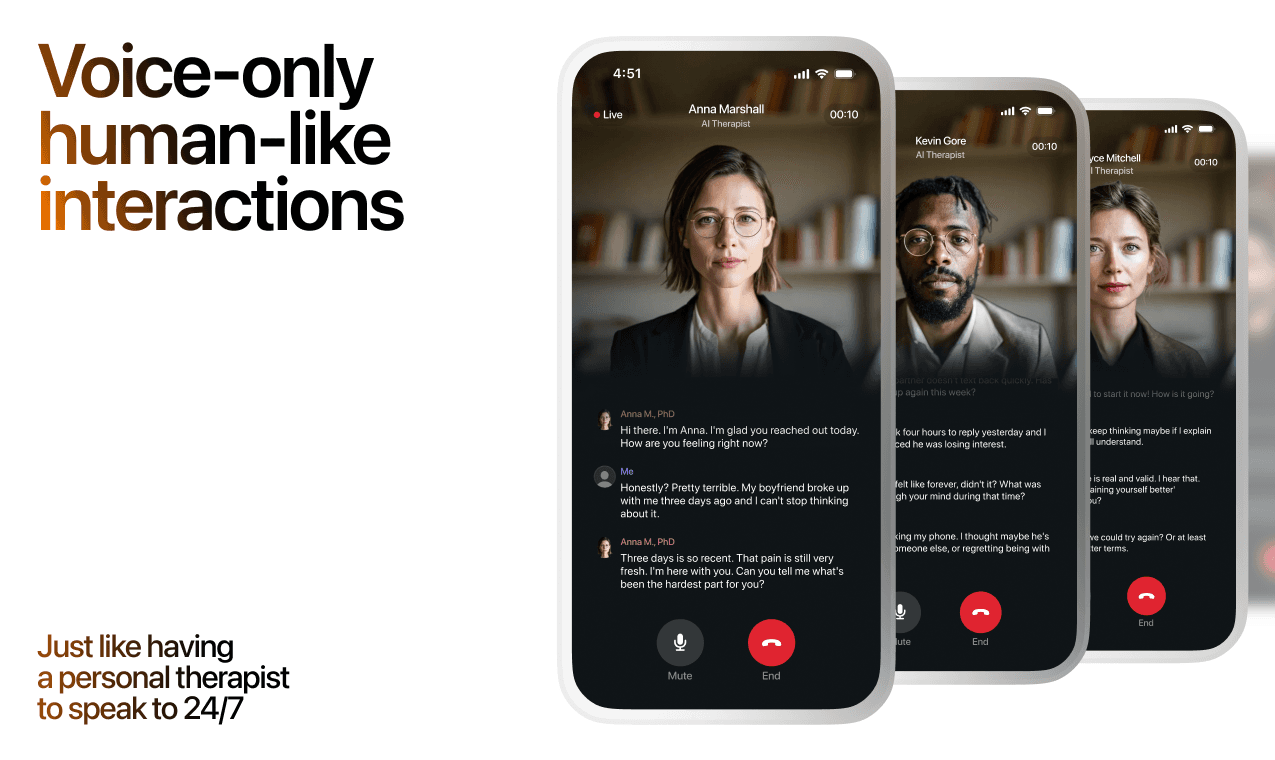
Here's what happens in a typical Lovon session:
You share what's on your mind
There's no script, no intake form, no waiting room. You speak or type whatever you're feeling — in your own words, at your own pace.
Lovon validates and explores
Using frameworks from CBT (Cognitive Behavioral Therapy) and motivational interviewing, Lovon acknowledges your feelings first, then gently helps you explore them. No dismissive "just move on" advice.
You build coping skills together
Lovon doesn't just listen — it actively works with you on evidence-based techniques: thought reframing, urge surfing, behavioral experiments, and more.
What a Session with Lovon Looks Like
When to Seek Professional Help
AI support is a valuable tool, but it's not a replacement for professional care. Please consider reaching out to a licensed therapist if you experience any of the following:
- Persistent thoughts of self-harm or suicide
- Inability to perform daily activities (work, eating, sleeping) for more than 2 weeks
- Turning to alcohol or substances to cope
- Intense anger or desire to harm your ex-partner
- Complete emotional numbness that doesn't improve over time
Crisis Resources (US): If you're in immediate danger, call 988 (Suicide & Crisis Lifeline) or text HOME to 741741 (Crisis Text Line). Available 24/7, free, and confidential.
Outside the US? Find a crisis line in your country
Ready to Start?
Your healing journey can begin right now
A 7-day trial. No judgment. Just a safe space to process what you're going through.
Frequently Asked Questions
Is Lovon a replacement for a real therapist?
Is my conversation with Lovon AI private?
How is Lovon different from ChatGPT for emotional support?
Can I use Lovon if I'm already seeing a therapist?
Can I try Lovon before subscribing?
About the Author

The Lovon Editorial Team
Mental Health & Wellness Content Team
The Lovon Editorial Team develops mental health and wellness content designed to make psychological concepts accessible and actionable. Our goal is to bridge the gap between clinical research and everyday life - helping you understand why your mind works the way it does and what you can do about it....
Related articles
- Emotionally Immature Parents: Minimizing Harm and Requiring Justification
When emotionally immature parents minimize harm and require excessive justification for hurt feelings, they create a…
- BPD Treatment Specialization: Four Parent Types Affecting Emotional Regulation
For individuals with borderline personality disorder (BPD), emotional regulation difficulties rarely emerge in…
- Stepparent Stress Blended Family: 2026 Coping Guide
Stepparent stress in a blended family peaks around authority and loyalty conflicts. Get 6 steps to cope, troubleshooting…
- Understanding Toxic Parent Accountability Patterns
When adult children attempt to address harm caused by their parents, they often encounter a predictable set of responses…
See also
Quizzes
- Boundaries Test: Free 12-Question Self-Check
See where your boundaries slip, in 3 minutes.
- Emotional Intelligence Test: Your EQ in a Relationship
Find where your EQ slips when things get tense.
Free tools
- How to Come Out to Your Parents
A chat about how to come out to your parents that starts with whether now is safe, not with the speech. Tell it your…
- What to Say Back to a Hostile Co-Parent
A chat, not a form. Paste the message your ex sent about the kids, say what actually has to be decided, and you get a…
From the wiki
- How to break up with someone you still love?
Loving someone does not mean the relationship works. If you have circled the same decision for months and the reasons…
Disclaimer: This article is for informational purposes only and does not constitute medical advice, diagnosis, or treatment. Always seek the advice of your physician or other qualified health provider with any questions you may have regarding a medical condition. If you are in crisis or think you may have an emergency, call 988 (Suicide & Crisis Lifeline) or go to the nearest emergency room. Outside the US? Find a crisis line in your country.