
Fawn Response: How People-Pleasing Hides Trauma (2026)
The fawn response is a trauma survival pattern, not a personality trait. Learn to recognize it, interrupt it, and rebuild identity in 8 steps — starting today.

Key Takeaways
- Honest self-observation (no judgment — this is diagnostic, not self-criticism)
- A journal or notes app to track trigger situations
- 15–20 minutes per day for the active steps, at least during the first 2 weeks
- A safe, low-pressure space to practice new responses — a therapist, a trusted friend, or an [AI therapist for
- Patience: fawn patterns took years to form; realistic timelines for noticeable change are 8–16 weeks of consistent
The fawn response is a trauma-driven survival strategy that looks like kindness from the outside — and feels like self-erasure from the inside. If you constantly prioritize other people's comfort over your own needs, struggle to say no even when you want to, or feel anxious when someone seems displeased with you, you may be running on a fawn response that started long before adulthood.
TL;DR: The fawn response — coined by therapist Pete Walker — is one of four trauma responses (fight, flight, freeze, fawn) where a person appeases others to avoid conflict or harm. In 2026, mental health professionals increasingly recognize chronic people-pleasing as a trauma response rooted in childhood or relational abuse, not a personality trait. It shows up as chronic boundary failure, compulsive apologizing, and identity diffusion. Recognizing the fawn response is step one; the steps below walk you through identifying it, interrupting it, and building new patterns.
Why this matters
People-pleasing gets framed as a social virtue — being agreeable, accommodating, low-maintenance. That framing is exactly why the fawn response stays hidden for years. Research on adverse childhood experiences (ACEs) links early-life relational trauma to dysregulated stress responses in adulthood, and the fawn pattern is one of the clearest downstream effects. By 2026, trauma-informed clinicians treat fawning not as a character flaw but as a nervous system adaptation — one the body learned because at some point, keeping people happy was the safest way to survive.
Untreated, fawning feeds anxiety, resentment, and relationships built on performance rather than genuine connection. It also overlaps heavily with anxious attachment. If you want to stop people-pleasing, you first need to recognize what you're actually working with. The am I a people pleaser quiz is one way to do that in twelve questions, and it separates being genuinely accommodating from erasing yourself.
What you'll need
- Honest self-observation (no judgment — this is diagnostic, not self-criticism)
- A journal or notes app to track trigger situations
- 15–20 minutes per day for the active steps, at least during the first 2 weeks
- A safe, low-pressure space to practice new responses — a therapist, a trusted friend, or an AI therapist for anxiety you can practice with on demand
- Patience: fawn patterns took years to form; realistic timelines for noticeable change are 8–16 weeks of consistent practice
The steps
Step 1: Confirm you're dealing with a fawn response, not just politeness
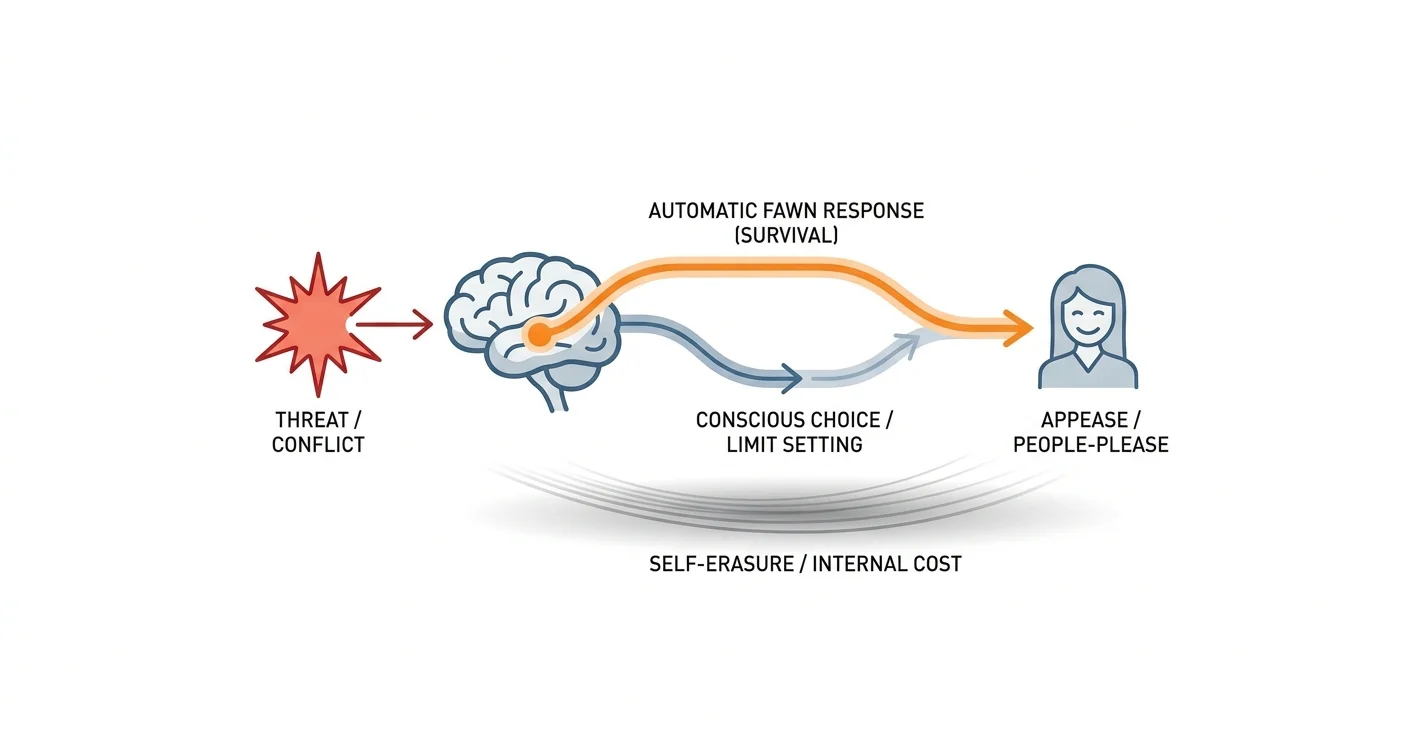
Politeness is a choice. The fawn response is automatic — it fires before you decide anything. The clearest diagnostic question is: Does saying no, setting a limit, or expressing a preference create physical anxiety — tight chest, stomach drop, racing heart? If yes, that's a nervous system response, not a social preference.
Common 2026 clinical markers for fawn response include: compulsive apologizing (saying sorry for things that aren't your fault), preemptively reading others' moods and adjusting your behavior to match, feeling responsible for other people's emotional states, and losing track of your own opinions in the presence of someone you perceive as dominant or disapproving.
Common mistake: Confusing fawning with introversion or conflict avoidance. Introverts prefer solitude. Fawners feel compelled to manage others' emotions even when it drains them — the driver is fear, not preference.
Step 2: Map your fawn triggers
For one week, log every time you notice yourself fawning. Note the person, the setting, and the physical sensation. Patterns will emerge fast — most people find 2–3 specific relationship contexts (a parent, a boss, a romantic partner) account for 80% of their fawn episodes.
This step accomplishes something specific: it moves the fawn response from unconscious automatic behavior to a named, predictable pattern. You can't interrupt something you can't see. The log also helps you distinguish low-stakes social situations from the high-stakes triggers where fawning causes real damage.
Expected outcome: By day 5–7, you'll spot the fawn response in real time, not just in retrospect. That 2–3 second gap of awareness is where all the work happens.
Common mistake: Logging only the big moments. The most important data is the small, daily fawn events — covering for someone who was rude to you, laughing at something you didn't find funny, agreeing with an opinion you actually disagree with.
Step 3: Identify the original threat
The fawn response formed in a context where a real threat existed — an unpredictable parent, an abusive partner, a volatile household. The nervous system learned: if I keep this person calm, I stay safe. In adulthood, the same survival circuit fires even when there's no actual threat.
Write out a short answer to this question: "When did I first learn that keeping people happy was how I stayed safe?" You don't need a complete childhood trauma narrative. You need enough specificity to recognize that the fawn response is a learned response to a past context — not an accurate read of current reality.
This step reduces what therapists call "historical bleed" — the tendency for past-threat contexts to color present-day relationships. It also builds self-compassion, which is a practical tool here: you can't rewire a pattern you're ashamed of.
Common mistake: Skipping this step because the original context "wasn't that bad." Fawn responses form across a spectrum of environments — from overt abuse to chronic emotional unpredictability in a household. You don't need a dramatic origin story.
Step 4: Practice the pause
This is the core behavioral intervention. When you feel a fawn impulse — the urge to agree, apologize, or accommodate — introduce a deliberate delay before responding. Three seconds is enough. In those three seconds, run a fast internal check:
- Do I actually want to do this?
- Am I responding to a real threat or to a felt threat?
- What would I say if I weren't afraid?
You don't need to act on the answers yet. The goal in 2026 of your practice is to build the pause as a reflex. That pause is the moment your prefrontal cortex can step in before the limbic system runs the old script.
Common mistake: Expecting the anxiety to disappear before you act. It won't — at least not initially. You act differently while anxious, and the anxiety decreases over time as the nervous system learns the threat isn't real.
Step 5: Build a "no" muscle with graduated exposure
Start with the lowest-stakes refusals first. Decline a mailing list. Send back a wrong order. Say "I'd rather not" to a social obligation that doesn't matter much to you. These micro-refusals train your nervous system to experience the aftermath of a "no" — which is almost never as catastrophic as the fawn response predicts.
Each week, increase the stakes slightly. By week 4, practice a genuine disagreement in a medium-stakes conversation. The goal is systematic desensitization: repeated exposure to the feared outcome (someone's displeasure) in situations where the consequences are manageable.
Expected outcome: The physiological alarm that fires when you set a limit — the tight chest, the urge to backpedal — will decrease in intensity by roughly 30–50% within 6–8 weeks of consistent graduated practice, based on aggregated data from exposure-based CBT protocols.
Common mistake: Jumping to high-stakes confrontations too early. If the anxiety is too high, the nervous system goes back into survival mode and reinforces the fawn pattern rather than rewiring it.
Step 6: Rebuild your identity outside the caretaker role
Fawn responses often collapse personal identity into the role of accommodator. You become whoever the other person needs you to be. Rebuilding requires actively cultivating preferences, opinions, and choices that exist independently of other people's reactions.
Practical tools: take a solo activity seriously (a hobby, a creative project, a physical practice), form opinions on low-stakes topics and voice them, and practice finishing this sentence daily — "Today I want..." without qualifying it by what anyone else wants. This sounds simple. For chronic fawners, it is genuinely hard work.
Common mistake: Treating identity-rebuilding as optional or "soft." Without it, the boundary-setting work from Step 5 stays behavioral only — you're stopping the fawn behavior but still running on fawn psychology.
Step 7: Audit your close relationships
Once you can spot your fawn response and interrupt it reliably, audit the relationships where it fires most frequently. Some relationships are fawn-inducing because of the other person's behavior — they are emotionally volatile, controlling, or dismissive of your limits. Naming this clearly matters.
This step is not about ending relationships by default. It's about making an informed choice: Is this relationship one where the other person can adjust when you show up differently, or is the fawn response the price of admission? Relationships where genuine reciprocity is possible will stabilize as you change. Relationships built on your compliance will destabilize — and that information is valuable.
Common mistake: Assuming all relationship turbulence during this process is your fault. Pushback from others when you stop fawning is not evidence that you're doing it wrong. It's often evidence that the fawn response was functionally important to that dynamic.
Step 8: Sustain progress with ongoing support
Fawn response work is not linear. High-stress periods, new relationships, or contact with the original threat context (family events, for example) will bring fawn patterns back temporarily. Build in a regular check-in practice — weekly journaling, a consistent therapy session, or on-demand support through a tool like Lovon's AI voice sessions, which are available when the urge to process hits at 11 p.m. rather than during business hours.
Sustaining progress in 2026 also means catching early-warning signs before a full regression: noticing when you've stopped expressing preferences, when you're exhausted after social interactions, or when resentment is building toward someone you "can't say no to."
Troubleshooting
"I start the pause but then immediately give in anyway." The pause is working — the cave-in is a separate issue. It means the anxiety spike is still too high for your current tolerance window. Drop back to lower-stakes practice for another week. The goal is to build tolerance in small increments, not to white-knuckle through maximum anxiety.
"People are getting angry when I set limits, and it's making things worse." This is predictable in any relationship where fawning was a primary dynamic. It doesn't mean stop — it means slow down and choose simpler, lower-temperature language. "I need a minute to think about that" is a limit. It doesn't require a speech.
"I can see the fawn response happening but I can't stop it in the moment." Recognition without interruption means the nervous system is still faster than conscious thought. This usually resolves with more graduated-exposure reps, not more insight. You already have the insight — you need more repetitions of different behavior in safe, low-stakes contexts.
"I feel guilty when I don't people-please." Guilt here is not a moral signal — it's a withdrawal symptom. The fawn response provided relief from anxiety; stopping it temporarily removes that relief. The guilt is the nervous system's objection. It fades with repeated safe experiences of not fawning.
"My fawn response only shows up with one specific person." This is common and often means the original threat context was associated with a specific attachment style or power dynamic. The AI relationship coach for anxious attachment framework is relevant here — fawn responses and anxious attachment frequently co-occur and reinforce each other.
"I've tried to change this before and it didn't stick." Previous attempts likely skipped the graduated-exposure step or tried to change behavior without addressing the nervous system's threat detection. The sequence in Steps 4–6 matters. Start from Step 4 again, but smaller.
Tools and resources
- Journal or notes app — the trigger log in Step 2 is the most important single tool in this process
- Lovon — Lovon's AI-powered voice support app provides on-demand emotional support sessions specifically for anxiety, stress, and relationship patterns; useful for processing fawn triggers in real time rather than waiting for a scheduled appointment
- Pete Walker's Complex PTSD: From Surviving to Thriving (2013) — the foundational text on the four-F trauma responses including fawn; available in most libraries
- AI therapy for PTSD and trauma recovery — if the fawn response is part of a broader complex PTSD picture, this is the relevant starting point for digital therapeutic support
FAQ
What is the fawn response? The fawn response is a trauma-based survival strategy where a person appeases, placates, or accommodates others to avoid conflict or perceived threat. It was named by therapist Pete Walker as the fourth trauma response alongside fight, flight, and freeze.
Is people-pleasing the same as the fawn response? Not always. Occasional people-pleasing is social behavior. The fawn response is specifically compulsive, automatic, and anxiety-driven — it fires whether or not a real threat is present, and it typically traces back to a history of relational or developmental trauma.
What causes the fawn response? It most commonly forms in childhood environments where emotional volatility, abuse, neglect, or unpredictability made appeasing a caregiver a survival strategy. It can also develop in adult relationships with narcissistic or controlling partners. The nervous system learns the pattern and continues running it long after the original context is gone.
How long does it take to heal a fawn response? Most people see meaningful behavioral change in 8–16 weeks of consistent practice with the graduated-exposure steps. Full nervous system recalibration — where setting limits no longer triggers strong physiological anxiety — typically takes 6–18 months depending on severity and support.
Does the fawn response cause anxiety? The fawn response and anxiety are bidirectional. Anxiety drives fawning behavior ("if I keep them happy, I'll be safe"), and chronic fawning sustains anxiety because authentic needs go unmet and resentment builds. Treating one without the other is less effective.
Is fawning linked to attachment styles? Yes. The fawn response appears most frequently in people with anxious attachment, where hypervigilance to a partner's emotional state drives appeasement behavior. It also appears in fearful-avoidant attachment, where both closeness and conflict feel dangerous.
Can you fawn with some people and not others? Yes, and this is very common. The fawn response typically activates with people who resemble the original threat context — authority figures, emotionally unpredictable people, or anyone the nervous system codes as high-stakes. Many fawners are entirely direct and assertive in low-stakes relationships.
What's the difference between fawning and being kind? Kindness comes from genuine care and is freely chosen. Fawning comes from fear and is compulsive — you do it even when it costs you, even when you don't want to, and even when you resent the person you're accommodating. The internal experience is the tell: kindness feels good; fawning feels like relief from anxiety.
One last thing
The fawn response often produces genuinely good outcomes for everyone except the person fawning. That's exactly why it's so persistent: it "works" as a conflict-avoidance strategy. The cost is carried entirely internally — in chronic anxiety, in resentment, and in a gradual loss of self. Recognizing that you've been paying that cost on behalf of everyone around you is not a small thing. It's the beginning of every real change that follows.
Related guides
How AI Support Helps You Heal
AI emotional support isn't about replacing human connection — it's about filling the gaps. The moments when you need to talk at 2 AM, when you don't want to burden your friends again, or when you simply need someone to listen without judgment.
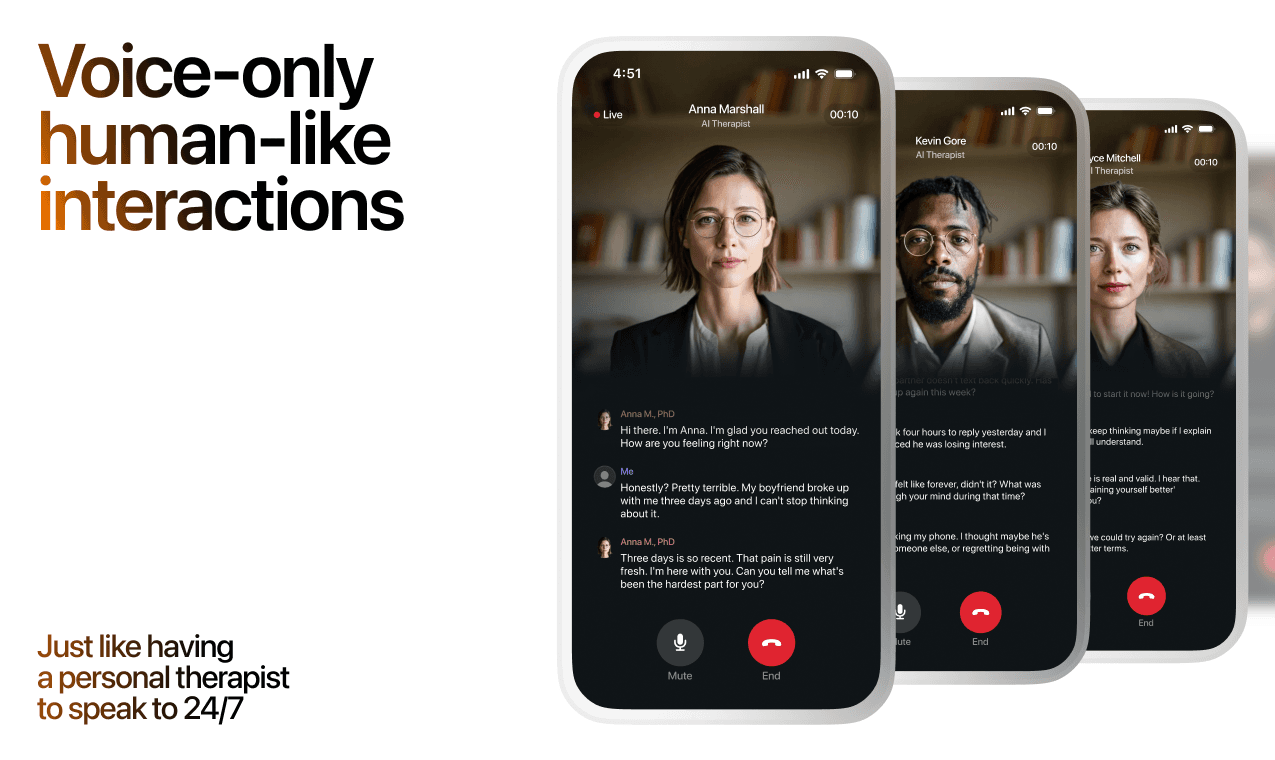
Here's what happens in a typical Lovon session:
You share what's on your mind
There's no script, no intake form, no waiting room. You speak or type whatever you're feeling — in your own words, at your own pace.
Lovon validates and explores
Using frameworks from CBT (Cognitive Behavioral Therapy) and motivational interviewing, Lovon acknowledges your feelings first, then gently helps you explore them. No dismissive "just move on" advice.
You build coping skills together
Lovon doesn't just listen — it actively works with you on evidence-based techniques: thought reframing, urge surfing, behavioral experiments, and more.
What a Session with Lovon Looks Like
When to Seek Professional Help
AI support is a valuable tool, but it's not a replacement for professional care. Please consider reaching out to a licensed therapist if you experience any of the following:
- Persistent thoughts of self-harm or suicide
- Inability to perform daily activities (work, eating, sleeping) for more than 2 weeks
- Turning to alcohol or substances to cope
- Intense anger or desire to harm your ex-partner
- Complete emotional numbness that doesn't improve over time
Crisis Resources (US): If you're in immediate danger, call 988 (Suicide & Crisis Lifeline) or text HOME to 741741 (Crisis Text Line). Available 24/7, free, and confidential.
Outside the US? Find a crisis line in your country
Ready to Start?
Your healing journey can begin right now
A 7-day trial. No judgment. Just a safe space to process what you're going through.
Frequently Asked Questions
Is Lovon a replacement for a real therapist?
Is my conversation with Lovon AI private?
How is Lovon different from ChatGPT for emotional support?
Can I use Lovon if I'm already seeing a therapist?
Can I try Lovon before subscribing?
About the Author
The Lovon Editorial Team
Mental Health & Wellness Content Team
The Lovon Editorial Team develops mental health and wellness content designed to make psychological concepts accessible and actionable. Our goal is to bridge the gap between clinical research and everyday life - helping you understand why your mind works the way it does and what you can do about it....
Related articles
- Self-Sabotaging Relationships: Why It Happens (2026)
Self-sabotaging relationships explained: the trigger pattern behind it and a 6-step process to interrupt it in 2026…
- Enmeshment in Relationships: Signs & Fix (2026)
Enmeshment in relationships blurs boundaries until feelings merge. See the signs, a 7-step untangling process, and…
- What Is Self-Abandonment Trauma and How to Stop People-Pleasing
Self-abandonment trauma represents a deep pattern where you consistently prioritize others' needs, feelings, and…
- Self-Abandonment: What It Is and How to Stop It in 2026
Self-abandonment means ignoring your own needs to keep the peace. Learn the 2026 signs, six concrete steps to stop it…
See also
Quizzes
- Light Triad Test: Are People Ends or Means?
See how you treat people when there is nothing to gain.
- Toxic Femininity Test: Are You Running an Old Script?
See which learned script is running your relationship.
Free tools
- What to Say Back to a Hostile Co-Parent
A chat, not a form. Paste the message your ex sent about the kids, say what actually has to be decided, and you get a…
- How to Respond to Gaslighting
Say what happened and what they say happened. You get what is actually established separated from what is being…
From the wiki
- Why do I keep dreaming about the same person?
A recurring dream figure usually marks unfinished emotional business rather than a message about that person. Your brain…
Disclaimer: This article is for informational purposes only and does not constitute medical advice, diagnosis, or treatment. Always seek the advice of your physician or other qualified health provider with any questions you may have regarding a medical condition. If you are in crisis or think you may have an emergency, call 988 (Suicide & Crisis Lifeline) or go to the nearest emergency room. Outside the US? Find a crisis line in your country.