
How to Stop Obsessing Over Someone: 8 Steps (2026)
Learn how to stop obsessing over someone with 8 practical steps backed by psychology. Break the thought loop, process grief, and rebuild your life in 2026.

Key Takeaways
- A journal or notes app (10 minutes a day)
- A timer (for thought-interruption exercises)
- Social media controls or a temporary blocker app
- Willingness to feel uncomfortable for short, contained periods
- A support outlet — a friend, therapist, or an AI voice therapy app like Lovon
Obsessive thoughts about someone — an ex, a crush, someone who hurt you — can hijack your entire day. This guide walks you through 8 concrete steps to break the loop in 2026, grounded in psychological principles and built for real life.
TL;DR: Learning how to stop obsessing over someone takes more than willpower. The 8 steps below — from interrupting the thought loop to rebuilding your identity outside the obsession — give you a practical sequence to follow. Most people feel a meaningful shift within 2–3 weeks of consistent effort. Lovon's AI voice support can support the process anytime, day or night.
Why this matters
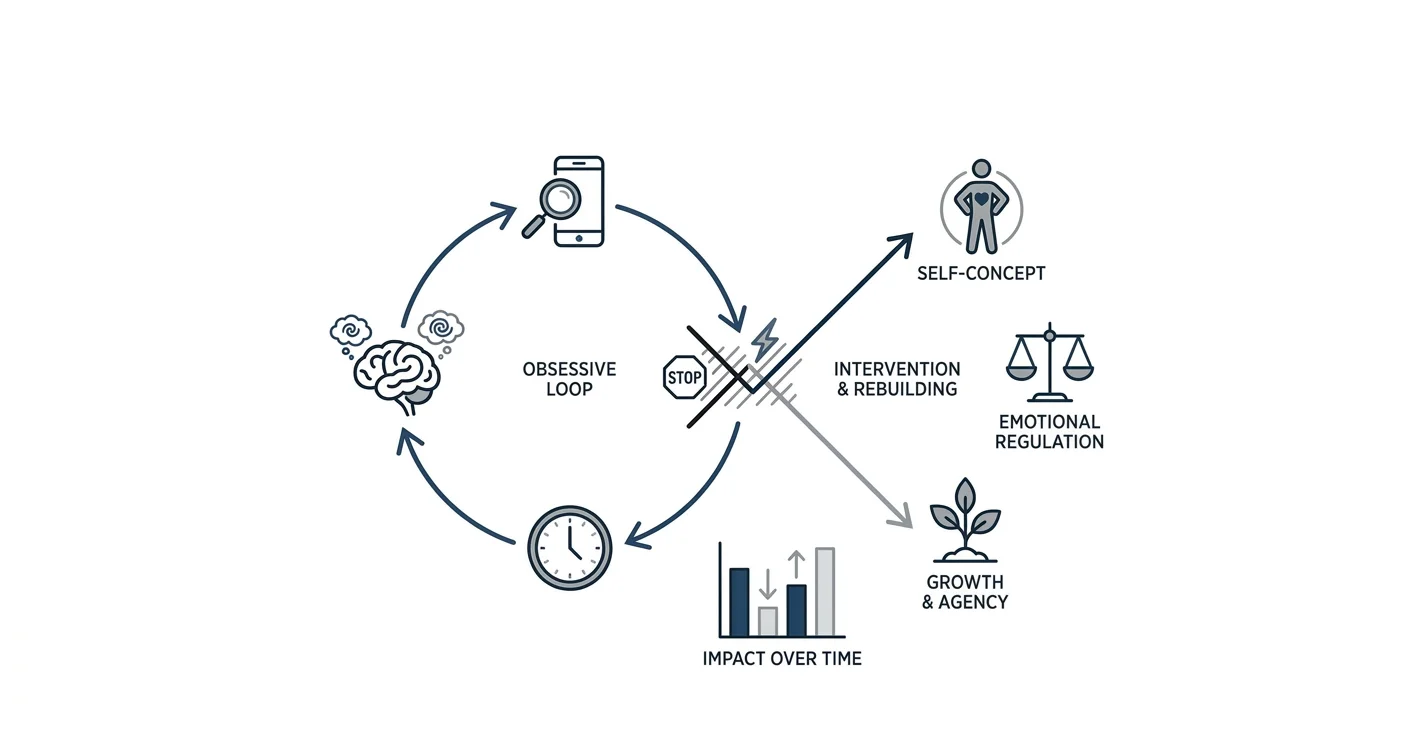
Obsessive thinking about a person is not a character flaw. It is a neurological pattern: your brain's threat-detection system (the amygdala) tags the person as emotionally significant, and then keeps scanning for information about them. The more you try to suppress the thought, the stronger it gets — a well-documented phenomenon researchers call the "rebound effect." In 2026, with constant social media exposure and digital contact trails, breaking that loop is harder than ever and more necessary than ever.
The steps below do not ask you to feel nothing. They ask you to interrupt the cycle long enough for your nervous system to reset.
What you'll need
- A journal or notes app (10 minutes a day)
- A timer (for thought-interruption exercises)
- Social media controls or a temporary blocker app
- Willingness to feel uncomfortable for short, contained periods
- A support outlet — a friend, therapist, or an AI voice support app like Lovon
The 8 steps
Step 1: Name the obsession out loud
What it accomplishes: Labeling a thought pattern reduces its emotional charge — a technique rooted in cognitive defusion from Acceptance and Commitment Therapy (ACT).
Why it matters: When you name what is happening — "I am obsessing over this person" — you create distance between you and the thought. You are the observer, not the thought itself.
How to do it: Each time an intrusive thought appears, say or write: "There's the obsession again." Do not argue with it or analyze it. Just label it. Set a 2-minute timer if it helps contain the exercise.
Expected outcome: Within 5–7 days, many people report the thought feels less urgent after labeling it.
Common mistake: Trying to reason with the thought instead of just naming it. Reasoning feeds the loop.
Step 2: Cut the information supply
What it accomplishes: Stops your brain from getting fresh material to obsess over.
Why it matters: Every time you check their Instagram, re-read old texts, or ask mutual friends for updates, you give the obsession new fuel. The brain cannot move on from something it keeps rehearsing.
How to do it: Mute or block their accounts — not as punishment, as hygiene. Delete the text thread. Ask one trusted person to hold you accountable. Set a 30-day minimum.
Expected outcome: The first 72 hours feel worse. After day 4, the intrusive spikes start to space out.
Common mistake: Keeping "just one" channel of contact open. One is enough to restart the loop every day.
Step 3: Schedule a "worry window"
What it accomplishes: Gives obsessive thoughts a container so they stop bleeding into every hour.
Why it matters: Thought suppression backfires. Giving the thoughts a designated time — and only that time — reduces their intrusion elsewhere. Research on worry postponement shows this cuts intrusive thought frequency by roughly 35% over two weeks.
How to do it: Pick a 15-minute window daily (not before bed). When an obsessive thought arrives outside that window, tell yourself: "I'll think about that at 4 p.m." Write it down so your brain trusts you'll return to it. At 4 p.m., sit with the thoughts for the full 15 minutes, then close the journal.
Expected outcome: Thoughts become more predictable and less disruptive to work and sleep.
Common mistake: Choosing a worry window right before sleep — this wires the brain to activate at bedtime.
Step 4: Identify what need the person was meeting
What it accomplishes: Moves the focus from the person to the unmet need underneath — which is actually solvable.
Why it matters: Obsession rarely lives in the person themselves. It lives in what they represented: safety, validation, excitement, belonging. When you identify the actual need, you can start meeting it in other ways.
How to do it: Write down 3 answers to: "What did this person give me that I cannot give myself?" Be specific. "They made me feel seen" is more useful than "I loved them."
Expected outcome: A shift from helplessness to agency — you can pursue that need through other channels.
Common mistake: Stopping at "I miss them" without going one level deeper.
Step 5: Interrupt rumination with a physical pattern break
What it accomplishes: Disrupts the neurological loop by forcing the brain to shift processing modes.
Why it matters: Rumination is a cognitive loop; physical movement activates different neural networks and forces the loop to pause. Even a 10-minute brisk walk reduces cortisol and shifts prefrontal engagement.
How to do it: The moment you catch yourself in a rumination spiral, stand up and do something that requires mild physical coordination — a short walk, 20 jumping jacks, washing dishes. The task has to engage your body enough that multi-tasking the obsessive thought becomes hard.
Expected outcome: A 10–15 minute interruption to the thought spiral, which is often enough time for the intensity to drop.
Common mistake: Choosing passive distractions (scrolling, TV) that leave the brain free to keep ruminating in the background.
Step 6: Rebuild a self-concept that does not include them
What it accomplishes: Fills the identity gap the obsession is currently occupying.
Why it matters: Obsessive attachment often signals that a large part of your self-concept was built around this person — your plans, your future, your daily routines. The obsession persists partly because the alternative is a blank space. You fill that space deliberately, or the obsession fills it for you.
How to do it: List 5 things that were true about you before this person entered your life. Reactivate one of them this week — a hobby, a friendship, a goal. Do not wait to feel motivated. Action precedes motivation in identity reconstruction.
Expected outcome: Over 3–4 weeks, a growing sense of a life that does not orbit one person.
Common mistake: Waiting until the obsession fades before investing in other areas. The investment is what makes the obsession fade.
Step 7: Process the grief instead of bypassing it
What it accomplishes: Addresses the emotional core driving the obsession.
Why it matters: Obsession is often unprocessed grief — for the relationship, the future you imagined, or the version of yourself in that relationship. Bypassing grief keeps you stuck in the bargaining stage indefinitely.
How to do it: Set aside 20 minutes once a week for deliberate grief processing. Write, cry, talk to someone — but do it intentionally rather than reactively. Apps like Lovon let you voice this out loud to an AI voice companion anytime, which can feel easier than writing when emotions are raw.
Expected outcome: The emotional charge around the person gradually decreases as grief moves through rather than around you.
Common mistake: Treating sadness as a sign you are "not over it" and then suppressing it further. Sadness processed is sadness released.
Step 8: Build a consistent self-check-in practice
What it accomplishes: Creates ongoing self-awareness so the obsession does not silently rebuild.
Why it matters: Obsessive patterns often creep back under stress. A daily 5-minute check-in — even just asking yourself "How am I doing today, and what do I need?" — keeps you oriented to your own emotional state rather than someone else's.
How to do it: Use a journaling prompt, a meditation app, or a voice conversation with an AI tool like Lovon each morning. Consistency matters more than length. Even 5 minutes daily beats an hour once a week.
Expected outcome: Greater emotional self-awareness and faster detection when obsessive patterns start re-emerging.
Common mistake: Treating this step as optional once things feel better. The check-in is what keeps things better.
Troubleshooting
The obsession is about someone who hurt me, not just someone I miss. This is common after narcissistic abuse or emotionally manipulative relationships. The trauma bond is neurologically similar to addiction — the intermittent reinforcement pattern keeps your nervous system scanning for resolution that never came. Steps 4 and 7 are especially critical here. Consider reading about narcissistic abuse signs and how to spot an abusive relationship before working through those steps.
I've tried everything and the thoughts still won't stop. If obsessive thoughts persist beyond 6–8 weeks of consistent effort, this may indicate OCD-spectrum rumination or an anxious attachment pattern that needs clinical support. These steps are not a substitute for a licensed therapist when the severity is high.
I keep relapsing and checking their social media. This is normal, not failure. Each relapse is data: note what triggered it (boredom, loneliness, a specific time of day) and address the trigger rather than the behavior. A digital blocker app removes the decision point entirely during high-risk hours.
The obsession is affecting my sleep. Rumination and sleep disruption reinforce each other. Move your worry window to the afternoon, avoid screen contact with anything related to the person after 8 p.m., and try a body-scan relaxation exercise at bedtime. The freeze response and hypervigilance that accompany trauma bonds can also disrupt sleep — see Lovon's article on the freeze response and why you shut down under stress for more context.
I feel ashamed of how much I'm still thinking about this person. Shame makes the obsession worse — it adds a second layer of self-criticism on top of the original thought loop. Self-compassion is not a soft add-on here; it is mechanically necessary for the process to work.
My obsession seems tied to a pattern across multiple relationships. If this is not the first time you have been in this cycle, the obsession may be expressing an attachment style or unresolved early wound rather than just a reaction to this specific person. That is worth exploring with a therapist or through structured self-reflection tools.
Tools and resources
- Journal or notes app — the single most useful free tool for steps 1, 4, and 7
- Digital blocker apps (Freedom, Cold Turkey) — for step 2
- Timer app — for the worry window in step 3
- Lovon — AI voice support available anytime for steps 7 and 8; especially useful at 2 a.m. when a human therapist is not available
- Licensed therapist — non-negotiable if symptoms are severe, persistent beyond 8 weeks, or tied to trauma
- Are they a red flag? Spot the warning signs — useful if you are unsure whether the relationship itself was part of the problem
FAQ
What's the fastest way to stop obsessing over someone? The quickest reset is cutting the information supply (step 2) combined with a physical pattern break (step 5). These two together can reduce the intensity of obsessive thoughts within 3–5 days. There is no overnight solution, but those two steps are where to start in 2026.
Is obsessing over someone a mental health condition? Not by itself. Obsessive thinking about a person is a normal stress response when emotional stakes are high. It becomes a clinical concern — such as OCD, limerence, or attachment disorder — when it persists for months, impairs daily functioning, or feels completely outside your control.
How long does it take to stop obsessing over an ex? Most people notice a meaningful reduction in intrusive thoughts within 2–4 weeks of following consistent steps. Full emotional detachment typically takes longer — often 2–6 months depending on relationship length, trauma involvement, and how much overlap remains in your daily environment.
Why do I keep obsessing even when I know it's not healthy? Because knowing and feeling are processed in different parts of the brain. The prefrontal cortex understands it is unhealthy; the limbic system does not care. That is why insight alone does not stop obsession — you need behavioral and somatic tools, not just reasoning.
Is it obsession or love? Love generally expands your world; obsession contracts it. If your thoughts about this person crowd out other relationships, work, sleep, and your own identity, that is obsession regardless of whether real affection is also present.
Can an AI therapy app actually help with obsessive thoughts? AI voice support tools like Lovon are effective for building coping skills, processing out loud, and maintaining daily check-ins. They are not a replacement for clinical care when symptoms are severe. For everyday obsessive thinking tied to relationships and stress, they are a practical, always-available resource.
What if I have to stay in contact with the person I'm obsessing over — a coworker or co-parent? Full no-contact is not always possible. In that case, strict "business only" contact rules apply: no personal conversations, no checking their other social channels, and deliberate emotional debriefs (journal, therapist, or Lovon) after each interaction.
Does obsessing over someone mean they are the right person for me? Not reliably. Obsession correlates more strongly with anxious attachment, unmet needs, and emotional activation than with compatibility. The intensity of thought does not measure the quality of fit.
One last thing
Research on thought suppression by Daniel Wegner (the "white bear" studies) showed that telling yourself not to think about something makes you think about it more — sometimes 3x as often as before suppression. The paradox built into how to stop obsessing over someone is that trying to stop the thoughts directly is one of the least effective strategies. Every step in this guide works with the obsession rather than against it: naming it, containing it, processing it, and replacing the need it meets. That reframe alone — from fighting thoughts to redirecting them — is often what makes 2026 the year people finally shift the pattern.
Related guides
How AI Support Helps You Heal
AI emotional support isn't about replacing human connection — it's about filling the gaps. The moments when you need to talk at 2 AM, when you don't want to burden your friends again, or when you simply need someone to listen without judgment.
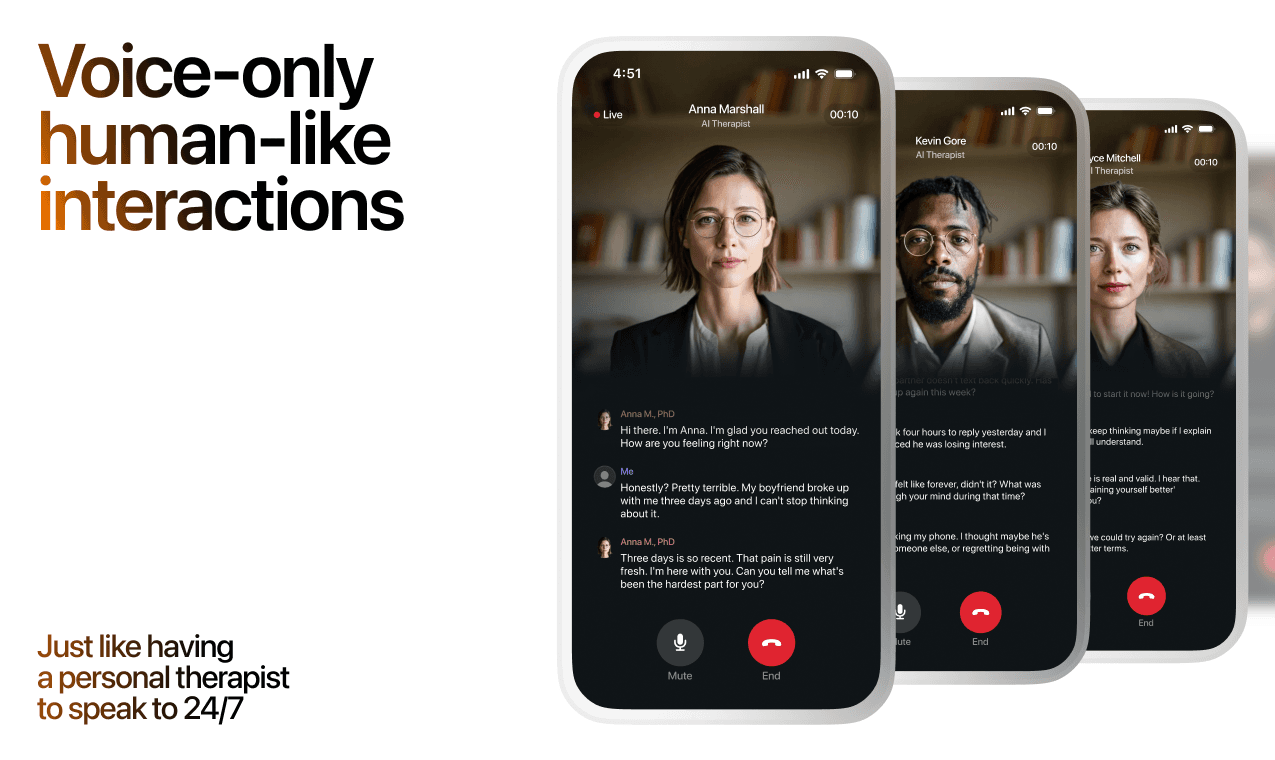
Here's what happens in a typical Lovon session:
You share what's on your mind
There's no script, no intake form, no waiting room. You speak or type whatever you're feeling — in your own words, at your own pace.
Lovon validates and explores
Using frameworks from CBT (Cognitive Behavioral Therapy) and motivational interviewing, Lovon acknowledges your feelings first, then gently helps you explore them. No dismissive "just move on" advice.
You build coping skills together
Lovon doesn't just listen — it actively works with you on evidence-based techniques: thought reframing, urge surfing, behavioral experiments, and more.
What a Session with Lovon Looks Like
When to Seek Professional Help
AI support is a valuable tool, but it's not a replacement for professional care. Please consider reaching out to a licensed therapist if you experience any of the following:
- Persistent thoughts of self-harm or suicide
- Inability to perform daily activities (work, eating, sleeping) for more than 2 weeks
- Turning to alcohol or substances to cope
- Intense anger or desire to harm your ex-partner
- Complete emotional numbness that doesn't improve over time
Crisis Resources (US): If you're in immediate danger, call 988 (Suicide & Crisis Lifeline) or text HOME to 741741 (Crisis Text Line). Available 24/7, free, and confidential.
Outside the US? Find a crisis line in your country
Ready to Start?
Your healing journey can begin right now
A 7-day trial. No judgment. Just a safe space to process what you're going through.
Frequently Asked Questions
Is Lovon a replacement for a real therapist?
Is my conversation with Lovon AI private?
How is Lovon different from ChatGPT for emotional support?
Can I use Lovon if I'm already seeing a therapist?
Can I try Lovon before subscribing?
About the Author
The Lovon Editorial Team
Mental Health & Wellness Content Team
The Lovon Editorial Team develops mental health and wellness content designed to make psychological concepts accessible and actionable. Our goal is to bridge the gap between clinical research and everyday life - helping you understand why your mind works the way it does and what you can do about it....
Related articles
- Why Do I Feel Anxious for No Reason? 2026 Guide
Anxious with no clear trigger? See the real causes behind free-floating anxiety in 2026 and the steps that calm your…
- Is My Partner Emotionally Unavailable Quiz: 2026 Verdict
Take the 12-question is my partner emotionally unavailable quiz, score your pattern, and get a 2026 verdict on whether…
- Catastrophizing About Relationship: How to Stop in 2026
Catastrophizing about your relationship? Get 7 steps to break the spiral in 2026, spot the thinking traps behind it, and…
- Anxious Attachment Triggers: How to Defuse Them (2026)
Anxious attachment triggers explained: a 6-step sequence to name, regulate, and defuse them in 2026, plus…
See also
Quizzes
- Rejection Sensitivity Test: Free 12-Question Check
See how strongly you expect and read rejection.
- Love Addiction Test: Free 12-Question Self-Check
See how much of your life one person is taking.
Free tools
- How to Tell Someone You Like Them
The wording depends on what you would lose. Tell it who they are to you and how you usually talk, and you get something…
- Breakup Message Writer
A chat for saying it once. Tell it how long it has been and why now, and get a message you could actually send, plus the…
From the wiki
- What is an attachment style?
An attachment style is the habit your nervous system formed for handling closeness: what you actually do when someone…
Disclaimer: This article is for informational purposes only and does not constitute medical advice, diagnosis, or treatment. Always seek the advice of your physician or other qualified health provider with any questions you may have regarding a medical condition. If you are in crisis or think you may have an emergency, call 988 (Suicide & Crisis Lifeline) or go to the nearest emergency room. Outside the US? Find a crisis line in your country.