
Love Bombing Signs: What They Mean in 2026
Learn the clearest love bombing signs — premature declarations, relentless contact, rushed commitment — and exactly what to do when you spot them in 2026.

Key Takeaways
- A clear memory (or a notes app) to log specific behaviors with dates
- Honest input from at least one trusted friend who has seen you two together
- Willingness to sit with discomfort — some of what you notice may hurt
- About 20 minutes to read this fully and reflect
- A private space to process what comes up
Love bombing feels like finally being chosen — until the control starts. This guide breaks down the clearest love bombing signs, explains why they're easy to miss, and walks you through what to do when you suspect you're caught in one.
TL;DR: Love bombing is a pattern where someone floods you with affection, attention, and grand gestures early in a relationship — not out of genuine connection, but to gain control. The clearest love bombing signs in 2026 include premature declarations of love, relentless contact, rapid push toward commitment, and intense jealousy when you need space. If something feels too much too fast, trust that instinct. Lovon's AI-powered support can help you sort through the confusion — talking through relationship red flags is a good first step.
Why this matters
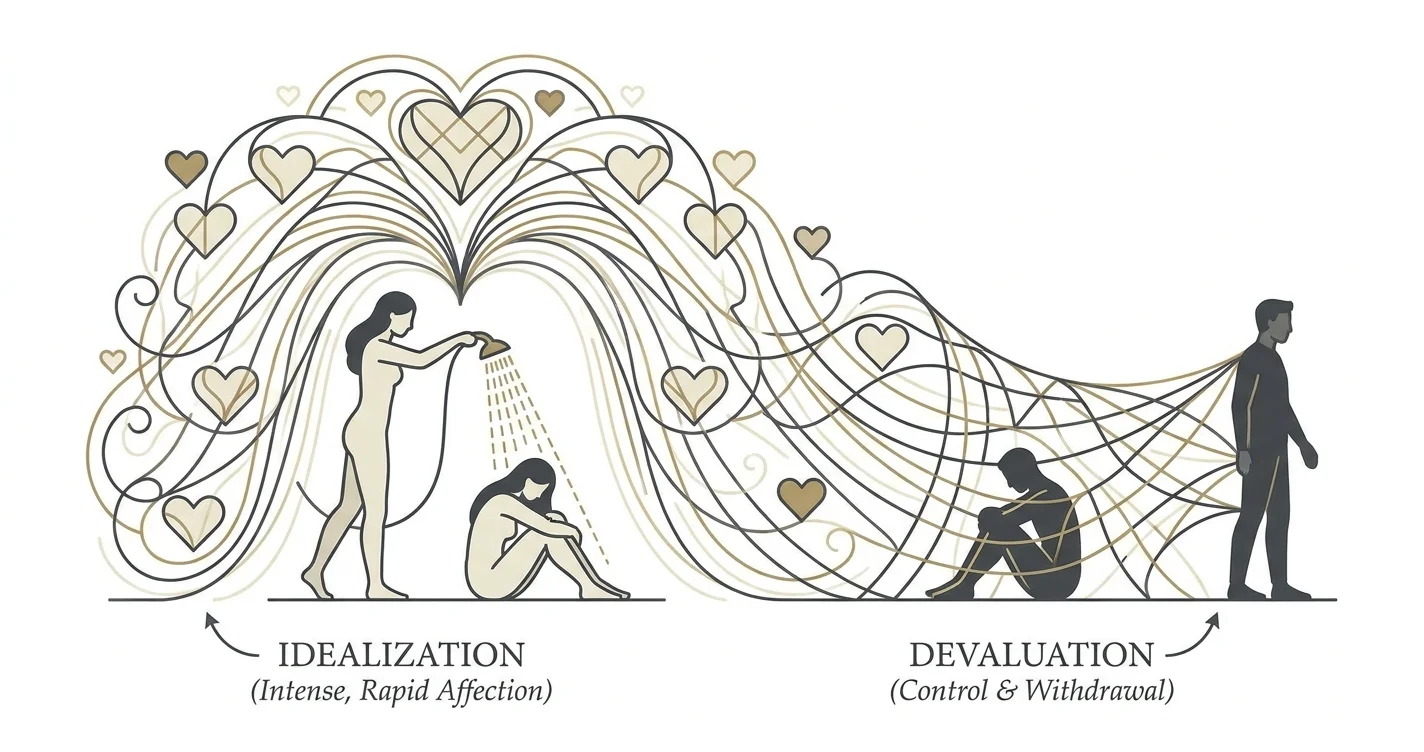
Researchers who study coercive control consistently identify love bombing as one of the earliest and most reliable predictors of future emotional abuse. A 2023 review published in Partner Abuse found that idealization followed by devaluation — the classic love bombing cycle — appears in the majority of documented abusive relationships. The problem is timing: by the time the devaluation hits, most targets have already built deep emotional dependency. Catching the signs early is the difference between a clean exit and a years-long recovery.
What you'll need before you start
- A clear memory (or a notes app) to log specific behaviors with dates
- Honest input from at least one trusted friend who has seen you two together
- Willingness to sit with discomfort — some of what you notice may hurt
- About 20 minutes to read this fully and reflect
- A private space to process what comes up
The steps: how to identify and respond to love bombing signs
Step 1: Map the timeline of intensity
Pull up your messages or your memory and answer one question: how fast did this escalate? Healthy attraction builds gradually over weeks and months as two people reveal themselves to each other. Love bombing compresses that arc into days. If you received "I've never felt this way about anyone" within the first two weeks, or if they were calling you "the one" before your first month together, write that down. Premature declarations of love are the single most cited love bombing sign in clinical literature. The speed itself is the red flag — not the warmth.
Common mistake: Dismissing the pace because the attention feels good. That feeling is exactly the mechanism. The goal of love bombing is to manufacture emotional debt before you've had time to evaluate the person clearly.
Step 2: Count the contact
Love bombers don't just reach out often — they make you feel guilty for not responding fast enough. In 2026, this shows up as triple-texting within minutes, calling when you don't reply to a text, checking your "last seen" status, or framing your normal availability as rejection. Track a 48-hour window and count unprompted contact attempts. A healthy early-stage partner respects that you have a life. A love bomber treats your independent life as a threat.
Expected outcome of this step: you'll likely find a pattern that feels flattering in isolation but suffocating in aggregate.
Common mistake: Interpreting constant contact as passion. Passion respects your time. Surveillance does not.
Step 3: Test their response when you pull back slightly
This is the most diagnostic step. The next time they reach out, wait two to three hours before replying — longer than usual, but not disappearing. Then watch what happens. A secure person notices the delay and moves on. A love bomber escalates: more messages, emotional withdrawal designed to trigger your anxiety, or direct accusations that you're pulling away or losing interest. Their inability to tolerate a small, normal gap in contact reveals the control dynamic underneath the affection.
Common mistake: Caving immediately when they escalate, which teaches them the escalation works.
Step 4: Check for manufactured exclusivity
Love bombers push for commitment — official relationship status, moving in together, meeting family — at a pace that bypasses your ability to make an informed decision. They frame urgency as romance: "I just know," "Why wait when this is real?" In 2026, this also shows up digitally: pressure to be listed as a partner on social media before you're ready, or distress when you haven't updated your status. Ask yourself: has any major relationship milestone been their idea on a timeline you didn't choose? If the answer is yes to more than one, that's a pattern, not a coincidence.
Common mistake: Mistaking their certainty for your certainty. Their confidence in the relationship is not evidence the relationship is safe.
Step 5: Audit their behavior toward others
Love bombers often have a history that's visible if you ask. How do they talk about their exes? Do past partners appear uniformly "crazy" or "ungrateful"? Do their friends describe them as intense or difficult? One conversation with someone who knew them before you did can surface years of behavioral data. You're not investigating them — you're collecting information that you deserve to have before deepening your investment.
Common mistake: Accepting their narrative about their past without any cross-reference.
Step 6: Name what you feel — not what you want to feel
This step is internal. Sit with the question: when you're with them, do you feel seen — or do you feel watched? Do you feel cherished — or do you feel obligated? Love bombing produces a specific emotional cocktail: euphoria mixed with low-grade anxiety, a sense of being special mixed with a fear of disappointing them. That combination is not what healthy early love feels like. Healthy early love is mostly warm, occasionally nervous, and fundamentally calm. If anxiety is a dominant thread, pay attention to it. Lovon's voice-based support is built for exactly this kind of reflection — working through narcissistic abuse signs and what they feel like from the inside is something many people find easier to do out loud.
Step 7: Decide on your next move with support
Once you've worked through steps 1–6, you have information. Now use it. Options range from a direct conversation about pace and boundaries, to a slow withdrawal, to a clean exit, depending on severity. If you've identified 4 or more of the love bombing signs above, a conversation about slowing down is unlikely to produce lasting change — love bombing is typically a deeply ingrained relational strategy, not a misunderstanding. The next step is either a firm boundary with a clear consequence, or an exit plan. Either way, do it with someone in your corner.
Common mistake: Giving one more chance without any behavioral evidence that change is possible.
Troubleshooting
"I confronted them and they said I'm being paranoid." This is a common response. Document the specific behaviors — dates, messages, actions — so your assessment is grounded in evidence, not feeling. If their reaction to your concern is dismissal or anger rather than curiosity, that response is itself diagnostic.
"They've started pulling back since I raised it, and now I want them back." This is the devaluation phase beginning. The sudden withdrawal after intense affection is designed to make you chase. Recognizing the pattern doesn't make the pull disappear, but it does let you make a conscious choice about whether to act on it.
"We've been together two years. Can love bombing still apply?" Yes. Long-term love bombing often cycles: idealization, then devaluation, then return to idealization when you threaten to leave. If the pattern repeats after conflict or boundary-setting, the relationship structure is still present even if the initial honeymoon phase is long past.
"I think I might be the one love bombing." This is worth examining honestly. If you've recognized your own behaviors here — relentless contact, jealousy when they need space, rushing milestones — the self-aware next step is to understand what's driving it. Anxiety, fear of abandonment, and insecure attachment styles are common roots, and all of them respond to support. The am I a narcissist quiz on Lovon is one honest starting point.
"My friends say he's great. Why don't I feel safe?" Love bombers are often publicly charming. Your friends see the performance; you live in the dynamic. Your private experience is valid data.
"I left but I keep second-guessing myself." This is normal and documented. Trauma bonding — the attachment that forms under cycles of intensity and withdrawal — is real and neurochemically similar to other forms of dependency. Give yourself time, structure, and external support rather than trying to resolve it through contact with them.
Tools and resources
- A behavior log — a private notes app where you record specific incidents with dates. Concrete records counteract the gaslighting and self-doubt that often accompany love bombing.
- A trusted outside perspective — one friend or family member who will tell you the truth, not what you want to hear.
- Lovon — voice conversations with an AI voice companion, available any time, built for exactly the kind of emotional processing that love bombing confusion requires. Particularly useful at 2 a.m. when you want to talk it through before you text them back.
- The National Domestic Violence Hotline — if the situation has escalated beyond emotional pressure into threats or control of resources, reach out at 1-800-799-7233 (available 24/7 in 2026).
What to do next
If you've read this and recognized your relationship in more than three steps, the single most useful next move is to talk it through with someone who won't minimize it. Lovon's app is available around the clock for exactly this. You might also want to read about covert narcissist signs and how to protect yourself — love bombing and covert narcissism overlap significantly, and understanding both gives you a fuller picture.
FAQ
What are the most common love bombing signs? The clearest love bombing signs are: premature declarations of love (within the first two weeks), relentless contact with guilt-tripping when you don't respond, pressure to commit to milestones — moving in, exclusivity, meeting family — before you're ready, and intense jealousy or distress when you need space. Most targets report the combination feels overwhelming but also flattering, which is exactly why it works.
Is love bombing always intentional? Not always consciously. Some people love bomb because of anxious or disorganized attachment styles formed in childhood — they genuinely feel what they're expressing, but their intensity is driven by fear of abandonment rather than real knowledge of you. Whether or not it's intentional, the effect on you is the same: manufactured dependency before you have enough information to consent to it.
How is love bombing different from just being really into someone? The key difference is respect for your pace. Someone who is genuinely excited about you will still accept "I need a bit of space" without escalating. A love bomber can't. Genuine enthusiasm wants to know you. Love bombing wants to own you.
Can love bombing happen in long-term relationships? Yes. In long-term relationships, it often appears as a cycle: love bombing returns after a period of distance, devaluation, or when you threaten to leave. If the affection surges reliably when you pull back and drops when you're fully available, that pattern is the signal.
What does love bombing feel like from the inside? Most people describe a mix of being deeply seen and vaguely uneasy — like wearing a costume that's slightly too tight. There's often a background anxiety about disappointing them, even early on. If your dominant emotional experience is relief when they're happy with you rather than simple enjoyment of the relationship, that ratio is worth examining.
How long does the love bombing phase last? It varies. Some cases last a few weeks; others persist for months before the first devaluation. The shift is usually triggered by the target establishing any boundary or showing independence. In 2026, research on coercive control patterns suggests the idealization phase ends faster in relationships where the target has a strong external support network — another reason your friendships and outside life matter.
Should I confront a love bomber directly? A calm, specific conversation about pace and boundaries is reasonable as a first step. Say what you need — more space, a slower timeline — and observe the response. If they hear you and adjust, that's meaningful. If they respond with defensiveness, guilt-tripping, or a brief compliance followed by return to the same behavior, you have your answer.
When does love bombing cross into abuse? Love bombing itself is a form of emotional manipulation. It crosses into recognized abuse when it's paired with isolation from friends and family, monitoring of your communications, financial control, or threats. If any of those elements are present alongside the love bombing signs above, contact the National Domestic Violence Hotline at 1-800-799-7233.
One last thing
The hardest part of identifying love bombing signs isn't the recognition — it's the grief that follows. You're not mourning the person; you're mourning the relationship you thought you had. That loss is real even if the connection wasn't. In 2026, more people are naming this experience publicly than ever before, which means more support exists for it than ever before. You're not alone in this, and confusion about it doesn't mean you're weak — it means the pattern worked exactly as designed.
Related guides
How AI Support Helps You Heal
AI emotional support isn't about replacing human connection — it's about filling the gaps. The moments when you need to talk at 2 AM, when you don't want to burden your friends again, or when you simply need someone to listen without judgment.
Here's what happens in a typical Lovon session:
You share what's on your mind
There's no script, no intake form, no waiting room. You speak or type whatever you're feeling — in your own words, at your own pace.
Lovon validates and explores
Using frameworks from CBT (Cognitive Behavioral Therapy) and motivational interviewing, Lovon acknowledges your feelings first, then gently helps you explore them. No dismissive "just move on" advice.
You build coping skills together
Lovon doesn't just listen — it actively works with you on evidence-based techniques: thought reframing, urge surfing, behavioral experiments, and more.
What a Session with Lovon Looks Like

When to Seek Professional Help
AI support is a valuable tool, but it's not a replacement for professional care. Please consider reaching out to a licensed therapist if you experience any of the following:
- Persistent thoughts of self-harm or suicide
- Inability to perform daily activities (work, eating, sleeping) for more than 2 weeks
- Turning to alcohol or substances to cope
- Intense anger or desire to harm your ex-partner
- Complete emotional numbness that doesn't improve over time
Crisis Resources (US): If you're in immediate danger, call 988 (Suicide & Crisis Lifeline) or text HOME to 741741 (Crisis Text Line). Available 24/7, free, and confidential.
Outside the US? Find a crisis line in your country
Ready to Start?
Your healing journey can begin right now
A 7-day trial. No judgment. Just a safe space to process what you're going through.
Frequently Asked Questions
Is Lovon a replacement for a real therapist?
Is my conversation with Lovon AI private?
How is Lovon different from ChatGPT for emotional support?
Can I use Lovon if I'm already seeing a therapist?
Can I try Lovon before subscribing?
About the Author
The Lovon Editorial Team
Mental Health & Wellness Content Team
The Lovon Editorial Team develops mental health and wellness content designed to make psychological concepts accessible and actionable. Our goal is to bridge the gap between clinical research and everyday life - helping you understand why your mind works the way it does and what you can do about it....
Related articles
- Narcissist Gaslighting: Narcissistic Gaslighting Signs and Examples
You had good arguments, but by the end of the discussion, you were apologizing and wondering if you are the problem.
- Love Bombing: Is it Love or a Red Flag? Signs It's Gone Bad
It is normal to want to feel adored and swept off your feet early in the relationship. However, there is a distinct…
- Gaslighting in Relationships: 12 Signs to Watch (2026)
Gaslighting in relationships signs, explained clearly: 12 patterns to check, common mistakes, and what to do next…
- Passive Aggressive Partner: How to Recognize It (2026)
Learn how to spot a passive aggressive partner in 2026 — silent treatment, sarcasm, and stonewalling patterns explained…
See also
Quizzes
- Is My Relationship Healthy? 15-Question Check-In
Check your relationship health in 3 minutes.
- Are They a Red Flag? 10 Questions to Check Your Partner
Check your partner in 3 minutes.
Free tools
- How to Respond to Gaslighting
Say what happened and what they say happened. You get what is actually established separated from what is being…
- How to Confront a Narcissistic Parent
Most of these conversations fail because you went in wanting three things at once. Tell it what you want to raise, and…
From the wiki
- How to leave a toxic relationship?
Leaving a toxic relationship is rarely a decision problem — you usually know. What stops you is that the pull toward…
Disclaimer: This article is for informational purposes only and does not constitute medical advice, diagnosis, or treatment. Always seek the advice of your physician or other qualified health provider with any questions you may have regarding a medical condition. If you are in crisis or think you may have an emergency, call 988 (Suicide & Crisis Lifeline) or go to the nearest emergency room. Outside the US? Find a crisis line in your country.