
Narcissistic Gaslighting: Examples & Responses (2026)
Narcissistic gaslighting erodes your reality over time. See 6 real-word-for-word examples, a 6-step response plan, and tools to rebuild self-trust in 2026.
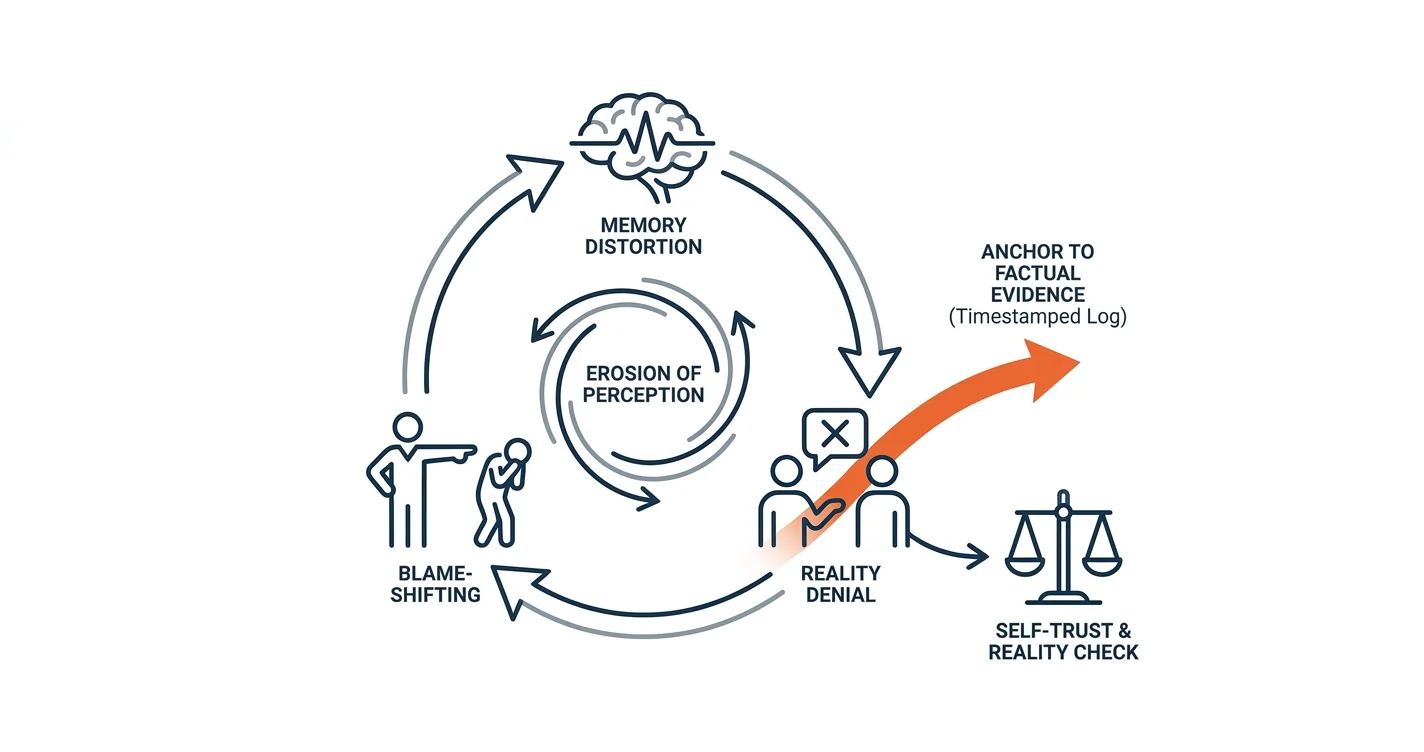

Key Takeaways
- A private journal or notes app (not shared with the person you're concerned about)
- 15–30 minutes of uninterrupted time per session
- A trusted person outside the relationship you can reality-check with
- Willingness to treat your own memory as credible evidence
- Access to a support tool — Lovon's AI-powered voice sessions offer on-demand emotional processing when talking to a
Narcissistic gaslighting is one of the most disorienting forms of emotional manipulation — it doesn't just distort individual arguments, it erodes your grip on reality over time. This guide names the specific tactics, gives you word-for-word examples, and walks you through exactly how to respond in 2026.
TL;DR: Narcissistic gaslighting combines reality denial, memory distortion, and blame-shifting to make you doubt your own perception. Common examples include "That never happened," "You're too sensitive," and "Everyone agrees you're the problem." The most effective responses anchor you to documented facts, set hard conversational limits, and build an external reality check outside the relationship. If you're unsure whether what you're experiencing qualifies, the am I dating a narcissist quiz on Lovon is a structured starting point.
Why This Matters in 2026
Research from the Journal of Personality Disorders shows gaslighting is present in roughly 30–40% of reported narcissistically abusive relationships. The damage isn't dramatic — it accumulates in small, deniable moments until you stop trusting your own memory, instincts, and emotional reactions. Understanding the exact mechanics is the first step to dismantling them.
What You'll Need
Before working through the steps below, gather these:
- A private journal or notes app (not shared with the person you're concerned about)
- 15–30 minutes of uninterrupted time per session
- A trusted person outside the relationship you can reality-check with
- Willingness to treat your own memory as credible evidence
- Access to a support tool — Lovon's AI-powered voice sessions offer on-demand emotional processing when talking to a person isn't immediately possible
The Core Steps
Step 1: Identify the Specific Tactic Being Used
Narcissistic gaslighting is not one behavior — it's a cluster of 6 distinct tactics. You need to name the one in play before you can counter it.
The 6 tactics with word-for-word examples:
- Flat denial — "That never happened." / "I never said that."
- Reality minimization — "You're so sensitive." / "You always blow everything out of proportion."
- Memory distortion — "You remember it wrong." / "You were drunk, you don't know what you heard."
- Deflection via counter-accusation — "Why are you trying to start a fight?" / "This is exactly why nobody takes you seriously."
- Third-party weaponization — "Even your sister thinks you're too emotional." / "I talked to your friends — they agree with me."
- Identity attack — "You've always been unstable." / "This is just your anxiety making things up."
Write down which category the last 3 incidents fall into. Patterns are more diagnostic than individual events.
Expected outcome: You shift from feeling confused to seeing a repeating script. The confusion is the point of gaslighting — naming the tactic breaks its mechanism.
Common mistake: Treating each incident as isolated. Gaslighting works through accumulation. One "you're too sensitive" is feedback; twelve is a campaign.
Step 2: Build a Real-Time Evidence Log
Your memory is the target. Protect it with documentation.
Date and timestamp every significant incident within 30 minutes of it happening. Write the exact words used, your emotional state, and any witnesses or context. Keep this log somewhere the other person cannot access — a private app, a locked note, a journal at a friend's place.
In 2026, voice memos timestamped on your phone are admissible in therapy contexts and in many legal jurisdictions. A voice memo narrated immediately after an incident carries more weight than a reconstructed account written days later.
Expected outcome: You have a factual record that cannot be re-narrated. When they say "That never happened," you have a dated entry proving it did.
Common mistake: Logging only the big blowups. The low-grade, everyday minimizations are what normalize the dynamic. Log those too.
Step 3: Apply the Gray Rock Method in the Moment
Gray rock means becoming uninteresting as a target — flat, non-reactive, brief. This is not about suppressing your feelings; it's a tactical choice to deny the gaslighter the emotional response that fuels the behavior.
In practice:
- Keep responses under 10 words when possible: "I see it differently." / "That's not how I remember it."
- Don't justify, over-explain, or try to convince. Convincing requires accepting their frame.
- Do not DARVO with them — don't defend, attack, or deny in kind. That's their script, not yours.
- End conversations that devolve: "I'm not able to continue this right now" is a complete sentence.
The goal in 2026 is not to win the argument. It's to stop investing energy in a conversation designed to make you lose.
Expected outcome: Fewer extended spirals. Gaslighting is high-effort and requires your engagement. Withdraw it, and the tactic becomes less rewarding.
Common mistake: Trying to present evidence in the moment. "But I have it in writing" rarely resolves a gaslighting episode — it escalates it. The log is for you, not for winning arguments with them.
Step 4: Establish a Reality Anchor Outside the Relationship
Gaslighting is most effective in isolation. One trusted external perspective — a therapist, a close friend who knows the situation, a support community — is a structural defense, not just emotional comfort.
This person needs to know enough context to say "Yes, what you described sounds like X" or "Actually, I think you may have misread that." Both are useful. The goal is a reality-check function, not a validation machine.
If in-person support isn't immediately accessible, Lovon's free AI therapist for relationship problems provides a private, judgment-free space to process incidents in real time — available at 2 a.m. when the spiral happens, not just during office hours.
Expected outcome: Your self-trust recovers faster when it's periodically calibrated against an external reference point.
Common mistake: Only using support reactively (after a bad episode). Schedule regular check-ins so your baseline perception stays grounded, not just your crisis moments.
Step 5: Set Behavioral Limits, Not Emotional Demands
Telling a narcissist "You need to stop gaslighting me" is a non-starter. It requires their agreement on a shared definition of reality — which gaslighting, by design, makes impossible.
Instead, set behavioral limits that are specific, observable, and self-enforceable:
- "If this conversation continues to include claims about what I remember or feel, I'm leaving the room."
- "I won't discuss this topic without a third party present."
- "If you bring up [specific person's] opinion as evidence of my credibility, I'm ending the call."
Behavioral limits don't require the other person's buy-in. They only require you to follow through. Follow-through, not the limit itself, is the active ingredient.
Expected outcome: You reduce your exposure to the tactic without requiring the other person to change. In 2026, this is the most clinically supported short-term intervention for people in relationships with high-conflict personality traits.
Common mistake: Setting limits you won't enforce. An unenforced limit accelerates the dynamic because it demonstrates that consequences are theoretical.
Step 6: Decide on the Relationship's Future With Clear Eyes
Gaslighting from a narcissistic person rarely stops without significant external intervention — typically structured therapy for the gaslighter, not just the target. The research on behavior change in narcissistic personality disorder is sobering: studies published in 2024 in Clinical Psychology Review estimate sustained behavioral change rates under 30% even with active treatment.
Your decision doesn't have to happen today. But it needs to be made with accurate information, not with the distorted self-image that months of gaslighting may have produced.
Three honest questions to ask yourself:
- Has the behavior decreased, stayed flat, or escalated over the last 6 months?
- Are you spending more mental energy managing their perception of reality than living your actual life?
- Does your self-trust feel intact when you're away from them — or does it return only to erode again when you're back?
If you want to check patterns before making any decision, the am I a narcissist quiz on Lovon also helps you rule out whether any of these patterns may run in both directions — worth doing with honest self-reflection.
Expected outcome: Clarity. Not necessarily an easy answer, but a real one.
Common mistake: Waiting for a "final" incident that proves it definitively. Gaslighting creates ambiguity by design. You don't need a smoking gun to trust the pattern you've already documented.
Troubleshooting
"I can't tell if it's gaslighting or if I actually am misremembering things." Both can be true. Start the evidence log before concluding either way. After 2–3 weeks of dated documentation, review it with someone outside the relationship. Pattern clarity comes from volume, not from a single incident.
"The gray rock method makes me feel shut down and numb." Gray rock is a tactic for specific high-conflict exchanges, not a permanent emotional posture. Use it surgically — during the loop, not all the time. Process the suppressed feelings afterward in a safe space.
"They agreed they gaslighted me, then did it again the next week." Acknowledgment without behavioral change is part of the cycle for high-narcissism personalities. Acknowledge the acknowledgment and track behavior, not promises.
"My therapist doesn't seem to take this seriously." Find a therapist with explicit training in high-conflict personality dynamics or coercive control. The modality matters. A general CBT practitioner may not recognize the specific pattern.
"I've set limits but I always cave." That's a self-compassion and nervous system issue, not a character flaw. Caving under pressure when you're trauma-bonded is a physiological response. Work the limits in low-stakes moments first to build the behavioral muscle.
"I'm out of the relationship but I still doubt my memories of it." Post-relationship gaslighting effects can persist for 12–18 months post-separation according to trauma specialists. This is normal. Consistent external reality-checking and trauma-informed support accelerate recovery.
Tools and Resources
- Evidence log: Any timestamped private notes app (iOS Notes in locked mode, Bear, Day One)
- Reality anchor: A trauma-informed therapist, a domestic abuse hotline counselor, or a trusted person with context
- On-demand support: Lovon's AI voice support app — available 24/7 for processing relationship distress between therapy sessions
- Pattern identification: Are they a red flag quiz on Lovon — structured questions that surface behavioral patterns you may be normalizing
- Crisis support: National Domestic Violence Hotline — 1-800-799-7233 (24/7, US)
What to Do Next
If you've worked through the steps above and still feel uncertain whether the relationship has a viable path, the practical next move is a full attachment and relationship pattern assessment. Understanding your own attachment style — particularly if you carry anxious or fearful-avoidant patterns — tells you why gaslighting hits you as hard as it does and what makes you more susceptible to this dynamic.
FAQ
What is narcissistic gaslighting? Narcissistic gaslighting is a manipulation tactic used by people with narcissistic traits to make you doubt your own memory, perception, and emotional responses. It involves repeated denial of events, minimization of your feelings, and blame-shifting designed to keep you dependent on their version of reality.
What are the most common examples of narcissistic gaslighting? The most frequently cited examples are: "That never happened," "You're too sensitive," "You're imagining things," "Everyone agrees you're the problem," and "You've always been unstable." These phrases appear across relationship types — romantic, family, and workplace dynamics.
How do you respond to gaslighting without escalating? Use short, neutral statements that don't accept the reframe: "I see it differently" or "That's not my recollection." Avoid justifying your memory — that concedes the premise that it needs defending. End conversations that go in circles rather than arguing to resolution.
Can you gaslight someone without being a narcissist? Yes. Gaslighting behavior can occur without a narcissistic personality disorder diagnosis. The difference is frequency, intent, and whether the person is capable of genuine accountability when confronted. Occasional deflection is not the same as a sustained campaign of reality distortion.
How long does it take to recover from narcissistic gaslighting? Recovery timelines vary significantly. Trauma specialists report that most people experience meaningful reduction in self-doubt within 6–12 months of leaving the relationship and engaging consistent support. Full restoration of self-trust can take longer depending on the duration of exposure.
Is narcissistic gaslighting considered emotional abuse? Yes. Mental health clinicians and legal frameworks in many US states categorize sustained gaslighting as a form of coercive control and emotional abuse. The National Domestic Violence Hotline explicitly includes it under psychological abuse.
What's the difference between gaslighting and lying? Lying is an attempt to change what you believe about an external fact. Gaslighting targets your confidence in your own perception and mental reliability. The goal isn't just to mislead — it's to make you unable to trust your own judgment so you defer to the gaslighter's version of events.
How do I know if I'm being gaslighted or if I actually have a bad memory? Start a dated evidence log immediately after incidents — before discussing them with the other person. Retrospective review of a 2–4 week log with a trusted third party is the most reliable diagnostic. If the log shows consistent patterns of denial of documented events, that's not a memory problem.
One Last Thing
Gaslighting doesn't announce itself. Research on coercive control patterns from 2023 found that the median time from relationship start to the target first labeling the behavior as "gaslighting" is 2.4 years. The most common reason for the delay: the target assumed the confusion was their own fault. It almost never is. The fact that you're reading this page and applying the term suggests your perception is working exactly as it should.
Related Guides
How AI Support Helps You Heal
AI emotional support isn't about replacing human connection — it's about filling the gaps. The moments when you need to talk at 2 AM, when you don't want to burden your friends again, or when you simply need someone to listen without judgment.
Here's what happens in a typical Lovon session:
You share what's on your mind
There's no script, no intake form, no waiting room. You speak or type whatever you're feeling — in your own words, at your own pace.
Lovon validates and explores
Using frameworks from CBT (Cognitive Behavioral Therapy) and motivational interviewing, Lovon acknowledges your feelings first, then gently helps you explore them. No dismissive "just move on" advice.
You build coping skills together
Lovon doesn't just listen — it actively works with you on evidence-based techniques: thought reframing, urge surfing, behavioral experiments, and more.
What a Session with Lovon Looks Like

When to Seek Professional Help
AI support is a valuable tool, but it's not a replacement for professional care. Please consider reaching out to a licensed therapist if you experience any of the following:
- Persistent thoughts of self-harm or suicide
- Inability to perform daily activities (work, eating, sleeping) for more than 2 weeks
- Turning to alcohol or substances to cope
- Intense anger or desire to harm your ex-partner
- Complete emotional numbness that doesn't improve over time
Crisis Resources (US): If you're in immediate danger, call 988 (Suicide & Crisis Lifeline) or text HOME to 741741 (Crisis Text Line). Available 24/7, free, and confidential.
Outside the US? Find a crisis line in your country
Ready to Start?
Your healing journey can begin right now
A 7-day trial. No judgment. Just a safe space to process what you're going through.
Frequently Asked Questions
Is Lovon a replacement for a real therapist?
Is my conversation with Lovon AI private?
How is Lovon different from ChatGPT for emotional support?
Can I use Lovon if I'm already seeing a therapist?
Can I try Lovon before subscribing?
About the Author

The Lovon Editorial Team
Mental Health & Wellness Content Team
The Lovon Editorial Team develops mental health and wellness content designed to make psychological concepts accessible and actionable. Our goal is to bridge the gap between clinical research and everyday life - helping you understand why your mind works the way it does and what you can do about it....
Related articles
- Narcissistic Relationships — Deflection and Reality Reframing Tactics
Narcissistic relationships often begin subtly, without the obvious red flags many expect to see. What starts as…
- Narcissistic and Emotionally Immature Parents — Communication Manipulation Patterns
Growing up with narcissistic and emotionally immature parents often means navigating a minefield of confusing…
- Future Faking in Relationships: Red Flags & Recovery 2026
Future faking in relationships means empty promises used to avoid real commitment. Learn the 2026 red flags…
- Narcissistic Relationship: 9 Signs You're Dating a Narcissist
Most people do not know they are in a narcissistic relationship until they are already very involved.
See also
Quizzes
- Is My Relationship Healthy? 15-Question Check-In
Check your relationship health in 3 minutes.
- Are They a Red Flag? 10 Questions to Check Your Partner
Check your partner in 3 minutes.
Free tools
- How to Respond to a Narcissist
Paste what they said. You get the part that actually needs answering separated from the part designed to pull you in, a…
- What to Say Back to a Hostile Co-Parent
A chat, not a form. Paste the message your ex sent about the kids, say what actually has to be decided, and you get a…
From the wiki
- How to leave a toxic relationship?
Leaving a toxic relationship is rarely a decision problem — you usually know. What stops you is that the pull toward…
Disclaimer: This article is for informational purposes only and does not constitute medical advice, diagnosis, or treatment. Always seek the advice of your physician or other qualified health provider with any questions you may have regarding a medical condition. If you are in crisis or think you may have an emergency, call 988 (Suicide & Crisis Lifeline) or go to the nearest emergency room. Outside the US? Find a crisis line in your country.