
Toxic Parent Patterns: Signs & How to Set Limits (2026)
Recognize toxic parent patterns — manipulation, enmeshment, conditional love — and follow 7 concrete steps to set limits that actually hold in 2026.
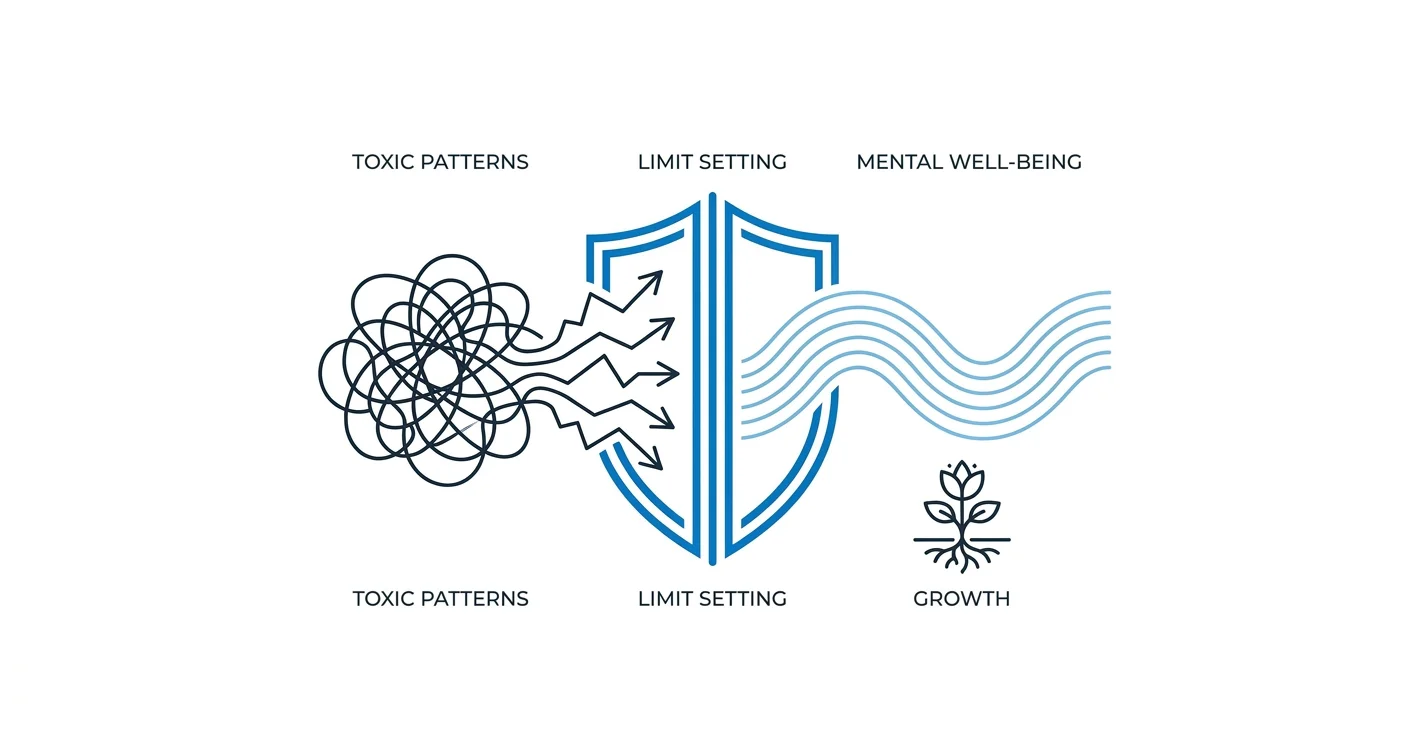

Key Takeaways
- A private space to reflect — journal, notes app, or just quiet time
- At least 20–30 minutes per step, especially steps 1 and 3
- Willingness to sit with discomfort without resolving it immediately
- A support person you trust, or access to a mental health resource (more on this at the end)
- Patience — limit-setting with a parent is a process measured in weeks and months, not one conversation
Growing up with a toxic parent is disorienting because the harm often looks like love — or at least like a normal family. This guide names the most common toxic parent patterns, helps you tell the difference between difficult and damaging, and gives you concrete steps to set limits that actually hold.
TL;DR: Toxic parent patterns include emotional manipulation, conditional love, guilt-tripping, enmeshment, and consistent invalidation of your feelings. In 2026, more adults are recognizing these patterns and doing something about them — not by cutting ties overnight, but by learning what limits to draw and how to hold them. If you grew up walking on eggshells, this guide is your starting point.
Why this matters
A 2023 study published in Child Abuse & Neglect found that adults who experienced emotional invalidation in childhood show significantly higher rates of anxiety and depression in adulthood — even when no physical abuse occurred. The damage is real, and it compounds over decades when left unnamed. Calling a behavior a pattern is the first step to changing how you respond to it.
What you'll need
Before working through these steps, have the following:
- A private space to reflect — journal, notes app, or just quiet time
- At least 20–30 minutes per step, especially steps 1 and 3
- Willingness to sit with discomfort without resolving it immediately
- A support person you trust, or access to a mental health resource (more on this at the end)
- Patience — limit-setting with a parent is a process measured in weeks and months, not one conversation
The Steps
Step 1: Name the patterns you're actually dealing with
Vague awareness ("my parent is toxic") does not protect you. Specific pattern recognition does. Work through this list and mark what you've experienced consistently — not once, but as a recurring dynamic.
The 7 most common toxic parent patterns in 2026:
- Emotional manipulation — using guilt, silence, or threats to control your choices. Example: "After everything I've done for you, this is how you treat me."
- Conditional love — affection that appears only when you comply and disappears when you don't. This teaches children that love must be earned, not given.
- Enmeshment — treating you as an extension of themselves rather than a separate person. Your achievements are their achievements; your failures are personal attacks on them.
- Invalidation — dismissing or mocking your emotions. "You're too sensitive." "Stop being dramatic." Over time, you stop trusting your own feelings.
- Role reversal (parentification) — leaning on you for emotional support as if you were the parent. Common in single-parent households, but damaging regardless of circumstance.
- Volatility — unpredictable moods that keep you in a permanent state of alert. You spend energy managing their emotional state instead of your own.
- Narcissistic control — conversations always return to them; your needs are minimized or dismissed as selfish. If this pattern feels familiar, the article on narcissistic abuse signs goes deeper.
Write down which patterns appear in your relationship. Naming them on paper reduces the emotional fog.
Step 2: Separate the past from the present
This is harder than it sounds. Many adults carry a child's nervous system into adult interactions with their parents — the moment a parent uses a familiar tone, the old fear response fires before rational thought catches up.
Ask yourself: Am I reacting to what just happened, or to what this moment reminds me of?
This distinction matters for limit-setting. If you react from the old wound, your limits will sound like emotional outbursts to the other person. If you respond from the present moment, your limits sound like adult decisions — which is what they are.
Practice this by writing a two-column list: what the parent did (concrete behavior) versus how it made you feel (your internal response). Keep the columns separate. Both are valid, but they serve different functions in the conversation you'll eventually have.
Step 3: Define your actual limits — before any conversation
Most people think setting limits means rehearsing what to say. It actually starts with knowing what you will and won't do, regardless of what the other person says or feels.
Limits are about your behavior, not theirs. You cannot limit what they do; you can only decide what you'll do in response.
Be specific. Vague limits collapse under pressure. Compare:
- Vague: "I need more respect."
- Specific: "I won't stay on a phone call where I'm being yelled at. I'll say I'm hanging up and then I will."
Write 3–5 specific limits before you have any conversation. Each one should follow this structure: If [behavior], then I will [action].
Common examples:
- If they bring up past mistakes to win an argument, I'll say "I'm not discussing that" and redirect or leave.
- If a holiday visit becomes a guilt session, I'll leave after 2 hours rather than 6.
- If they call after 9pm to vent, I won't answer and I'll call back the next morning.
Step 4: Have the conversation — once, calmly
You don't owe your parent a debate. You're sharing what you will do going forward, not asking for permission.
Keep it short. A limit statement should be 2–3 sentences: "I want to have a better relationship with you. When this behavior happens, I'm going to respond this way. I'm not trying to punish you — I just need this to change for us to keep spending time together."
Expect pushback. Toxic parent patterns almost always include resistance to any limit — guilt, tears, rage, or complete dismissal. That resistance is not evidence that your limit is wrong. It is evidence that the pattern is real.
Say what you said once. Do not argue. Do not over-explain. The explanation is not the limit — the follow-through is.
Step 5: Follow through every single time
This is where most people lose the progress they made in steps 1–4.
If you say you'll leave and you don't, the limit disappears. If you say you won't answer calls after 9pm and you do, your parent learns that persistence works. Limits only exist in behavior, not in words.
The first few times will feel cruel. You may feel overwhelming guilt, especially if your parent cries or says you've abandoned them. That guilt is the old conditioning doing its job. It does not mean you're doing something wrong.
Expect a pattern escalation before things settle. Research on family systems consistently shows that when one member changes their behavior, the system pushes back hard before it adjusts. Knowing this in advance makes the pressure easier to endure.
Step 6: Build a support structure outside the family
Setting limits with a toxic parent is emotionally expensive. You need somewhere to process what comes up — someone who isn't inside the family system.
This could be a therapist, a trusted friend, a support group for adult children of difficult parents, or a mental health app you can talk to between sessions. In 2026, on-demand emotional support is more accessible than it's ever been. Lovon's AI voice support app is built specifically for situations like this — you can talk through what happened after a hard call with a parent at 11pm, without waiting for a Thursday appointment.
The key is consistency. Processing once a week is not enough when you're actively changing a 20- or 30-year dynamic. You need regular check-ins with yourself.
Step 7: Revisit and adjust — limits are not permanent declarations
A limit you set in January 2026 may look different by June. That's not failure. Relationships shift, your own needs shift, and some limits turn out to be more restrictive than necessary while others need to be tighter.
Review your limits every 60–90 days. Ask: Is this limit still protecting what I intended it to protect? Has anything changed in the relationship that makes it worth adjusting?
Some adults move toward lower-contact arrangements. Others find that firm, consistent limits actually restore some warmth to the relationship once the parent realizes the dynamic has genuinely changed. Neither outcome is guaranteed, but both are possible.
Troubleshooting
"I set a limit and my parent said I was being abusive." This is a manipulation tactic, not an accurate description. Deciding how you'll spend your time and what treatment you'll accept is not abuse. You don't need to defend it.
"I can't enforce limits because I'm financially dependent on my parent." This is a real constraint, not an excuse. Work on financial independence as a parallel goal. In the meantime, set limits in areas that don't trigger financial consequences, and build the rest gradually.
"My parent is elderly or sick, and I feel guilty about any limits." Illness doesn't cancel the harm. You can be caring and present without accepting behaviors that damage you. Limits can look like: "I'll visit every Sunday but I won't stay if the conversation becomes an argument."
"I've tried this and my parent just pretends the conversation never happened." Stop re-explaining. Let the behavior do the work. When the behavior happens, execute the limit. Don't reference the conversation again — just act.
"I'm not sure if my parent is toxic or just difficult." Difficult parents make mistakes, have bad days, and sometimes say things they regret. Toxic patterns are consistent, deny harm, and resist change even when the impact is clearly visible. If you're unsure, look for the pattern over time, not the single incident.
"I feel like I'm grieving something." You are. Recognizing that you didn't get the parent you needed is a real loss. That grief is valid and it coexists with the work of setting limits. Don't rush through it. The fawn response article on the Lovon blog covers one of the most common ways people adapt to exactly this kind of early environment.
Tools and resources
- Journal or notes app — essential for steps 1 and 3
- Trusted support person — someone outside the family who can witness your process without taking sides
- Lovon — the AI voice support app for on-demand emotional support between sessions or when you need to process something at an odd hour
- Adult Children of Alcoholics and Dysfunctional Families (ACA) — free peer support groups, widely available in 2026 both in-person and online
- Adult Children of Emotionally Immature Parents by Lindsay C. Gibson, PsyD — a widely cited clinical resource on this topic, readable for non-clinicians
- A licensed therapist who specializes in family of origin work, particularly if you're dealing with complex trauma
FAQ
What are the most common toxic parent patterns? The most common are emotional manipulation, conditional love, guilt-tripping, enmeshment, invalidation, volatility, and parentification. These patterns are consistent — not occasional bad days — and they leave lasting effects on how you relate to yourself and others in adulthood.
Can a toxic parent change? Some do, particularly when they have genuine insight and access to support. Most do not change without significant external pressure or their own therapeutic work. Setting limits is not about changing your parent — it's about protecting yourself whether they change or not.
Is it normal to feel guilty after setting limits with a parent? Yes, and it is almost universal. Guilt is the mechanism toxic parent patterns use to survive. Feeling guilty does not mean you've done something wrong. It means the conditioning is working as intended. The guilt typically decreases once you've held a limit several times.
What's the difference between a toxic parent and a narcissistic parent? Narcissistic parenting is a specific subset of toxic patterns — one defined by an inability to see the child as separate, a need for constant admiration, and a lack of empathy. Toxic parent patterns is a broader category that includes narcissism but also covers emotionally immature, parentifying, or chronically volatile behavior that doesn't meet the clinical bar for narcissistic personality disorder.
What does conditional love look like from a parent? It looks like warmth and approval when you perform, achieve, or comply — and withdrawal, silence, or criticism when you don't. The child learns that love depends on behavior. In adulthood this often shows up as people-pleasing, anxiety around disapproval, and difficulty trusting that anyone's affection is unconditional.
When should I consider low or no contact? When limits have been consistently communicated, consistently violated, and the contact itself is causing measurable harm to your mental health. Low or no contact is a limit, not a punishment. It is appropriate when every other limit has failed and the relationship remains damaging rather than merely difficult.
How long does it take to recover from toxic parent patterns? There is no universal timeline. Adults who recognize these patterns in their 20s and do consistent therapeutic work often report meaningful shifts within 1–2 years. Those who begin the work later, or who are still in regular contact with the toxic parent, typically need more time. Recovery is not linear.
Can talking to an AI therapist help with parent relationship issues? For processing thoughts between sessions, practicing what you want to say, or getting support at an hour when a human therapist isn't available, yes — an AI voice support app like Lovon can be a useful tool. It is not a substitute for clinical care, especially in cases involving complex trauma or significant mental health symptoms.
What to do next
If you've read this far, you already know more than you did an hour ago — and that knowledge is the thing toxic parent patterns most depend on you not having. The next move is step 1: name the patterns in writing, tonight.
If you want support while you work through this, Lovon is available at any hour for a voice conversation about what you're carrying. You don't have to wait for a scheduled appointment to start.
Related guides
How AI Support Helps You Heal
AI emotional support isn't about replacing human connection — it's about filling the gaps. The moments when you need to talk at 2 AM, when you don't want to burden your friends again, or when you simply need someone to listen without judgment.
Here's what happens in a typical Lovon session:
You share what's on your mind
There's no script, no intake form, no waiting room. You speak or type whatever you're feeling — in your own words, at your own pace.
Lovon validates and explores
Using frameworks from CBT (Cognitive Behavioral Therapy) and motivational interviewing, Lovon acknowledges your feelings first, then gently helps you explore them. No dismissive "just move on" advice.
You build coping skills together
Lovon doesn't just listen — it actively works with you on evidence-based techniques: thought reframing, urge surfing, behavioral experiments, and more.
What a Session with Lovon Looks Like

When to Seek Professional Help
AI support is a valuable tool, but it's not a replacement for professional care. Please consider reaching out to a licensed therapist if you experience any of the following:
- Persistent thoughts of self-harm or suicide
- Inability to perform daily activities (work, eating, sleeping) for more than 2 weeks
- Turning to alcohol or substances to cope
- Intense anger or desire to harm your ex-partner
- Complete emotional numbness that doesn't improve over time
Crisis Resources (US): If you're in immediate danger, call 988 (Suicide & Crisis Lifeline) or text HOME to 741741 (Crisis Text Line). Available 24/7, free, and confidential.
Outside the US? Find a crisis line in your country
Ready to Start?
Your healing journey can begin right now
A 7-day trial. No judgment. Just a safe space to process what you're going through.
Frequently Asked Questions
Is Lovon a replacement for a real therapist?
Is my conversation with Lovon AI private?
How is Lovon different from ChatGPT for emotional support?
Can I use Lovon if I'm already seeing a therapist?
Can I try Lovon before subscribing?
About the Author

The Lovon Editorial Team
Mental Health & Wellness Content Team
The Lovon Editorial Team develops mental health and wellness content designed to make psychological concepts accessible and actionable. Our goal is to bridge the gap between clinical research and everyday life - helping you understand why your mind works the way it does and what you can do about it....
Related articles
- 10 Signs of a Toxic Relationship: Spotting Unhealthy Patterns
Everyone wants a relationship where they receive support and positive emotions. While many relationships begin that way…
- How to Heal as an Adult Child of an Alcoholic (2026)
How to heal as an adult child of an alcoholic in 2026: name your childhood role, rebuild trust in yourself, set…
- Recognizing Narcissistic Abuse Patterns in Relationships
Narcissistic abuse patterns represent a constellation of manipulative behaviors that systematically undermine a person's…
- CPTSD from Childhood: Symptoms & Healing Steps 2026
CPTSD from childhood causes emotional flashbacks, shame, and hypervigilance. Learn the exact healing steps — from…
See also
Quizzes
- Am I Dating a Narcissist? 15-Trait Quiz
Understand the pattern in 3 minutes.
- Is My Relationship Healthy? 15-Question Check-In
Check your relationship health in 3 minutes.
Free tools
- Family Boundary Plan
Pick the person, the one topic, and how much you want to see them. You get a three-rung ladder, the guilt lines to…
- AI Relationship Coach
Get free relationship advice and family counselling guidance with our AI Relationship Coach.
From the wiki
- How to leave a toxic relationship?
Leaving a toxic relationship is rarely a decision problem — you usually know. What stops you is that the pull toward…
Disclaimer: This article is for informational purposes only and does not constitute medical advice, diagnosis, or treatment. Always seek the advice of your physician or other qualified health provider with any questions you may have regarding a medical condition. If you are in crisis or think you may have an emergency, call 988 (Suicide & Crisis Lifeline) or go to the nearest emergency room. Outside the US? Find a crisis line in your country.