
What Is Casual Dating? How It Differs from a Relationship (2026)
Casual dating means connection without commitment — but the emotional stakes are real. Learn exactly how it differs from a relationship and when to exit in 2026.

Key Takeaways
- Honest self-knowledge — Do you tend to attach quickly? Do you get anxious when someone pulls back? Your attachment
- Communication skills — Casual does not mean avoidant. You still need to be able to say what you want and what you don't.
- Realistic expectations — Know that casual dating can shift. Feelings develop. Plans change. People leave.
- Emotional bandwidth — If you are already stretched thin by stress, burnout, or grief, adding relational ambiguity
- Time — Casual dating still takes time, energy, and emotional attention. It is not a zero-cost arrangement.
Casual dating means spending time with someone romantically — going on dates, enjoying physical or emotional connection — without a mutual commitment to an exclusive future together. It sits between "just friends" and "in a relationship," and in 2026 it is one of the most searched relationship topics precisely because the line between casual and committed has never felt blurrier.
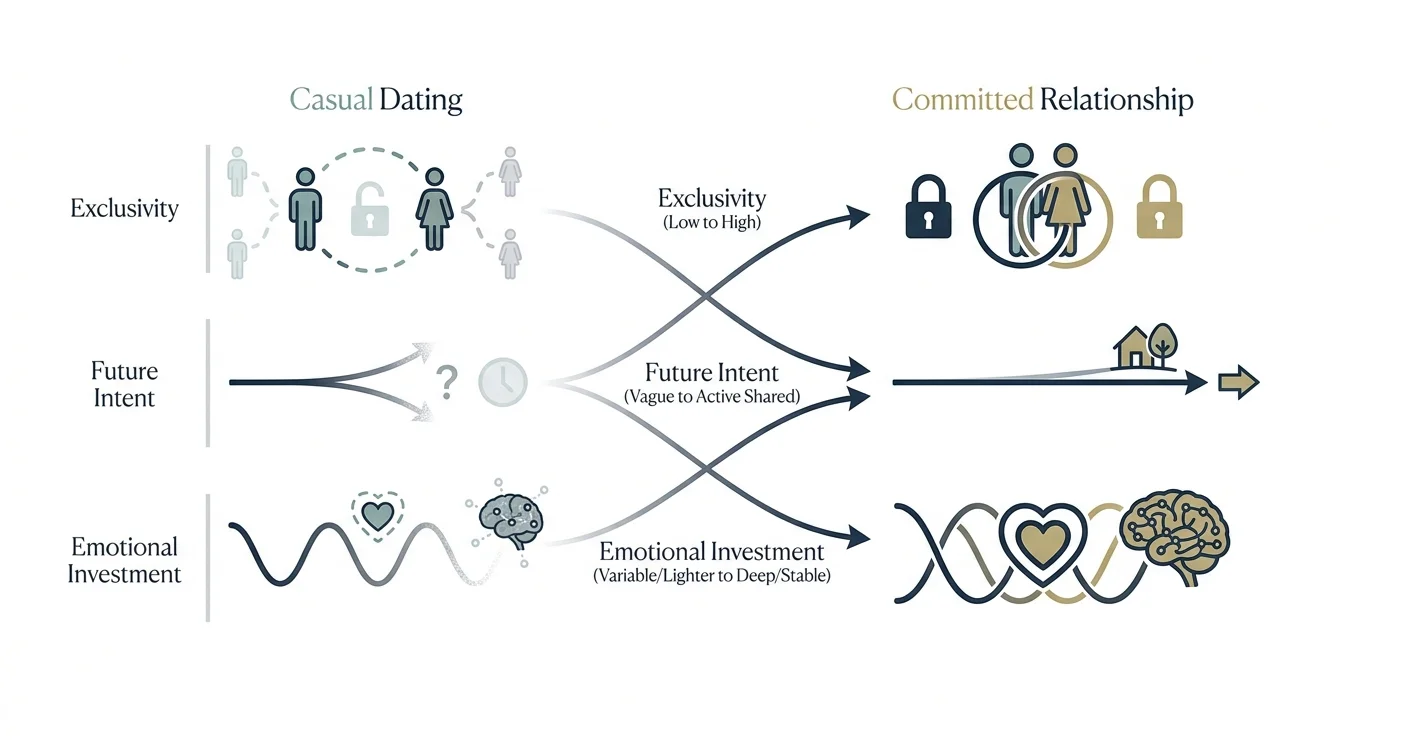
TL;DR: Casual dating is a relationship style defined by low commitment and open expectations. It differs from a committed relationship mainly on three axes: exclusivity, future intent, and emotional investment. Neither style is better — what matters is whether both people share the same understanding. If the arrangement is causing confusion, anxiety, or one-sided feelings, that is a signal worth paying attention to.
Why this matters
About 50% of adults in the U.S. report having been in a situationship or casual arrangement at some point, according to aggregated survey data from 2024. The emotional stakes are real even when the label is light. Mismatched expectations in casual dating are one of the most common reasons people seek emotional support — they feel confused, attached when they "shouldn't" be, or hurt by something they agreed to on paper.
Understanding what casual dating actually is — and what it is not — helps you go in with clear eyes.
What you'll need before you start
Before deciding whether casual dating is right for you, check in on a few things:
- Honest self-knowledge — Do you tend to attach quickly? Do you get anxious when someone pulls back? Your attachment style shapes how casual arrangements feel in practice.
- Communication skills — Casual does not mean avoidant. You still need to be able to say what you want and what you don't.
- Realistic expectations — Know that casual dating can shift. Feelings develop. Plans change. People leave.
- Emotional bandwidth — If you are already stretched thin by stress, burnout, or grief, adding relational ambiguity can compound that load.
- Time — Casual dating still takes time, energy, and emotional attention. It is not a zero-cost arrangement.
The core differences: casual dating vs. a committed relationship
1. Define what "casual" actually means in your situation
Casual dating has no universal definition, which is exactly what causes confusion. Before anything else, be honest about which version you are in:
- Pure casual — No exclusivity, no long-term planning, primarily physical or light emotional connection.
- Dating around — Seeing multiple people simultaneously while keeping options open.
- Situationship — Emotionally involved but no defined commitment, often with the texture of a relationship but none of the labels.
- "Just seeing each other" — Exclusive in practice but uncommitted in language.
Naming your version matters because the emotional rules of each are different. What you need to do now is say the version out loud — to yourself first, then to the other person.
Common mistake: Assuming your definition matches theirs without checking.
2. Have the expectations conversation — once, clearly
The single most damaging thing in casual dating is skipping the conversation about what each person wants. Do it early — ideally within the first 2 to 3 dates — and cover three things:
- Exclusivity — Are you each free to date other people?
- Pace — Is either person open to this becoming more serious, or is the arrangement intentionally capped?
- Communication norms — How often will you be in contact? What does check-in look like?
Keep it short. You are not negotiating a contract. You are making sure you are not living in two different arrangements. One honest 10-minute conversation prevents weeks of emotional second-guessing.
Common mistake: Having the conversation once and never revisiting it as feelings change.
3. Track your own emotional state honestly
This step gets skipped most often. Every few weeks, check in with yourself on these questions:
- Am I enjoying this, or am I anxious more than I am happy?
- Am I waiting for something — a text, a step forward, a "we need to talk"?
- Would I be hurt if this person told me they were seeing someone else?
If your honest answers lean toward anxiety, waiting, or hurt, the arrangement may no longer match your actual needs. That is not a failure — it is information.
People with an anxious attachment style (estimated at roughly 20% of adults, based on aggregated attachment research) are especially prone to tolerating casual arrangements that are causing them real distress because they fear that voicing a need will push the other person away.
Common mistake: Reframing distress as being "too sensitive" rather than acknowledging a real mismatch.
4. Understand the five key differences from a committed relationship
| Feature | Casual Dating | Committed Relationship |
|---|---|---|
| Exclusivity | Not assumed | Typically expected |
| Future planning | Absent or vague | Active and shared |
| Emotional depth | Variable, often lighter | Usually deeper over time |
| Social integration | Rarely meets friends/family | Usually does |
| Accountability | Low | Higher |
A committed relationship in 2026 does not automatically mean marriage-track or cohabitation. What separates it from casual dating is mutual agreement to prioritize each other and to plan, at least loosely, around a shared future.
Common mistake: Confusing duration ("we've been doing this for 6 months") with commitment. Length of time does not automatically upgrade a casual arrangement.
5. Decide when to exit or escalate
Casual dating has two healthy endings: it becomes more serious by mutual choice, or it ends clearly. What is not healthy is letting it run indefinitely on ambiguity.
Signs it is time to escalate the conversation:
- One or both of you is developing feelings that the current arrangement doesn't hold space for.
- You are spending 3 or more days a week together and have stopped seeing other people.
- You are making decisions — travel, plans, social events — with the other person implicitly factored in.
Signs it is time to exit:
- You are consistently more anxious than happy.
- Your needs and theirs are structurally incompatible (one wants eventual commitment, one doesn't).
- The arrangement is being used to avoid a harder conversation.
Exiting does not require an explanation longer than one honest sentence. "This isn't working for me anymore" is complete.
Common mistake: Waiting for the other person to initiate the exit because it feels less painful. It rarely is.
6. Give yourself space to process — especially if it gets complicated
Casual arrangements that end, or that drift into emotional gray zones, carry real emotional weight. Dismissing that weight because "it was only casual" delays processing it.
If you notice:
- Replaying conversations looking for signs you missed
- Feeling more alone after seeing them than before
- Difficulty focusing on other parts of your life
...those are worth talking through. Lovon's AI voice support app lets you work through that kind of relational confusion in real time — no appointment, no waitlist. It is built for exactly this: the low-grade emotional noise that doesn't always feel "serious enough" for traditional therapy but is absolutely worth addressing.
Troubleshooting common problems
Problem: You caught feelings but they haven't. Fix: Say it plainly rather than hinting. "I'm starting to want more from this." Their response tells you what you need to know in under 60 seconds.
Problem: You agreed to casual but feel jealous. Fix: Jealousy in a casual arrangement usually signals that your actual preference has shifted. Sit with it for a few days before acting, then name it honestly.
Problem: They keep moving the goalposts — acting like a partner, then pulling back. Fix: That pattern — sometimes called future faking — is a real dynamic worth learning about. Naming the pattern helps you decide if you want to stay in it.
Problem: You don't know what you want. Fix: That is not a character flaw — it is normal, especially after a previous relationship ended. Give yourself a time-bounded window (e.g., 4 weeks) to date casually and observe your own reactions before deciding.
Problem: The other person says they want casual but behaves like they want commitment. Fix: Behavior is the data. If their actions consistently contradict their stated preference, point to a specific behavior and ask what it means. "You introduced me to your friends last weekend — I want to make sure we're on the same page about where this is."
Problem: You feel like you can't bring it up without seeming "too much." Fix: That fear — of being too needy, too intense, too much — often traces to earlier experiences of having needs dismissed. It is worth exploring, not suppressing. Lovon's app is a low-pressure place to work through exactly that kind of pattern.
Tools and resources
- Future faking in relationships: red flags and recovery — useful if you suspect the other person is stringing you along with implied commitment they never intend to deliver.
- BPD attachment patterns: what drives the push-pull cycle — relevant if the emotional dynamic in your casual arrangement feels unusually intense or oscillating.
- Lovon's AI voice support app — for real-time support when the feelings get complicated and you need to talk it through before the next conversation.
What to do next
If you have read this and realized your current situation is more complicated than "casual dating" covers, the next move is to read about the specific pattern that feels closest to your experience — the pursuer-withdrawer dynamic is one of the most common ways casual arrangements generate pain, and understanding it often reframes everything.
FAQ
What is casual dating exactly? Casual dating is a romantic arrangement without a formal commitment to exclusivity or a shared future. Both people typically agree — explicitly or implicitly — that the connection is enjoyable but not binding.
Is casual dating the same as friends with benefits? No. Friends with benefits emphasizes a pre-existing friendship and a primarily physical arrangement with emotional distance kept intentional. Casual dating usually involves dates, some emotional connection, and an open (not necessarily physical-first) dynamic.
Can casual dating turn into a serious relationship? Yes, and it does — but only when both people genuinely want that and say so. It does not happen by default just because time passes. Someone has to name it.
How do you know if casual dating is hurting you? If you feel more anxious than happy most of the time, if you are hiding how you feel to avoid rocking the boat, or if the arrangement is affecting your sleep, focus, or self-esteem, it is hurting you.
Is it normal to feel attached in a casual relationship? Completely normal. The brain does not reliably distinguish between "committed" and "casual" when emotional or physical intimacy is involved. Attachment happens. What matters is what you do with that information.
How long should casual dating last? There is no fixed rule. What matters is that both people periodically check whether the arrangement still fits. If no one has checked in after 3 to 4 months, that gap itself is information.
What are the rules of casual dating? The only universal rules are: say what you want, respect what the other person says they want, and revisit the conversation if something changes. Everything else is negotiated between the two people involved.
Can you do casual dating if you have an anxious attachment style? You can, but it requires more self-awareness than it does for securely attached people. Anxious attachment amplifies the uncertainty that casual arrangements produce. Knowing that going in helps you manage your reactions rather than be driven by them.
One last thing
In 2026, "casual dating" is one of the most searched relationship terms — but the emotional experience it describes is one of the oldest. The confusion, the hope, the second-guessing after a silent day — none of that is new, and none of it means you are handling it wrong. The people who come out of casual arrangements with the least damage are not the ones who felt less. They are the ones who stayed honest about what they were feeling and said it out loud before it got too heavy to carry.
Related guides
How AI Support Helps You Heal
AI emotional support isn't about replacing human connection — it's about filling the gaps. The moments when you need to talk at 2 AM, when you don't want to burden your friends again, or when you simply need someone to listen without judgment.
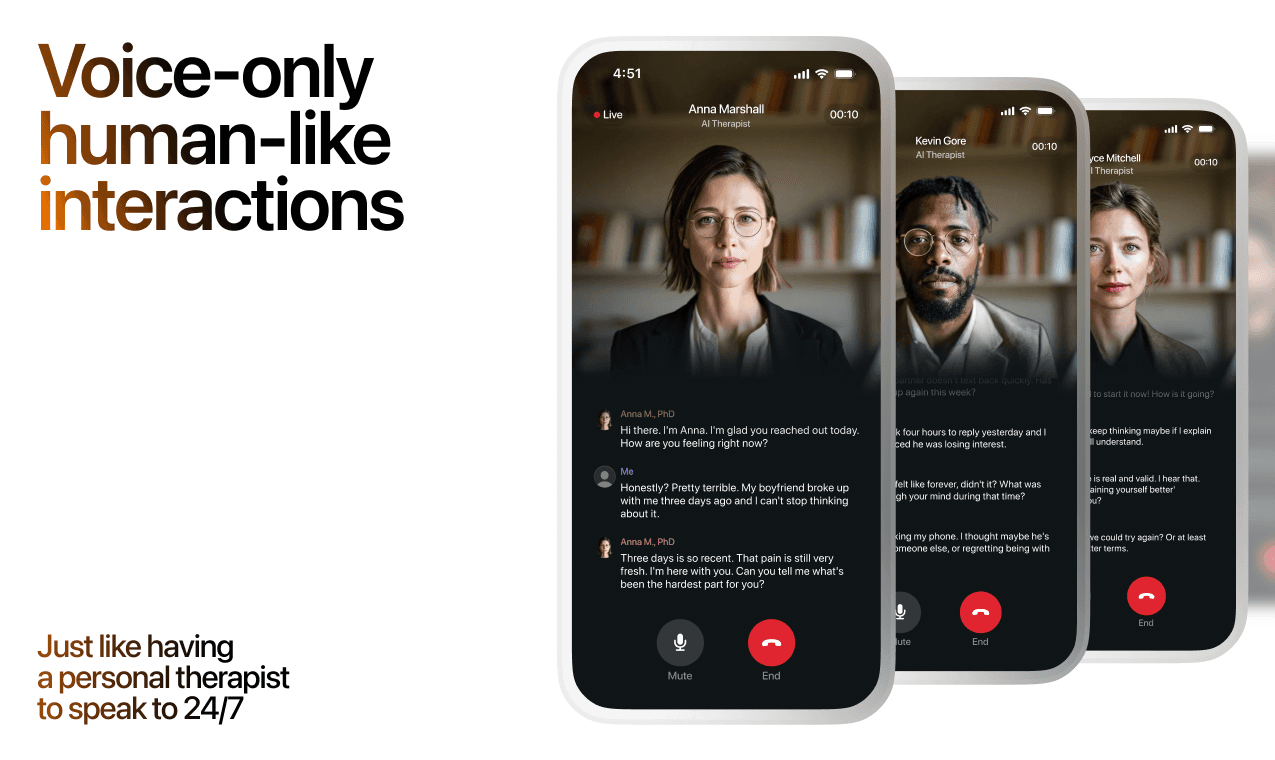
Here's what happens in a typical Lovon session:
You share what's on your mind
There's no script, no intake form, no waiting room. You speak or type whatever you're feeling — in your own words, at your own pace.
Lovon validates and explores
Using frameworks from CBT (Cognitive Behavioral Therapy) and motivational interviewing, Lovon acknowledges your feelings first, then gently helps you explore them. No dismissive "just move on" advice.
You build coping skills together
Lovon doesn't just listen — it actively works with you on evidence-based techniques: thought reframing, urge surfing, behavioral experiments, and more.
What a Session with Lovon Looks Like
When to Seek Professional Help
AI support is a valuable tool, but it's not a replacement for professional care. Please consider reaching out to a licensed therapist if you experience any of the following:
- Persistent thoughts of self-harm or suicide
- Inability to perform daily activities (work, eating, sleeping) for more than 2 weeks
- Turning to alcohol or substances to cope
- Intense anger or desire to harm your ex-partner
- Complete emotional numbness that doesn't improve over time
Crisis Resources (US): If you're in immediate danger, call 988 (Suicide & Crisis Lifeline) or text HOME to 741741 (Crisis Text Line). Available 24/7, free, and confidential.
Outside the US? Find a crisis line in your country
Ready to Start?
Your healing journey can begin right now
A 7-day trial. No judgment. Just a safe space to process what you're going through.
Frequently Asked Questions
Is Lovon a replacement for a real therapist?
Is my conversation with Lovon AI private?
How is Lovon different from ChatGPT for emotional support?
Can I use Lovon if I'm already seeing a therapist?
Can I try Lovon before subscribing?
About the Author
The Lovon Editorial Team
Mental Health & Wellness Content Team
The Lovon Editorial Team develops mental health and wellness content designed to make psychological concepts accessible and actionable. Our goal is to bridge the gap between clinical research and everyday life - helping you understand why your mind works the way it does and what you can do about it....
Related articles
- Dating App Burnout in 2026: How to Cope With Match Fatigue
Dating app burnout peaks around week 3 or 4 of swiping. Here's how to spot match fatigue, reset with a real break, and…
- BPD — Attachment Style as Identity and Loss Perception
For individuals living with borderline personality disorder (BPD), the connection between attachment style and identity…
- AI Relationship Coach for Dating App Burnout: Buy in 2026
Wiped out from swiping? See how an AI relationship coach for dating app burnout helps in 2026, what to look for, and…
- Avoidant Attachment Style: Patterns & How to Change (2026)
Avoidant attachment style affects 1 in 4 adults. Learn the 7-step process to identify your patterns and build earned…
See also
Quizzes
- Why Am I Single? 12-Question Quiz With 5 Real Reasons
Find which of five reasons is actually yours.
- Am I in Love? 13-Question Gut Check
Know what you feel in 2 minutes.
Free tools
- The 'What Are We?' Conversation, Planned in One Go
A chat for the conversation you keep rehearsing and not having. Say how long it has been and what you want it to be, and…
- How to Tell Someone You Love Them
How to tell someone you love them is rarely about the words, which are short. It is about the moment and the answer…
From the wiki
- What does dating mean?
Dating means spending intentional romantic time with someone to find out whether you fit. It sits in the middle of a…
Disclaimer: This article is for informational purposes only and does not constitute medical advice, diagnosis, or treatment. Always seek the advice of your physician or other qualified health provider with any questions you may have regarding a medical condition. If you are in crisis or think you may have an emergency, call 988 (Suicide & Crisis Lifeline) or go to the nearest emergency room. Outside the US? Find a crisis line in your country.