
One Chases, One Retreats: End the Pursuer-Withdrawer Loop
Why one partner keeps pressing while the other goes quiet, and the exact words each side can use to interrupt the cycle before it escalates.

Key Takeaways
- Initial trigger: A disagreement, perceived slight, or moment of disconnection occurs
- Pursuer response: Attempts to address the issue, seek reassurance, or initiate conversation about the relationship
- Withdrawer interpretation: Experiences this as pressure, criticism, or demand; feels cornered or inadequate
- Withdrawer response: Becomes quiet, changes the subject, leaves the room, or responds with minimal engagement
- Pursuer interpretation: Reads withdrawal as rejection, indifference, or confirmation that something is deeply wrong
Introduction
You bring up a concern, and your partner shuts down. You try harder to connect, and they pull further away. The more you pursue, the more they withdraw — and the cycle tightens until both of you feel trapped, misunderstood, and alone even when you're together. This is the pursuer-withdrawer relationship loop, a dynamic that research from relationship science consistently identifies as one of the most destabilizing patterns in long-term partnerships.
This pattern isn't about one person being "right" or "wrong." It's a self-reinforcing cycle where each partner's instinctive response to stress inadvertently triggers the other's deepest fears. Understanding how this loop functions — and why it feels so intractable — is the first step toward breaking free from it. This article draws on established relationship research and therapeutic approaches to help you recognize, interrupt, and ultimately transform this exhausting dynamic.
What the Pursuer-Withdrawer Relationship Pattern Actually Is
The pursuer-withdrawer relationship cycle describes a specific interaction pattern where one partner responds to relationship distress by seeking connection, discussion, and reassurance (the pursuer), while the other responds by creating distance, deflecting conversation, or shutting down emotionally (the withdrawer). Studies in attachment theory and couples therapy research suggest this dynamic emerges from fundamentally different strategies for managing relational anxiety — strategies closely tied to your attachment pattern.
The pursuer typically experiences anxiety through disconnection. When conflict arises or emotional distance grows, their nervous system reads this as a threat to the relationship itself. Their instinct is to close that gap — through conversation, processing, seeking reassurance, or initiating difficult discussions. They're attempting to restore safety through connection.
The withdrawer, conversely, experiences anxiety through intensity or perceived criticism. When emotions run high or conflict escalates, their system interprets the interaction itself as threatening. Their instinct is to create space — through silence, deflection, leaving the room, or emotional shutdown. They're attempting to restore safety through regulation and distance.
Neither strategy is inherently dysfunctional. Problems arise when these two strategies collide repeatedly, creating a feedback loop where each person's attempt to manage their own anxiety amplifies their partner's distress.
How the Pursuer-Withdrawer Loop Reinforces Itself
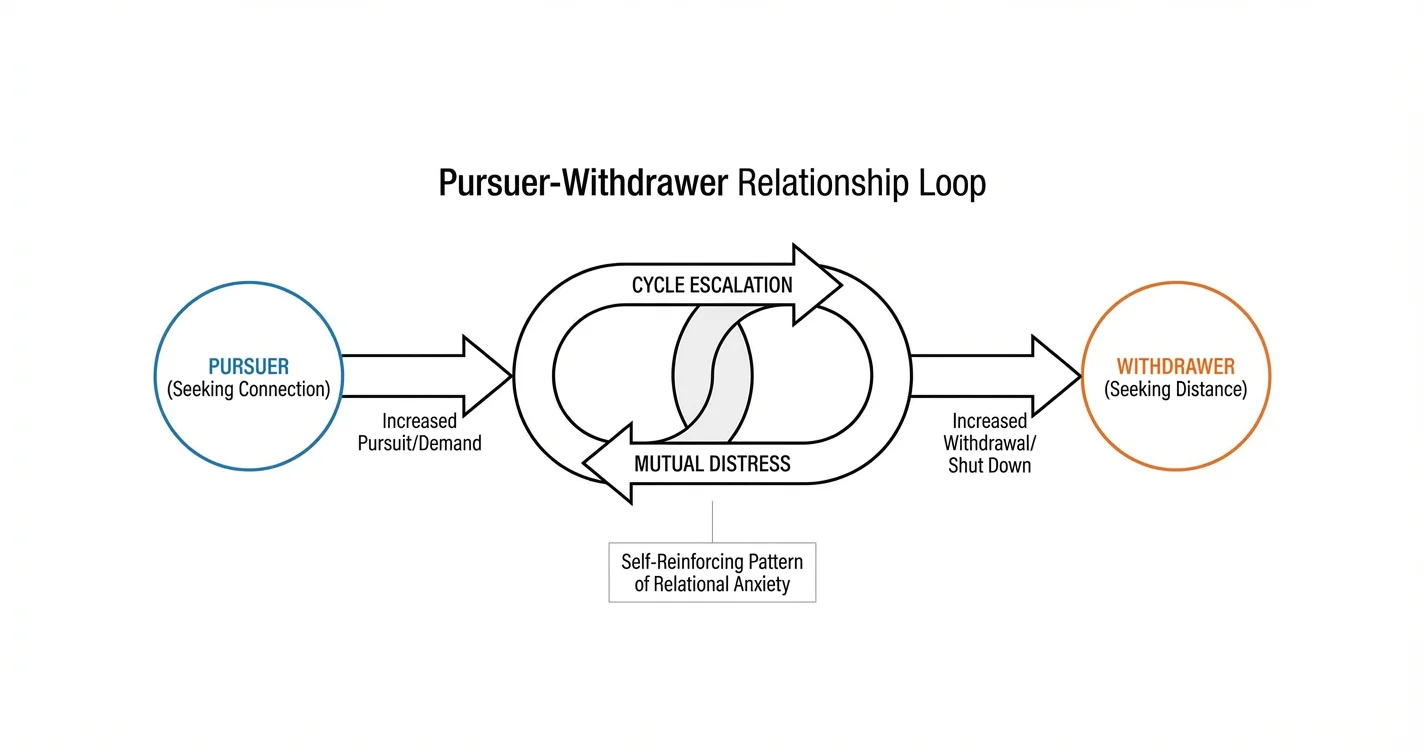
The destructive power of this pattern lies in its self-perpetuating nature. The more the pursuer seeks connection, the more overwhelmed and cornered the withdrawer feels. The more the withdrawer creates distance, the more abandoned and panicked the pursuer becomes. Each person's coping mechanism becomes the other's trigger.
Here's how the cycle typically escalates:
- Initial trigger: A disagreement, perceived slight, or moment of disconnection occurs
- Pursuer response: Attempts to address the issue, seek reassurance, or initiate conversation about the relationship
- Withdrawer interpretation: Experiences this as pressure, criticism, or demand; feels cornered or inadequate
- Withdrawer response: Becomes quiet, changes the subject, leaves the room, or responds with minimal engagement
- Pursuer interpretation: Reads withdrawal as rejection, indifference, or confirmation that something is deeply wrong
- Pursuer escalation: Increases efforts to connect — follows, asks more questions, expresses frustration about the distance
- Withdrawer escalation: Increases protective distance — shuts down further, stonewalls, or eventually explodes to create space
What makes this particularly insidious is that both partners are acting from their own logic of safety. The pursuer believes: "If we can just talk about this, we can fix it and be close again." The withdrawer believes: "If I can just get some space to think, I can calm down and handle this better." Both are right about their own needs — but in the heat of the pattern, each person's solution becomes the other's problem.
Research on relationship stability indicates that couples stuck in rigid pursuer-withdrawer dynamics report significantly lower relationship satisfaction and higher rates of eventual separation compared to couples who can flexibly shift these roles or exit the pattern when it emerges.
Why This Pattern Develops and Who It Affects
The pursuer-withdrawer relationship pattern often has roots in attachment history and learned conflict styles, but it's important to understand that multiple factors contribute to how these dynamics develop. While early relational experiences — including parenting styles and family conflict patterns — can shape how someone responds to relationship stress, genetic predispositions, individual temperament, and life experiences all play significant roles.
Some people naturally have higher sensitivity to disconnection cues or lower tolerance for emotional intensity. These individual differences interact with learned patterns to create the roles people tend to fall into during conflict.
Common backgrounds for pursuers include:
- Experiences where needs were inconsistently met, creating vigilance around connection
- Family environments where problems were addressed through discussion and emotional processing
- Previous relationships where emotional availability was unpredictable
- Temperamental sensitivity to social and emotional cues
Common backgrounds for withdrawers include:
- Experiences where emotional expression was met with criticism or overwhelm
- Family environments where conflict was avoided or explosive, making space feel safer
- Previous relationships where emotional demands felt consuming or impossible to meet
- Temperamental tendency toward internal processing and higher threshold for social stimulation
Importantly, these roles aren't fixed personality traits. Many people switch positions depending on the issue or relationship. Someone might pursue around emotional intimacy but withdraw around discussions of commitment. The same person might be a withdrawer with a romantic partner but a pursuer with their children or friends.
Gender socialization also influences these patterns, though not deterministically. Traditional gender roles have historically encouraged women toward emotional caretaking (pursuer behaviors) and men toward emotional stoicism (withdrawer behaviors), but contemporary research shows these roles distribute across all gender combinations and can shift over time within the same relationship.
Recognizing the Pattern in Your Relationship
Identifying when you're in the pursuer-withdrawer loop is half the battle. These dynamics often feel invisible when you're inside them — you're just reacting to what your partner is doing, which feels like the cause rather than part of a mutual cycle.
Signs you might be in a pursuer role:
- You find yourself frequently initiating conversations about "us" or relationship problems
- You feel anxious when your partner is quiet or seems distant
- You interpret your partner's need for space as rejection or evidence they don't care
- You notice you're asking "Are you okay?" or "Are we okay?" repeatedly
- You sometimes follow your partner to continue a conversation after they've withdrawn
- You feel responsible for fixing emotional disconnection
Signs you might be in a withdrawer role:
- You feel cornered or pressured during emotional conversations
- You need time alone to process feelings before discussing them
- You sometimes shut down, go silent, or leave the room during conflict
- You feel criticized or like nothing you say will be enough
- You experience your partner's emotional intensity as overwhelming
- You feel relief when a difficult conversation ends, even if nothing was resolved
When couples recognize themselves in both columns at different times or around different issues, that's actually a positive sign — it indicates flexibility rather than rigid polarization. The most concerning version of this pattern is when the roles become completely fixed and both partners feel helpless to change them.
Breaking the Cycle: Strategies That Actually Work
Interrupting the pursuer-withdrawer relationship loop requires both partners to act against their instincts simultaneously. This is uncomfortable, which is why the pattern persists — your default response feels like the only way to find safety. Effective intervention involves understanding what your partner needs in their moment of distress, even when it contradicts what you need in yours.
For Pursuers: Creating Safety Through Patience
The pursuer's most powerful intervention is strategic disengagement — not abandoning the issue, but temporarily releasing the pressure that drives their partner into deeper withdrawal. This might include:
- Name the pattern when you notice it starting: "I think we're getting into that cycle where I push and you pull back. Can we pause?"
- Express your underlying need directly: Instead of "Why won't you talk to me?" try "I feel scared when we disconnect, and I need to know we're okay."
- Offer space with a return plan: "I can see you need time. Would you be willing to come back to this in an hour?" This provides the withdrawer with space while giving the pursuer a concrete reconnection point.
- Self-soothe during the gap: Use the interval to regulate your own nervous system through movement, calling a friend, or working with tools like Lovon.app to process the anxiety without dumping it back on your partner immediately.
The hardest part for pursuers is tolerating the discomfort of disconnection without attempting to resolve it instantly. Your nervous system will scream that distance equals danger. Learning to sit with that anxiety briefly — trusting that the break is temporary, not permanent — is the core skill.
For Withdrawers: Engaging Before Complete Shutdown
The withdrawer's most powerful intervention is partial engagement — offering something before the complete shutdown that sends their partner into panic. This might include:
- Acknowledge your partner's bid before you disengage: "I hear that you're upset. I need some time to think about this, but I'm not leaving the conversation forever."
- Set a specific return time: "I need 30 minutes to calm down, and then I'll come find you." Then actually do it.
- Explain your internal experience: "When we get intense like this, my brain shuts down and I can't think clearly. It's not that I don't care — I need to step back so I can actually engage."
- Offer small check-ins: If you need extended space, brief touch-points ("Still processing, but I'm here") can prevent your partner's anxiety from spiraling.
The hardest part for withdrawers is staying present through uncomfortable emotional intensity and resisting the urge to shut down completely. Your nervous system will scream that engagement equals overwhelm or inadequacy. Learning to tolerate brief discomfort while you negotiate space — rather than disappearing without communication — is the core skill.
Mutual Interventions: Changing the System
Some strategies require both partners' participation:
- Establish a "time-out" protocol in calm moments: Agree on specific language ("I need a pause") and time limits (20-60 minutes) that both partners commit to respecting
- Separate "processing" from "solving": Pursuers often want to process emotions together; withdrawers need to process internally first. Acknowledge both needs: "Can you give me an hour to think, and then we'll process together?"
- Identify your early warning signs: What does each of you do in the first 30 seconds of the pattern starting? Can you catch it before full escalation?
- Practice role reversal: Have the pursuer practice asking for space and the withdrawer practice initiating difficult conversations — this builds flexibility and empathy
When one partner begins changing their steps in the dance, the entire dynamic shifts. It's difficult for a withdrawer to keep fleeing when the pursuer stops chasing. It's difficult for a pursuer to keep panicking when the withdrawer stays connected while negotiating space.
When Professional Help Becomes Necessary
While many couples can make significant progress on the pursuer-withdrawer loop with awareness and self-guided strategies, some situations warrant professional intervention. Consider seeking help from a couples therapist when:
- The pattern has become so entrenched that attempts to discuss it trigger immediate escalation
- Either partner feels emotionally or physically unsafe during conflict
- The dynamic persists despite consistent attempts to change it
- One or both partners are developing symptoms of anxiety, depression, or trauma responses related to the relationship
- The relationship includes other complicating factors like infidelity, substance use, or unresolved trauma
Approaches like Emotionally Focused Therapy (EFT) and the Gottman Method specifically address pursuer-withdrawer dynamics by helping couples understand the attachment fears driving their behaviors. Therapists trained in these methods can slow down the cycle as it happens in session, making the usually invisible pattern tangible and interruptible.
Between sessions or when professional help isn't immediately accessible, some people find that processing relationship patterns through voice-based support tools like Lovon.app helps them identify their own contributions to the cycle and develop language for discussing it with their partner without escalating.
Individual therapy can also be valuable, particularly when the pattern connects to deeper attachment wounds or trauma. Understanding your own nervous system's responses — and developing capacity to self-regulate during relationship stress — strengthens your ability to respond flexibly rather than reactively.
Moving From Pattern to Partnership
The pursuer-withdrawer relationship loop is remarkably common, which means it's also remarkably solvable. Unlike fundamental incompatibilities or values mismatches, this is a process problem, not a compatibility problem. The underlying attachment needs — the pursuer's need for reassurance and the withdrawer's need for autonomy — aren't inherently contradictory. They only become problems when the strategies for meeting those needs lock into rigid opposition. If you want to see how much the loop has cost the rest of the relationship, a test of relationship quality scores connection, repair after friction and teamwork separately, so you can tell which one needs attention first.
Breaking this pattern doesn't mean erasing your natural tendencies. Pursuers will likely always be more oriented toward connection through conversation. Withdrawers will likely always need processing space. The goal isn't to fundamentally change your conflict style — it's to develop enough flexibility that your partner's differences don't trigger your worst fears, and your coping mechanisms don't trigger theirs.
With practice, couples report that recognizing the pattern becomes almost humorous: "Oh, we're doing the thing again." That moment of meta-awareness — the ability to step outside the dance and see it as a system rather than individual failings — is often the turning point. From there, you're no longer adversaries caught in a loop; you're partners working together to interrupt a shared problem.
The pursuer-withdrawer cycle thrives in silence and invisibility. The moment you name it, discuss it during calm periods, and develop language and protocols for interrupting it, you've fundamentally changed the dynamic. You've transformed an unconscious reaction pattern into a shared challenge you're facing together — which is precisely the kind of collaborative partnership that makes relationships resilient.
Disclaimer: This is general information, not medical advice or diagnosis. If symptoms are severe, affecting your daily life, or you're having thoughts of self-harm — seek professional help. In the US: call or text 988 (Suicide & Crisis Lifeline). For immediate danger: 911 or local emergency services.
How AI Support Helps You Heal
AI emotional support isn't about replacing human connection — it's about filling the gaps. The moments when you need to talk at 2 AM, when you don't want to burden your friends again, or when you simply need someone to listen without judgment.
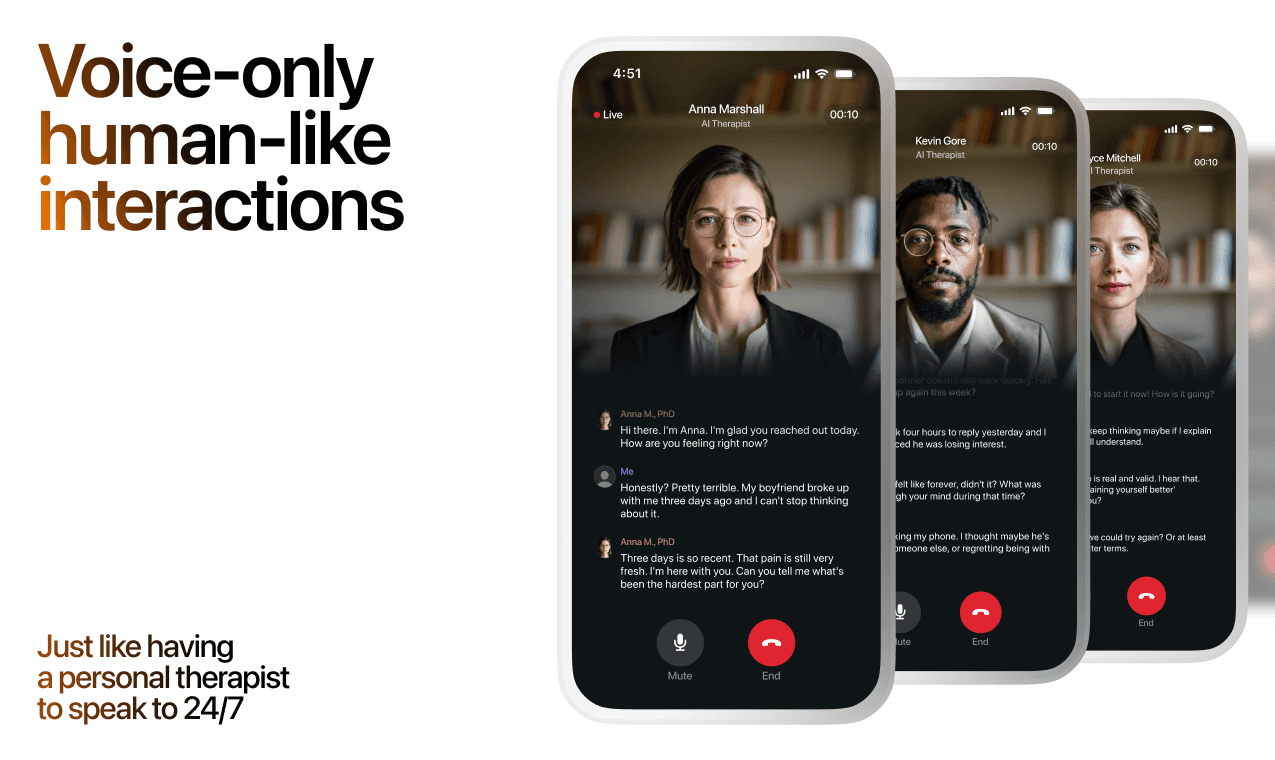
Here's what happens in a typical Lovon session:
You share what's on your mind
There's no script, no intake form, no waiting room. You speak or type whatever you're feeling — in your own words, at your own pace.
Lovon validates and explores
Using frameworks from CBT (Cognitive Behavioral Therapy) and motivational interviewing, Lovon acknowledges your feelings first, then gently helps you explore them. No dismissive "just move on" advice.
You build coping skills together
Lovon doesn't just listen — it actively works with you on evidence-based techniques: thought reframing, urge surfing, behavioral experiments, and more.
What a Session with Lovon Looks Like
When to Seek Professional Help
AI support is a valuable tool, but it's not a replacement for professional care. Please consider reaching out to a licensed therapist if you experience any of the following:
- Persistent thoughts of self-harm or suicide
- Inability to perform daily activities (work, eating, sleeping) for more than 2 weeks
- Turning to alcohol or substances to cope
- Intense anger or desire to harm your ex-partner
- Complete emotional numbness that doesn't improve over time
Crisis Resources (US): If you're in immediate danger, call 988 (Suicide & Crisis Lifeline) or text HOME to 741741 (Crisis Text Line). Available 24/7, free, and confidential.
Outside the US? Find a crisis line in your country
Ready to Start?
Your healing journey can begin right now
A 7-day trial. No judgment. Just a safe space to process what you're going through.
Frequently Asked Questions
Is Lovon a replacement for a real therapist?
Is my conversation with Lovon AI private?
How is Lovon different from ChatGPT for emotional support?
Can I use Lovon if I'm already seeing a therapist?
Can I try Lovon before subscribing?
About the Author

The Lovon Editorial Team
Mental Health & Wellness Content Team
The Lovon Editorial Team develops mental health and wellness content designed to make psychological concepts accessible and actionable. Our goal is to bridge the gap between clinical research and everyday life - helping you understand why your mind works the way it does and what you can do about it....
Related articles
- Best AI couples therapy apps in 2026
Compare the best AI couples therapy apps in 2026. Choose voice support for solo reflection, and licensed couples therapy…
- Pursuer-Withdrawer Pattern: Break the Cycle in 2026
The pursuer withdrawer relationship cycle traps both partners. Learn the 7 steps to interrupt it, backed by EFT research…
- AI Life Coach for Relationship Goals 2026
The best AI life coach for relationship goals in 2026: voice-based, personalized sessions for communication, conflict…
- How to Stop Yelling at Your Partner (2026 Guide)
Learn how to stop yelling at your partner with a step-by-step 2026 method: spot the trigger, call a pause, reset your…
See also
Quizzes
- Am I the Problem? 12-Question Self-Audit
Honest audit in 3 minutes.
- Am I Sabotaging My Relationship? 12-Question Quiz
Find the move you reach for, in 2 minutes.
Free tools
- How to Communicate Better in a Relationship
Skip the tips. Give it the one sentence you keep trying to say that turns into a fight, in the words you actually used…
- Conflict Script Builder
Pick the situation and what you want out of it, and get three lines you can say out loud: an opener, a response for when…
From the wiki
- What does clingy mean in a relationship?
Clingy is what people call behavior that asks for more contact or reassurance than the other person wants to give…
Disclaimer: This article is for informational purposes only and does not constitute medical advice, diagnosis, or treatment. Always seek the advice of your physician or other qualified health provider with any questions you may have regarding a medical condition. If you are in crisis or think you may have an emergency, call 988 (Suicide & Crisis Lifeline) or go to the nearest emergency room. Outside the US? Find a crisis line in your country.