
CPTSD from Childhood: Symptoms & Healing Steps 2026
CPTSD from childhood causes emotional flashbacks, shame, and hypervigilance. Learn the exact healing steps — from stabilization to identity repair — that work in 2026.

Key Takeaways
- Some baseline safety. You need to be out of the environment that caused the trauma, or at minimum have physical
- Patience with nonlinearity. Progress happens in spirals, not straight lines. A hard week in month four does not
- At least one supportive relationship or resource. A therapist, a trusted friend, a peer support group, or a mental
- A basic understanding of your symptoms. The section below covers the most common ones so you know what you're
- Learn your personal triggers. Write down 3–5 situations, sensations, or interactions that reliably send your system
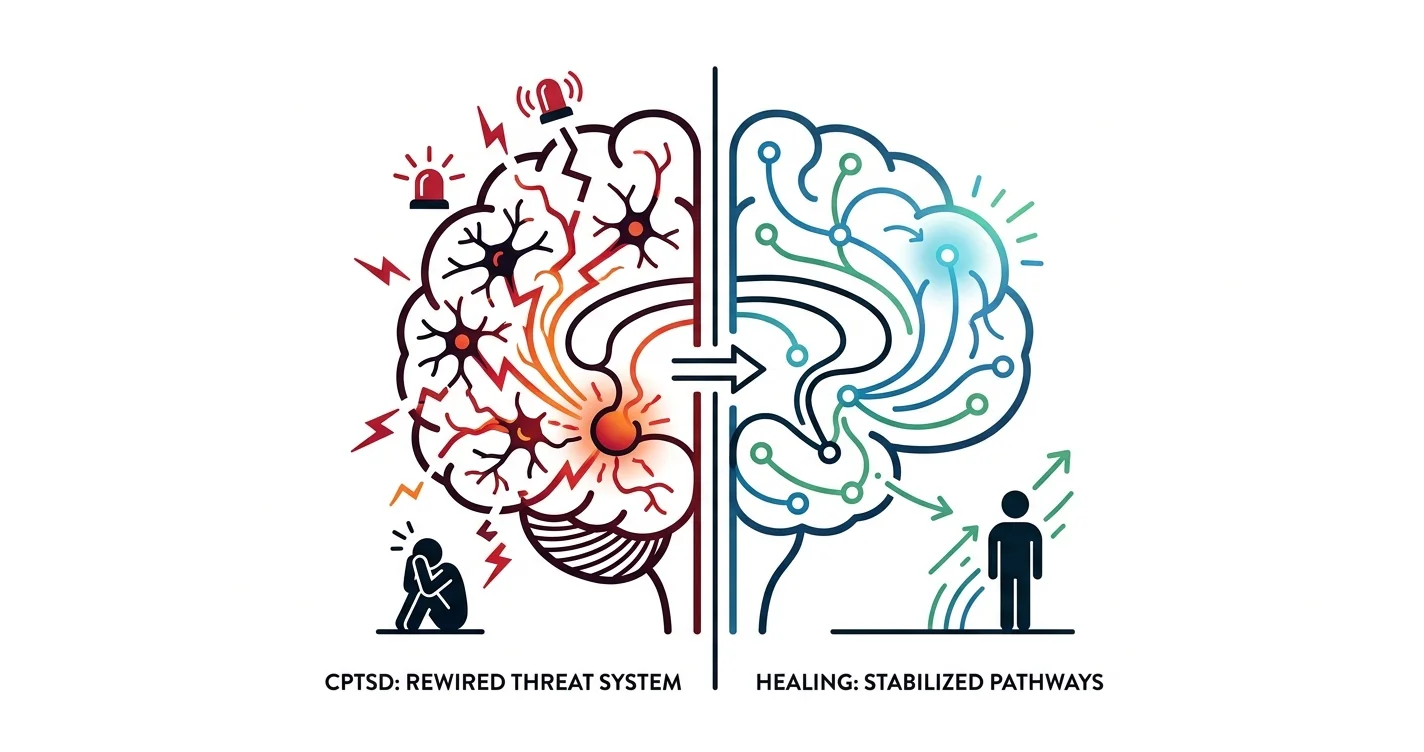
CPTSD from childhood is one of the most misunderstood mental health conditions — it looks like anxiety, depression, or personality issues on the surface, but the root is repeated early trauma that rewired how your nervous system responds to the world.
TL;DR: CPTSD from childhood develops when repeated trauma — neglect, abuse, chaos at home — happens before the brain finishes developing. In 2026, clinicians recognize it as distinct from single-event PTSD, with symptoms that include emotional flashbacks, deep shame, hypervigilance, and difficulty trusting people. Healing is real but nonlinear: it requires safety first, then gradual trauma processing, then rebuilding identity. This guide walks through each stage with specific steps you can start now.
Why CPTSD from childhood is different from regular PTSD
PTSD typically follows one traumatic event — a car accident, a assault, a disaster. CPTSD from childhood forms across months or years of repeated harm during a period when you had no ability to escape or protect yourself. A child's brain is still building its threat-detection system, emotional regulation circuits, and sense of self. When that environment is consistently unsafe — emotionally, physically, or both — those systems develop around survival, not thriving.
The result in 2026 is a nervous system that treats ordinary life as dangerous. A raised voice feels like an alarm. Intimacy feels like a trap. Criticism lands like a verdict on your worth as a person.
This is not a character flaw. It is the brain doing exactly what it learned to do.
What you'll need before you start
Healing CPTSD from childhood is not a weekend project. Before jumping into steps, be honest about what you're bringing into this:
- Some baseline safety. You need to be out of the environment that caused the trauma, or at minimum have physical safety today. Processing old wounds while still in an unsafe situation is not possible.
- Patience with nonlinearity. Progress happens in spirals, not straight lines. A hard week in month four does not erase month three.
- At least one supportive relationship or resource. A therapist, a trusted friend, a peer support group, or a mental health app. Isolation slows everything down.
- A basic understanding of your symptoms. The section below covers the most common ones so you know what you're working with.
Recognizing CPTSD from childhood: the main symptoms
Before you can heal, you need to name what's happening. CPTSD from childhood shows up across several domains:
Emotional flashbacks — These are not visual replays of events. They are sudden floods of shame, terror, rage, or smallness that feel present-tense but are actually the emotional state of your younger self. You may not even know what triggered them.
Hypervigilance — Constantly scanning for threats, reading every room, bracing for something to go wrong. This is exhausting and often invisible to others.
Deep shame and negative self-concept — Not just guilt about actions, but a core belief that something is fundamentally wrong with you. This is one of the signature markers that distinguishes CPTSD from standard PTSD.
Difficulty with relationships — Trouble trusting, fear of abandonment, either clinging or pulling away, or choosing people who confirm the familiar dynamic of your childhood.
Dissociation — Feeling detached from your body, memory gaps, emotional numbness, or going through the motions without feeling present.
Somatic symptoms — Chronic tension, gut problems, fatigue, and unexplained physical pain are common. The body holds what the mind learned to suppress.
If you recognize most of these, you are not broken. You adapted. The steps below are about updating that adaptation for the life you are living now, in 2026, not the one you survived then.
The healing steps
Step 1 — Stabilize before you process
Every evidence-informed approach to trauma — including the Phase-Oriented model endorsed by the International Society for Traumatic Stress Studies (ISTSS) — starts with stabilization, not trauma confrontation. Jumping straight into reliving memories without a regulated nervous system retraumatizes rather than heals.
What stabilization looks like in practice:
- Learn your personal triggers. Write down 3–5 situations, sensations, or interactions that reliably send your system into fight, flight, freeze, or fawn.
- Build a grounding kit. This is a short list of sensory anchors that bring you back to the present moment: cold water on your wrists, naming 5 objects you can see, a specific song, a particular smell.
- Establish one daily regulation practice. Even 5 minutes of slow breathing (4-count inhale, 6-count exhale) changes nervous system tone over weeks.
Do not rush to Step 2 until you can get through most days without being completely derailed by a trigger. That threshold matters.
Step 2 — Name the freeze and fawn patterns
Many people with CPTSD from childhood default to the freeze response — shutting down, going blank, or becoming unable to act when stress hits. Others default to the fawn response — compulsive people-pleasing that masks the original fear of punishment or abandonment.
Neither is a weakness. Both were logical survival strategies. The problem is they don't turn off when the danger is gone.
To work with these patterns:
- When you freeze, the goal is not to force action but to gently notice the freeze without judgment. Name it: "I'm frozen right now." That observation alone activates a different part of the brain.
- When you fawn, practice one small no per week. Not a dramatic confrontation — just noticing where you agreed because you were afraid, and trying one lower-stakes boundary.
Step 3 — Process the emotional flashbacks
Pete Walker's 13-step process for emotional flashbacks (from Complex PTSD: From Surviving to Thriving, 2013) remains one of the most-cited practical tools in 2026. The core of it:
- Tell yourself "I am having an emotional flashback" — this alone interrupts the spiral.
- Remind yourself the feeling has a historical source, not a current one.
- Comfort your inner child rather than criticizing yourself for the intensity of the feeling.
- Speak back to the inner critic: the shame is not the truth, it is a relic.
Writing through flashbacks in a journal rather than just sitting in them helps externalize the experience. When it's on paper, it's easier to see it as a memory rather than a current reality.
Step 4 — Work with a trauma-informed professional
Self-help tools are real and useful, but CPTSD from childhood responds best to therapy modalities specifically designed for complex trauma. Three with strong evidence bases in 2026:
- EMDR (Eye Movement Desensitization and Reprocessing) — processes traumatic memories by reducing their emotional charge. Effective for childhood trauma specifically, with multiple randomized controlled trials behind it.
- Somatic experiencing — works through the body rather than narrative, releasing stored tension and completing interrupted survival responses.
- IFS (Internal Family Systems) — maps the different "parts" of yourself (the critic, the scared child, the protector) and builds a compassionate relationship between them.
If access to a therapist is a barrier — cost, availability, stigma — AI-powered mental health support like Lovon can bridge the gap between sessions or serve as a first step toward talking about what you are carrying.
Step 5 — Rebuild your sense of self
The shame core of CPTSD from childhood often means you arrive at adulthood with a fragmented or negative self-concept. This step is about actively constructing who you are outside of survival mode.
- Identify 3 values that feel genuinely yours, not inherited from the environment that hurt you.
- Notice what you enjoy without needing permission. Small things count.
- Challenge the inner critic by keeping a weekly log of things you did that were good enough — not perfect, just good enough.
Identity repair is slow. Most people doing this work in 2026 report it taking 2–4 years of consistent effort to feel meaningfully different. That is not a failure timeline — it is a realistic one.
Step 6 — Address relationship patterns
Childhood CPTSD almost always imprints on attachment. You may notice anxious attachment (fear of abandonment driving you to over-pursue), avoidant patterns (emotional distance as protection), or disorganized attachment (wanting closeness but panicking when you get it).
Healing here means:
- Learning to tolerate the discomfort of intimacy without immediately categorizing it as dangerous.
- Communicating needs directly instead of assuming others should read them or that expressing them will cause rejection.
- Choosing relationships based on safety, not familiarity — familiar often means it mirrors what you grew up with.
Step 7 — Maintain the long game
Relapse into old patterns is not failure — it is information. Notice which situations pull you back (high stress, conflict, illness, major life changes), and treat those as signals to return to your stabilization tools, not evidence that healing hasn't worked.
Schedule a monthly check-in with yourself. Ask: What triggered me this month? What did I handle better than I would have a year ago? What do I still need support with?
Troubleshooting
"I understand my CPTSD intellectually but nothing changes emotionally." This is very common. Insight without somatic and relational work stays in the head. Add a body-based practice — even 5 minutes of intentional movement or breathwork — before any journaling or cognitive work.
"Therapy makes things worse at first." This is normal in weeks 2–6 of trauma processing. Things surface before they settle. If it persists past 8 weeks, tell your therapist — the pacing may need adjustment.
"I keep attracting the same kind of relationships." Familiar pain feels safer than unfamiliar safety. This is a nervous system pattern, not a character flaw. Work explicitly with your attachment style — it changes with consistent, safe relational experiences over time.
"I dissociate and can't remember my sessions or what I read." Dissociation blocks encoding. Ground yourself before any therapeutic work: feet on floor, 3 slow breaths, name where you are. Short sessions (20 minutes) work better than marathon ones when dissociation is high.
"My family tells me my childhood wasn't that bad." Minimization is part of the environment that caused the harm. Your nervous system's response is data. You do not need external validation to name your experience.
"I feel ashamed of still struggling as an adult." CPTSD from childhood does not resolve on its own without intentional work. Struggling is not weakness — it is what happens when a child-sized wound never got proper attention. Getting support in 2026 is the practical move, not the sentimental one.
Tools and resources
- Lovon — Voice-based AI mental health support, available 24/7, built with input from PhD psychologists. Useful for processing between therapy sessions, practicing coping tools, or as a first step when talking to another person feels too hard.
- Pete Walker's Complex PTSD: From Surviving to Thriving (2013) — The most practical self-help book specifically on CPTSD, written by a therapist who has CPTSD himself.
- ISTSS (International Society for Traumatic Stress Studies) — Publishes clinical guidelines updated through 2026 and has a therapist directory.
- NAMI Helpline — 1-800-950-6264. Free, US-based, for anyone navigating a mental health crisis or needing help finding care.
- AI therapy for PTSD and trauma recovery — a deeper look at how AI-supported tools fit into trauma healing.
FAQ
What is CPTSD from childhood? CPTSD from childhood is Complex Post-Traumatic Stress Disorder that develops from repeated or prolonged trauma in early life — such as abuse, neglect, or living in a chronically unsafe environment — rather than from a single traumatic event.
How is CPTSD different from PTSD? PTSD typically follows one traumatic incident. CPTSD from childhood develops over sustained trauma during formative years, and includes additional symptoms: deep shame, negative self-concept, emotional dysregulation, and difficulty with relationships that go beyond the core PTSD symptom cluster.
Can CPTSD from childhood be fully healed? Many people achieve significant and lasting recovery. "Full healing" for most means the symptoms no longer run their life, not that they disappear entirely. With consistent, appropriate support, quality of life improves measurably — most people engaged in active trauma work for 2–4 years report major gains.
What kind of therapy is best for CPTSD from childhood? EMDR, somatic experiencing, and Internal Family Systems (IFS) have the strongest evidence bases specifically for complex childhood trauma in 2026. Standard CBT alone is often insufficient because CPTSD is stored in the body and relational patterns, not just thought patterns.
What are emotional flashbacks? Emotional flashbacks are sudden, intense floods of shame, fear, or despair that feel present-tense but originate from past trauma. Unlike visual flashbacks, they often have no obvious trigger and no clear memory attached — they just feel like you are suddenly a helpless child again.
Can I heal CPTSD from childhood without a therapist? Self-help tools — psychoeducation, grounding practices, journaling, peer support — produce real improvement. A trauma-informed therapist accelerates and deepens the work. If therapy is inaccessible, AI mental health support like Lovon and structured self-help resources are a meaningful starting point, not a consolation prize.
How long does healing CPTSD from childhood take? There is no universal timeline. Most people doing consistent, focused work report noticeable improvement within 6–12 months and meaningful identity-level change over 2–4 years. Severity of original trauma, current life stability, and quality of support all affect the pace.
Is hypervigilance always part of CPTSD from childhood? Hypervigilance is one of the most consistent symptoms — it is the nervous system scanning for threat because that scan was once essential for survival. It reduces significantly with stabilization work, somatic therapy, and the accumulation of safe experiences over time.
One last thing
Childhood CPTSD shapes the brain during the years it is most plastic — which is exactly why it has such a deep reach. But plasticity does not stop at 18. The adult brain still changes in response to new, repeated experiences. Every time you stay present through discomfort instead of dissociating, every time you choose a safe relationship over a familiar one, every time you talk back to the inner critic — you are physically remodeling the system that childhood built. That is not a metaphor. Neuroplasticity research in 2026 continues to confirm it. The work is worth doing.
Related guides
How AI Support Helps You Heal
AI emotional support isn't about replacing human connection — it's about filling the gaps. The moments when you need to talk at 2 AM, when you don't want to burden your friends again, or when you simply need someone to listen without judgment.
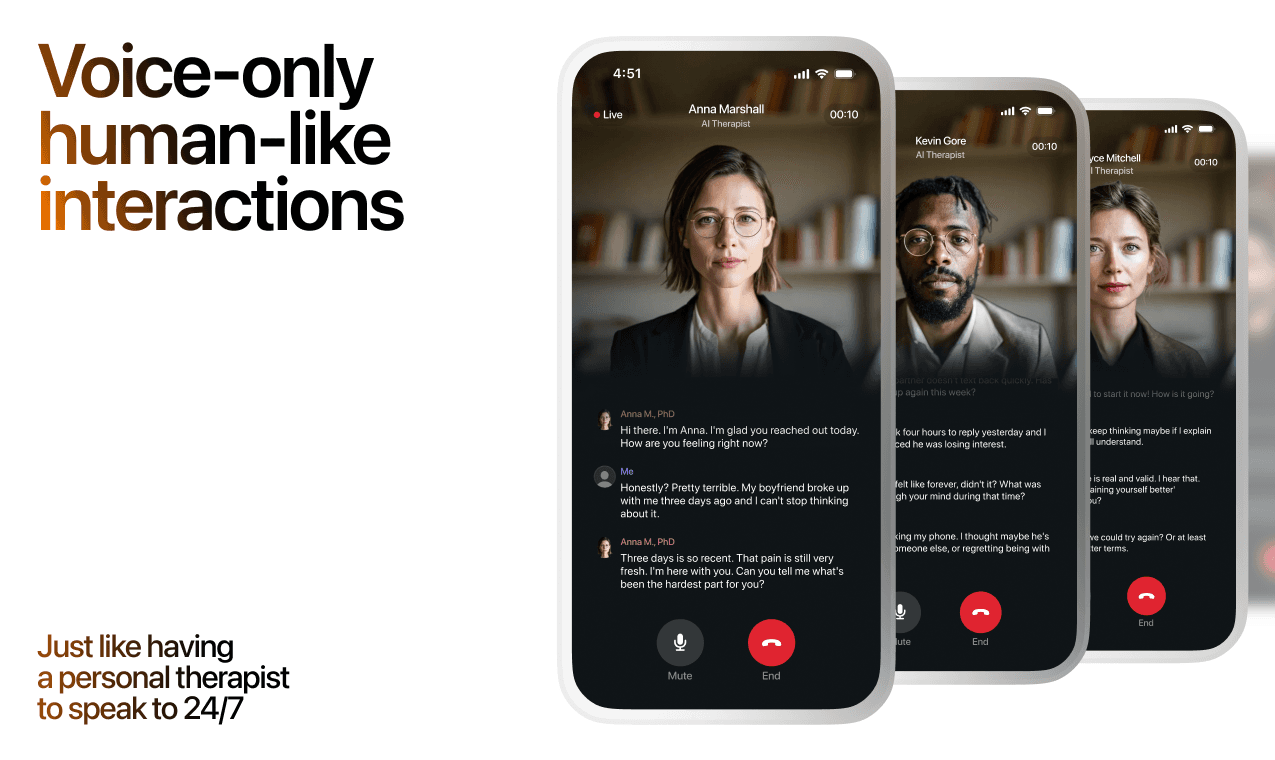
Here's what happens in a typical Lovon session:
You share what's on your mind
There's no script, no intake form, no waiting room. You speak or type whatever you're feeling — in your own words, at your own pace.
Lovon validates and explores
Using frameworks from CBT (Cognitive Behavioral Therapy) and motivational interviewing, Lovon acknowledges your feelings first, then gently helps you explore them. No dismissive "just move on" advice.
You build coping skills together
Lovon doesn't just listen — it actively works with you on evidence-based techniques: thought reframing, urge surfing, behavioral experiments, and more.
What a Session with Lovon Looks Like
When to Seek Professional Help
AI support is a valuable tool, but it's not a replacement for professional care. Please consider reaching out to a licensed therapist if you experience any of the following:
- Persistent thoughts of self-harm or suicide
- Inability to perform daily activities (work, eating, sleeping) for more than 2 weeks
- Turning to alcohol or substances to cope
- Intense anger or desire to harm your ex-partner
- Complete emotional numbness that doesn't improve over time
Crisis Resources (US): If you're in immediate danger, call 988 (Suicide & Crisis Lifeline) or text HOME to 741741 (Crisis Text Line). Available 24/7, free, and confidential.
Outside the US? Find a crisis line in your country
Ready to Start?
Your healing journey can begin right now
A 7-day trial. No judgment. Just a safe space to process what you're going through.
Frequently Asked Questions
Is Lovon a replacement for a real therapist?
Is my conversation with Lovon AI private?
How is Lovon different from ChatGPT for emotional support?
Can I use Lovon if I'm already seeing a therapist?
Can I try Lovon before subscribing?
About the Author

The Lovon Editorial Team
Mental Health & Wellness Content Team
The Lovon Editorial Team develops mental health and wellness content designed to make psychological concepts accessible and actionable. Our goal is to bridge the gap between clinical research and everyday life - helping you understand why your mind works the way it does and what you can do about it....
Related articles
- Toxic Parent Signs: Overcoming Their Hurtful Legacy And Reclaiming Your Life
There is a big difference between parents who made mistakes and parents whose behavior often made their children feel…
- Understanding Toxic Parent Accountability Patterns
When adult children attempt to address harm caused by their parents, they often encounter a predictable set of responses…
- Toxic Parent Patterns: Signs & How to Set Limits (2026)
Recognize toxic parent patterns — manipulation, enmeshment, conditional love — and follow 7 concrete steps to set limits…
- How to Heal from Emotionally Immature Narcissistic Parents Trauma
Healing from emotionally immature narcissistic parents trauma is a profound journey that requires more than willpower or…
See also
Quizzes
- Boundaries Test: Free 12-Question Self-Check
See where your boundaries slip, in 3 minutes.
- Alexithymia Test: Can You Name What You Feel?
See where your feelings lose their names, in 3 minutes.
Free tools
- Write a Letter to Your Mom or Dad
A chat, not a template, for a letter to your mom or dad. Tell it the occasion, one or two things you remember, and what…
- AI Relationship Coach
Get free relationship advice and family counselling guidance with our AI Relationship Coach.
From the wiki
- Why do I keep dreaming about my ex?
Recurring dreams about an ex usually mean your brain is still consolidating a relationship that took up years of memory…
Disclaimer: This article is for informational purposes only and does not constitute medical advice, diagnosis, or treatment. Always seek the advice of your physician or other qualified health provider with any questions you may have regarding a medical condition. If you are in crisis or think you may have an emergency, call 988 (Suicide & Crisis Lifeline) or go to the nearest emergency room. Outside the US? Find a crisis line in your country.