
Decision Paralysis and the Pull of Default Choices
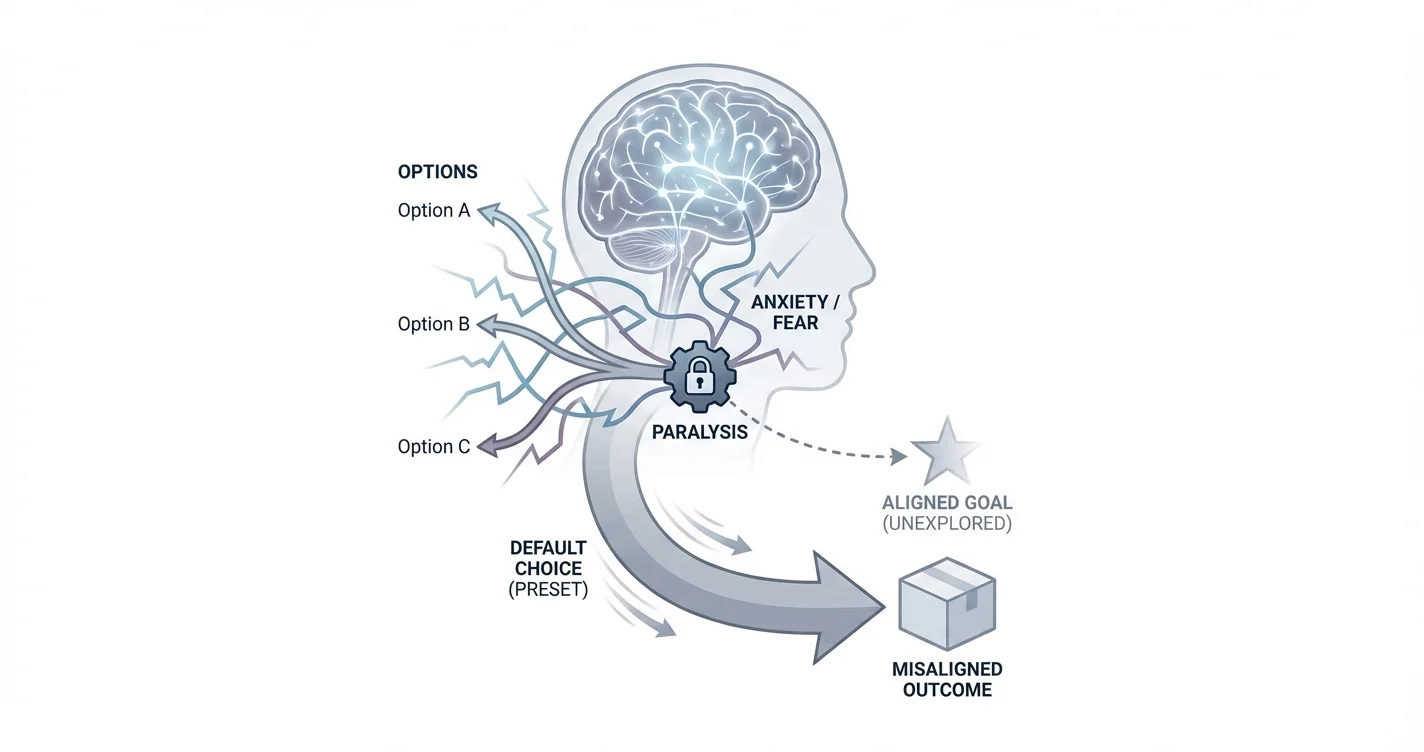
Decision paralysis occurs when the fear of making the wrong choice becomes so overwhelming that we freeze entirely. In these moments, many people gravitate

Key Takeaways
- Decision paralysis significantly interferes with your daily functioning, preventing you from making necessary
- You experience severe anxiety, panic symptoms, or physical distress when facing decisions
- You've noticed the range of decisions that feel overwhelming steadily expanding over time
- Decision avoidance has led to negative consequences like missed opportunities, relationship conflicts, or problems
- You frequently experience intense regret over decisions, spending substantial time ruminating on past choices
Introduction
Decision paralysis occurs when the fear of making the wrong choice becomes so overwhelming that we freeze entirely. In these moments, many people gravitate toward default options—not because these choices align with their goals, but because accepting a preset selection feels safer than the anxiety of deciding. This pattern appears across countless areas of life, from selecting healthcare plans to choosing career paths to deciding what to order at restaurants. Research suggests that decision avoidance itself constitutes a choice, one that often carries consequences we didn't consciously choose. Understanding the psychological mechanisms behind this phenomenon can help you recognize when you're defaulting out of fear rather than intention, and develop strategies to make more aligned decisions even when uncertainty feels uncomfortable.
The Psychology Behind Decision Paralysis
Decision paralysis stems from several interconnected psychological factors. At its core, this phenomenon involves an overwhelming fear that making the "wrong" choice will lead to regret, loss, or negative judgment from others or ourselves. When faced with multiple options, especially when the differences between them seem subtle or the stakes feel high, our minds can become locked in analysis mode without ever reaching a conclusion.
Neuroimaging studies suggest that decision-making involves coordination between brain regions associated with emotion regulation, risk assessment, and future planning. When these systems become overwhelmed by perceived consequences, the brain may essentially stall, creating the subjective experience of being "stuck." This isn't laziness or indifference—it's an overactive protection mechanism attempting to shield you from potential harm.
The relationship between anxiety and decision-making creates a feedback loop. Initial anxiety about making the wrong choice triggers avoidance behaviors, which temporarily reduces discomfort. However, this relief reinforces the pattern, making it more likely you'll avoid decisions in the future. Over time, this can erode confidence in your judgment and expand the categories of decisions that feel overwhelming.
What many people don't realize is that avoiding a decision is actually making a choice—specifically, the choice to accept whatever default option exists. Whether that's staying in an unsatisfying job (the default of inaction), accepting the standard insurance plan (the default your employer selected), or letting others make plans for you (the default of social passivity), these are still choices with real consequences.
Why Default Options Feel Safer
Default choices carry a unique psychological appeal when decision paralysis sets in. These preset options offer several forms of relief to an anxious mind, even when they don't serve your actual needs or preferences.
Diffused responsibility: When you accept a default option, you can mentally attribute that choice to external circumstances rather than your own judgment. If the outcome disappoints, you can tell yourself "it wasn't really my choice" or "everyone does it this way." This provides psychological distance from potential regret, even though you still experience the consequences.
Reduced cognitive load: Making decisions requires mental energy for evaluating options, projecting future scenarios, and weighing competing values. Defaults eliminate this effort entirely. For someone already depleted by anxiety or other demands, the path of least cognitive resistance becomes powerfully attractive.
Social validation: Default options often represent what most people do, providing implicit social proof. There's perceived safety in numbers—if the standard healthcare plan or typical career progression didn't work out, at least you wouldn't be alone in that experience. This fear of standing out in failure drives many people toward conventional choices even when those don't align with their circumstances.
Reversibility illusion: Defaults sometimes carry an unconscious assumption that they're temporary or easily changed. "I'll just go with this for now and decide later" becomes a form of decision postponement that can extend indefinitely. The default option becomes permanent by default, not by design.
Mental health professionals working with clients experiencing decision paralysis note that default choices are rarely aligned with the life someone actually wants to create. The temporary comfort of avoiding a decision frequently gives way to longer-term dissatisfaction, resentment, or a sense that life is happening to you rather than being actively shaped by your choices.
The Hidden Costs of Defaulting
While accepting preset options provides short-term anxiety relief, this pattern carries significant long-term consequences that often aren't immediately apparent.
Accumulated misalignment: Each individual default choice might seem minor, but these decisions compound over time. Accepting the standard meal plan, typical vacation destination, conventional career path, and default social arrangements creates a life constructed entirely from other people's preferences and assumptions. The cumulative effect is often a persistent feeling of disconnection from your own existence.
Erosion of agency: Every time you avoid a decision out of fear, you reinforce the belief that you're incapable of making good choices. This creates a self-fulfilling pattern where decreased confidence leads to more avoidance, which further undermines trust in your judgment. Over months and years, this can significantly impact your sense of autonomy and self-efficacy.
Missed opportunities: Defaults represent average solutions designed for typical situations. By definition, they don't account for your specific circumstances, values, or goals. The standard insurance plan might miss coverage you specifically need. The conventional career progression might bypass opportunities that align with your strengths. Each default accepted is a potential better fit left unexplored.
Relationship impacts: Decision avoidance doesn't just affect individual choices—it influences relationships. Partners and friends may become frustrated by repeated "I don't know, whatever you want" responses. Professional relationships can suffer when colleagues perceive you as passive or disengaged. The pattern can also attract people who prefer making decisions for others, creating power imbalances in relationships.
Emerging research on decision-making and well-being suggests that having control over life choices, even when those choices lead to suboptimal outcomes, is associated with greater life satisfaction than having objectively better outcomes imposed by external forces. The subjective experience of agency appears to matter as much as the objective quality of outcomes.
Breaking the Cycle of Decision Paralysis
Moving beyond the pattern of fear-driven defaulting requires developing new approaches to decision-making that acknowledge anxiety without being controlled by it. These strategies come from therapeutic approaches that mental health professionals use when working with decision paralysis.
Separate the decision from its perceived stakes
Decision paralysis often stems from catastrophizing potential negative outcomes. A useful technique involves explicitly examining what would actually happen if you made the "wrong" choice. Write down the decision, then list realistic consequences of various options. This often reveals that perceived catastrophic outcomes are either unlikely or recoverable, reducing the emotional charge around the decision.
For decisions that genuinely carry significant consequences, break them into smaller component choices. Rather than "Should I change careers?"—an overwhelming question—focus on "Should I have a conversation with someone in that field?" or "Should I spend one hour researching this possibility?" Smaller decisions reduce paralysis while still moving you forward.
Use time-boxing for decision-making
Give yourself a specific, limited timeframe to make a decision. For minor choices, this might be five minutes. For moderate ones, perhaps a day or week. This creates healthy pressure that can overcome paralysis without requiring unlimited rumination. When the time expires, you commit to choosing based on the information you have, acknowledging that perfect certainty is usually impossible.
This approach works particularly well with what practitioners call the "future you" test. Project yourself forward to after the decision has been made. Imagine you chose option A—how does future you feel about that choice? Then imagine choosing option B. This perspective shift can bypass some of the anxiety-driven thought loops by engaging a different cognitive framework.
Acknowledge that wrong choices aren't permanent catastrophes
One fundamental distortion in decision paralysis is the belief that wrong choices are irreversible disasters. In reality, most decisions can be adjusted, reversed, or learned from. Building tolerance for imperfect choices reduces the stakes of any individual decision. Some people find it helpful to intentionally make a "wrong" choice in a low-stakes situation—ordering something different than usual, taking a new route—to practice tolerating suboptimal outcomes and adjusting.
Work with emotional resistance rather than avoiding it
Decision paralysis often signals that important values or fears are in play. Rather than trying to logic your way past the anxiety, spend time with it. What specifically feels threatening about this choice? What values conflict here? What fear underlies the paralysis? Tools like Lovon.app can provide a space to process these emotional dimensions of decision-making through conversation, helping clarify what's actually driving the avoidance.
Sometimes the paralysis itself contains useful information. If you've been stuck between two job offers for weeks, the inability to choose might indicate that neither truly fits what you need, or that a factor you haven't consciously acknowledged is influencing your feelings about the options.
Distinguishing Healthy Deliberation from Paralysis
Not all extended decision-making constitutes problematic paralysis. Important choices warrant thoughtful consideration. The distinction lies in whether your process is productive or stuck.
Healthy deliberation involves actively gathering relevant information, consulting people with applicable experience, and weighing options against your values and circumstances. You make incremental progress in understanding the choice, even if slowly. The process, while perhaps uncomfortable, doesn't generate overwhelming anxiety or complete avoidance.
Decision paralysis, by contrast, involves repetitive mental loops without new information or insight. You might research obsessively but never feel you have "enough" information. You might list pros and cons repeatedly without getting closer to a choice. The process generates significant distress and often expands to consume mental energy beyond what the decision objectively warrants. You may find yourself avoiding reminders of the decision or feeling resentful that you have to choose at all.
Another key difference: healthy deliberation maintains connection with your preferences and values, while paralysis often loses touch with what you actually want. If you can articulate clear reasons for finding a decision difficult, that suggests deliberation. If you simply feel stuck without being able to explain why, that suggests paralysis.
When decision-making consistently takes disproportionate time and energy, or when you find yourself repeatedly defaulting to preset options out of avoidance, these patterns may benefit from professional support. Therapists specializing in anxiety and decision-making can help identify underlying fears, develop decision-making frameworks that work for your cognitive style, and address the perfectionism or fear of judgment that often fuels paralysis.
Building Decision-Making Confidence
Developing greater ease with decisions is a skill that strengthens with practice. Like physical exercise, this works best when you start at an appropriate level and gradually increase difficulty.
Begin by making small decisions quickly and consciously. Rather than letting habit or defaults guide minor choices, actively decide what to have for breakfast, which route to take, or what to wear. Notice when your mind wants to defer these small choices or avoid them entirely. Making conscious choices in low-stakes situations builds the neural pathways and emotional tolerance for decision-making.
Track your decisions and their outcomes. Many people with decision paralysis have distorted perceptions of their decision-making history, remembering primarily the choices that didn't work out while discounting successful ones. Keeping a simple record of decisions and their actual consequences can provide evidence that you're more capable than anxiety suggests.
Develop a personal decision-making framework based on your core values. When you clearly understand what matters most to you, decisions become less about finding the objectively "correct" answer and more about choosing the option most aligned with your priorities. This might involve identifying your top three to five values and explicitly considering how options relate to each one.
Consider working with support resources designed for decision-making and emotional processing. In addition to traditional therapy, tools like Lovon.app offer on-demand conversations to work through the anxiety and competing considerations that often underlie decision paralysis, providing a space to think aloud and gain clarity when you're feeling stuck.
When to Seek Professional Help
While everyone experiences occasional difficulty with decisions, certain patterns indicate that professional support would be beneficial. Consider reaching out to a mental health professional if:
- Decision paralysis significantly interferes with your daily functioning, preventing you from making necessary choices about work, relationships, health, or finances
- You experience severe anxiety, panic symptoms, or physical distress when facing decisions
- You've noticed the range of decisions that feel overwhelming steadily expanding over time
- Decision avoidance has led to negative consequences like missed opportunities, relationship conflicts, or problems at work
- You frequently experience intense regret over decisions, spending substantial time ruminating on past choices
- The fear of making wrong choices is connected to perfectionism, past trauma, or other mental health concerns like generalized anxiety disorder or obsessive-compulsive patterns
Therapists trained in cognitive-behavioral approaches can help restructure thought patterns that fuel decision paralysis. Those specializing in anxiety disorders can address the underlying fears that make choices feel threatening. For some individuals, decision paralysis connects to deeper concerns about identity, self-trust, or worthiness that benefit from exploratory therapeutic work.
Professional support doesn't mean your difficulty with decisions reflects a fundamental flaw or weakness. Decision-making happens in the context of your life experiences, neurobiology, current stressors, and learned patterns—all factors that therapy can help address. Many people find that relatively brief therapeutic work focused specifically on decision-making creates lasting improvement in their confidence and ability to make aligned choices.
Conclusion
Decision paralysis and the pull toward default choices represent an understandable but ultimately limiting response to the anxiety of making potentially wrong decisions. While accepting preset options provides temporary relief from the discomfort of choice, this pattern gradually constructs a life shaped by others' assumptions rather than your own intentions and values. The hidden truth is that avoiding a decision doesn't protect you from consequences—it simply means accepting whatever default exists, often with outcomes you didn't consciously choose.
Breaking free from this cycle involves acknowledging that uncertainty is inherent to decisions, wrong choices are rarely permanent catastrophes, and the confidence to choose develops through practice rather than emerging fully formed. By starting with smaller decisions, examining the fears underlying your paralysis, using structured approaches like time-boxing and the future-you perspective, and accessing support when needed, you can gradually build the capacity to make choices aligned with the life you actually want to create. The goal isn't perfect decision-making—it's developing sufficient trust in your judgment to move forward despite uncertainty, knowing you can adjust, learn, and choose again.
Disclaimer: This is general information, not medical advice or diagnosis. If symptoms are severe, affecting your daily life, or you're having thoughts of self-harm—seek professional help. In the US: call or text 988 (Suicide & Crisis Lifeline). For immediate danger: 911 or local emergency services.
How AI Support Helps You Heal
AI emotional support isn't about replacing human connection — it's about filling the gaps. The moments when you need to talk at 2 AM, when you don't want to burden your friends again, or when you simply need someone to listen without judgment.
Here's what happens in a typical Lovon session:
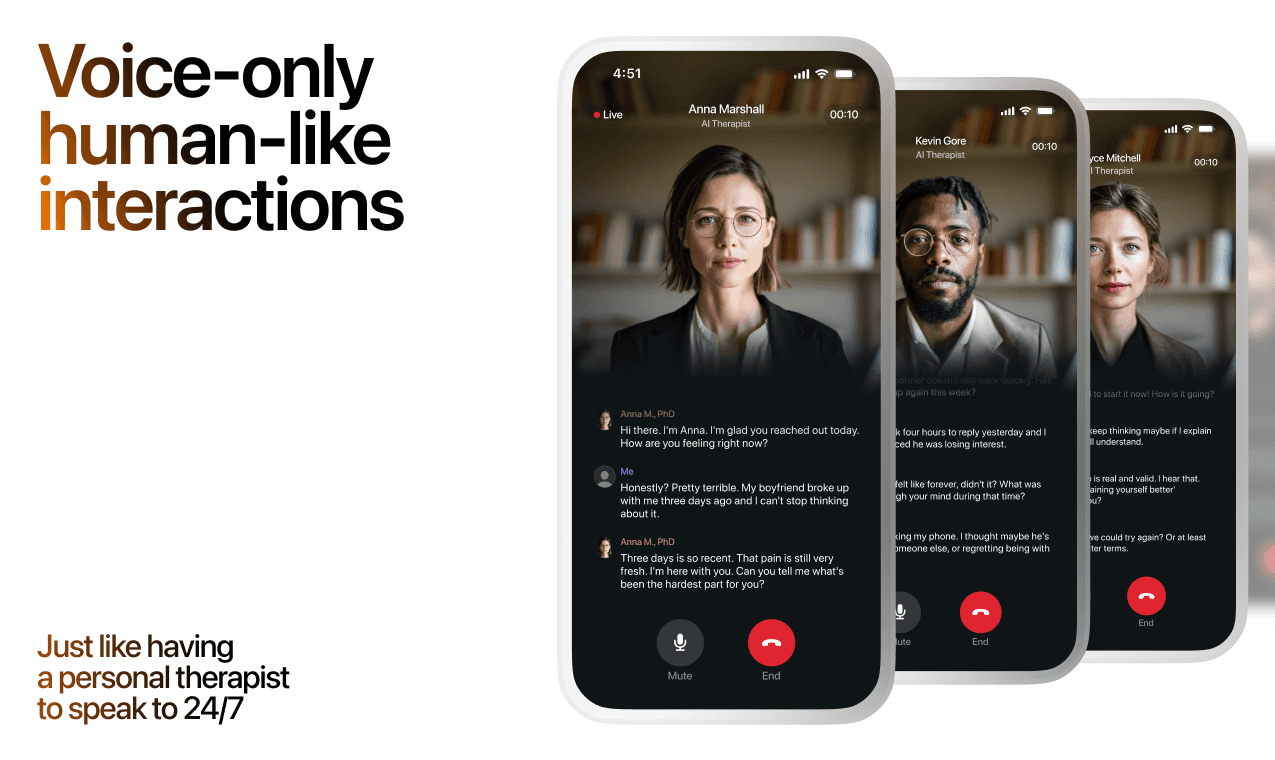
You share what's on your mind
There's no script, no intake form, no waiting room. You speak or type whatever you're feeling — in your own words, at your own pace.
Lovon validates and explores
Using frameworks from CBT (Cognitive Behavioral Therapy) and motivational interviewing, Lovon acknowledges your feelings first, then gently helps you explore them. No dismissive "just move on" advice.
You build coping skills together
Lovon doesn't just listen — it actively works with you on evidence-based techniques: thought reframing, urge surfing, behavioral experiments, and more.
What a Session with Lovon Looks Like
When to Seek Professional Help
AI support is a valuable tool, but it's not a replacement for professional care. Please consider reaching out to a licensed therapist if you experience any of the following:
- Persistent thoughts of self-harm or suicide
- Inability to perform daily activities (work, eating, sleeping) for more than 2 weeks
- Turning to alcohol or substances to cope
- Intense anger or desire to harm your ex-partner
- Complete emotional numbness that doesn't improve over time
Crisis Resources (US): If you're in immediate danger, call 988 (Suicide & Crisis Lifeline) or text HOME to 741741 (Crisis Text Line). Available 24/7, free, and confidential.
Outside the US? Find a crisis line in your country
Ready to Start?
Your healing journey can begin right now
A 7-day trial. No judgment. Just a safe space to process what you're going through.
Frequently Asked Questions
Is Lovon a replacement for a real therapist?
Is my conversation with Lovon AI private?
How is Lovon different from ChatGPT for emotional support?
Can I use Lovon if I'm already seeing a therapist?
Can I try Lovon before subscribing?
About the Author
The Lovon Editorial Team
Mental Health & Wellness Content Team
The Lovon Editorial Team develops mental health and wellness content designed to make psychological concepts accessible and actionable. Our goal is to bridge the gap between clinical research and everyday life - helping you understand why your mind works the way it does and what you can do about it....
Related articles
- ADHD and Procrastination: Why It Happens (2026 Guide)
ADHD and procrastination linked to dopamine and task-initiation gaps, not laziness. Get the 2026 step-by-step fix: body…
- Acceptance and Commitment Therapy as Therapeutic Framework
Acceptance and Commitment Therapy as a therapeutic framework has transformed how mental health professionals approach…
- Understanding Amygdala Emotional Hijacking and How to Regain Control
Amygdala emotional hijacking occurs when your brain's emotional response system overrides rational thinking in fractions…
- Understanding CPTSD Symptom Expansion and How It Affects Recovery
When people begin addressing their Complex PTSD, many encounter an unexpected and disorienting phenomenon: their…
See also
Quizzes
- Experiential Avoidance Test: Do You Avoid Your Feelings?
See which way you keep feelings out, in 3 minutes.
- Inner Critic Test: How Harsh Is the Voice in Your Head?
See what kind of critic you live with, in 3 minutes.
Free tools
- What to Say When a Pet Dies
Get a message you can actually send to someone whose dog or cat just died: one that uses the animal's name, treats the…
- Family Boundary Plan
Pick the person, the one topic, and how much you want to see them. You get a three-rung ladder, the guilt lines to…
From the wiki
- How to stop maladaptive daydreaming?
Maladaptive daydreaming is immersive waking fantasy that eats hours, usually with music and pacing attached. You rarely…
Disclaimer: This article is for informational purposes only and does not constitute medical advice, diagnosis, or treatment. Always seek the advice of your physician or other qualified health provider with any questions you may have regarding a medical condition. If you are in crisis or think you may have an emergency, call 988 (Suicide & Crisis Lifeline) or go to the nearest emergency room. Outside the US? Find a crisis line in your country.