
Flight Response Becoming Chronic Avoidance and Overachievement Pattern
The body's flight response is designed to protect us from immediate danger, triggering a cascade of neurobiological changes that prepare us to escape
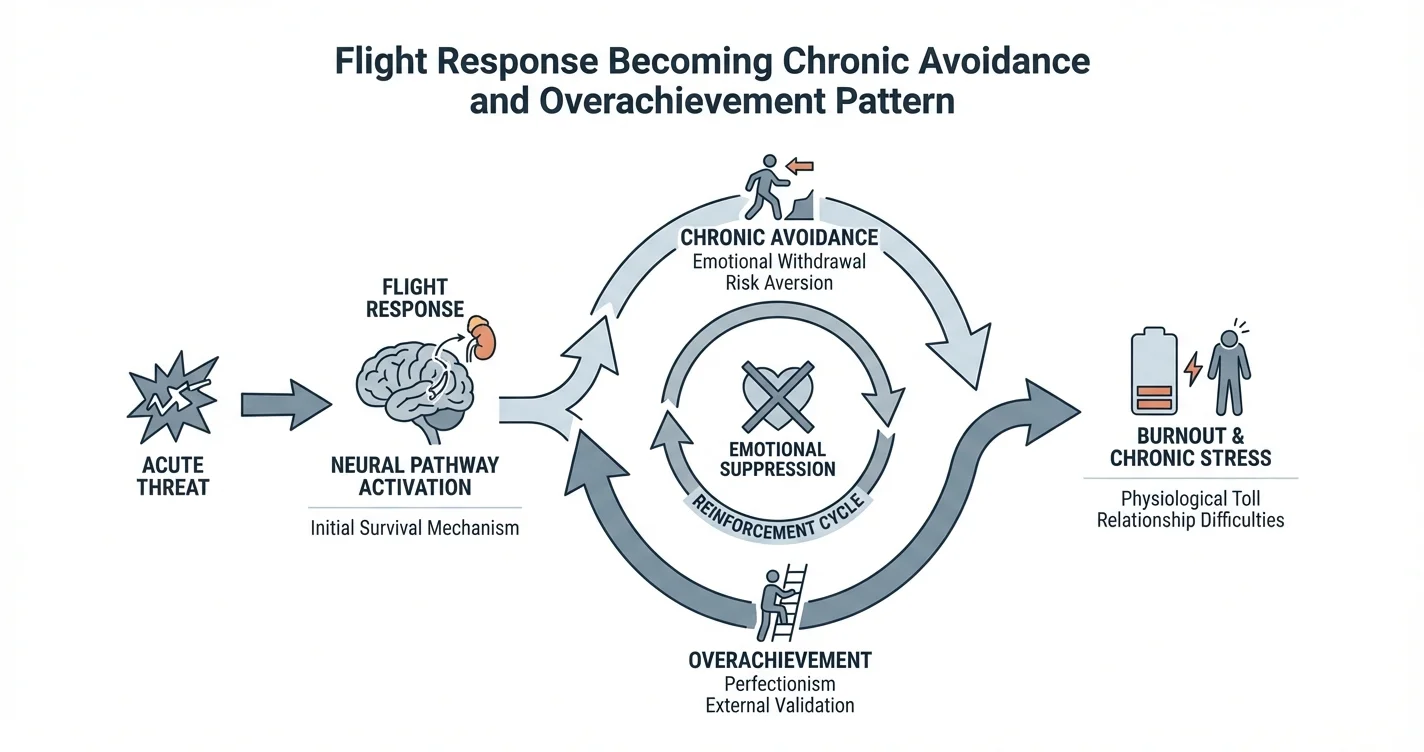

Key Takeaways
- Sensitization of threat-detection circuits, making the amygdala increasingly responsive to perceived dangers
- Reduced prefrontal cortex regulation of emotional responses during prolonged stress
- Habituation to elevated stress hormones, creating a baseline state of heightened arousal
- Neuroplastic changes that reinforce avoidance pathways through repeated activation
- Initial sensitization: Repeated activation of flight response to specific triggers
Introduction
The body's flight response is designed to protect us from immediate danger, triggering a cascade of neurobiological changes that prepare us to escape threatening situations. However, when this acute survival mechanism persists beyond the initial threat, it can evolve into something far more complex: a chronic pattern of avoidance paired paradoxically with relentless overachievement. This transformation from a temporary stress response into a habitual behavioral pattern affects millions of individuals, often without their conscious awareness.
Understanding how the flight response becomes chronic avoidance and overachievement patterns is essential for anyone experiencing persistent anxiety, perfectionism, or difficulty engaging with emotional challenges. Research suggests that this transformation occurs through repeated activation of stress pathways, eventually rewiring how we approach not just danger, but everyday challenges, relationships, and our own internal experiences. As of early 2026, mental health professionals increasingly recognize this pattern as a significant factor in burnout, relationship difficulties, and chronic stress-related conditions.
The Neurobiological Foundation of Flight Response Patterns
The flight response originates in the autonomic nervous system, specifically through activation of the sympathetic branch. When the amygdala detects a potential threat, it signals the hypothalamus to initiate a stress response within fractions of a second. This triggers the release of adrenaline and noradrenaline, followed by cortisol production that sustains the heightened state over minutes to hours.
Under normal circumstances, this response resolves once the threat passes, allowing the parasympathetic nervous system to restore equilibrium. However, when threats are chronic, ambiguous, or internalized—such as criticism, performance pressure, or relationship conflict—the system may remain partially activated. Studies indicate that prolonged activation of stress pathways can alter the sensitivity of threat-detection systems, creating a lower threshold for triggering the flight response.
This neurobiological shift has profound implications for behavior. The brain begins to categorize situations that involve vulnerability, emotional exposure, or potential failure as threats equivalent to physical danger. What starts as a protective mechanism evolves into a generalized response pattern that shapes decision-making, relationship dynamics, and self-perception.
The transition from acute to chronic activation involves several key mechanisms:
- Sensitization of threat-detection circuits, making the amygdala increasingly responsive to perceived dangers
- Reduced prefrontal cortex regulation of emotional responses during prolonged stress
- Habituation to elevated stress hormones, creating a baseline state of heightened arousal
- Neuroplastic changes that reinforce avoidance pathways through repeated activation
How Flight Mode Transforms Into Chronic Avoidance
The connection between flight response and avoidance behavior appears straightforward—both involve moving away from perceived threats. However, chronic avoidance represents a sophisticated psychological adaptation that extends far beyond the original biological response.
When the flight response becomes chronic avoidance, individuals develop elaborate strategies to prevent encountering situations that might trigger the original stress response. This can manifest across multiple domains of life. In relationships, it might appear as emotional withdrawal, difficulty with vulnerable conversations, or a pattern of ending connections before they become too close. In professional settings, chronic avoidance might involve declining opportunities that involve visibility or evaluation, despite having the necessary skills.
Research on avoidance behaviors suggests they provide immediate anxiety relief, which reinforces the pattern through negative reinforcement. Each time someone avoids a challenging situation, they experience temporary reduction in discomfort, which strengthens the neural pathways associated with avoidance. Over time, this creates a self-perpetuating cycle where the range of avoided situations expands, and the capacity to tolerate discomfort diminishes.
Importantly, chronic avoidance often operates below conscious awareness. Many individuals don't recognize they're avoiding; instead, they construct rational explanations for their choices. Someone might explain they're "not interested" in a promotion that would require public speaking, when the underlying driver is avoidance of the anxiety associated with visibility and potential criticism.
The relationship between flight response and chronic avoidance involves several developmental stages:
- Initial sensitization: Repeated activation of flight response to specific triggers
- Generalization: Expansion of triggers to include symbolically related situations
- Cognitive elaboration: Development of beliefs and narratives that justify avoidance
- Identity integration: Avoidance patterns becoming incorporated into self-concept
The Paradox of Flight Response Turning Into Overachievement
Perhaps the most counterintuitive aspect of how flight response becomes chronic avoidance and overachievement patterns is the simultaneous development of perfectionism and high achievement. On the surface, these seem contradictory—how can someone both avoid challenges and pursue excellence relentlessly?
The answer lies in the specific nature of what's being avoided. Individuals with flight-based overachievement patterns don't avoid achievement itself; they avoid the emotional vulnerability, uncertainty, and potential judgment that accompany genuine engagement with challenges. Overachievement becomes a sophisticated avoidance strategy, a way to stay perpetually in motion, outrunning criticism, failure, or deeper emotional needs.
Clinical observations suggest that flight-based overachievers maintain constant forward momentum as a defense against stillness or introspection. Achievement provides external validation that temporarily quiets internal anxiety, creating another reinforcement loop. The individual learns that accomplishment generates positive feedback, which briefly alleviates the chronic stress associated with the underlying flight response.
This pattern often involves specific characteristics:
- Externally-driven motivation rather than intrinsic interest or values
- Difficulty experiencing satisfaction from accomplishments, immediately moving to the next goal
- Anxiety when not actively working toward something measurable
- Perfectionism focused on avoiding criticism rather than pursuing excellence for its own sake
- Difficulty with unstructured time or activities without clear objectives
The connection to flight response becomes evident when examining what happens if achievement is threatened. Rather than experiencing disappointment or adapting strategy, these individuals often experience intense anxiety resembling a threat response—because for them, failure represents not just disappointment but exposure to the underlying vulnerabilities they've been fleeing.
For many people working through these patterns, support tools like Lovon.app can provide on-demand processing of the emotions that arise when they begin recognizing these dynamics. Having accessible support for naming feelings and exploring patterns can be particularly valuable during the uncomfortable period of increased self-awareness.
Recognizing the Chronic Avoidance and Overachievement Cycle
Identifying when flight response has developed into chronic avoidance and overachievement patterns requires attention to both external behaviors and internal experiences. These patterns often persist precisely because they're partially functional—the individual does achieve, does avoid some forms of discomfort, and may appear highly successful to external observers.
Several indicators suggest this pattern may be present. First, there's often a quality of drivenness that feels compulsive rather than freely chosen. The person feels they must keep achieving, not because they're passionate about their goals but because stopping feels intolerable. Second, accomplishments provide diminishing satisfaction, with the individual quickly pivoting to the next target without integrating or celebrating what they've achieved.
Third, there's typically difficulty with genuine vulnerability in relationships. The same patterns that drive professional overachievement—the need to control outcomes, avoid uncertainty, stay in motion—create barriers to emotional intimacy. Relationships may feel superficial, or the individual might avoid them entirely, rationalizing that they're "too busy" or "focused on their career."
Fourth, physical symptoms often accompany these patterns. The body remains in a state of chronic activation, leading to issues like sleep disturbances, digestive problems, tension headaches, or jaw clenching. These represent the physiological cost of maintaining the flight response over extended periods.
Key questions that can illuminate these patterns include:
- Do I feel genuine satisfaction from my accomplishments, or immediate pressure to do more?
- Can I tolerate periods of rest without anxiety or feeling I "should" be productive?
- Do I avoid specific types of situations (conflict, vulnerability, uncertainty) across multiple life domains?
- Does slowing down or facing potential failure trigger anxiety disproportionate to the actual stakes?
- Have relationships suffered because I struggle with emotional presence or intimacy?
Understanding these patterns represents the essential first step toward change. Many individuals experience significant anxiety when they first recognize how deeply these dynamics have shaped their lives, as the recognition itself can feel threatening to the protective strategies they've relied upon.
Breaking the Cycle: From Flight Response to Grounded Engagement
Transforming chronic avoidance and overachievement patterns stemming from flight response requires a multifaceted approach that addresses both the neurobiological foundations and the psychological patterns that have developed over time. This isn't about eliminating the capacity for flight response—which remains an essential survival mechanism—but about restoring flexibility so that acute stress responses don't automatically trigger chronic behavioral patterns.
A foundational element involves nervous system regulation. Since the flight response originates in autonomic activation, developing capacity to recognize and modulate this activation creates space for different choices. Techniques that engage the parasympathetic nervous system—such as specific breathing patterns, progressive muscle relaxation, or vagal nerve stimulation—can help shift the body out of chronic activation. Research indicates that consistent practice with these approaches may gradually reduce the baseline arousal level, making the system less reactive to perceived threats.
Equally important is developing tolerance for the emotions and sensations that avoidance patterns have kept at bay. This typically involves gradually approaching avoided situations in manageable increments, while maintaining awareness of the physiological and emotional responses that arise. The goal isn't to force confrontation with everything simultaneously, but to build evidence that uncomfortable emotions and uncertainty can be tolerated without catastrophic outcomes.
Cognitive work also plays a significant role, particularly in examining the beliefs that sustain overachievement patterns. Many individuals with flight-based perfectionism hold core beliefs about their worth being conditional on achievement, or about criticism representing genuine danger rather than information. Exploring these beliefs, their origins, and their current accuracy creates opportunities for developing more balanced perspectives.
For relationship-based avoidance, the work often involves practicing incremental vulnerability with safe individuals. This might begin with naming emotions in low-stakes situations, then gradually moving toward more significant disclosures and authentic engagement. Having on-demand support through resources like Lovon.app can be valuable during this process, providing a space to process emotions and prepare for challenging conversations without the pressure of formal therapy scheduling.
Practical strategies for breaking these cycles include:
- Establishing regular "check-in" practices to assess current nervous system state and emotional experience
- Deliberately engaging in activities valued for intrinsic reasons rather than achievement potential
- Setting boundaries around work and productivity to practice tolerating non-achievement
- Seeking therapeutic support specialized in trauma and anxiety patterns, particularly approaches like somatic experiencing or EMDR that address stored physiological activation
- Building community and connection that isn't contingent on achievement or performance
Advanced Considerations: Individual Variations and Complexity
While the core pattern of flight response becoming chronic avoidance and overachievement follows recognizable trajectories, individual presentations vary significantly based on temperament, early experiences, and the specific contexts in which the pattern developed. Understanding these variations helps avoid oversimplified approaches to complex behavioral patterns.
Some individuals develop primarily achievement-focused patterns with minimal apparent avoidance. These individuals might appear highly functional, excelling across multiple domains while privately experiencing intense anxiety and emptiness. The avoidance in these cases often centers on internal experiences—emotions, needs, or existential questions—rather than external situations.
Others develop primarily avoidance-focused patterns where achievement becomes secondary to minimizing exposure to triggering situations. These individuals might underperform relative to their capabilities, having constructed lives with minimal challenge or risk. The flight element manifests as withdrawal rather than forward momentum.
Individual temperament also influences how these patterns develop. Those with naturally higher sensitivity to environmental stimuli may develop flight-based patterns more readily, as their nervous systems respond more intensely to perceived threats. Conversely, those with naturally lower sensitivity might require more significant or prolonged stressors before developing chronic patterns.
Early relational experiences play a significant role in shaping these patterns, though it's important to note that multiple factors contribute to their development. Environments characterized by high criticism, unpredictable responses, or emotional unavailability may contribute to developing flight-based coping strategies, alongside genetic predispositions and individual temperament. However, these patterns can also develop in response to specific traumatic events, systemic stressors, or cumulative challenges across development.
It's also important to acknowledge that what appears as flight-based overachievement may coexist with or mask other conditions, including attention difficulties, mood disorders, or trauma-related conditions. Professional assessment can help differentiate overlapping presentations and ensure appropriate support.
When to Seek Professional Help
While self-awareness and self-directed strategies provide valuable starting points, certain situations indicate professional support would be beneficial or necessary:
Professional help is particularly important when these patterns significantly impair functioning—such as inability to maintain relationships, work performance suffering despite intense effort, or physical health consequences from chronic stress. If you're experiencing panic attacks, persistent insomnia, or symptoms of burnout including emotional exhaustion and cynicism, professional guidance can provide structured support for addressing underlying patterns.
Additionally, if avoidance has become so pervasive that it restricts life opportunities, or if you recognize these patterns but feel unable to change them despite repeated attempts, working with a therapist specializing in anxiety, trauma, or stress-related conditions can be invaluable. Therapeutic approaches particularly relevant for these patterns include somatic experiencing, EMDR, acceptance and commitment therapy, and specialized cognitive-behavioral approaches for perfectionism and avoidance.
Mental health professionals can also help differentiate flight-based patterns from other conditions with similar presentations, ensuring that any interventions address the actual underlying dynamics rather than surface symptoms.
Conclusion
Understanding how flight response becomes chronic avoidance and overachievement patterns illuminates one of the more complex adaptations to prolonged stress. What begins as an acute protective mechanism transforms through repeated activation and reinforcement into habitual ways of relating to challenges, emotions, and other people. The paradoxical pairing of avoidance and achievement reflects the sophisticated nature of these adaptations—not contradictory impulses but an integrated strategy for managing persistent anxiety while maintaining external functioning.
Recognition represents the crucial first step. Many individuals have lived with these patterns so long they've become invisible, woven into identity and daily routines. Becoming aware of the flight response underlying both the avoidance and the relentless achievement creates possibilities for different choices. Change doesn't require eliminating the capacity for flight—which remains valuable—but rather restoring flexibility and expanding the range of responses available when facing challenges.
The path forward involves multiple elements: nervous system regulation to address the physiological foundations, gradual exposure to develop tolerance for avoided experiences, cognitive work to examine sustaining beliefs, and relationship practices to build capacity for genuine connection. Progress typically unfolds gradually, with periods of integration between insights and behavioral changes. Support resources, whether professional therapy, peer communities, or accessible tools like Lovon.app for processing emotions as patterns shift, can provide valuable scaffolding during this transition.
Ultimately, transforming chronic avoidance and overachievement patterns creates space for a fundamentally different relationship with yourself and your life—one characterized by greater choice, authenticity, and the capacity to engage with both challenges and connections from a place of groundedness rather than perpetual flight.
Disclaimer: This is general information, not medical advice or diagnosis. If symptoms are severe, affecting your daily life, or you're having thoughts of self-harm — seek professional help. In the US: call or text 988 (Suicide & Crisis Lifeline). For immediate danger: 911 or local emergency services.
How AI Support Helps You Heal
AI emotional support isn't about replacing human connection — it's about filling the gaps. The moments when you need to talk at 2 AM, when you don't want to burden your friends again, or when you simply need someone to listen without judgment.
Here's what happens in a typical Lovon session:
You share what's on your mind
There's no script, no intake form, no waiting room. You speak or type whatever you're feeling — in your own words, at your own pace.
Lovon validates and explores
Using frameworks from CBT (Cognitive Behavioral Therapy) and motivational interviewing, Lovon acknowledges your feelings first, then gently helps you explore them. No dismissive "just move on" advice.
You build coping skills together
Lovon doesn't just listen — it actively works with you on evidence-based techniques: thought reframing, urge surfing, behavioral experiments, and more.
What a Session with Lovon Looks Like

When to Seek Professional Help
AI support is a valuable tool, but it's not a replacement for professional care. Please consider reaching out to a licensed therapist if you experience any of the following:
- Persistent thoughts of self-harm or suicide
- Inability to perform daily activities (work, eating, sleeping) for more than 2 weeks
- Turning to alcohol or substances to cope
- Intense anger or desire to harm your ex-partner
- Complete emotional numbness that doesn't improve over time
Crisis Resources (US): If you're in immediate danger, call 988 (Suicide & Crisis Lifeline) or text HOME to 741741 (Crisis Text Line). Available 24/7, free, and confidential.
Outside the US? Find a crisis line in your country
Ready to Start?
Your healing journey can begin right now
A 7-day trial. No judgment. Just a safe space to process what you're going through.
Frequently Asked Questions
Is Lovon a replacement for a real therapist?
Is my conversation with Lovon AI private?
How is Lovon different from ChatGPT for emotional support?
Can I use Lovon if I'm already seeing a therapist?
Can I try Lovon before subscribing?
About the Author

The Lovon Editorial Team
Mental Health & Wellness Content Team
The Lovon Editorial Team develops mental health and wellness content designed to make psychological concepts accessible and actionable. Our goal is to bridge the gap between clinical research and everyday life - helping you understand why your mind works the way it does and what you can do about it....
Related articles
- High-Functioning Anxiety Signs You're Missing (2026)
Recognize the high functioning anxiety signs hiding behind productivity and composure — 8 specific patterns, what they…
- ADHD Sleep Cycle Disruption: Melatonin Release Delayed and Bedtime Procrastination
If you have ADHD and find yourself wide awake at midnight despite feeling exhausted hours earlier, you're not imagining…
- Mental Health Decline Indicators Through Irritability Changes Appetite Shifts Low Energy Social Isolation Declining Hygiene
Mental health doesn't typically deteriorate overnight. Instead, it sends signals—subtle at first, then increasingly…
- Amygdala and Prefrontal Cortex Partnership in Emotional Regulation
The partnership between the amygdala and prefrontal cortex represents one of the most crucial relationships in your…
See also
Quizzes
- Perfectionism Test: What Are Your Standards Costing?
See what your standards actually cost, in 3 minutes.
- Defense Mechanisms Test: Which Ones Do You Use Most?
See what your defenses do with hard feelings, in 3 minutes.
Free tools
- Vent to an AI
Need to vent and there is nobody to call, or nobody you want to tell? Type it here. You are talking to an AI listener…
- 5-4-3-2-1 Grounding Exercise
A guided run through the 5-4-3-2-1 technique, with paced breathing first if you need it. No sign-up, nothing stored…
From the wiki
- What to do if you have no friends?
Pick one activity that repeats weekly with the same people, and go for six to eight weeks straight. Repetition, not…
Disclaimer: This article is for informational purposes only and does not constitute medical advice, diagnosis, or treatment. Always seek the advice of your physician or other qualified health provider with any questions you may have regarding a medical condition. If you are in crisis or think you may have an emergency, call 988 (Suicide & Crisis Lifeline) or go to the nearest emergency room. Outside the US? Find a crisis line in your country.