
How to Heal Inner Child Trauma with Somatic Therapy Guide
Many adults carry unresolved childhood wounds that manifest as anxiety, relationship difficulties, or emotional dysregulation—often without understanding...
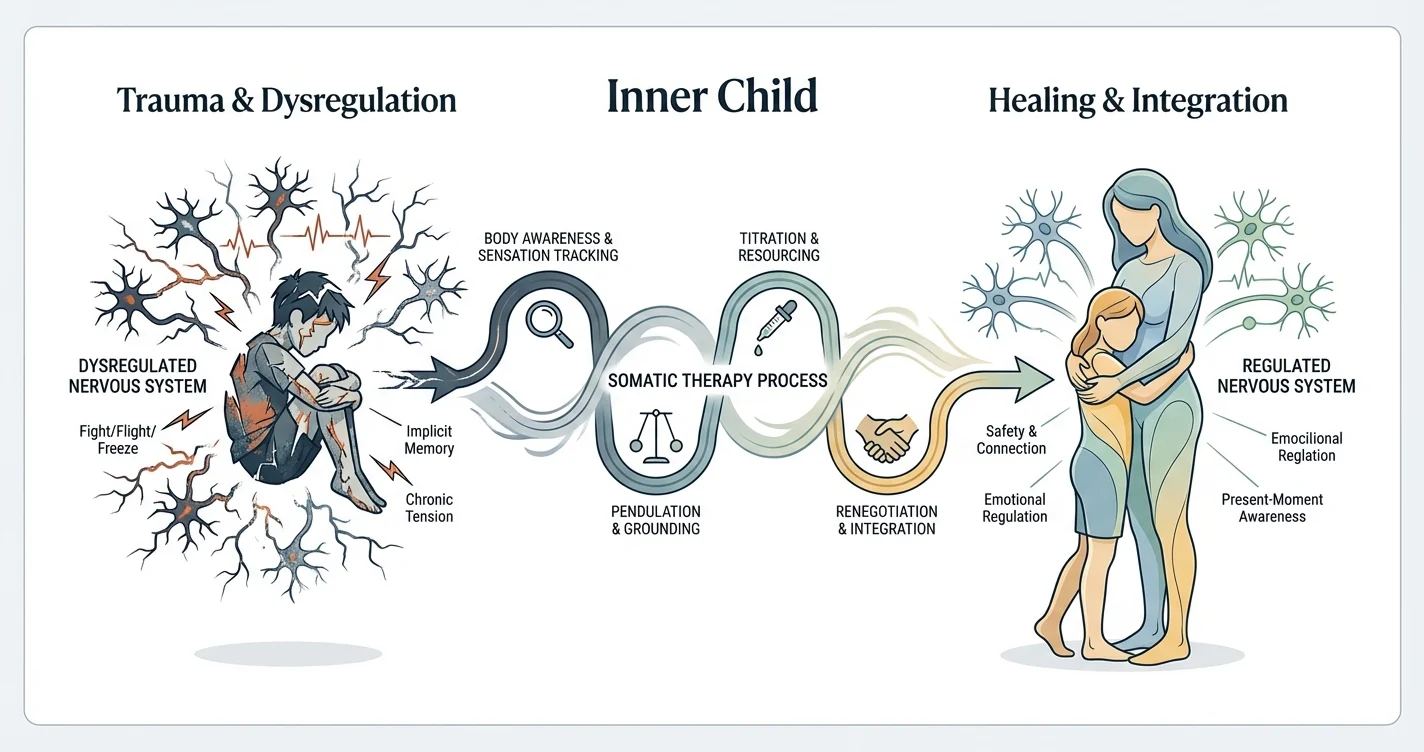

Key Takeaways
- Body scanning and sensation tracking: Learning to notice subtle physical sensations without judgment, developing the
- Pendulation: Moving attention between areas of comfort and discomfort in the body, building tolerance for difficult
- Grounding techniques: Anchoring awareness in present-moment physical sensations to counter dissociation and overwhelm
- Titration: Processing traumatic material in small, manageable doses rather than overwhelming the nervous system
Introduction
Many adults carry unresolved childhood wounds that manifest as anxiety, relationship difficulties, or emotional dysregulation—often without understanding why. Traditional talk therapy can provide insight, but when trauma is stored in the body, cognitive approaches alone may not reach the deeper layers of healing. Somatic therapy for inner child trauma offers a pathway to address these wounds by working directly with bodily sensations, nervous system responses, and the implicit memories held in our tissues.
This guide draws on current clinical understanding and practitioner approaches to somatic therapy, exploring how body-based techniques can support recovery from developmental trauma and facilitate inner child healing. Whether you're new to somatic approaches or seeking to deepen your existing practice, the methods outlined here provide actionable strategies grounded in the mind-body connection.
Understanding Somatic Therapy for Inner Child Healing
Somatic therapy operates on the principle that trauma lives not just in our thoughts and memories, but in our bodies. When we experience overwhelming stress during childhood, our nervous systems encode these experiences as bodily sensations, muscular tension patterns, and automatic protective responses. Decades later, these patterns continue to influence how we react to relationships, stress, and emotional challenges.
The "inner child" represents the part of ourselves that experienced developmental wounds—moments when our needs for safety, connection, or validation went unmet. Research in neuroscience suggests that early relational experiences shape neural pathways that persist into adulthood, influencing everything from emotional regulation to attachment patterns. When these formative experiences involved neglect, invalidation, or overwhelming stress, the effects can manifest as chronic tension, dissociation, or heightened stress responses.
Somatic therapy approaches inner child work by creating opportunities to revisit these stored experiences through the body's wisdom. Rather than simply talking about what happened, practitioners guide clients to notice present-moment sensations, track nervous system responses, and gradually renegotiate traumatic patterns. This process allows for integration at a physiological level, potentially shifting long-standing patterns that cognitive insight alone cannot reach.
Key Somatic Therapy Techniques for Childhood Trauma Recovery
Several evidence-informed somatic approaches have shown promise for addressing developmental trauma and supporting inner child healing. While specific methodologies vary, most share core principles of body awareness, nervous system regulation, and gradual trauma processing.
Foundational somatic practices include:
- Body scanning and sensation tracking: Learning to notice subtle physical sensations without judgment, developing the capacity to stay present with uncomfortable feelings
- Pendulation: Moving attention between areas of comfort and discomfort in the body, building tolerance for difficult sensations gradually
- Grounding techniques: Anchoring awareness in present-moment physical sensations to counter dissociation and overwhelm
- Titration: Processing traumatic material in small, manageable doses rather than overwhelming the nervous system
Practitioners working with childhood trauma often begin by establishing what's called "resources"—experiences of safety, stability, or comfort that can be anchored in bodily sensations. For someone whose inner child experienced chronic unpredictability, developing awareness of present-moment safety might involve noticing the feeling of feet on the ground, the support of a chair, or the rhythm of breath. These resources become touchstones when more challenging material emerges.
Breathwork represents another core somatic technique, though approaches vary significantly. Some practitioners use conscious breathing patterns to activate or calm the nervous system, while others simply guide clients to notice the breath's natural rhythm. For adults with unresolved childhood trauma, the breath often carries patterns of holding or restriction developed as protective responses. Gentle awareness of these patterns, without forcing change, can facilitate organic shifts in nervous system regulation.
Movement-based somatic work recognizes that trauma often involves interrupted survival responses—the fight, flight, or freeze reactions that weren't able to complete during overwhelming childhood experiences. Through mindful movement, clients may gradually allow their bodies to complete these protective impulses in a safe, controlled environment. This might look like gentle pushing against a wall to access healthy boundaries, or trembling and shaking to discharge held tension.
Step-by-Step Somatic Approaches for Inner Child Work
Implementing somatic therapy for inner child healing typically follows a phased approach, though the process rarely progresses in a perfectly linear fashion. Understanding this framework can help you recognize where you are in your healing journey and what might be helpful next.
Phase One: Building Somatic Awareness and Safety
Before exploring traumatic material, developing basic body awareness and establishing a sense of present-moment safety is essential. Many adults with childhood trauma have learned to disconnect from bodily sensations as a survival strategy—what's sometimes called dissociation or numbing. Reconnecting with the body requires patience and gentleness.
Begin with brief moments of noticing physical sensations throughout your day. Rather than trying to feel everything at once, start with neutral or pleasant sensations: the warmth of morning coffee, the texture of fabric, the feeling of sunlight on your skin. This builds capacity for interoception—awareness of internal bodily states—without triggering overwhelming responses.
Grounding practices form the foundation of this phase. When you notice anxiety, disconnection, or emotional overwhelm, deliberately bring attention to your physical environment and body. Feel your feet on the floor, press your hands together, or notice five things you can see. These practices activate present-moment awareness, helping to counter the nervous system's tendency to remain stuck in past threat responses.
Phase Two: Recognizing Patterns and Protective Responses
As body awareness develops, you may begin noticing how certain situations trigger characteristic physical responses. Perhaps your chest tightens before difficult conversations, your shoulders rise toward your ears when criticized, or your breath becomes shallow when facing conflict. These patterns often represent the inner child's protective strategies—ways of bracing against anticipated harm.
Rather than trying to eliminate these responses, somatic therapy encourages curious observation. What sensations arise? Where do you notice them in your body? What do they remind you of? This investigative approach helps connect present-day reactions with their developmental origins, without requiring detailed narrative memory.
Tools like Lovon.app can support this phase of awareness-building by providing on-demand opportunities to process stress responses as they arise. When you notice a somatic pattern emerging—that familiar tightness or shutdown—having immediate access to supportive reflection can help you stay present with the experience rather than automatically moving into avoidance.
Phase Three: Gentle Renegotiation and Integration
With increased awareness and nervous system resources, you can begin carefully exploring the edges of traumatic material. This process, which practitioners call "titration," involves approaching difficult experiences in small doses—just enough to engage the healing process without overwhelming your system.
Working with a qualified somatic therapist becomes particularly valuable in this phase. They can help you notice when you're approaching overwhelm and guide you back to resources before crossing that threshold. This repeated experience of approaching discomfort, staying present, and returning to safety gradually expands your window of tolerance—your capacity to remain regulated while feeling difficult emotions.
The inner child work in this phase might involve gentle dialogue with younger parts of yourself, imagining protective interventions in past situations, or allowing incomplete protective responses to find expression. Someone whose childhood involved suppressing anger might explore what it feels like to press into a wall or make sounds of protest in a safe, contained way. Another person might practice setting boundaries through embodied "no" responses after years of learned compliance.
Comparing Somatic Therapy and Traditional Talk Therapy for Inner Child Healing
Understanding the distinctions between somatic and traditional talk therapy approaches helps clarify when each might be most beneficial and how they can complement each other.
Traditional talk therapy, including psychodynamic and cognitive-behavioral approaches, primarily engages the explicit memory system and verbal processing. These methods excel at creating narrative coherence, identifying thought patterns, and developing insight into relational dynamics. For many people, understanding the connection between childhood experiences and current difficulties represents a crucial step in healing.
However, childhood trauma—particularly experiences that occurred before language development or were overwhelming to the nervous system—may not be fully accessible through verbal processing alone. These experiences are often stored as implicit memories: bodily sensations, emotional states, and behavioral patterns that operate outside conscious awareness. You might "know" intellectually that your childhood difficulties weren't your fault, yet continue experiencing shame responses in your body when facing similar situations.
Somatic therapy addresses this gap by working directly with the implicit memory system and nervous system responses. Rather than primarily talking about experiences, somatic approaches emphasize noticing and working with present-moment bodily sensations, allowing shifts to occur at a pre-verbal, physiological level.
Research in trauma treatment suggests that approaches integrating both verbal processing and somatic awareness may offer advantages over either method alone. The cognitive understanding developed in talk therapy can provide context and meaning-making, while somatic techniques facilitate the physiological integration necessary for lasting change. Many contemporary therapists trained in trauma treatment incorporate elements of both approaches.
For individuals with significant dissociation or disconnection from bodily experience, gentle somatic work may need to precede deeper verbal processing. Conversely, those who find themselves repeatedly overwhelmed by bodily sensations might benefit from cognitive tools to create some distance and perspective before diving more deeply into somatic exploration.
Advanced Considerations for Somatic Inner Child Work
As you progress in healing childhood trauma through somatic approaches, several nuanced considerations can support deeper integration while maintaining safety.
Working with Attachment Patterns
Developmental trauma frequently involves disrupted attachment—the foundational relationships with early caregivers that shape our capacity for connection, trust, and emotional regulation. These patterns become encoded in our nervous systems and influence how we approach relationships throughout life. Someone with anxious attachment might notice chronic tension and hypervigilance around connection, while avoidant patterns might manifest as numbing or disconnection when intimacy increases.
Somatic therapy can address these patterns by helping you recognize the bodily experience of different attachment states. What does anxious pursuing feel like in your chest, throat, or belly? What sensations accompany withdrawal or shutting down? With this awareness, you can begin experimenting with interrupting automatic patterns—perhaps allowing yourself to feel the urge to pursue connection without immediately acting on it, noticing what happens in your body when you resist the impulse to withdraw.
Navigating Dissociation and Overwhelm
While somatic therapy emphasizes body awareness, some people with significant childhood trauma may experience dissociation—a protective disconnection from bodily sensations, emotions, or present-moment awareness. For individuals with this pattern, too much emphasis on feeling bodily sensations can paradoxically trigger more disconnection.
In these situations, practitioners often use a technique called "grounding in the external environment" before internal body focus. This might involve describing objects in the room, engaging sensory awareness (sight, sound, touch), or gentle movement that provides external feedback. Only gradually, as the nervous system develops more capacity for regulation, does attention shift toward internal sensations.
It's important to note that some individuals may need specialized treatment approaches beyond standard somatic therapy, particularly when dissociation is severe or when complex trauma histories are present. Working with practitioners who have advanced training in trauma treatment can help ensure approaches are appropriately tailored to individual needs.
Integrating Daily Practices
Healing inner child trauma through somatic approaches is not limited to formal therapy sessions. Many practitioners emphasize the importance of integrating brief somatic practices into daily life, allowing the nervous system to gradually develop new patterns through repetition.
This might include several minutes of morning body scanning, pausing during the day to notice and release held tension, or brief grounding practices during transitions. Platforms like Lovon.app can support these between-session practices by providing accessible opportunities to process emotions and reflect on somatic patterns as they arise in real time, complementing the work done in formal therapy.
When to Seek Professional Help
While many somatic practices can be safely explored independently, professional guidance becomes essential in certain circumstances. If you're experiencing significant dissociation, frequent flashbacks, overwhelming emotional reactions that interfere with daily functioning, or thoughts of self-harm, working with a qualified trauma therapist is crucial.
Look for professionals with specialized training in somatic approaches to trauma, such as Somatic Experiencing, Sensorimotor Psychotherapy, or other body-centered modalities. These practitioners understand how to work with the nervous system's responses to developmental trauma while maintaining appropriate safeguards against retraumatization.
Additionally, if you have a history of complex trauma, attachment disruptions, or significant adverse childhood experiences, the support of a skilled professional can help navigate the healing process more safely than attempting to do so alone. Somatic therapy for deep childhood wounds often requires the co-regulation provided by a trusted therapeutic relationship—the experience of having another nervous system help stabilize your own during difficult moments.
Conclusion
Healing inner child trauma with somatic therapy offers a pathway to address wounds that may not fully respond to verbal processing alone. By working directly with bodily sensations, nervous system patterns, and implicit memories, somatic approaches facilitate integration at the physiological level where trauma is stored.
The journey of inner child healing through somatic methods requires patience, self-compassion, and often professional guidance. The techniques outlined here—from basic body awareness and grounding to more advanced work with attachment patterns and traumatic material—represent a gradual process of building capacity, recognizing patterns, and gently renegotiating old protective responses.
Whether you're exploring these approaches independently, working with a somatic therapist, or using supportive tools like Lovon.app to process emotions between sessions, remember that healing rarely follows a linear path. Some days will feel like progress; others may bring unexpected challenges as deeper layers emerge. This variability is normal and part of the integration process.
As you develop somatic awareness and expand your window of tolerance, the inner child wounds that once dictated automatic reactions can gradually transform. The tightness in your chest may soften, the urge to flee connection may quiet, or the chronic bracing may release—small shifts that, over time, allow for more authentic presence in your life and relationships.
Disclaimer: This is general information, not medical advice or diagnosis. If symptoms are severe, affecting your daily life, or you're having thoughts of self-harm — seek professional help. In the US: call or text 988 (Suicide & Crisis Lifeline). For immediate danger: 911 or local emergency services.
How AI Support Helps You Heal
AI emotional support isn't about replacing human connection — it's about filling the gaps. The moments when you need to talk at 2 AM, when you don't want to burden your friends again, or when you simply need someone to listen without judgment.
Here's what happens in a typical Lovon session:
You share what's on your mind
There's no script, no intake form, no waiting room. You speak or type whatever you're feeling — in your own words, at your own pace.
Lovon validates and explores
Using frameworks from CBT (Cognitive Behavioral Therapy) and motivational interviewing, Lovon acknowledges your feelings first, then gently helps you explore them. No dismissive "just move on" advice.
You build coping skills together
Lovon doesn't just listen — it actively works with you on evidence-based techniques: thought reframing, urge surfing, behavioral experiments, and more.
What a Session with Lovon Looks Like

When to Seek Professional Help
AI support is a valuable tool, but it's not a replacement for professional care. Please consider reaching out to a licensed therapist if you experience any of the following:
- Persistent thoughts of self-harm or suicide
- Inability to perform daily activities (work, eating, sleeping) for more than 2 weeks
- Turning to alcohol or substances to cope
- Intense anger or desire to harm your ex-partner
- Complete emotional numbness that doesn't improve over time
Crisis Resources (US): If you're in immediate danger, call 988 (Suicide & Crisis Lifeline) or text HOME to 741741 (Crisis Text Line). Available 24/7, free, and confidential.
Outside the US? Find a crisis line in your country
Ready to Start?
Your healing journey can begin right now
1 free conversation. No credit card. No judgment. Just a safe space to process what you're going through.
Frequently Asked Questions
Is AI therapy a replacement for a real therapist?
Is my conversation with Lovon AI private?
How is Lovon different from ChatGPT for emotional support?
Can I use Lovon if I'm already seeing a therapist?
Can I try Lovon for free?
About the Author

The Lovon Editorial Team
Mental Health & Wellness Content Team
The Lovon Editorial Team develops mental health and wellness content designed to make psychological concepts accessible and actionable. Our goal is to bridge the gap between clinical research and everyday life - helping you understand why your mind works the way it does and what you can do about it....
Related articles
- EMDR Method by Francine Shapiro for Trauma Therapy Applications
The EMDR method by Francine Shapiro for trauma therapy applications has transformed how mental health professionals…
- The Rewrite Method Program Review: Inner Child Healing and Nervous System Regulation
Many people struggling with unresolved childhood trauma find themselves caught in cycles of emotional dysregulation…
- CPTSD — Affect Regulation Difficulties and Self-Concept Disturbances Beyond PTSD
Complex Post-Traumatic Stress Disorder (CPTSD) represents a significant expansion beyond traditional PTSD, characterized…
- Somatic Exercises for Anxiety: Beginner's Guide 2026
Learn 6 somatic exercises for anxiety that calm your nervous system fast. Step-by-step instructions for shaking…
See also
Quizzes
- Empathy Test: Free 12-Question Self-Check
See which part of your empathy is strained, in 3 minutes.
- Aromantic Test: Where Do You Sit on the Spectrum?
See where you sit on the aromantic spectrum, in 3 min.
Free tools
- What to Say When They Are Struggling
A chat, not a list. Tell the coach who this person is to you, what they are going through, and what you already said…
- Am I Overreacting, or Is This a Big Deal?
A chat for the small thing you cannot stop turning over. Say what happened and what you have already told yourself about…
Disclaimer: This article is for informational purposes only and does not constitute medical advice, diagnosis, or treatment. Always seek the advice of your physician or other qualified health provider with any questions you may have regarding a medical condition. If you are in crisis or think you may have an emergency, call 988 (Suicide & Crisis Lifeline) or go to the nearest emergency room. Outside the US? Find a crisis line in your country.