
Narcissistic Parent Dynamics and Power Imbalance in Relationships
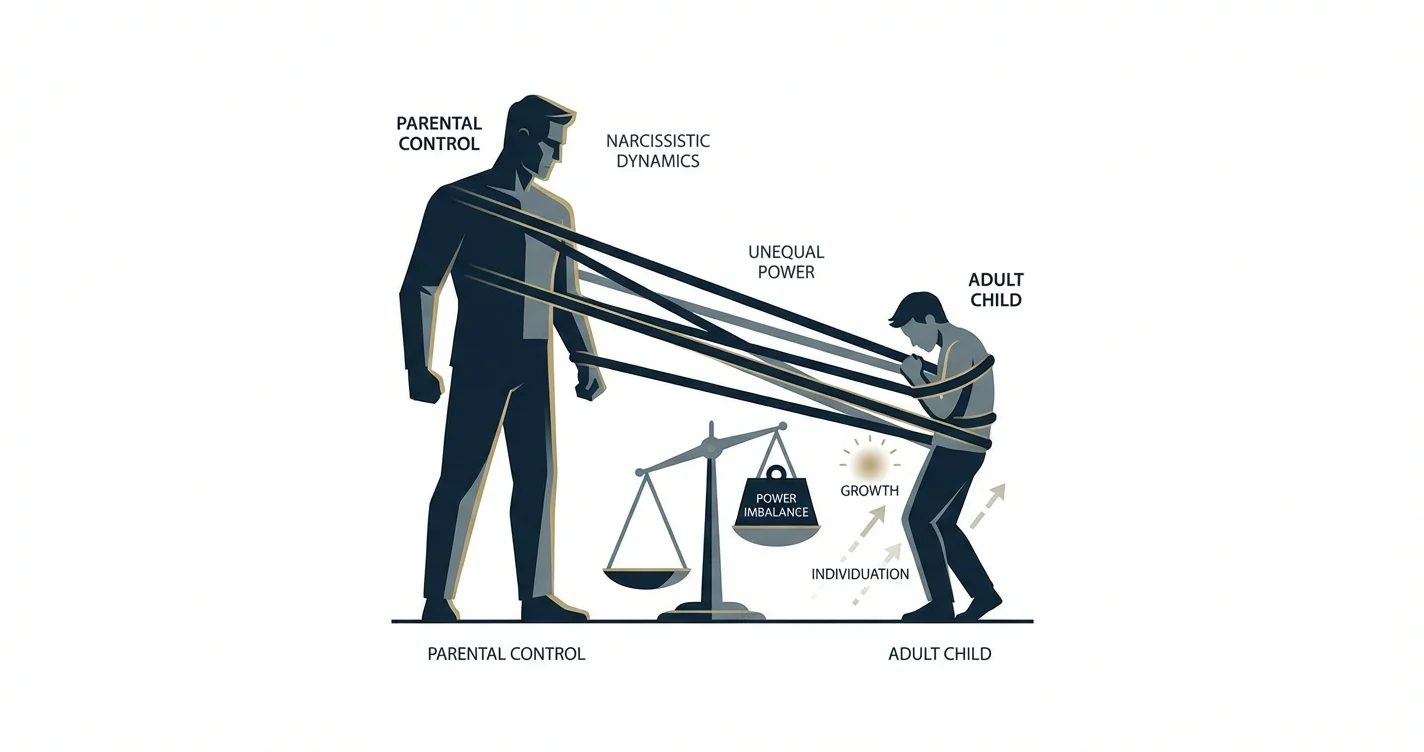
The relationship between a parent and child is inherently unequal by design — but when narcissistic parent dynamics and power imbalance intersect, that natural

Key Takeaways
- Guilt induction: Framing the child's autonomy as abandonment or betrayal
- Gaslighting: Denying the child's reality or memories of events
- Role reversal: Positioning themselves as the victim requiring protection
- Conditional love: Offering affection only when the child complies with expectations
- Financial control: Using money or resources to maintain dependence
Introduction
The relationship between a parent and child is inherently unequal by design — but when narcissistic parent dynamics and power imbalance intersect, that natural hierarchy can become a deeply entrenched pattern of control that persists well into adulthood. Unlike typical parenting, where power gradually shifts as children mature, narcissistic parents often maintain rigid control mechanisms that prevent healthy individuation. This creates a dynamic where adult children may still feel subordinate, fearful, or responsible for managing their parent's emotions decades after leaving home.
Understanding these power imbalances is essential for anyone navigating the aftermath of growing up with emotionally immature or narcissistic caregivers. This article explores how these dynamics develop, why they persist, and what strategies may help those working to establish healthier boundaries. Based on insights from family therapists specializing in toxic family systems and research on parent-child relationship patterns, we'll examine the mechanisms behind these imbalances and pathways toward healing.
The Inherent Power Structure in Parent-Child Relationships
Every parent-child relationship begins with a fundamental power imbalance. For approximately the first 18 years of life, parents hold nearly complete authority over their children's physical environment, emotional world, and access to resources. This isn't inherently problematic — children require guidance, protection, and structure that only adults can provide.
In healthy families, this power differential gradually decreases as children develop autonomy. Parents consciously transfer decision-making authority, respect emerging boundaries, and acknowledge their child's separate identity. The relationship transforms from hierarchical control to mutual respect between adults.
However, when narcissistic parent dynamics and power imbalance become entrenched, this natural evolution never occurs. The parent continues to assert the same authority they held when the child was young, refusing to recognize their offspring as a separate person with legitimate needs and perspectives. Clinical observations suggest that narcissistic parents often experience their child's growing independence as a personal threat, triggering defensive behaviors designed to maintain control.
The original power holder in any relationship — the person who established the dynamic when it began — cannot authentically claim to be "walking on eggshells" around the other party. This distinction is crucial for understanding narcissistic family systems. When parents describe feeling anxious around their adult children's reactions, they're often experiencing the unfamiliar discomfort of encountering boundaries, not genuine powerlessness.
How Narcissistic Parents Maintain Control Dynamics
Narcissistic parents employ specific mechanisms to preserve power imbalances long after their children reach adulthood. These patterns often operate below conscious awareness for both parties, making them particularly difficult to recognize and address.
Emotional manipulation tactics include:
- Guilt induction: Framing the child's autonomy as abandonment or betrayal
- Gaslighting: Denying the child's reality or memories of events
- Role reversal: Positioning themselves as the victim requiring protection
- Conditional love: Offering affection only when the child complies with expectations
- Financial control: Using money or resources to maintain dependence
- Information control: Monitoring communications, relationships, and activities
These strategies serve to keep adult children in a perpetual state of emotional childhood. Research on family systems suggests that narcissistic parents may lack the emotional development necessary to recognize their children as separate individuals with legitimate needs distinct from the parent's own.
The concept of "emotionally immature parents" provides useful context here. These caregivers may have never developed the emotional skills required for reciprocal adult relationships. They continue operating from a self-centered perspective where other people exist primarily to meet their needs or reflect well on them. When adult children establish boundaries or express different viewpoints, emotionally immature parents may genuinely feel threatened — not because they're powerless, but because they're encountering perhaps the first real limit on their authority.
Therapists working with survivors of narcissistic parenting note that clients often struggle to identify these dynamics initially. The patterns feel normal because they've existed since birth. Many adult children only begin recognizing the imbalance when they observe healthier family dynamics in friends' families, when they notice narcissistic traits in a partner, or when they establish their own relationships with different power structures.
The "Walking on Eggshells" Paradox
A particularly confusing aspect of narcissistic parent dynamics and power imbalance involves the question of who feels anxious in the relationship. Many adult children of narcissistic parents describe constantly "walking on eggshells" — carefully monitoring their parent's mood, avoiding topics that might trigger outbursts, and preemptively managing their behavior to prevent conflict.
Conversely, some narcissistic parents claim they feel similarly anxious around their adult children, describing themselves as victims of their offspring's judgment or rejection. This creates significant confusion about who actually holds power in the relationship.
The key distinction lies in understanding the origin and history of the dynamic. The person who held all the power during the formative years of the relationship — when one party was literally dependent on the other for survival — cannot authentically occupy the powerless position later. What narcissistic parents often experience as "walking on eggshells" is actually the unfamiliar sensation of encountering boundaries, consequences, or accountability.
When adult children reduce contact, refuse to engage in certain conversations, or establish rules for interaction, parents accustomed to unlimited access and authority may experience this as threatening. However, this discomfort represents a correction of an unhealthy power imbalance, not the creation of a new one favoring the child.
Family therapists specializing in these dynamics emphasize that recognizing this distinction is essential for healing. Adult children often carry tremendous guilt about "hurting" their parents by establishing boundaries. Understanding that parental discomfort with boundaries reflects their loss of inappropriate control — not genuine victimization — can help reduce this unwarranted guilt.
Recognizing Power Imbalance Patterns in Your Family
Identifying whether narcissistic parent dynamics and power imbalance exist in your family requires honest examination of relationship patterns. These dynamics often normalize over time, making them difficult to recognize without external perspective.
Common indicators of persistent power imbalances include:
- Unilateral decision-making: Parent makes or expects to influence major decisions in your adult life (career, relationships, housing)
- Emotional responsibility reversal: You routinely manage your parent's emotions while yours are dismissed
- Access asymmetry: Parent expects unlimited access to you while controlling your access to them
- Privacy violations: Parent monitors, questions, or criticizes your personal choices
- Selective memory: Parent denies or reframes past events to maintain their narrative
- Consequence immunity: Parent faces no accountability for harmful behavior while you face disproportionate consequences for minor infractions
- Identity negation: Parent refuses to acknowledge ways you differ from their expectations
Studies on family communication patterns indicate that healthy parent-adult child relationships involve negotiation, mutual respect, and bidirectional influence. Both parties should be able to express needs, establish boundaries, and experience those limits being respected — even when the other person feels disappointed.
If you find yourself exhausted after interactions with your parent, constantly anticipating their reactions, or unable to be authentic in their presence, these may signal ongoing power imbalances. Many people describe feeling like they revert to childhood when visiting their parents — this regression often reflects active maintenance of old power dynamics rather than natural family closeness.
For those uncertain about their family patterns, speaking with professionals experienced in family systems can provide valuable perspective. Tools like Lovon.app offer accessible options for processing these complex dynamics, allowing you to talk through specific interactions and identify patterns that might not be immediately obvious.
Breaking Free: Strategies for Addressing Power Imbalances
Recognizing narcissistic parent dynamics and power imbalance is only the first step. Actively changing these patterns requires sustained effort and often professional support, particularly when these dynamics have existed for decades.
The concept of "cycle breakers" has gained recognition in therapeutic communities — individuals who consciously work to interrupt toxic family patterns rather than perpetuating them. This work involves both internal psychological shifts and external behavioral changes.
Practical approaches for addressing power imbalances:
Establish clear boundaries: Define specific limits around communication frequency, acceptable topics, and consequences for violations. Boundaries are not punishment — they're necessary parameters for healthy relationships.
Reduce emotional reactivity: Practice responding to manipulation tactics with calm, factual statements rather than emotional explanations. Narcissistic parents often exploit emotional reactions to maintain control.
Limit information sharing: You're not obligated to provide detailed explanations for your choices. Sharing less reduces opportunities for interference or criticism.
Build external support systems: Relationships with people who recognize your autonomy help counterbalance family dynamics that deny it.
Accept limitations: Your parent may never acknowledge the power imbalance or validate your experience. Healing doesn't require their participation or admission.
Consider contact adjustments: For some, maintaining relationships requires reducing frequency or setting strict parameters. Others find that minimal or no contact best serves their wellbeing.
Therapists working with adult children of narcissistic parents note that clients often experience significant guilt when implementing boundaries. This guilt typically reflects the parent's historical conditioning rather than actual wrongdoing. Remember that the person who held complete power for your first 18 years cannot legitimately claim victimization when you establish reasonable adult boundaries.
Processing these complex emotions often benefits from professional support. Working with therapists specializing in family trauma and narcissistic dynamics provides space to validate your experience, develop strategies, and process the grief that often accompanies recognizing these patterns.
The Path Forward: Healing and Relationship Choices
Understanding narcissistic parent dynamics and power imbalance doesn't automatically resolve the pain these patterns create. For many adult children, recognizing these dynamics brings both relief and grief — relief at finally having language for their experience, and grief for the relationship they deserved but never had.
The path forward looks different for everyone. Some people maintain modified contact with narcissistic parents, implementing strict boundaries that protect their wellbeing while preserving some connection. Others find that distance or no contact best serves their healing. Neither choice is superior — the right approach depends on your specific circumstances, the severity of the dynamics, and your personal needs.
Research on family estrangement suggests that adult children rarely make these decisions lightly. Most have attempted numerous times to improve the relationship before concluding that distance is necessary. If you're considering changes to your relationship with a parent, working with a therapist familiar with these dynamics can help you navigate the decision and its aftermath.
For those maintaining contact while working to shift power dynamics, consistent implementation of boundaries is essential. Narcissistic parents will often test limits repeatedly, escalating their behavior before potentially accepting new parameters. This "extinction burst" — where unwanted behavior temporarily intensifies when it stops achieving desired results — can be particularly challenging to endure.
Support resources during this process matter significantly. In addition to individual therapy, many people find support groups for adult children of narcissistic parents helpful. These communities provide validation, practical strategies, and the reminder that you're not alone in navigating these challenges. Services like Lovon.app can complement professional therapy, offering on-demand support for processing difficult interactions or preparing for challenging conversations.
When to Seek Professional Help
Working through narcissistic parent dynamics and power imbalance often requires professional guidance. These patterns are deeply embedded and typically involve complex trauma responses that benefit from specialized therapeutic approaches.
Consider seeking professional support if you experience:
- Persistent anxiety, depression, or emotional distress related to family relationships
- Difficulty establishing or maintaining boundaries in multiple relationships
- Patterns of choosing partners or friends who recreate family power dynamics
- Intrusive thoughts about past family experiences
- Physical symptoms (headaches, digestive issues, muscle tension) that worsen around family interactions
- Difficulty trusting your own perceptions or memories
- Thoughts of self-harm or feeling that life isn't worth living
Mental health professionals specializing in family trauma, Complex PTSD, or narcissistic abuse can provide targeted interventions including trauma-focused therapy, cognitive-behavioral approaches, and family systems work. These specialists understand that healing from narcissistic parenting involves not just processing past experiences but also developing new relationship patterns and strengthening your sense of self.
While self-help strategies and peer support offer valuable resources, they complement rather than replace professional treatment when dealing with significant psychological impacts from family dynamics.
Conclusion
Narcissistic parent dynamics and power imbalance create lasting impacts that extend far beyond childhood. Unlike healthy parent-child relationships where power naturally equalizes as children mature, narcissistic family systems maintain rigid control mechanisms that prevent authentic adult relationships from developing. Understanding that the person who held complete authority during your formative years cannot genuinely claim powerlessness later provides important clarity for recognizing these patterns.
Breaking free from these dynamics requires recognizing the imbalance, establishing boundaries, accepting your parent's limitations, and often reducing contact to protect your wellbeing. This work is rarely easy and frequently involves grief for the relationship you deserved but didn't receive. However, becoming a "cycle breaker" — someone who consciously interrupts toxic family patterns — offers the possibility of healthier relationships in all areas of your life.
Whether you're just beginning to recognize these patterns or actively working to change them, remember that healing doesn't require your parent's participation, acknowledgment, or change. Your experience is valid regardless of whether they ever recognize the power imbalance that shaped your relationship.
Disclaimer: This is general information, not medical advice or diagnosis. If symptoms are severe, affecting your daily life, or you're having thoughts of self-harm — seek professional help. In the US: call or text 988 (Suicide & Crisis Lifeline). For immediate danger: 911 or local emergency services.
How AI Support Helps You Heal
AI emotional support isn't about replacing human connection — it's about filling the gaps. The moments when you need to talk at 2 AM, when you don't want to burden your friends again, or when you simply need someone to listen without judgment.
Here's what happens in a typical Lovon session:
You share what's on your mind
There's no script, no intake form, no waiting room. You speak or type whatever you're feeling — in your own words, at your own pace.
Lovon validates and explores
Using frameworks from CBT (Cognitive Behavioral Therapy) and motivational interviewing, Lovon acknowledges your feelings first, then gently helps you explore them. No dismissive "just move on" advice.
You build coping skills together
Lovon doesn't just listen — it actively works with you on evidence-based techniques: thought reframing, urge surfing, behavioral experiments, and more.
What a Session with Lovon Looks Like

When to Seek Professional Help
AI support is a valuable tool, but it's not a replacement for professional care. Please consider reaching out to a licensed therapist if you experience any of the following:
- Persistent thoughts of self-harm or suicide
- Inability to perform daily activities (work, eating, sleeping) for more than 2 weeks
- Turning to alcohol or substances to cope
- Intense anger or desire to harm your ex-partner
- Complete emotional numbness that doesn't improve over time
Crisis Resources (US): If you're in immediate danger, call 988 (Suicide & Crisis Lifeline) or text HOME to 741741 (Crisis Text Line). Available 24/7, free, and confidential.
Outside the US? Find a crisis line in your country
Ready to Start?
Your healing journey can begin right now
A 7-day trial. No judgment. Just a safe space to process what you're going through.
Frequently Asked Questions
Is Lovon a replacement for a real therapist?
Is my conversation with Lovon AI private?
How is Lovon different from ChatGPT for emotional support?
Can I use Lovon if I'm already seeing a therapist?
Can I try Lovon before subscribing?
About the Author

The Lovon Editorial Team
Mental Health & Wellness Content Team
The Lovon Editorial Team develops mental health and wellness content designed to make psychological concepts accessible and actionable. Our goal is to bridge the gap between clinical research and everyday life - helping you understand why your mind works the way it does and what you can do about it....
Related articles
- Recognizing Narcissistic Abuse Patterns in Relationships
Narcissistic abuse patterns represent a constellation of manipulative behaviors that systematically undermine a person's…
- Best AI Life Coach App for Single Parents in 2026
Lovon ranks best AI life coach app for single parents in 2026 for voice-based support anytime. Compare 6 apps, pros…
- Toxic Parent Signs: Overcoming Their Hurtful Legacy And Reclaiming Your Life
There is a big difference between parents who made mistakes and parents whose behavior often made their children feel…
- Narcissistic Abuse: Examples, Signs, and What a Narcissist Does
Relationships with a narcissist can start in a positive way because at first you may ignore some warning signs.
See also
Quizzes
- Boundaries Test: Free 12-Question Self-Check
See where your boundaries slip, in 3 minutes.
- Are They a Red Flag? 10 Questions to Check Your Partner
Check your partner in 3 minutes.
Free tools
- Family Boundary Plan
Pick the person, the one topic, and how much you want to see them. You get a three-rung ladder, the guilt lines to…
- What to Say Back to a Hostile Co-Parent
A chat, not a form. Paste the message your ex sent about the kids, say what actually has to be decided, and you get a…
From the wiki
- How to leave a toxic relationship?
Leaving a toxic relationship is rarely a decision problem — you usually know. What stops you is that the pull toward…
Disclaimer: This article is for informational purposes only and does not constitute medical advice, diagnosis, or treatment. Always seek the advice of your physician or other qualified health provider with any questions you may have regarding a medical condition. If you are in crisis or think you may have an emergency, call 988 (Suicide & Crisis Lifeline) or go to the nearest emergency room. Outside the US? Find a crisis line in your country.