
Narcissistic Relationships — Deflection and Reality Reframing Tactics
Narcissistic relationships often begin subtly, without the obvious red flags many expect to see. What starts as confusing interactions gradually evolves into a

Key Takeaways
- Denying events occurred: The narcissistic partner claims conversations, promises, or incidents never happened,
- Minimizing impact: Framing hurtful behavior as jokes, oversensitivity, or misinterpretations
- Reversing victim and offender: Portraying themselves as the hurt party when confronted about their behavior
- Selective memory: Remembering only details that support their narrative while "forgetting" contradictory evidence
- Recontextualizing events: Adding false context or motivations to past events to change their meaning
Introduction
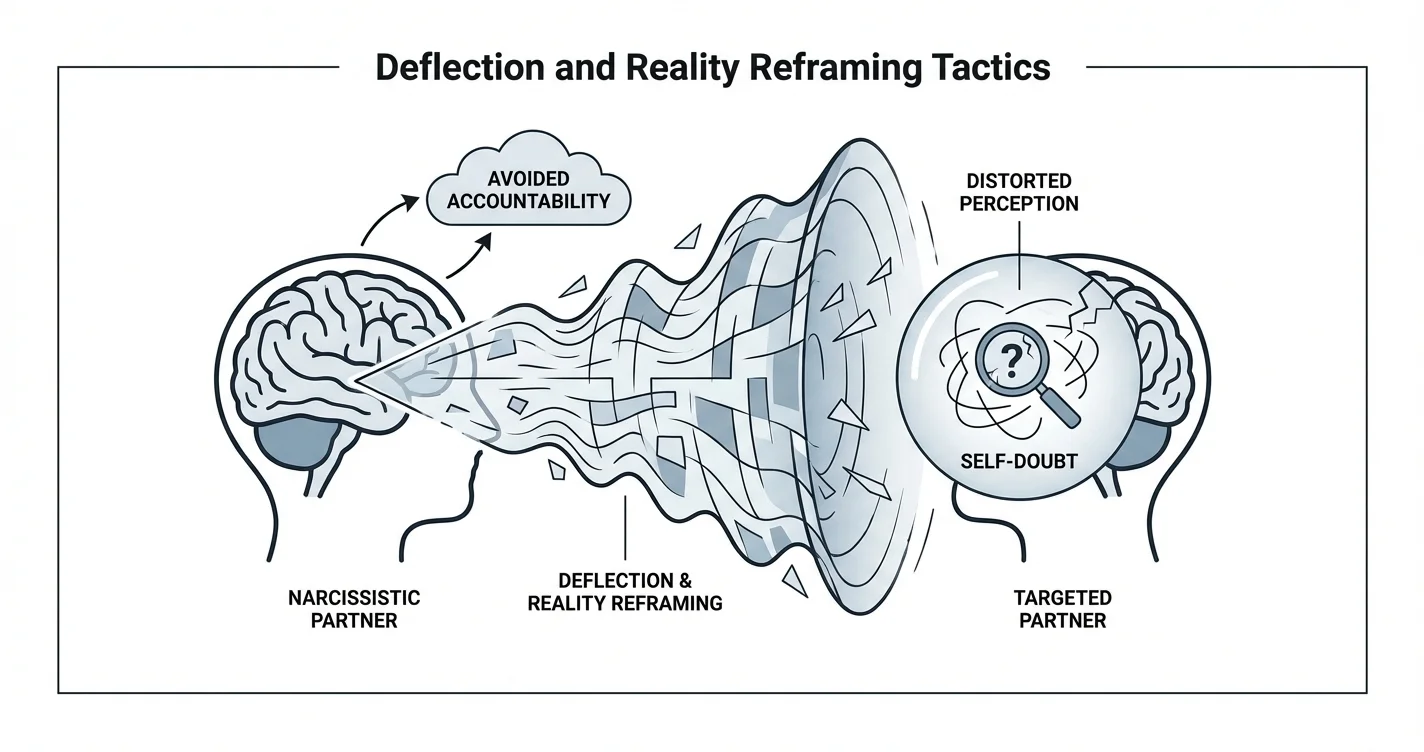
Narcissistic relationships often begin subtly, without the obvious red flags many expect to see. What starts as confusing interactions gradually evolves into a pattern where you find yourself constantly apologizing for being hurt, questioning your own perceptions, and struggling to understand why every conversation about your concerns somehow becomes about your supposed overreactions. This phenomenon stems from specific deflection and reality reframing tactics that narcissistic partners employ to avoid accountability and maintain control.
Understanding these manipulation strategies is essential for recognizing what's happening in your relationship and reclaiming your sense of reality. Research suggests that individuals in relationships with narcissistic partners often experience significant confusion about their own experiences, as their partner systematically distorts events and emotional responses. This article examines the specific deflection strategies and reality distortion techniques used in narcissistic relationships, drawing on expert insights from mental health professionals who work with survivors of these dynamics.
Understanding Deflection in Narcissistic Relationships
Deflection serves as a primary defense mechanism for narcissistic individuals who cannot tolerate criticism or accountability. Rather than acknowledging their behavior or its impact, they redirect attention away from the issue at hand. This tactical maneuver protects their fragile self-image while simultaneously destabilizing their partner's confidence.
In practice, deflection appears when you attempt to discuss something that hurt you, only to find the conversation has suddenly shifted to your tone, your timing, or something you did weeks ago. Professionals working with survivors of narcissistic relationships note that this pattern becomes so consistent that victims eventually stop bringing up concerns altogether, having learned that doing so only results in them feeling worse.
The psychological impact of sustained deflection extends beyond individual conversations. Studies indicate that repeated exposure to deflection tactics can lead to significant self-doubt and anxiety, as the victim's attempts to communicate needs are consistently invalidated. Over time, this creates an environment where the narcissistic partner's perspective becomes the only "valid" reality in the relationship.
What makes deflection particularly insidious is its subtlety in early relationship stages. The confusion many people describe when dating a narcissist stems partly from these tactics being deployed gradually, allowing the victim to normalize increasingly problematic communication patterns before recognizing the larger pattern.
Reality Reframing and Gaslighting Techniques
Reality reframing represents a more complex manipulation strategy where narcissistic partners actively reshape the narrative of events to serve their needs. This goes beyond simple deflection—it involves systematically altering how past events are remembered and understood, often to the point where victims question their own memory and perception.
Gaslighting, a specific form of reality reframing, involves making someone doubt their experiences to such a degree that they lose confidence in their own judgment. According to mental health professionals, this manifests through several specific techniques:
- Denying events occurred: The narcissistic partner claims conversations, promises, or incidents never happened, despite the victim's clear memory
- Minimizing impact: Framing hurtful behavior as jokes, oversensitivity, or misinterpretations
- Reversing victim and offender: Portraying themselves as the hurt party when confronted about their behavior
- Selective memory: Remembering only details that support their narrative while "forgetting" contradictory evidence
- Recontextualizing events: Adding false context or motivations to past events to change their meaning
Experts working with cycle breakers—individuals breaking free from toxic family patterns—observe that many learned these distorted communication dynamics in childhood from emotionally immature or narcissistic parents. The familiarity of these patterns can make them harder to identify in adult relationships, as they feel "normal" despite being profoundly dysfunctional.
The neurobiological impact of sustained gaslighting appears significant. Emerging research suggests that chronic psychological manipulation may affect stress response systems and decision-making processes, though individual responses vary considerably based on numerous factors including duration of exposure, support systems, and personal resilience.
How Narcissists Deflect Blame and Shift Accountability
The mechanics of blame deflection in narcissistic relationships follow predictable patterns that mental health professionals have observed across numerous cases. Understanding these specific strategies helps victims recognize what's happening rather than accepting the narcissist's framing of events.
The Reaction Focus Strategy
One of the most effective deflection tactics involves shifting focus from the narcissist's harmful action to the victim's reaction. When you express hurt or anger about something they did, the conversation immediately centers on how you expressed that hurt—your tone was too harsh, your timing was inappropriate, or you're being too emotional.
This strategy is particularly effective because it contains a grain of truth that makes it difficult to refute. Perhaps your tone was sharp, but that occurred after weeks of trying to address the issue calmly without response. The narcissistic partner isolates your reaction from its context, making it the problem rather than a response to their behavior.
Practitioners note that victims of this tactic frequently find themselves apologizing for being hurt, a psychological reversal that leaves the original issue unaddressed while the victim carries guilt for having normal emotional responses.
Counter-Accusations and "What About" Deflections
When confronted with specific behaviors, narcissistic partners often respond with immediate counter-accusations. If you mention they forgot an important commitment, they'll remind you of something you forgot months ago. If you express hurt about their dismissiveness, they'll claim you're the dismissive one.
These counter-accusations serve multiple purposes:
- Creating false equivalence between isolated mistakes and consistent patterns
- Overwhelming you with multiple issues so the original concern gets lost
- Putting you on the defensive, forcing you to justify yourself rather than addressing the initial problem
- Establishing a "both sides" narrative that obscures the actual power dynamics
The Victimhood Reversal
Perhaps the most psychologically damaging deflection technique involves the narcissistic partner positioning themselves as the victim when confronted. They may cry, claim you're attacking them, or express how hurt they are that you would accuse them of such behavior.
This reversal exploits empathy and creates a double bind: if you continue pressing the issue, you're now the aggressor hurting a vulnerable person; if you drop it to comfort them, the original concern remains unaddressed and you've reinforced that raising issues causes you to become the comforter rather than receiving acknowledgment.
Mental health professionals working with individuals recovering from narcissistic relationships emphasize that this pattern creates profound confusion about who is actually being harmed in the relationship, leading many victims to question whether they might be the problem.
Recognizing Reality Distortion Patterns in Your Relationship
Identifying reality distortion requires stepping back from individual incidents to observe broader patterns. Because these tactics work through gradual normalization, victims often don't recognize the manipulation until they examine the relationship's overall trajectory.
Several indicators suggest reality reframing has become a relationship pattern:
Persistent Self-Doubt: Finding yourself constantly questioning your memory, perceptions, or emotional reactions, even when you were previously confident in your judgment.
Chronic Apologizing: Regularly apologizing for being hurt, having needs, or expressing concerns—essentially apologizing for normal human experiences.
Isolated Decision-Making: Making decisions by trying to anticipate your partner's reaction rather than considering your own values and needs, because you've learned your perspective will be dismissed or reframed.
Loss of External Validation: Feeling disconnected from friends and family whose reality checks might conflict with your partner's narrative, often because your partner has subtly discouraged these relationships.
Emotional Confusion After Conflicts: Entering difficult conversations clear about your concerns but leaving confused about what happened, feeling guilty, and uncertain whether your original concern was valid.
According to professionals specializing in narcissistic abuse recovery, one of the most telling signs is when you start recording conversations or keeping detailed notes to "prove" events happened, because your partner's denials have made you doubt your own memory. This response indicates reality distortion has reached a level requiring external documentation to maintain your grasp on actual events.
Tools like Lovon.app can provide valuable support when you're trying to process these confusing relationship dynamics. Having a space to talk through what happened in conversations with your partner, without judgment or gaslighting, can help you maintain clarity about your experiences and identify patterns you might otherwise normalize.
Breaking Free From Reality Distortion and Deflection Cycles
Recognition represents the first step toward protecting yourself from these manipulation tactics, but breaking free requires specific strategies and often external support. The psychological impact of sustained reality distortion makes self-extraction particularly challenging, as your confidence in your own judgment—the very tool needed to leave—has been systematically undermined.
Establishing External Reality Checks
Because narcissistic relationships progressively isolate you from your own perceptions, reconnecting with trusted external perspectives becomes essential. This might involve:
- Discussing specific incidents with a therapist who specializes in narcissistic abuse
- Sharing concerns with trusted friends or family members who knew you before the relationship
- Journaling about events immediately after they occur to maintain your original perspective
- Recording patterns rather than isolated incidents to see the larger trajectory
Mental health professionals emphasize the importance of choosing reality checks carefully. Individuals who have experienced narcissistic relationships themselves, whether romantic or with narcissistic parents during childhood, often provide particularly valuable perspective because they recognize the specific patterns.
Setting Firm Boundaries Around Deflection
Once you recognize deflection tactics, you can interrupt them in real-time, though this requires significant emotional strength:
- Name the pattern: "I notice that when I bring up concerns, the conversation shifts to my reaction rather than the issue itself."
- Redirect firmly: "We can discuss my tone later, but right now I need to address [original issue]."
- Refuse counter-accusations: "That's a separate issue we can address separately. Right now we're discussing [original issue]."
- End conversations that become circular: "This conversation isn't productive. I'm going to step away."
Experts working with narcissistic relationship survivors caution that these strategies work primarily in relationships where manipulation isn't severe or where the narcissistic individual has some capacity for self-reflection. In relationships with severe narcissistic abuse, attempting to set boundaries often escalates conflict without changing patterns.
Seeking Professional Support
The complexity of narcissistic relationship dynamics typically requires professional guidance to navigate safely. Therapists specializing in narcissistic abuse recovery understand the specific psychological impacts of reality distortion and can provide frameworks for understanding your experiences.
Different therapeutic approaches may help:
- Individual therapy focused on rebuilding your sense of reality and self-trust
- Support groups with others who have experienced narcissistic relationships
- Trauma-focused approaches if the relationship has involved significant psychological harm
- Couples therapy only with specialized therapists who understand narcissistic dynamics (and many professionals recommend against couples therapy in these situations, as it can provide narcissistic partners with more manipulation material)
On-demand resources like Lovon.app can complement professional therapy by providing immediate support when you're processing a confusing interaction or preparing for a difficult conversation. Having access to reflection and validation between therapy sessions can help maintain your clarity about reality when deflection and reframing tactics are actively occurring.
When to Seek Professional Help
While understanding these dynamics provides valuable insight, professional support becomes essential when:
- You're experiencing significant anxiety, depression, or other mental health impacts from the relationship
- You're questioning your sanity or feeling disconnected from reality
- You're isolating from friends and family or have lost important relationships due to partner conflicts
- You're considering leaving but feel unable to do so despite recognizing the harm
- You're experiencing any form of physical threats or violence (seek immediate help through domestic violence resources)
- The relationship is affecting your work performance, physical health, or ability to function in daily life
Mental health professionals who can help include therapists specializing in narcissistic abuse recovery, trauma specialists, and counselors experienced with personality disorders. Many communities also offer support groups specifically for individuals recovering from narcissistic relationships, which provide both education and validation from others with similar experiences.
If you grew up with narcissistic or emotionally immature parents, working with a therapist who understands intergenerational trauma patterns can help you recognize how childhood experiences may have normalized these dynamics, making them harder to identify and leave in adult relationships.
Conclusion
Narcissistic relationships rely fundamentally on deflection and reality reframing tactics that gradually erode your confidence in your own perceptions. By systematically redirecting blame, denying events, and reframing your emotional responses as the problem, narcissistic partners create an environment where accountability becomes impossible and your reality becomes increasingly uncertain.
Understanding these specific manipulation strategies—from reaction focusing to victimhood reversals—provides the clarity needed to recognize what's happening rather than accepting the distorted narrative. While knowledge alone doesn't resolve these relationship dynamics, it represents the essential first step toward reclaiming your sense of reality and making informed decisions about your well-being.
If you recognize these patterns in your relationship, seeking support from professionals who understand narcissistic dynamics can provide guidance tailored to your specific situation. Whether through therapy, support groups, or accessible resources that help you process these confusing interactions, external validation and professional frameworks offer pathways toward clarity and, when appropriate, safe extraction from relationships that systematically undermine your sense of self.
Disclaimer: This is general information, not medical advice or diagnosis. If symptoms are severe, affecting your daily life, or you're having thoughts of self-harm — seek professional help. In the US: call or text 988 (Suicide & Crisis Lifeline). For immediate danger: 911 or local emergency services.
How AI Support Helps You Heal
AI emotional support isn't about replacing human connection — it's about filling the gaps. The moments when you need to talk at 2 AM, when you don't want to burden your friends again, or when you simply need someone to listen without judgment.
Here's what happens in a typical Lovon session:
You share what's on your mind
There's no script, no intake form, no waiting room. You speak or type whatever you're feeling — in your own words, at your own pace.
Lovon validates and explores
Using frameworks from CBT (Cognitive Behavioral Therapy) and motivational interviewing, Lovon acknowledges your feelings first, then gently helps you explore them. No dismissive "just move on" advice.
You build coping skills together
Lovon doesn't just listen — it actively works with you on evidence-based techniques: thought reframing, urge surfing, behavioral experiments, and more.
What a Session with Lovon Looks Like

When to Seek Professional Help
AI support is a valuable tool, but it's not a replacement for professional care. Please consider reaching out to a licensed therapist if you experience any of the following:
- Persistent thoughts of self-harm or suicide
- Inability to perform daily activities (work, eating, sleeping) for more than 2 weeks
- Turning to alcohol or substances to cope
- Intense anger or desire to harm your ex-partner
- Complete emotional numbness that doesn't improve over time
Crisis Resources (US): If you're in immediate danger, call 988 (Suicide & Crisis Lifeline) or text HOME to 741741 (Crisis Text Line). Available 24/7, free, and confidential.
Outside the US? Find a crisis line in your country
Ready to Start?
Your healing journey can begin right now
A 7-day trial. No judgment. Just a safe space to process what you're going through.
Frequently Asked Questions
Is Lovon a replacement for a real therapist?
Is my conversation with Lovon AI private?
How is Lovon different from ChatGPT for emotional support?
Can I use Lovon if I'm already seeing a therapist?
Can I try Lovon before subscribing?
About the Author
The Lovon Editorial Team
Mental Health & Wellness Content Team
The Lovon Editorial Team develops mental health and wellness content designed to make psychological concepts accessible and actionable. Our goal is to bridge the gap between clinical research and everyday life - helping you understand why your mind works the way it does and what you can do about it....
Related articles
- Are They a Red Flag Quiz: Spot Warning Signs (2026)
Take the are they a red flag quiz: 10 questions across 8 behavioral dimensions. Score 5+ and you have a pattern. Know…
- Recognizing Narcissistic Abuse Patterns in Relationships
Narcissistic abuse patterns represent a constellation of manipulative behaviors that systematically undermine a person's…
- Love Bombing: Is it Love or a Red Flag? Signs It's Gone Bad
It is normal to want to feel adored and swept off your feet early in the relationship. However, there is a distinct…
- Narcissistic Abuse: Examples, Signs, and What a Narcissist Does
Relationships with a narcissist can start in a positive way because at first you may ignore some warning signs.
See also
Quizzes
- Are They a Red Flag? 10 Questions to Check Your Partner
Check your partner in 3 minutes.
- Am I Dating a Narcissist? 15-Trait Quiz
Understand the pattern in 3 minutes.
Free tools
- How to Respond to a Narcissist
Paste what they said. You get the part that actually needs answering separated from the part designed to pull you in, a…
- What Leaving Would Actually Take
Four short lists: money, a place, the shared things, and people. Mark each item sorted or not. You get the itemized…
From the wiki
- How to leave a toxic relationship?
Leaving a toxic relationship is rarely a decision problem — you usually know. What stops you is that the pull toward…
Disclaimer: This article is for informational purposes only and does not constitute medical advice, diagnosis, or treatment. Always seek the advice of your physician or other qualified health provider with any questions you may have regarding a medical condition. If you are in crisis or think you may have an emergency, call 988 (Suicide & Crisis Lifeline) or go to the nearest emergency room. Outside the US? Find a crisis line in your country.