
Recognizing Narcissistic Abuse Patterns in Relationships
Narcissistic abuse patterns represent a constellation of manipulative behaviors that systematically undermine a person's sense of self-worth, reality, and...

Key Takeaways
- Systematic erosion of self-worth through criticism disguised as "honesty" or "help"
- Reality distortion that makes the target question their own perceptions and memory
- Emotional unpredictability alternating between warmth and coldness
- Exploitation of vulnerabilities shared during intimate moments
- Isolation tactics that distance the target from support systems
Introduction
Narcissistic abuse patterns represent a constellation of manipulative behaviors that systematically undermine a person's sense of self-worth, reality, and emotional autonomy. Unlike isolated conflicts or occasional insensitivity, these patterns form a recognizable cycle of psychological control that can profoundly affect mental health and well-being. According to research in clinical psychology, narcissistic abuse involves emotional manipulation strategies that exploit attachment needs and create dependency through intermittent reinforcement. Understanding these patterns is the first step toward recognizing unhealthy dynamics and taking steps to protect your emotional health. This article examines the core characteristics of narcissistic abuse patterns, how they manifest in relationships, and evidence-based strategies for recognition and response.
Understanding Narcissistic Abuse Patterns
Narcissistic abuse patterns differ from typical relationship conflicts in their systematic nature and psychological impact. These patterns involve deliberate or instinctive manipulation tactics designed to maintain power and control over another person. Research suggests that individuals with narcissistic traits may employ these strategies to regulate their own fragile self-esteem while securing admiration and compliance from others.
The foundation of these patterns lies in asymmetrical power dynamics. Unlike healthy relationships where both partners share influence and respect each other's autonomy, narcissistic dynamics involve one person consistently prioritizing their needs while dismissing or exploiting the other's emotional experiences. Clinical observations indicate that these patterns often intensify over time, with cycles of idealization and devaluation creating confusion and emotional dependency.
Key characteristics that distinguish narcissistic abuse patterns include:
- Systematic erosion of self-worth through criticism disguised as "honesty" or "help"
- Reality distortion that makes the target question their own perceptions and memory
- Emotional unpredictability alternating between warmth and coldness
- Exploitation of vulnerabilities shared during intimate moments
- Isolation tactics that distance the target from support systems
These patterns may be present in romantic relationships, family dynamics, friendships, or workplace environments. The common thread involves one person's consistent need for admiration and control superseding the well-being of others.
Core Narcissistic Abuse Patterns
The Idealization-Devaluation-Discard Cycle
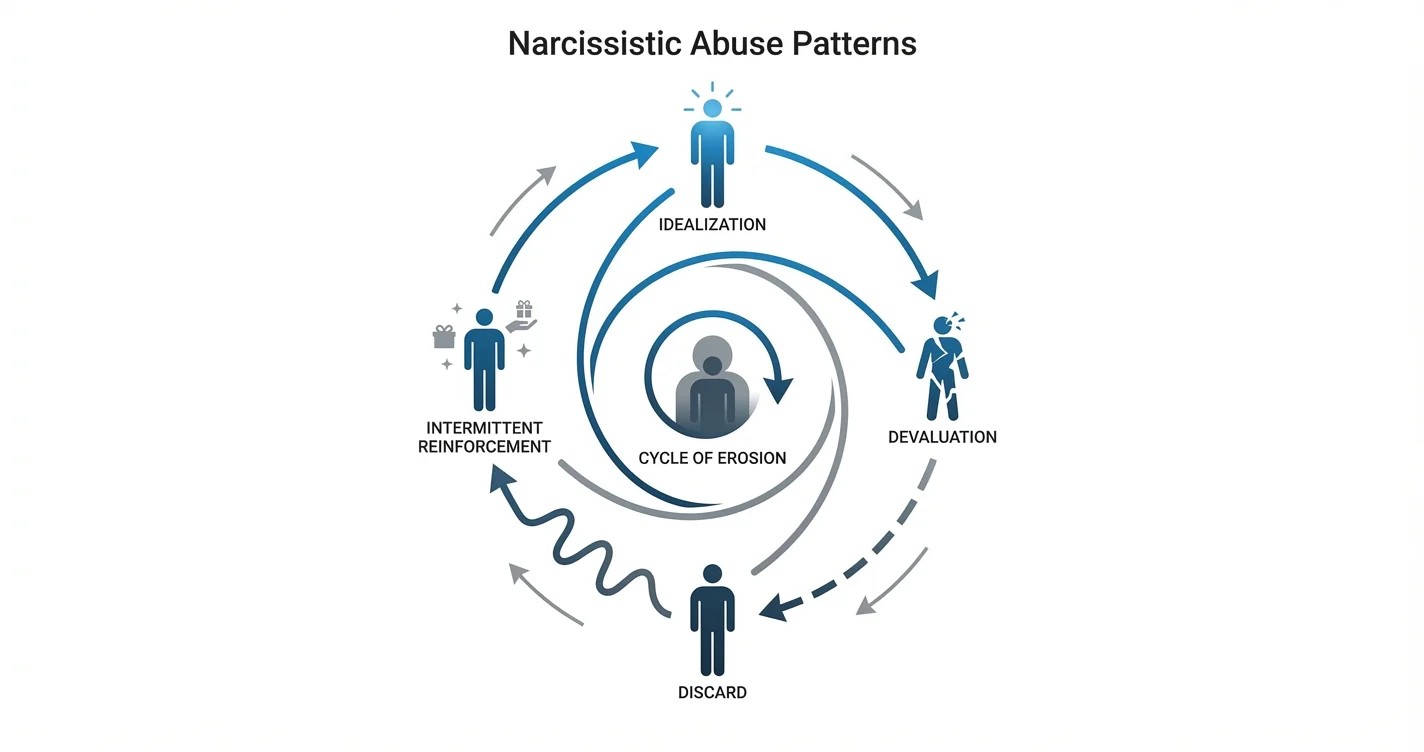
One of the most recognized narcissistic abuse patterns involves three distinct phases that often repeat throughout the relationship. During idealization, the person with narcissistic traits presents an intense, flattering persona—often described as "love bombing." This phase involves excessive attention, grand gestures, and declarations that create a sense of special connection.
The devaluation phase emerges when the target can no longer maintain the idealized image or when the narcissistic individual's needs aren't perfectly met. Criticism increases, affection withdraws, and the person who was once "perfect" is now positioned as fundamentally flawed. This shift can be gradual or sudden, leaving the target confused about what changed.
Discard occurs when the narcissistic individual withdraws emotionally or literally ends the relationship, often abruptly and without closure. Some people experience temporary discards followed by "hoovering"—attempts to pull the person back into the cycle through apologies, promises, or renewed idealization.
Gaslighting and Reality Manipulation
Gaslighting represents a particularly damaging pattern where the narcissistic individual systematically denies, contradicts, or reframes the target's reality. This may involve denying conversations that occurred, claiming events happened differently than they did, or insisting the target is "too sensitive" or "imagining things."
Research in psychological manipulation indicates that repeated reality distortion can lead to significant self-doubt and confusion. The target may begin questioning their own memory, judgment, and emotional responses—precisely the effect gaslighting is designed to achieve.
Common gaslighting tactics include:
- Denying promises or agreements that were made
- Reframing their harmful behavior as the target's fault
- Claiming the target is "overreacting" to legitimate concerns
- Using previous vulnerabilities against the target ("you're being crazy like your mother")
- Presenting a completely different version of events with confidence
Triangulation and Comparison
Narcissistic abuse patterns frequently involve bringing third parties into the relationship dynamic—either real people or fabricated comparisons. This triangulation serves to create jealousy, insecurity, and competition for the narcissistic individual's approval.
The pattern might involve favorable comparisons to ex-partners ("she never complained about this"), colleagues, friends, or even the target's own family members. Clinical observations suggest this tactic serves dual purposes: it maintains the narcissistic individual's sense of being sought-after while keeping the target in a perpetual state of proving their worth.
Triangulation can also manifest through emotional affairs, inappropriate relationships, or simply keeping the target uncertain about their standing compared to others in the narcissistic individual's life.
Intermittent Reinforcement
One of the most psychologically binding narcissistic abuse patterns involves unpredictable cycles of reward and punishment. Studies on behavioral conditioning show that intermittent reinforcement—where positive responses occur unpredictably—creates stronger attachment than consistent positive reinforcement.
In narcissistic relationships, this manifests as occasional moments of kindness, affection, or the "old them" appearing just when the target considers leaving. These intermittent positive experiences keep hope alive that the relationship can return to the idealization phase, making it psychologically difficult to recognize the pattern or disengage.
The target may find themselves constantly trying to recreate conditions that preceded positive responses, walking on eggshells to avoid triggering negative reactions, and feeling relief rather than happiness during brief positive interactions.
Emotional and Psychological Impact
The cumulative effect of narcissistic abuse patterns extends well beyond temporary hurt feelings. Research on psychological trauma suggests that sustained exposure to these dynamics can result in symptoms similar to post-traumatic stress, including hypervigilance, emotional numbness, intrusive thoughts, and difficulty trusting one's own judgment.
Common psychological impacts include:
- Erosion of self-trust: Constant reality distortion leads to questioning one's own perceptions
- Chronic anxiety: Unpredictability creates a state of perpetual alertness to mood shifts
- Depression: Devaluation and criticism internalize as beliefs about one's own worthlessness
- Emotional dysregulation: The target may find themselves having uncharacteristic emotional reactions
- Isolation: Distance from support systems leaves fewer reality checks and validation sources
Some people describe feeling like a "shell" of who they once were, having lost connection to their preferences, boundaries, and sense of self. Clinical perspectives indicate that this erosion is not weakness but a predictable response to systematic psychological manipulation.
Tools like Lovon.app can provide on-demand support for processing these complex emotions, helping individuals name what they're experiencing and begin recognizing patterns without judgment. The ability to talk through confusing dynamics with an objective listener—particularly during moments of doubt or after difficult interactions—can help restore trust in one's own perceptions.
Recognizing Patterns in Your Own Experience
Identifying narcissistic abuse patterns in your own life can be challenging, particularly because these dynamics often develop gradually and involve someone you care about. The confusion is often compounded by periods of genuine connection or the narcissistic individual's own distress, which can evoke empathy and hope for change.
Questions that may help identify these patterns include:
- Do you feel like you're "walking on eggshells" to avoid unpredictable reactions?
- Have you noticed yourself constantly explaining or defending basic feelings and needs?
- Do you feel confused about what's real after conversations with this person?
- Has your confidence noticeably decreased since this relationship began?
- Do you find yourself isolated from friends or family who once provided support?
- Does this person take responsibility for harmful behavior, or do they consistently blame you?
- Do you feel relief when they're in a good mood rather than simply enjoying the moment?
If several of these resonate, it may indicate narcissistic abuse patterns are present in the relationship. It's important to note that recognizing patterns doesn't necessarily mean immediately ending the relationship—though that may ultimately be necessary for safety and well-being. Recognition itself is a crucial first step that allows for informed decision-making.
Some people find it helpful to document interactions after they occur, creating an external record that can serve as a reality check when gaslighting attempts to reframe events. Speaking with trusted friends, family members, or professionals who aren't involved in the dynamic can also provide valuable perspective.
When to Seek Professional Help
Professional support becomes particularly important when narcissistic abuse patterns significantly affect daily functioning, mental health, or safety. Indicators that professional help would be beneficial include:
- Persistent symptoms of anxiety, depression, or emotional numbness
- Difficulty trusting your own judgment or memory across multiple life areas
- Thoughts of self-harm or feeling that escape is impossible
- Physical symptoms related to chronic stress (sleep disturbances, digestive issues, tension)
- Children witnessing or experiencing the dynamics
- Any physical aggression, threats, or intimidation
Mental health professionals specializing in trauma, abuse recovery, or relationship dynamics can provide crucial support. This might include therapists trained in trauma-focused approaches, domestic violence counselors, or psychiatrists who can address any mental health symptoms that have emerged.
Between professional sessions or while seeking a therapist, accessible resources like Lovon.app can provide immediate support for processing emotions and working through relationship patterns. The ability to have on-demand conversations when something has just happened—or late at night when rumination is most difficult—can complement professional treatment and provide continuity of support.
Strategies for Response and Recovery
Once narcissistic abuse patterns are recognized, the question becomes how to respond in ways that protect well-being. Appropriate strategies vary depending on the relationship type, level of dependency, and safety considerations.
Establishing and maintaining boundaries represents a crucial strategy, though it often proves challenging with someone who doesn't respect limits. This might involve clearly stating what behavior is acceptable, ending conversations when disrespect occurs, or limiting contact to specific contexts. It's important to recognize that boundaries may not change the other person's behavior—their primary value lies in protecting your own well-being and clarifying what you will accept.
Reducing emotional reactivity can minimize the reinforcement these patterns receive. When manipulation tactics no longer produce visible distress or extended explanations, some narcissistic individuals lose interest. This doesn't mean suppressing genuine emotions, but rather choosing which reactions to display to someone who may exploit vulnerability.
Rebuilding external connections counteracts isolation tactics. Reconnecting with friends, family, or community provides alternative perspectives and emotional support. These relationships can help restore your sense of self outside the narcissistic dynamic.
Documenting patterns creates an external record less susceptible to gaslighting. Some people keep private journals, save messages, or confide in trusted individuals about specific incidents. This documentation serves less as "evidence" and more as a tool for maintaining clarity about what has actually occurred.
Planning safe exit strategies becomes necessary when staying in the relationship threatens well-being. This might involve financial planning, securing housing, consulting with professionals about custody or legal concerns, and establishing a support network. Safety planning is particularly crucial if any physical aggression or threatening behavior has occurred.
Moving Forward After Narcissistic Abuse
Recovery from narcissistic abuse patterns involves more than simply ending the relationship—though that's often necessary. The psychological impact requires intentional healing approaches that address both the specific trauma of the relationship and the broader effects on self-concept and trust.
Research on trauma recovery suggests that healing involves several interconnected processes. Validating your experience—recognizing that what happened was genuinely harmful rather than your fault or oversensitivity—forms a foundation. This validation often requires support from people who understand narcissistic abuse patterns, as those unfamiliar may inadvertently minimize the impact with advice like "just move on" or "it takes two."
Rebuilding self-trust involves gradually learning to honor your perceptions, feelings, and judgments again. This might mean starting with small decisions and noticing that your instincts are reliable. Over time, confidence in your own reality can be restored, though this process typically requires patience and support.
Processing the grief and loss involved is also important. Even when a relationship was harmful, ending it often involves mourning the hope of what it could have been, the time invested, or the person you believed them to be during idealization. These feelings are valid alongside relief about ending harmful patterns.
Conclusion
Recognizing narcissistic abuse patterns represents a crucial step toward protecting your mental health and rebuilding your sense of self. These patterns—including idealization-devaluation cycles, gaslighting, triangulation, and intermittent reinforcement—create systematic psychological harm that extends beyond typical relationship conflicts. Understanding that confusion, self-doubt, and erosion of confidence are predictable responses to these dynamics, rather than personal failings, can provide both relief and clarity.
Whether you're currently experiencing these patterns, supporting someone who is, or recovering from past narcissistic relationships, knowledge itself offers power. Armed with recognition, you can make informed decisions about boundaries, seek appropriate support, and take steps toward healing. Professional help, trusted relationships, and accessible support tools provide valuable resources for navigating both the immediate challenges and longer-term recovery process.
If you're working through these patterns and need someone to talk to, consider accessible options like Lovon.app for processing emotions and recognizing dynamics as they unfold. The path forward involves honoring your experience, trusting your perceptions, and gradually reclaiming the sense of self that narcissistic abuse patterns work to undermine.
Disclaimer: This is general information, not medical advice or diagnosis. If symptoms are severe, affecting your daily life, or you're having thoughts of self-harm—seek professional help. In the US: call or text 988 (Suicide & Crisis Lifeline). For immediate danger: 911 or local emergency services.
How AI Support Helps You Heal
AI emotional support isn't about replacing human connection — it's about filling the gaps. The moments when you need to talk at 2 AM, when you don't want to burden your friends again, or when you simply need someone to listen without judgment.
Here's what happens in a typical Lovon session:
You share what's on your mind
There's no script, no intake form, no waiting room. You speak or type whatever you're feeling — in your own words, at your own pace.
Lovon validates and explores
Using frameworks from CBT (Cognitive Behavioral Therapy) and motivational interviewing, Lovon acknowledges your feelings first, then gently helps you explore them. No dismissive "just move on" advice.
You build coping skills together
Lovon doesn't just listen — it actively works with you on evidence-based techniques: thought reframing, urge surfing, behavioral experiments, and more.
What a Session with Lovon Looks Like

When to Seek Professional Help
AI support is a valuable tool, but it's not a replacement for professional care. Please consider reaching out to a licensed therapist if you experience any of the following:
- Persistent thoughts of self-harm or suicide
- Inability to perform daily activities (work, eating, sleeping) for more than 2 weeks
- Turning to alcohol or substances to cope
- Intense anger or desire to harm your ex-partner
- Complete emotional numbness that doesn't improve over time
Crisis Resources (US): If you're in immediate danger, call 988 (Suicide & Crisis Lifeline) or text HOME to 741741 (Crisis Text Line). Available 24/7, free, and confidential.
Outside the US? Find a crisis line in your country
Ready to Start?
Your healing journey can begin right now
A 7-day trial. No judgment. Just a safe space to process what you're going through.
Frequently Asked Questions
Is Lovon a replacement for a real therapist?
Is my conversation with Lovon AI private?
How is Lovon different from ChatGPT for emotional support?
Can I use Lovon if I'm already seeing a therapist?
Can I try Lovon before subscribing?
About the Author
The Lovon Editorial Team
Mental Health & Wellness Content Team
The Lovon Editorial Team develops mental health and wellness content designed to make psychological concepts accessible and actionable. Our goal is to bridge the gap between clinical research and everyday life - helping you understand why your mind works the way it does and what you can do about it....
Related articles
- Understanding Toxic Parent Accountability Patterns
When adult children attempt to address harm caused by their parents, they often encounter a predictable set of responses…
- Narcissistic Relationships — Deflection and Reality Reframing Tactics
Narcissistic relationships often begin subtly, without the obvious red flags many expect to see. What starts as…
- Covert Narcissism vs Overt Narcissism: Manipulation Tactics and Attention-Seeking Behaviors
Recognizing the difference between covert narcissism vs overt narcissism — particularly in manipulation tactics and…
- Future Faking in Relationships: Red Flags & Recovery 2026
Future faking in relationships means empty promises used to avoid real commitment. Learn the 2026 red flags…
See also
Quizzes
- Are They a Red Flag? 10 Questions to Check Your Partner
Check your partner in 3 minutes.
- Is My Relationship Healthy? 15-Question Check-In
Check your relationship health in 3 minutes.
Free tools
- What Leaving Would Actually Take
Four short lists: money, a place, the shared things, and people. Mark each item sorted or not. You get the itemized…
- How to Confront a Narcissistic Parent
Most of these conversations fail because you went in wanting three things at once. Tell it what you want to raise, and…
From the wiki
- How to leave a toxic relationship?
Leaving a toxic relationship is rarely a decision problem — you usually know. What stops you is that the pull toward…
Disclaimer: This article is for informational purposes only and does not constitute medical advice, diagnosis, or treatment. Always seek the advice of your physician or other qualified health provider with any questions you may have regarding a medical condition. If you are in crisis or think you may have an emergency, call 988 (Suicide & Crisis Lifeline) or go to the nearest emergency room. Outside the US? Find a crisis line in your country.