
Toxic Family Apology Dynamics: How to Navigate False Peace
Toxic family apology dynamics create a confusing emotional landscape where apologies serve to maintain control rather than repair harm.
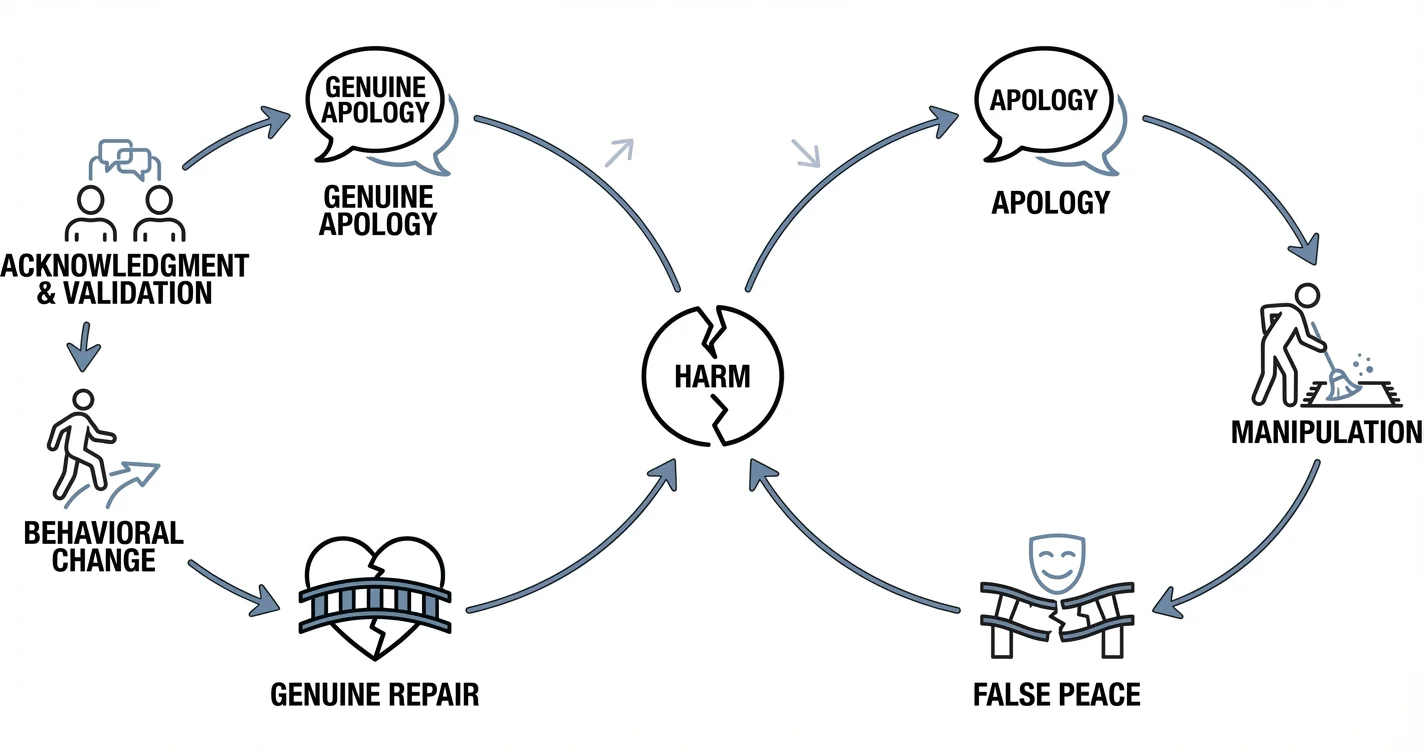

Key Takeaways
- Conditional apologies that shift blame back to the victim ("I'm sorry you felt hurt")
- Preemptive apologies designed to prevent accountability conversations
- Performative apologies offered publicly but never backed by behavioral change
- Coerced apologies where family members pressure the harmed person to accept reconciliation
- Does the apology acknowledge specific harm caused?
Introduction
Toxic family apology dynamics create a confusing emotional landscape where apologies serve to maintain control rather than repair harm. In dysfunctional family systems, the words "I'm sorry" often function as tools for manipulation, rug-sweeping, or restoring a false sense of harmony without addressing underlying issues. Understanding these patterns is essential for anyone navigating relationships with emotionally immature or narcissistic family members. Research from clinical psychology suggests that individuals raised in such environments may struggle to distinguish between genuine remorse and performative apologies designed to maintain the status quo. This article examines the mechanics of toxic family apology dynamics, drawing on expert insights from mental health practitioners who specialize in family trauma and boundary work.
Understanding Toxic Family Apology Dynamics
In healthy relationships, apologies acknowledge harm, validate the injured party's feelings, and include commitment to changed behavior. However, in families with toxic dynamics, apologies often serve entirely different functions. Practitioners working with adult children of emotionally immature parents note that these apologies frequently prioritize the comfort of the person apologizing over the healing of the person harmed.
Several distinct patterns characterize toxic family apology dynamics:
- Conditional apologies that shift blame back to the victim ("I'm sorry you felt hurt")
- Preemptive apologies designed to prevent accountability conversations
- Performative apologies offered publicly but never backed by behavioral change
- Coerced apologies where family members pressure the harmed person to accept reconciliation
Mental health professionals observe that children growing up in these environments learn to disconnect from their own thoughts, feelings, and needs. Instead, they become attuned to the emotional states and desires of the toxic parent, focusing on maintaining peace rather than advocating for themselves. This adaptive survival strategy can persist into adulthood, making it difficult to recognize when an apology is genuine versus manipulative.
The psychological impact of these dynamics extends beyond the immediate relationship. Studies in family systems theory indicate that children from families with emotionally immature parents often develop a pattern of self-distrust, questioning their own perceptions and emotional responses. When your valid hurt is consistently minimized through hollow apologies, you may internalize the message that your feelings are invalid or inconvenient.
Common Patterns in Apology Dynamics Within Toxic Families
The Rug-Sweeping Apology
This pattern involves a quick "I'm sorry" followed immediately by expectations that everyone move on without processing the harm. The toxic family member may become irritated or claim victimhood if you don't immediately accept their apology. Experts working with cycle breakers—individuals working to change intergenerational patterns—note that rug-sweeping apologies often include phrases like "Can't we just move past this?" or "I said I was sorry, what more do you want?"
The underlying message communicates that your continued hurt is unreasonable and that you're the problem for not immediately granting forgiveness. This dynamic trains family members to suppress legitimate grievances to maintain artificial harmony.
The Mood-Dependent Apology
In families where emotionally immature parents dictate the emotional climate of the entire household, apologies may appear when the toxic person's mood shifts. Boundary specialists observe that these apologies often occur after the parent has processed their own discomfort, not when the harmed party needs repair. The timing centers the apologizer's emotional regulation rather than the relationship repair.
These apologies may seem sincere in the moment but frequently disappear when the parent's mood changes again. The cycle repeats: harm, escalation, apology, brief peace, then harm again without any actual behavioral modification.
The Public Performance Apology
Some toxic family members offer elaborate apologies in front of other family members or friends while maintaining harmful behavior in private. This pattern serves to protect their reputation and isolate the person they've harmed. If you reject or question the public apology, other family members may view you as unreasonable or unforgiving.
Practitioners note that this dynamic is particularly damaging because it enlists other family members as unwitting participants in gaslighting, making the harmed person question whether they're being too harsh or holding grudges.
The Conditional Apology
These apologies contain qualifiers that negate the apology itself: "I'm sorry if you felt hurt," "I'm sorry, but you also..." or "I apologize that you took it that way." Mental health professionals working with family trauma emphasize that conditional apologies shift responsibility from the person who caused harm to the person who experienced it.
This pattern communicates that your emotional response is the problem, not the behavior that caused it. Over time, conditional apologies train you to minimize your own hurt and question whether you're being overly sensitive.
How Toxic Family Apology Dynamics Affect Your Well-Being
Growing up with toxic family apology dynamics creates lasting patterns that extend well beyond your relationship with your family of origin. Clinical psychologists note that adult children from these environments often struggle with several interconnected challenges.
Difficulty trusting your own perceptions becomes a persistent issue. When your experiences are consistently invalidated through false apologies, you may second-guess your memories, feelings, and interpretations of events. This self-doubt can affect your ability to set boundaries in all relationships, not just family ones.
Accepting poor treatment in other relationships often follows from normalized toxic apology patterns. If you learned that hollow apologies should satisfy you, you may struggle to advocate for genuine repair in romantic relationships, friendships, and professional settings. Tools like Lovon.app can help you process these patterns through voice conversations that help you identify when you're accepting inadequate apologies in various relationships.
Difficulty offering authentic apologies yourself represents another common challenge. Some individuals overcompensate by apologizing excessively for minor infractions, while others struggle to apologize at all, having never witnessed genuine accountability. Both patterns stem from the same source: you never learned what healthy repair actually looks like.
Chronic anxiety around conflict develops when disagreements in your family of origin never led to resolution, only temporary cease-fires negotiated through performative apologies. You may find yourself avoiding necessary confrontations or experiencing disproportionate stress when addressing even minor issues.
Research in attachment theory suggests that inconsistent repair following ruptures in early caregiver relationships can contribute to anxious or disorganized attachment patterns that persist into adulthood. While genetic factors and individual temperament also play roles, the repeated experience of false reconciliation without genuine change influences how you approach trust and vulnerability in later relationships.
Breaking Free: Strategies for Handling Toxic Family Apology Patterns
Recognizing toxic family apology dynamics represents an important first step, but developing practical strategies for navigating them requires conscious effort and often professional support.
Identify the Pattern Before Responding
When a family member offers an apology, practitioners recommend taking time to assess several factors before responding:
- Does the apology acknowledge specific harm caused?
- Is there evidence of understanding how their behavior affected you?
- Have they committed to specific behavioral changes?
- Is this part of a recurring cycle you've experienced before?
You don't need to accept or reject an apology immediately. Statements like "I need time to process this" or "I appreciate you saying that, and I need to see consistent change" allow you to maintain your boundaries without immediate reconciliation.
Clarify Your Needs
People who grew up focused on managing a toxic parent's emotions often have difficulty identifying what they actually need from an apology. Therapy approaches focused on reparenting and reconnecting with your authentic self emphasize the importance of getting clear on your requirements for repair.
Consider what genuine accountability would look like in your situation:
- Do you need acknowledgment of specific behaviors?
- Would you benefit from understanding why the harm occurred?
- What behavioral changes would demonstrate genuine remorse?
- What would need to happen for you to feel safe in the relationship?
Resources like Lovon.app offer on-demand space to talk through what you're actually feeling and what you need, particularly useful when processing family dynamics late at night or immediately after a difficult interaction when traditional therapy isn't accessible.
Set Boundaries Around Apology Acceptance
You're not obligated to accept any apology, regardless of who offers it or how they deliver it. Boundary work with families involves understanding that forgiveness and reconciliation are separate processes, both optional rather than mandatory.
Some practical boundary statements include:
- "I hear that you're sorry. I'm not ready to move forward yet."
- "An apology without changed behavior doesn't work for me anymore."
- "I need to see consistent different behavior over time, not just words."
- "I'm not comfortable pretending this didn't happen to make everyone comfortable."
Develop External Validation Sources
Since toxic family apology dynamics train you to doubt your own perceptions, developing relationships and resources that validate your reality becomes essential. This might include individual therapy, support groups for adult children of dysfunctional families, or trusted friends outside your family system who can offer perspective.
Experts working with cycle breakers note that rebuilding trust in your own intuition is possible through consistently honoring your feelings rather than dismissing them. This process takes time, particularly after years of conditioning to prioritize others' comfort over your own legitimate needs.
When to Seek Professional Help
If you're struggling with toxic family apology dynamics, professional support can provide essential guidance. Consider seeking help from a therapist, particularly one specializing in family trauma, narcissistic abuse recovery, or complex PTSD, if you experience:
- Persistent difficulty trusting your own perceptions and memories
- Anxiety or depression related to family interactions
- Difficulty setting boundaries in multiple areas of your life
- Confusion about what healthy relationships should look like
- Intrusive thoughts about family conflicts
- Avoidance of necessary life decisions due to family pressure
Therapists trained in family systems work, Internal Family Systems (IFS), or trauma-focused approaches can help you understand these patterns and develop strategies specific to your situation. Some people find that combining traditional therapy with supplemental resources like Lovon.app helps them process emotions between sessions and prepare for difficult family interactions.
For those experiencing severe impacts on daily functioning, thoughts of self-harm, or crisis situations related to family dynamics, immediate professional intervention is important. Support is available and recovery from these patterns is possible, though it typically requires professional guidance alongside your own commitment to change.
Conclusion
Understanding toxic family apology dynamics empowers you to recognize when "I'm sorry" serves to maintain dysfunction rather than repair harm. These patterns—whether rug-sweeping, mood-dependent, performative, or conditional apologies—prioritize the comfort of the person apologizing over genuine accountability and changed behavior. Recognizing these dynamics allows you to make informed decisions about which relationships warrant continued investment and which boundaries you need to protect your well-being.
Breaking free from toxic family apology dynamics involves reconnecting with your own feelings, needs, and intuition—capacities that may have been suppressed throughout childhood. This process isn't easy, and it doesn't always lead to reconciliation with family members. However, it does lead to healthier relationships, greater self-trust, and freedom from cycles that never actually resolved anything despite repeated apologies.
Whether you're navigating these dynamics in real-time or processing their long-term effects, remember that seeking support—through therapy, trusted relationships, or accessible tools for emotional processing—represents strength, not weakness. You deserve relationships built on genuine accountability, not just words that maintain the appearance of harmony while nothing actually changes.
Disclaimer: This is general information, not medical advice or diagnosis. If symptoms are severe, affecting your daily life, or you're having thoughts of self-harm—seek professional help. In the US: call or text 988 (Suicide & Crisis Lifeline). For immediate danger: 911 or local emergency services.
How AI Support Helps You Heal
AI emotional support isn't about replacing human connection — it's about filling the gaps. The moments when you need to talk at 2 AM, when you don't want to burden your friends again, or when you simply need someone to listen without judgment.
Here's what happens in a typical Lovon session:
You share what's on your mind
There's no script, no intake form, no waiting room. You speak or type whatever you're feeling — in your own words, at your own pace.
Lovon validates and explores
Using frameworks from CBT (Cognitive Behavioral Therapy) and motivational interviewing, Lovon acknowledges your feelings first, then gently helps you explore them. No dismissive "just move on" advice.
You build coping skills together
Lovon doesn't just listen — it actively works with you on evidence-based techniques: thought reframing, urge surfing, behavioral experiments, and more.
What a Session with Lovon Looks Like

When to Seek Professional Help
AI support is a valuable tool, but it's not a replacement for professional care. Please consider reaching out to a licensed therapist if you experience any of the following:
- Persistent thoughts of self-harm or suicide
- Inability to perform daily activities (work, eating, sleeping) for more than 2 weeks
- Turning to alcohol or substances to cope
- Intense anger or desire to harm your ex-partner
- Complete emotional numbness that doesn't improve over time
Crisis Resources (US): If you're in immediate danger, call 988 (Suicide & Crisis Lifeline) or text HOME to 741741 (Crisis Text Line). Available 24/7, free, and confidential.
Outside the US? Find a crisis line in your country
Ready to Start?
Your healing journey can begin right now
A 7-day trial. No judgment. Just a safe space to process what you're going through.
Frequently Asked Questions
Is Lovon a replacement for a real therapist?
Is my conversation with Lovon AI private?
How is Lovon different from ChatGPT for emotional support?
Can I use Lovon if I'm already seeing a therapist?
Can I try Lovon before subscribing?
About the Author

The Lovon Editorial Team
Mental Health & Wellness Content Team
The Lovon Editorial Team develops mental health and wellness content designed to make psychological concepts accessible and actionable. Our goal is to bridge the gap between clinical research and everyday life - helping you understand why your mind works the way it does and what you can do about it....
Related articles
- Covert Narcissism vs Overt Narcissism: Manipulation Tactics and Attention-Seeking Behaviors
Recognizing the difference between covert narcissism vs overt narcissism — particularly in manipulation tactics and…
- Rebuild Self-Esteem After a Toxic Relationship (2026)
Rebuild self-esteem after a toxic relationship with 6 concrete steps, common setbacks, and fixes. A 2026 guide with real…
- Narcissistic Parent Dynamics and Power Imbalance in Relationships
The relationship between a parent and child is inherently unequal by design — but when narcissistic parent dynamics and…
- Role Reversal With Narcissistic Parents: When Children Become Emotional Caretakers
When narcissistic parents create role reversal where the child becomes the emotional caretaker, the fundamental…
See also
Quizzes
- Emotional Intelligence Test: Your EQ in a Relationship
Find where your EQ slips when things get tense.
- Are They a Red Flag? 10 Questions to Check Your Partner
Check your partner in 3 minutes.
Free tools
- Write an Apology Letter You Could Actually Send
A chat that writes the letter, not advice about writing one. Say who it is for, what happened, and anything you have…
- AI Relationship Coach
Get free relationship advice and family counselling guidance with our AI Relationship Coach.
From the wiki
- How to leave a toxic relationship?
Leaving a toxic relationship is rarely a decision problem — you usually know. What stops you is that the pull toward…
Disclaimer: This article is for informational purposes only and does not constitute medical advice, diagnosis, or treatment. Always seek the advice of your physician or other qualified health provider with any questions you may have regarding a medical condition. If you are in crisis or think you may have an emergency, call 988 (Suicide & Crisis Lifeline) or go to the nearest emergency room. Outside the US? Find a crisis line in your country.