
What is Fawn Response: People Pleasing as Trauma Reaction
When faced with threat, most people are familiar with the classic fight, flight, or freeze responses.

Key Takeaways
- Automatic accommodation: Reflexively agreeing with others or adapting your preferences to match theirs, even when it
- Hyper-attunement to others' emotions: Constantly scanning for signs of displeasure or anger in others, similar to
- Difficulty identifying personal needs: A diminished or unclear sense of your own preferences, boundaries, or
- Preemptive people pleasing: Anticipating what others want and providing it before being asked, as a strategy to
- Difficulty saying no even to unreasonable requests, accompanied by anxiety or fear about the other person's reaction
Introduction
When faced with threat, most people are familiar with the classic fight, flight, or freeze responses. Yet there's a fourth trauma reaction that often goes unrecognized: the fawn response. This pattern involves appeasing, accommodating, and prioritizing others' needs to avoid conflict or perceived danger—a survival strategy that can become deeply ingrained in trauma survivors. Understanding what the fawn response is and how people pleasing develops as a trauma reaction provides crucial insight into patterns that may be affecting your relationships, boundaries, and sense of self. This guide draws on trauma research and clinical insights to help you identify fawn responses and begin addressing these protective patterns that no longer serve you.
Understanding the Fawn Response in Trauma Survivors
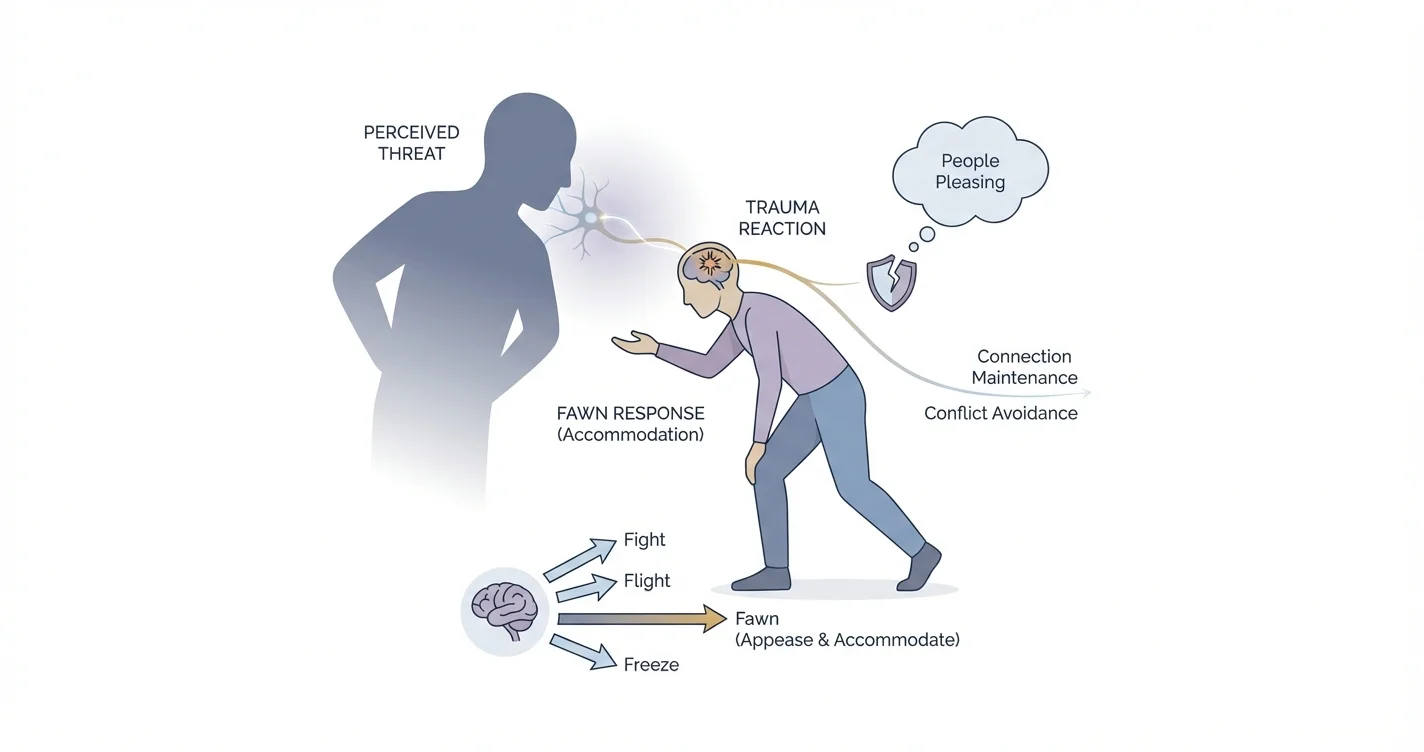
The fawn response represents a survival strategy where individuals attempt to avoid harm by pleasing, appeasing, or becoming useful to a perceived threat. Clinical research on trauma responses suggests that fawning develops when fighting back, escaping, or freezing aren't viable options—particularly in situations involving ongoing relational threat or power imbalances.
This response pattern involves several key characteristics:
- Automatic accommodation: Reflexively agreeing with others or adapting your preferences to match theirs, even when it conflicts with your genuine needs
- Hyper-attunement to others' emotions: Constantly scanning for signs of displeasure or anger in others, similar to the hypervigilance seen in other trauma responses
- Difficulty identifying personal needs: A diminished or unclear sense of your own preferences, boundaries, or feelings separate from others
- Preemptive people pleasing: Anticipating what others want and providing it before being asked, as a strategy to prevent potential conflict
Research on attachment and developmental trauma indicates that fawn responses often emerge in childhood environments where a caregiver's behavior was unpredictable, threatening, or conditional on the child's compliance. However, multiple factors contribute to these patterns, including genetic predispositions, temperament, and individual experiences. Some people develop fawning patterns in adulthood following traumatic relationships or environments where assertiveness resulted in punishment or abandonment.
The fawn response serves an important function: it helps maintain connection with others who hold power over your safety or well-being. In threatening situations, particularly those involving ongoing relationships rather than one-time events, appeasing behavior may genuinely reduce immediate harm. The challenge emerges when this protective pattern continues in contexts where the original threat no longer exists.
How the Fawn Response Differs from Other Trauma Reactions
Understanding fawn response requires distinguishing it from the more widely recognized fight, flight, and freeze reactions. Each trauma response represents a different survival strategy activated by the nervous system when threat is detected.
Fight response involves confrontation, anger, or aggressive defense. Individuals may become argumentative, controlling, or combative when triggered. This response assumes the possibility of overpowering the threat.
Flight response manifests as avoidance, withdrawal, or escape attempts. People may physically leave situations, emotionally distance themselves, or develop anxiety that motivates them to avoid potential threats entirely.
Freeze response involves immobilization, dissociation, or "playing dead." The nervous system essentially shuts down active responses when neither fighting nor fleeing seems possible, which can appear as emotional numbness or physical paralysis.
Fawn response takes a fundamentally different approach: befriending or appeasing the threat. Rather than opposing, escaping, or shutting down, fawning involves moving toward the source of danger through accommodation and usefulness.
These responses aren't mutually exclusive—many trauma survivors experience different reactions in different contexts or even multiple responses simultaneously. You might freeze initially, then shift to fawning as you attempt to navigate the situation. Research suggests that individuals often have a dominant pattern shaped by what proved most effective in their particular circumstances.
The fawn response can be particularly difficult to identify because it's often socially rewarded. Unlike fight responses (which may be labeled as anger issues) or flight responses (which might be recognized as avoidance), fawning often looks like kindness, empathy, or being agreeable. This makes it harder for both the individual and others to recognize it as a trauma pattern rather than simply a "nice personality."
Recognizing Fawn Response Patterns in Your Daily Life
Identifying fawn response in yourself or understanding how it manifests in trauma survivors requires looking beyond surface behaviors to the underlying motivation and felt experience. The distinction between genuine care for others and fawn response lies primarily in choice, flexibility, and internal experience.
Key indicators that people-pleasing may be a trauma response include:
In relationships:
- Difficulty saying no even to unreasonable requests, accompanied by anxiety or fear about the other person's reaction
- Automatically taking responsibility for others' emotions or problems that aren't yours to solve
- Losing track of your own opinions or preferences in the presence of others, particularly those in positions of authority or power
- Maintaining relationships with people who consistently disregard your needs because you fear their reaction to boundaries
In your internal experience:
- Feeling anxious or guilty when prioritizing your own needs, even in appropriate contexts
- Sensing that your value depends on what you provide to others rather than who you are
- Experiencing a near-constant background anxiety about whether others are upset with you
- Noticing that your mood depends heavily on whether you've pleased others that day
In decision-making:
- Struggling to identify what you genuinely want separate from what others want
- Making choices based primarily on avoiding others' disappointment or anger
- Finding it difficult to advocate for yourself even in situations where assertiveness would be appropriate
- Automatically deferring to others' judgment, particularly regarding your own experiences or feelings
Studies on trauma and interpersonal patterns suggest that individuals with fawn responses often report feeling like they're "performing" or "people-reading" rather than genuinely connecting. There's a quality of vigilance and strategy in interactions that healthy social connection typically doesn't require.
Tools like Lovon.app can help you explore these patterns by providing a space to reflect on specific interactions and notice when accommodation feels automatic versus chosen. Talking through recent situations where you found yourself people-pleasing can reveal the underlying fears or beliefs driving these behaviors.
Why Trauma Survivors Develop People Pleasing Behaviors
The development of fawn response represents an adaptation to specific relational contexts where this strategy improved outcomes—or at least reduced harm. Understanding why people-pleasing emerges as a trauma response requires considering both the circumstances that shaped this pattern and the individual factors that influenced how someone responded to those circumstances.
Developmental and relational factors:
Fawn responses frequently develop in environments where:
- A caregiver's availability, safety, or affection was conditional on the child's compliance or emotional caretaking
- Expressing needs, anger, or disagreement resulted in punishment, withdrawal of love, or escalated threat
- The child needed to manage an adult's emotions to maintain stability in the household
- Other survival strategies (fighting back, leaving, or shutting down) proved ineffective or increased danger
While early relational experiences often play a significant role, genetic factors and individual temperament also contribute to how these patterns develop. Some people may be temperamentally more attuned to social cues or relationship harmony, which intersects with environmental factors to shape response patterns.
Functional benefits that reinforce the pattern:
Fawn response persists because it provides certain benefits, even as it creates long-term costs:
- Immediate safety: Appeasing behavior may genuinely reduce conflict or aggression in the moment
- Connection maintenance: When abandonment feels life-threatening (as it can be in childhood), fawning preserves relationships
- Positive reinforcement: People-pleasing often receives social approval, making it difficult to recognize as problematic
- Identity and purpose: For some, caretaking becomes central to their sense of worth and identity
Research on trauma and nervous system regulation indicates that fawn responses can become automatic over time, operating below conscious awareness. What began as a deliberate strategy becomes a reflexive pattern that activates whenever the nervous system detects signals resembling the original threat—even in objectively safe situations.
This explains why trauma survivors may continue fawning long after leaving dangerous situations. The nervous system learned that certain cues (someone's disappointment, a conflict arising, an authority figure's presence) predict danger, and it automatically initiates the protective response that previously helped.
Breaking Free from Fawn Response Patterns Step by Step
Addressing people-pleasing as a trauma response requires a gradual approach that honors the protective function these patterns served while building new options. Change involves both nervous system regulation and practical skill development—you're not simply deciding to "stop people-pleasing" but rather creating new neural pathways and relational experiences.
Step 1: Develop awareness without judgment
Begin by noticing when fawn response activates without attempting to change it immediately. Pay attention to:
- Physical sensations (tension, anxiety, that characteristic feeling of "I should...")
- Thoughts that drive accommodation ("If I don't do this, they'll be upset with me")
- Situations or people that most reliably trigger fawn response
Awareness itself creates space between the automatic response and your actions. Some people find it helpful to journal about specific incidents or discuss them with support resources to identify patterns.
Step 2: Understand your specific triggers and underlying fears
Fawn response doesn't activate randomly—certain situations, relationship dynamics, or characteristics in others trigger it. Identifying your particular triggers helps you anticipate and prepare for challenging situations.
Ask yourself:
- Which people or contexts most reliably activate people-pleasing patterns?
- What specifically feels threatening (anger, disappointment, abandonment, judgment)?
- What do you fear will happen if you don't accommodate?
Understanding the underlying fear allows you to address it more directly. If you fear abandonment, that becomes a focus for building security. If you fear anger, learning that you can tolerate others' displeasure becomes essential.
Step 3: Start with low-stakes boundary experiments
Rather than attempting major changes in your most triggering relationships, practice small assertions in lower-stakes contexts:
- Express a preference about something minor (where to eat, what to watch)
- Say no to a small request from someone safe
- Allow a minor disagreement to exist without rushing to smooth it over
These experiments serve two purposes: they build skills and provide evidence that others can handle your authenticity. Many people discover that their worst fears don't materialize, or that they can tolerate the discomfort better than anticipated.
Step 4: Build capacity to tolerate discomfort
The most challenging aspect of reducing fawn response is tolerating the anxiety, guilt, or fear that emerges when you don't accommodate. This discomfort is essentially a false alarm—your nervous system signaling danger in situations that may be uncomfortable but not genuinely threatening.
Strategies that may help include:
- Grounding techniques that help you stay present when anxiety rises
- Reminding yourself that discomfort is different from danger
- Gradually increasing tolerance by staying with the uncomfortable feeling rather than immediately relieving it through accommodation
- Working with professionals who specialize in trauma and nervous system regulation
Tools like Lovon.app can provide support in processing the emotions that surface when you begin setting boundaries, helping you distinguish between genuine threat and the echoes of past experiences.
Step 5: Reconnect with your own needs and preferences
Fawn response often leaves people disconnected from their own internal experience. Rebuilding this connection requires deliberate practice:
- Regularly check in with yourself: "What do I actually want right now?"
- Notice your physical and emotional responses without immediately prioritizing others' needs
- Practice making small decisions based solely on your preferences
- Explore your values and what matters to you separate from others' expectations
This isn't selfishness—it's the foundation of healthy relationships where both people's needs matter.
Step 6: Seek relationships that support your authenticity
As you work on fawn response patterns, you'll likely discover which relationships can accommodate a more authentic version of you and which cannot. Some relationships may deepen as you bring more of yourself; others may struggle with your increased boundaries.
This sorting process, while often painful, provides important information. Relationships that require constant fawning for maintenance may need to be restructured or, in some cases, released. Building connections with people who value your genuine thoughts and feelings creates a relational environment that supports continued healing.
When Professional Support Becomes Essential
While self-awareness and gradual practice can begin shifting fawn response patterns, professional support often becomes necessary for deeper healing. Consider seeking help from a therapist, particularly one specializing in trauma and attachment, if:
- Fawn response significantly impairs your functioning or keeps you in harmful relationships
- You experience intense anxiety, panic, or emotional overwhelm when attempting to set boundaries
- People-pleasing patterns are connected to past trauma that requires specialized processing
- You're struggling with self-harm thoughts, severe depression, or other mental health concerns alongside fawn response patterns
- You've tried self-help approaches but find yourself unable to make meaningful changes
Therapeutic approaches that may specifically address fawn response include trauma-focused therapies, somatic approaches that work with nervous system regulation, and modalities addressing attachment patterns. Professionals can help you process the experiences that shaped these patterns while building new relational skills in a safe environment.
Between therapy sessions or when immediate support is needed, accessible resources like Lovon.app can provide a space to process emotions and prepare for difficult conversations, complementing professional treatment.
Conclusion: Moving From Survival to Authentic Connection
Understanding what the fawn response is and recognizing people-pleasing as a trauma reaction rather than a character flaw opens the possibility for meaningful change. The fawn response developed to protect you in circumstances where appeasing others genuinely improved your safety or connection. Acknowledging the adaptive function of these patterns is essential—they reflect your resilience and capacity to navigate difficult circumstances, not weakness or pathology.
As you work with fawn response patterns, remember that change happens gradually. The goal isn't eliminating your capacity for care, empathy, or accommodation—these remain valuable in appropriate contexts. Rather, you're building flexibility: the ability to choose when to accommodate and when to assert your own needs based on the current reality rather than past threats.
Healing from fawn response ultimately means developing the capacity for authentic connection where both people's needs, feelings, and boundaries matter. This creates relationships built on genuine mutuality rather than the exhausting vigilance of constant accommodation. The path involves patience with yourself, support from others, and recognition that the skills you developed to survive can evolve into new patterns that allow you to thrive.
Disclaimer: This is general information, not medical advice or diagnosis. If symptoms are severe, affecting your daily life, or you're having thoughts of self-harm—seek professional help. In the US: call or text 988 (Suicide & Crisis Lifeline). For immediate danger: 911 or local emergency services.
How AI Support Helps You Heal
AI emotional support isn't about replacing human connection — it's about filling the gaps. The moments when you need to talk at 2 AM, when you don't want to burden your friends again, or when you simply need someone to listen without judgment.
Here's what happens in a typical Lovon session:
You share what's on your mind
There's no script, no intake form, no waiting room. You speak or type whatever you're feeling — in your own words, at your own pace.
Lovon validates and explores
Using frameworks from CBT (Cognitive Behavioral Therapy) and motivational interviewing, Lovon acknowledges your feelings first, then gently helps you explore them. No dismissive "just move on" advice.
You build coping skills together
Lovon doesn't just listen — it actively works with you on evidence-based techniques: thought reframing, urge surfing, behavioral experiments, and more.
What a Session with Lovon Looks Like

When to Seek Professional Help
AI support is a valuable tool, but it's not a replacement for professional care. Please consider reaching out to a licensed therapist if you experience any of the following:
- Persistent thoughts of self-harm or suicide
- Inability to perform daily activities (work, eating, sleeping) for more than 2 weeks
- Turning to alcohol or substances to cope
- Intense anger or desire to harm your ex-partner
- Complete emotional numbness that doesn't improve over time
Crisis Resources (US): If you're in immediate danger, call 988 (Suicide & Crisis Lifeline) or text HOME to 741741 (Crisis Text Line). Available 24/7, free, and confidential.
Outside the US? Find a crisis line in your country
Ready to Start?
Your healing journey can begin right now
A 7-day trial. No judgment. Just a safe space to process what you're going through.
Frequently Asked Questions
Is Lovon a replacement for a real therapist?
Is my conversation with Lovon AI private?
How is Lovon different from ChatGPT for emotional support?
Can I use Lovon if I'm already seeing a therapist?
Can I try Lovon before subscribing?
About the Author
The Lovon Editorial Team
Mental Health & Wellness Content Team
The Lovon Editorial Team develops mental health and wellness content designed to make psychological concepts accessible and actionable. Our goal is to bridge the gap between clinical research and everyday life - helping you understand why your mind works the way it does and what you can do about it....
Related articles
- ADHD Rejection Sensitive Dysphoria Explained (2026)
Rejection sensitive dysphoria ADHD causes sudden, intense emotional pain from perceived rejection. Learn what RSD is…
- Freeze, Flight, and Fawn Trauma Responses as Safety-Seeking Behavioral Patterns
When confronted with perceived danger or overwhelming stress, our nervous system activates automatic protective…
- Ego Defense Mechanisms Protecting from Unprocessed Emotions
When something painful happens—a rejection, a loss, a humiliating moment—your mind has a split-second decision to make…
- People Pleasing Trauma Response: How to Stop It in 2026
People pleasing trauma response explained: it's the fawn response, not weakness. Six steps to stop it in 2026, plus what…
See also
Quizzes
- Self Esteem Test: What Is Your Worth Resting On?
See what your sense of worth is resting on.
- Perfectionism Test: What Are Your Standards Costing?
See what your standards actually cost, in 3 minutes.
Free tools
- How to Respond to a Narcissist
Paste what they said. You get the part that actually needs answering separated from the part designed to pull you in, a…
- How to Respond to Gaslighting
Say what happened and what they say happened. You get what is actually established separated from what is being…
From the wiki
- What is inhibited grief?
Inhibited grief is grief that never gets out. The loss happened, you kept functioning, and the feeling stayed sealed…
Disclaimer: This article is for informational purposes only and does not constitute medical advice, diagnosis, or treatment. Always seek the advice of your physician or other qualified health provider with any questions you may have regarding a medical condition. If you are in crisis or think you may have an emergency, call 988 (Suicide & Crisis Lifeline) or go to the nearest emergency room. Outside the US? Find a crisis line in your country.